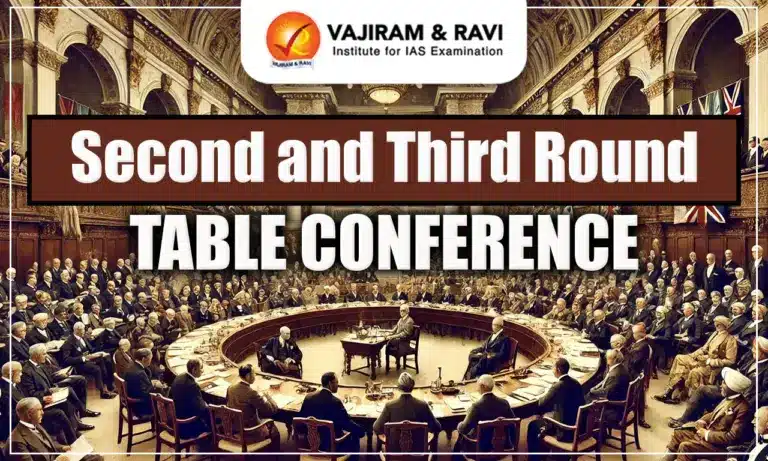
The Second and Third Round Table Conferences were held in London between 1931 and 1932 as part of the British government’s efforts to introduce constitutional reforms in India. The Second Round Table Conference took place from 7th September to 1st December 1931. It was attended by Mahatma Gandhi as the sole representative of the Indian National Congress, along with other Indian leaders and British officials. The Third Round Table Conference was held from 17th November to 24th December 1932. These conferences were convened to discuss the Simon Commission’s report and the future of India’s political structure. However, no agreement was reached, and the talks ended without any conclusive outcome.
Round Table Conference
A Round Table Conference is a formal meeting where different groups often with opposing views come together to discuss important issues. The goal is to reach an agreement through open conversation and negotiation. It is like a gathering of equals around a circular table, not to fight but to solve problems. It’s about finding common ground, even when opinions differ sharply.
Round Table Conference History
Round Table Conference by the British in the 1930s to address increasing demands for Indian self-rule during a politically tough time. Brought together a wide range of participants, British officials, Indian political leaders, minority representatives, and princely state delegates. Held in three separate sessions in London between 1930 and 1932.





Second Round Table Conference
The Second Round Table Conference took place in London from 7 September to 1 December 1931. It was organised after the First Round Table Conference failed to produce concrete results due to the absence of key Indian political figures. These conferences were initiated in response to the widespread dissatisfaction with the Simon Commission Report.
While the First Round Table Conference was called by Ramsay MacDonald under the Labour government, the subsequent ones were conducted under the Conservative Party. The Indian National Congress agreed to participate in the Second Round Table Conference following the Gandhi-Irwin Pact earlier that year.
Second Round Table Conference Participants
The Second Round Table Conference in London brought together representatives from across the political and social areas of Indian society.
- From Britain, Prime Minister James Ramsay MacDonald led the delegation, along with members from various British political parties.
- Princely states sent their rulers and advisors, including representatives from Alwar, Darbhanga, Bhopal, Bikaner, Indore, Jammu and Kashmir, Patiala, Baroda (Manubhai Mehta), Gwalior (Sardar Sahibzada Sultan Ahmed Khan), and Hyderabad (Sir Muhammad Akbar Hydari), among others.
- The Indian National Congress was represented by Mahatma Gandhi, who attended as its sole official representative, along with leaders like Rangaswami Iyengar and Madan Mohan Malaviya.
- C. P. Ramaswami Iyer represented the Government of British India.
- Muslim delegates included Aga Khan III (on behalf of the Muslim League), Muhammad Ali Jinnah, Maulana Shaukat Ali, A. K. Fazlul Huq, and Muhammad Iqbal.
- Hindu representation came from B. S. Moonje of the Hindu Mahasabha and M. R. Jayakar.
- Dr. B. R. Ambedkar attended on behalf of the Depressed Classes.
- Sikh interests were represented by Sardar Ujjal Singh.
- Women’s voices were brought forward by Sarojini Naidu, Begum Jahanara Shahnawaz, and Radhabai Subbarayan.
- Liberal leaders included Tej Bahadur Sapru and Chimanlal Harilal Setalvad.
- Labour representatives included N. M. Joshi, B. Shiva Rao, and V. V. Giri.
- Industrialists like G. D. Birla and Purshottamdas Thakurdas also participated.
- Other groups, including Christians, Parsis, and Anglo-Indians, were also represented, reflecting the diversity of British Indian society at the time.
Second Round Table Conference Results
The Second Round Table Conference has seen deep political rifts among Indian leaders. Although the Indian National Congress participated after the Gandhi-Irwin Pact, no consensus emerged on key constitutional issues. Ramsay MacDonald later announced the Communal Award, which sparked major controversy by proposing separate electorates for minorities. The conference ultimately failed to deliver any real constitutional reform.
Despite its failure, a few developments were seen. Two new provinces, Sindh and the North-West Frontier Province were separated. Other than this, Three expert committees were formed to examine finance, franchise and the princely states. An Indian Consultative Committee was also formed and none of these efforts led to immediate progress.
Third Round Table Conference
The Third Round Table Conference was held in London from 17th November to 24th December 1932, following the failure of the Second Round Table Conference. Unlike the previous sessions, it witnessed poor participation, with only a few delegates in attendance.
Third Round Table Conference Participants
The Third Round Table Conference in London saw limited participation compared to the earlier ones. It was attended by representatives from various sections of Indian society. Aga Khan III represented the British-Indian community. The princely states were represented by their Maharajas, Nawabs, Sardars, and Dewans, some of the notable states included Hyderabad, Bhopal, Mysore, Jammu and Kashmir, and Patiala.
- R. Ambedkar attended the Third Round Table Conference as the representative of the Depressed Classes. Women’s representation came through Begum Jahanara Shahnawaz. Other attendees included delegates from the European and Anglo-Indian communities, as well as labour groups. The Indian National Congress was not invited to the conference and therefore did not take part.
Third Round Table Conference Results
The Third Round Table Conference led to a few key developments. Its recommendations were published as a White Paper in March 1933, which was later debated in the British Parliament. A Joint Select Committee was then set up to review the proposals and prepare a draft for a new law. Eventually, this draft became the basis for the Government of India Act, 1935.

 Last updated on March, 2026
→ UPSC Final Result 2025 is now out.
→ UPSC has released UPSC Toppers List 2025 with the Civil Services final result on its official website.
→ Anuj Agnihotri secured AIR 1 in the UPSC Civil Services Examination 2025.
→ UPSC Marksheet 2025 is now out.
→ UPSC Notification 2026 & UPSC IFoS Notification 2026 is now out on the official website at upsconline.nic.in.
→ UPSC Calendar 2026 has been released.
→ Check out the latest UPSC Syllabus 2026 here.
→ UPSC Prelims 2026 will be conducted on 24th May, 2026 & UPSC Mains 2026 will be conducted on 21st August 2026.
→ The UPSC Selection Process is of 3 stages-Prelims, Mains and Interview.
→ Prepare effectively with Vajiram & Ravi’s UPSC Prelims Test Series 2026 featuring full-length mock tests, detailed solutions, and performance analysis.
→ Enroll in Vajiram & Ravi’s UPSC Mains Test Series 2026 for structured answer writing practice, expert evaluation, and exam-oriented feedback.
→ Join Vajiram & Ravi’s Best UPSC Mentorship Program for personalized guidance, strategy planning, and one-to-one support from experienced mentors.
→ Shakti Dubey secures AIR 1 in UPSC CSE Exam 2024.
→ Also check Best UPSC Coaching in India
Second and Third Round Table Conference FAQs
Q1. When was the Second Round Table Conference held?+
Q2. Who represented the Indian National Congress at the Second Conference?+
Q3. What was the outcome of the Second Conference?+
Q4. When was the Third Round Table Conference held?+
Q5. Why is the Third Conference considered less significant?+
Tags: second and third round table conference