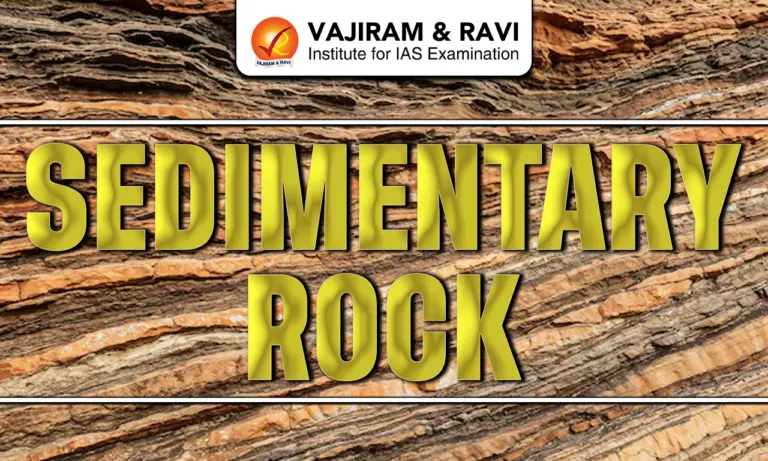
Rocks are naturally occurring solid aggregates of minerals forming the Earth’s crust. They are broadly classified into Igneous, Sedimentary and Metamorphic types. Sedimentary Rocks form through deposition, compaction and cementation of sediments at the Earth’s surface. These sediments originate from weathering, erosion or biological remains.
Sedimentary Rock
Sedimentary Rocks are formed by the cementation of sediments which include mineral particles and organic remains deposited at the Earth’s surface. These sediments are transported by agents like water, wind and ice before settling. They often form layered structures and are found in large sedimentary basins. These rocks provide key information about Earth’s history, past climates and life forms and are also found on Mars.
Sedimentary Rock Classification
Sedimentary Rocks can be broadly classified into three major categories based on both their origin and composition, integrating formation processes with mineral characteristics. The types of rocks include:
Mechanical Origin
These are formed from fragments of pre-existing rocks produced by weathering and erosion, then transported and deposited by agents like water, wind and ice.
- Clastic Sedimentary Rocks: Formed from fragments of pre-existing rocks called clasts like quartz, feldspar and mica, transported and cemented together.
- Conglomerates and Breccias (gravel sized particles; >2 mm),
- Sandstones (sand sized grains; 0.06-2 mm; such as quartz, feldspar, lithic fragments with arenite and wacke types),
- Mudrocks (fine particles; <60 μm; including siltstone, claystone, shale).
- Siliciclastic Sedimentary Rocks: Dominated by silicate minerals and formed from transported sediments.
Chemical Origin
These rocks form when dissolved minerals in water become supersaturated and precipitate directly as solid material.
- Evaporite Sedimentary Rocks: Formed by evaporation of water leaving mineral deposits like halite, gypsum and anhydrite. These rocks are typical in arid climates and restricted basins.
- Carbonate Sedimentary Rocks: Composed mainly of calcite, aragonite and dolomite minerals. Limestone and dolomite are common examples formed from biological activity or chemical precipitation in marine environments.
- Iron rich Sedimentary Rocks: Contain over 15% iron, such as banded iron formations and ironstones, formed under specific chemical conditions in ancient environments.
- Phosphatic Sedimentary Rocks: Rich in phosphate minerals with over 6.5% phosphorus, commonly found as nodules, bone beds and phosphatic mudrocks.
Organic Origin (Biochemical)
These are formed from accumulation of biological material such as plant remains and animal shells and contain more than 3% of organic carbon or biogenic minerals.
- Calcareous rocks: They include calcium rich rocks like limestone, chalk formed from shells, corals, foraminifera, etc.
- Carbonaceous rocks: These include coal formed from compressed vegetation.
- Siliceous Sedimentary Rocks: Composed mainly of silica in forms like chert, opal and chalcedony.
Also Read: Rock Systems of India





Sedimentary Rock Formation Process
Sedimentary Rocks form through a series of physical, chemical and biological processes acting over long geological time.
- Weathering and erosion: Pre-existing rocks break down into smaller particles due to physical and chemical processes, producing sediments like sand, silt and clay.
- Transportation: Sediments are carried by agents such as water, wind, glaciers and gravity from source areas to deposition sites like rivers, lakes or oceans.
- Deposition: Sediments settle when energy of the transporting medium decreases, forming layers in environments such as marine basins, deltas and floodplains.
- Burial: Over time, layers of sediments accumulate, causing older sediments to be buried under newer ones, increasing pressure and temperature conditions.
- Compaction: Weight of overlying sediments compresses grains closer together, reducing pore spaces and expelling water from sediments.
- Cementation: Dissolved minerals precipitate from groundwater and bind sediment grains together, forming solid rock through lithification.
- Diagenesis: Includes physical, chemical and biological changes after deposition, such as recrystallization, mineral formation and hardening of sediments into rock.
Sedimentary Rock Significance
Sedimentary Rocks are highly significant for economic, environmental and scientific purposes due to their composition and formation characteristics.
- Construction materials: Limestone and sandstone are widely used as building stones, while limestone is essential for cement production and infrastructure development.
- Energy resources: Major fossil fuels such as coal, petroleum and natural gas originate from organic rich Sedimentary Rocks, making them vital for global energy supply.
- Water resources: Many Sedimentary Rocks are porous and permeable, forming aquifers that store and supply groundwater for drinking and irrigation.
- Geological history: Fossils preserved in Sedimentary Rocks provide evidence of past life, climate conditions and evolution, aiding reconstruction of Earth’s history.
- Mineral resources: Important minerals like hematite, phosphates and building materials are found in Sedimentary Rocks, contributing to economic development.
- Soil formation: Weathering of Sedimentary Rocks produces fertile soils, especially in plains and river basins, supporting agriculture.
Sedimentary Rock Distribution
Sedimentary Rocks are widely distributed across continents and specific regions based on depositional environments and geological history.
- Global distribution: Sedimentary Rocks cover about 73% of Earth’s land surface but contribute only around 8% of crustal volume, forming a thin outer layer.
- Continental deposits: Large sedimentary accumulations occur in plains, deltas and basins such as Indo-Gangetic plains and coastal regions containing loam and clay.
- Sandstone regions: Sandstone deposits are widely found in regions like Madhya Pradesh, eastern Rajasthan, Himalayas, Andhra Pradesh, Bihar and Odisha.
- Plateau regions: The Vindhyan highlands consist mainly of Sedimentary Rocks like sandstone, shale and limestone, indicating ancient depositional environments.
- Coal basins: Major coal deposits occur in river basins such as Damodar, Mahanadi and Godavari, formed from Gondwana sedimentary sequences.
Terms Related to Sedimentary Rock
Key terms associated with Sedimentary Rocks help in understanding their formation, structure and characteristics.
- Sedimentation: Process by which particles settle and accumulate at a place, forming layers that eventually become Sedimentary Rocks.
- Lithification: Conversion of loose sediments into solid rock through compaction and cementation processes.
- Bedding: Layered arrangement of sediments forming strata, a characteristic feature of Sedimentary Rocks.
- Denudation: Combined processes of weathering and erosion that produce sediments from existing rocks.
- Diagenesis: Post depositional changes including compaction, cementation and chemical alterations transforming sediments into rock.
- Fossilization: Preservation of plant and animal remains within Sedimentary Rocks under suitable conditions like rapid burial and low oxygen.

 Last updated on March, 2026
→ UPSC Final Result 2025 is now out.
→ UPSC has released UPSC Toppers List 2025 with the Civil Services final result on its official website.
→ Anuj Agnihotri secured AIR 1 in the UPSC Civil Services Examination 2025.
→ UPSC Marksheet 2025 is now out.
→ UPSC Notification 2026 & UPSC IFoS Notification 2026 is now out on the official website at upsconline.nic.in.
→ UPSC Calendar 2026 has been released.
→ Check out the latest UPSC Syllabus 2026 here.
→ UPSC Prelims 2026 will be conducted on 24th May, 2026 & UPSC Mains 2026 will be conducted on 21st August 2026.
→ The UPSC Selection Process is of 3 stages-Prelims, Mains and Interview.
→ Prepare effectively with Vajiram & Ravi’s UPSC Prelims Test Series 2026 featuring full-length mock tests, detailed solutions, and performance analysis.
→ Enroll in Vajiram & Ravi’s UPSC Mains Test Series 2026 for structured answer writing practice, expert evaluation, and exam-oriented feedback.
→ Join Vajiram & Ravi’s Best UPSC Mentorship Program for personalized guidance, strategy planning, and one-to-one support from experienced mentors.
→ Shakti Dubey secures AIR 1 in UPSC CSE Exam 2024.
→ Also check Best UPSC Coaching in India
Sedimentary Rock FAQs
Q1. What are Sedimentary Rocks?+
Q2. What are the main types of Sedimentary Rocks?+
Q3. Why do Sedimentary Rocks have layers?+
Q4. Why are fossils found in Sedimentary Rocks?+
Q5. What are the uses of Sedimentary Rocks?+
Tags: geography sedimentary rock types of rocks