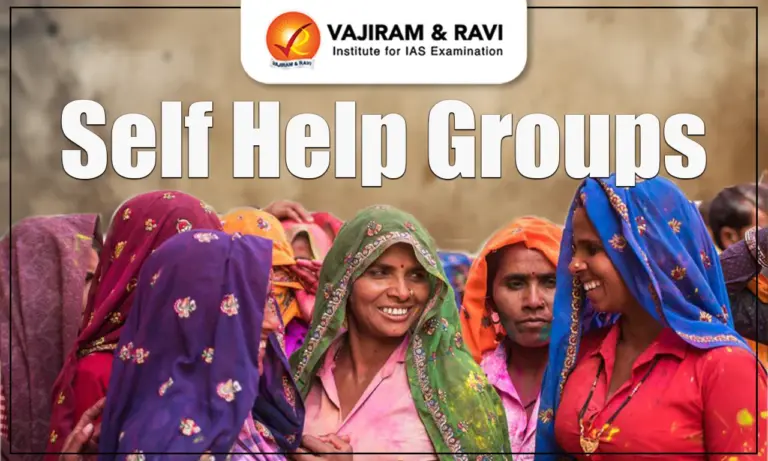
Self Help Groups are small organisations that are community based where members pool their resources together for mutual economic support with a focus on savings and credit activities. The group plays an important role in marginalising communities, providing financial assistance and promoting sustainable livelihoods. In this article, we are going to cover all about Self Help Groups, their meaning, role and contribution in socio-economic development.
Self Help Groups (SHGs)
- Self Help Groups are groups of people who come together to pool their resources and work for a mutual economic benefit.
- Self-help Groups have managed to treat a transformative movement in India as well as other developing countries. These groups work on the principles of mutual aid, self-reliance and collective empowerment.
- The groups focus on mobilizing people, take charge of their economic, social and personal growth.
Self Help Group Meaning
- A Self-Help Group (SHG) is a small, informal group of individuals from similar socio-economic backgrounds who voluntarily unite to pursue shared goals.
- They contribute regular savings, pool their resources, and utilize the collective fund to address personal needs or initiate income-generating ventures.





Self-Help Groups (SHGs) Objectives
Self- Help Groups have the following Objectives:
- Access to credit and promotion of entrepreneurship
- Build confidence among marginalised groups, with a special focus on women to foster a sense of community.
- Connect unbanked populations with proper official financial institutions.
- Improve skills, awareness and decision-making capabilities.
- Improve the standard of living of poor households through sustainable livelihoods.
Self-Help Groups (SHGs) Features
Following are the features of Self-Help Groups-
- Group Size: SHGs usually consist of 10–20 members, a manageable number that supports effective communication, coordination, and a strong sense of responsibility among members.
- Homogeneity: Members typically come from similar socio-economic backgrounds, fostering trust, mutual understanding, and collaboration in addressing shared challenges.
- Savings and Credit: Members regularly save to build a common fund, which is used to provide low-interest loans for personal or income-generating needs, promoting financial self-reliance and internal resource circulation.
- Collective Decision-Making: SHGs follow a democratic approach where decisions are made collectively, ensuring equal participation and shared ownership of group initiatives.
- Training and Capacity Building: Members undergo training in financial literacy, entrepreneurship, and skill development, empowering them to manage finances and run small businesses effectively.
- Bank Linkages: Through initiatives like NABARD’s SHG-Bank Linkage Programme, SHGs connect with formal banks, gaining access to credit and enhancing the group’s financial stability and community impact.
Emergence and Origin of SHGs in India
The Self Help Group (SHG) movement in India emerged as a grassroots response to rural poverty, lack of institutional credit, and women’s economic exclusion. It evolved through voluntary collective action, later supported by banks and government-led livelihood missions.
- Early Collective Efforts (1950s): The Textile Labour Association (TLA), Ahmedabad formed a women’s wing in 1954 to provide skill training like sewing and knitting to women from mill worker families, laying the foundation for organized self-help initiatives.
- Formation of SEWA (1972): A major milestone was the establishment of Self-Employed Women’s Association by Ela Bhatt.
SEWA organized poor self-employed women such as weavers, hawkers, and artisans in the unorganized sector to improve income security and bargaining power. - Rise of NGO-led SHGs (1980s): During the 1980s, several NGOs promoted small savings and credit groups to address rural indebtedness and exploitative moneylender practices.
- NABARD’s SHG-Bank Linkage Programme (1992): National Bank for Agriculture and Rural Development launched the SHG-Bank Linkage Programme (SBLP), integrating informal groups with the formal banking system. This became the world’s largest microfinance initiative.
- RBI Policy Support (1993): The Reserve Bank of India permitted SHGs to open savings bank accounts, formally recognizing them within the banking framework.
- Government-Led Livelihood Missions (1999 onwards): The Government of India launched Swarn Jayanti Gram Swarozgar Yojana in 1999 to promote self-employment through SHGs.
This later evolved into National Rural Livelihoods Mission (2011), strengthening SHGs across rural India. - Expansion and Institutionalization (2000s–Present): SHGs expanded rapidly under NRLM and state-level initiatives like Kudumbashree in Kerala, becoming key instruments of financial inclusion and women empowerment.
Role of SHGs in Socio-Economic Development
- Women Empowerment: SHGs empower women by promoting financial independence, boosting confidence, and involving them in decision-making, which enhances leadership skills and rights awareness.
- Poverty Alleviation: By providing access to microcredit for income-generating activities, SHGs help uplift families from poverty.
- Financial Inclusion: SHGs bring marginalized populations into the formal banking system by facilitating savings and credit access.
- Skill Development & Employment: Members receive training in trades like tailoring, handicrafts, and farming, enabling self-employment and job creation.
- Social Cohesion: SHGs strengthen community bonds and collectively tackle social issues such as domestic violence, child marriage, and illiteracy.
- Disaster Management: SHGs enhance community resilience by mobilizing resources and support during emergencies like natural disasters or pandemics.
Self Help Group (SHGs) Advantages
Self Help Groups (SHGs) have become one of the most effective grassroots development models in India. The advantages of SHgs in India are:
- Financial Inclusion – Provide collateral-free loans to poor households who lack access to formal banking; supported through initiatives like National Bank for Agriculture and Rural Development.
- Regular Savings Habit – Encourage small but consistent savings, building a common corpus for internal lending.
- Reduced Dependence on Moneylenders – Protect members from exploitative high-interest informal credit systems.
- Women Empowerment – Enhance decision-making power, leadership skills, and economic independence of women.
- Income Generation – Promote micro-enterprises such as dairy, tailoring, handicrafts, and food processing.
- Poverty Alleviation – Strengthen household income stability and reduce vulnerability to economic shocks.
- Social Awareness – Spread awareness about health, sanitation, education, and legal rights during group meetings.
- Elimination of Social Evils – Act collectively against dowry, alcoholism, and child marriage.
- Improved Access to Government Schemes – Facilitate better implementation of schemes under National Rural Livelihoods Mission.
- Financial Literacy – Improve banking knowledge, bookkeeping skills, and repayment discipline.
Self Help Groups (SHGs) Challenges
The major challenges associated with Self Help Groups (SHGs) are:
- Limited Outreach to the Poorest – SHGs sometimes fail to include the ultra-poor and most marginalized families, limiting their poverty alleviation impact.
- Patriarchal Social Structure – Deep-rooted gender bias and social restrictions prevent many women from actively participating in SHGs.
- Inadequate Banking Infrastructure – With limited rural bank branches compared to the large number of villages, access to formal credit linkage remains uneven despite support from National Bank for Agriculture and Rural Development.
- Irregular Meetings and Poor Participation – Some groups suffer from low attendance and weak group cohesion, affecting decision-making and sustainability.
- Weak Financial Management – Lack of proper bookkeeping skills and transparency can lead to mismanagement of funds.
- Overdependence on External Agencies – Excessive reliance on NGOs or government officials reduces self-sustainability and autonomy of SHGs.
- Loan Default Risk – Peer pressure ensures repayment, but income instability can lead to delayed or defaulted payments.
- Limited Skill Development – Inadequate training restricts members from expanding into profitable and competitive enterprises.
- Market Linkage Problems – SHG products often face poor marketing support and limited access to wider markets, reducing profitability.
- Regional Imbalance – SHG movement is stronger in southern states, while credit-deficient regions like parts of central and northeastern India lag behind.
Way Forward
- Expand Outreach to Credit-Deficient Regions – Strengthen SHG penetration in underserved states such as Madhya Pradesh, Rajasthan, and North-Eastern states to ensure balanced regional development and financial inclusion.
- Strengthen Financial Infrastructure – Enhance rural banking networks and promote digital banking with support from National Bank for Agriculture and Rural Development to improve timely credit flow and transparency.
- Capacity Building and Skill Development – Provide regular training in entrepreneurship, bookkeeping, digital literacy, and marketing skills to improve sustainability and income generation.
- Improved Market Linkages – Develop better branding, packaging, e-commerce access, and supply chain networks so SHG products can compete in wider markets.
- Robust Monitoring and Evaluation Mechanism – Establish dedicated state and district-level SHG monitoring cells for performance tracking, transparency, and quality control.
- Urban and Peri-Urban Expansion – Extend SHG models beyond rural areas under schemes like National Rural Livelihoods Mission to include the urban poor and migrant populations for inclusive growth.

 Last updated on March, 2026
→ UPSC Final Result 2025 is now out.
→ UPSC has released UPSC Toppers List 2025 with the Civil Services final result on its official website.
→ Anuj Agnihotri secured AIR 1 in the UPSC Civil Services Examination 2025.
→ UPSC Marksheet 2025 is now out.
→ UPSC Notification 2026 & UPSC IFoS Notification 2026 is now out on the official website at upsconline.nic.in.
→ UPSC Calendar 2026 has been released.
→ Check out the latest UPSC Syllabus 2026 here.
→ UPSC Prelims 2026 will be conducted on 24th May, 2026 & UPSC Mains 2026 will be conducted on 21st August 2026.
→ The UPSC Selection Process is of 3 stages-Prelims, Mains and Interview.
→ Prepare effectively with Vajiram & Ravi’s UPSC Prelims Test Series 2026 featuring full-length mock tests, detailed solutions, and performance analysis.
→ Enroll in Vajiram & Ravi’s UPSC Mains Test Series 2026 for structured answer writing practice, expert evaluation, and exam-oriented feedback.
→ Join Vajiram & Ravi’s Best UPSC Mentorship Program for personalized guidance, strategy planning, and one-to-one support from experienced mentors.
→ Shakti Dubey secures AIR 1 in UPSC CSE Exam 2024.
→ Also check Best UPSC Coaching in India
Self Help Groups FAQs
Q1. What are the 5 principles of SHG?+
Q2. What is a self-help support group?+
Q3. What is the function of SHG?+
Q4. How to register a self-help group?+
Q5. What are the objectives of a SHG?+
Tags: self help groups