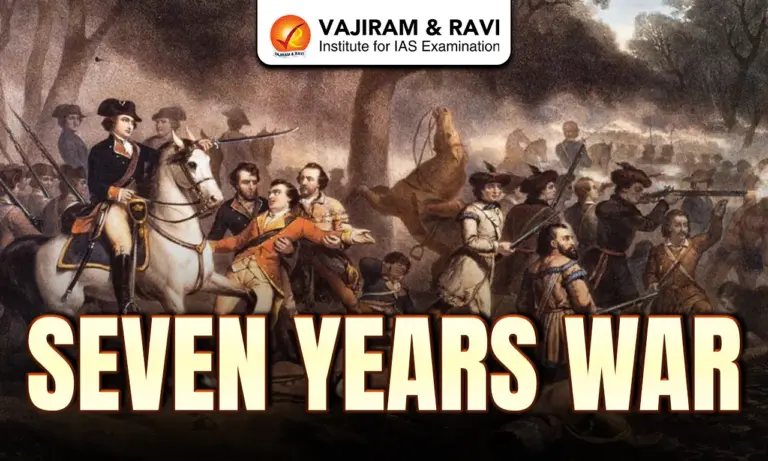
The Seven Years War (1756-1763) was a major conflict fought between powerful European countries like Britain, France, Austria, Prussia and Spain. It took place in Europe, North America, Asia and other regions, making it one of the first wars fought on a global scale. The war changed the balance of power in the world and influenced future events such as the American and French Revolutions.
Seven Years War Causes
- Colonial Rivalry Between Britain and France
- Britain and France were both trying to expand their overseas empires. In North America and India, they competed for new lands, resources and influence. This rivalry often led to clashes between the two powers.
- Race for Global Trade
- Both countries wanted to control important trade routes and valuable goods like fur, spices and sugar. This struggle to dominate global trade made tensions worse.
- European Alliances and Rivalries
- In Europe, countries formed two major alliances. Britain joined with Prussia, while France allied with Austria and Russia. These alliances meant that a local conflict could quickly grow into a large European war.
- Territorial Conflicts
- In North America, Britain and France fought over the Ohio River Valley, which was important for expansion. In India, the British and French East India Companies competed for control of regions like Bengal and the Carnatic.
Seven Years War Prelude and Diplomatic Revolution
Before the Seven Years War, the European powers changed their alliances in what is called the Diplomatic Revolution.
- Old Alliances Shattered
- Previously, France and Austria were enemies, while Britain and Prussia were on opposite sides. But by the 1750s, Austria wanted to take back Silesia from Prussia and needed a strong ally. France, seeing Britain as its main rival, agreed to join Austria. Meanwhile, Britain allied with Prussia to protect its interests in Europe and overseas.
- European Rivalries
- The changes in alliances were also about protecting territories and family interests. King George II of Britain wanted to safeguard Hanover in Germany, while Maria Theresa of Austria wanted to regain lost lands. France wanted to challenge Britain’s growing power but didn’t want to waste too much effort in Central Europe.
- Secret Diplomacy
- France used secret diplomacy to try to gain personal advantages in Europe. Austria, Russia and Britain also made defensive agreements to protect themselves and prepare for any attack.
- Rising Tensions in Colonies
- Even before open war in Europe, Britain and France were already fighting in North America and India. Their East India Companies and colonists clashed over land and trade. These colonial fights added fuel to the fire.





Seven Years War: Major Battles and Course of the War
- North America – French and Indian War
- In North America, the war between Britain and France is called the French and Indian War.
- Key Battles:
- Battle of Fort Duquesne (1758): British forces gained control over strategic forts.
- Battle of Quebec (1759): British victory gave them control over Canada and marked the decline of French power in North America.
- 2. Europe – Prussia vs Austria
- Frederick the Great of Prussia defended his small kingdom against Austria, France, Russia, and Sweden.
- Russian withdrawal in 1762 (after Empress Elizabeth’s death) saved Prussia.
- 3. India – Battle of Plassey (1757)
- The British East India Company defeated Nawab of Bengal.
- Established British control over eastern India.
Seven Years War Impact
- Britain Becomes a Global Superpower
- Britain’s victories in Canada, India and the Caribbean made it the strongest colonial and naval power in the world.
- Its empire expanded rapidly, giving it control over trade and overseas territories.
- Losses for France and Spain
- France lost Canada, Florida and most of its Indian territories. The war was expensive and caused a financial crisis, which later contributed to the French Revolution.
- Spain, allied with France, lost Florida but gained Louisiana. The war still caused long-term economic damage.
- Rise of American Discontent
- Britain’s huge war debt led it to tax the American colonies with measures like the Stamp Act and Tea Act.
- These taxes created resentment and eventually led to the American Revolution in 1776.
- British Control in India
- The war helped the British East India Company defeat the French in India.
- It marked the start of British colonial rule in India, which lasted until 1947.
- Shift in European Power
- Prussia became a major European power.
- Austria, France and Russia lost influence.
- The new balance of power created tensions that later led to the Napoleonic Wars.
- Military Lessons and Changes
- The war showed the importance of professional armies, strategy and alliances.
- European nations learned how global wars could affect colonies, trade and politics at home.
- Economic and Global Trade Impact
- Britain gained control over key trade routes and resources, strengthening its economy.
- The decline of French and Spanish influence opened new opportunities for Britain in Asia, Africa and the Americas.
Seven Years War Long Term Impacts
- Rise of Britain and Prussia
- Britain became the world’s leading naval and colonial power, gaining Canada, India and Caribbean islands.
- Prussia emerged stronger in Europe, changing the balance of power.
- Weakening of France and Spain
- France lost territories in North America and India and faced severe economic problems, which later contributed to the French Revolution.
- Spain lost Florida but gained Louisiana; overall, both countries’ global influence declined.
- Impact on India
- British victory over the French and local rulers like the Nawab of Bengal marked the start of British supremacy in India, setting the stage for nearly 200 years of colonial rule.
- Spark for Revolutions
- Britain’s war debts led to heavy taxation of the American colonies, causing resentment and the American Revolution.
- France’s financial crisis, worsened by the war, helped trigger the French Revolution.
- Changes in Global Warfare and Trade
- Nations realized wars were global, requiring strong armies, navies and control of colonies.
- Britain gained control of key trade routes and resources, reshaping world trade.
- Modernization of Governments
- European monarchies reformed taxes, reduced feudal privileges and strengthened central governments, paving the way for modern administration and democratic ideas.

 Last updated on March, 2026
→ UPSC Final Result 2025 is now out.
→ UPSC has released UPSC Toppers List 2025 with the Civil Services final result on its official website.
→ Anuj Agnihotri secured AIR 1 in the UPSC Civil Services Examination 2025.
→ UPSC Marksheet 2025 is now out.
→ UPSC Notification 2026 & UPSC IFoS Notification 2026 is now out on the official website at upsconline.nic.in.
→ UPSC Calendar 2026 has been released.
→ Check out the latest UPSC Syllabus 2026 here.
→ UPSC Prelims 2026 will be conducted on 24th May, 2026 & UPSC Mains 2026 will be conducted on 21st August 2026.
→ The UPSC Selection Process is of 3 stages-Prelims, Mains and Interview.
→ Prepare effectively with Vajiram & Ravi’s UPSC Prelims Test Series 2026 featuring full-length mock tests, detailed solutions, and performance analysis.
→ Enroll in Vajiram & Ravi’s UPSC Mains Test Series 2026 for structured answer writing practice, expert evaluation, and exam-oriented feedback.
→ Join Vajiram & Ravi’s Best UPSC Mentorship Program for personalized guidance, strategy planning, and one-to-one support from experienced mentors.
→ Shakti Dubey secures AIR 1 in UPSC CSE Exam 2024.
→ Also check Best UPSC Coaching in India
Seven Years War FAQs
Q1. What was the Seven Years’ War?+
Q2. What were the main causes of the Seven Years’ War?+
Q3. What were the key battles of the Seven Years’ War?+
Q4. How did the war affect Britain?+
Q5. What was the impact of the war on India?+
Tags: history history notes Seven Years War