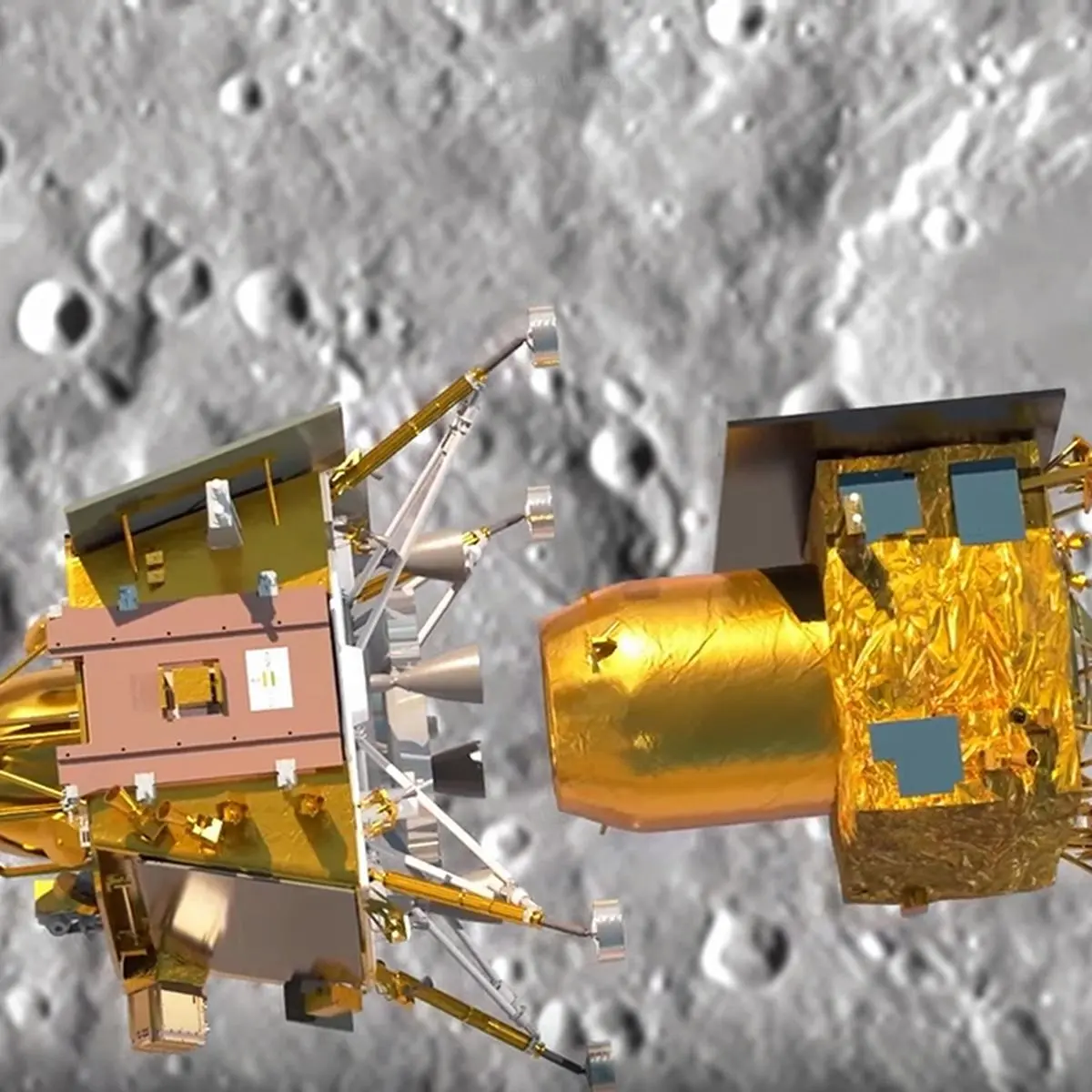
About Smart Lander for Investigating Moon (SLIM) spacecraft
- It is a spacecraft built and launched by the Japan Aerospace Exploration Agency (JAXA) on September 7, 2023, from the Tanegashima spaceport.
- It weighed only 590 kg.
- It was launched together with XRISM, a next-generation X-ray space telescope, onboard an H-2A rocket.
- It entered into an elliptical orbit around the moon over three minutes or so.
- Its apogee (farthest point) in this orbit is 4,000 km and perigee (closest point) is 600 km above the lunar surface.
What will SLIM do on the moon?
- Just before it lands, SLIM will deploy two small rovers called Lunar Excursion Vehicle (LEV) 1 and 2. LEV-1, LEV-2, and SLIM will together study the lunar surface near the landing point, collect temperature and radiation readings, and attempt to study the moon’s mantle.


Key points about XRISM Mission
- The X-Ray Imaging and Spectroscopy Mission (XRISM) is a joint mission of the Japan Aerospace Exploration Agency (JAXA) and the National Aeronautics and Space Administration (NASA), involving contributions from the European Space Agency (ESA) and Canadian Space Agency as well.
- Objective: The mission aims to observe X-rays coming from deep space and to identify their wavelengths with unprecedented precision.
- It will use state-of-the-art spectroscopy to measure changes in the brightness of celestial objects at different wavelengths.
- It detects X-rays with energies ranging from 400 to 12,000 electron volts. (For comparison, the energy of visible light is 2 to 3 electron volts.)
- This range will provide astrophysicists with new information about some of the universe’s hottest regions, largest structures, and objects with the strongest gravity.
Q1) What are X-rays ?
These are a form of electromagnetic radiation, similar to visible light. Unlike light, however, x-rays have higher energy and can pass through most objects, including the body. Medical x-rays are used to generate images of tissues and structures inside the body.
Source: How Japan’s moon-landing attempt in January will affect Chandrayaan 4 | Explained

 Last updated on Oct, 2026
→ UPSC 2027 Notification will be released on 13 January 2027 at upsconline.nic.in.
→ Check Nobel Prize 2026 Winners List here.
→ Download PIB PRiSM Monthly Magazine 2026 here.
→ Check UPSC Monthly Current Affairs Magazine The Recitals here.
→ Check out the latest UPSC Syllabus here.
→ Download UPSC Model Answers for Mains 2026
→ UPSC Mains Question Paper 2026 is out now for Essay & GS Paper 1, 2, 3 & 4.
→ UPSC Calendar 2027 has been released.
→ Enroll in Vajiram & Ravi’s UPSC Mains Test Series 2027 for structured answer writing practice, expert evaluation, and exam-oriented feedback.
→ Join Vajiram & Ravi’s UPSC Mentorship Program 2027 for personalized guidance, strategy planning, and one-to-one support from experienced mentors.
→ Go through the UPSC Mains Previous Year Papers to enhance your preparation.
→ UPSC has released UPSC Toppers List 2025 with the Civil Services final result on its official website.
→ Also check Best UPSC Coaching in India