Solar Storm Latest News
About Solar Storm
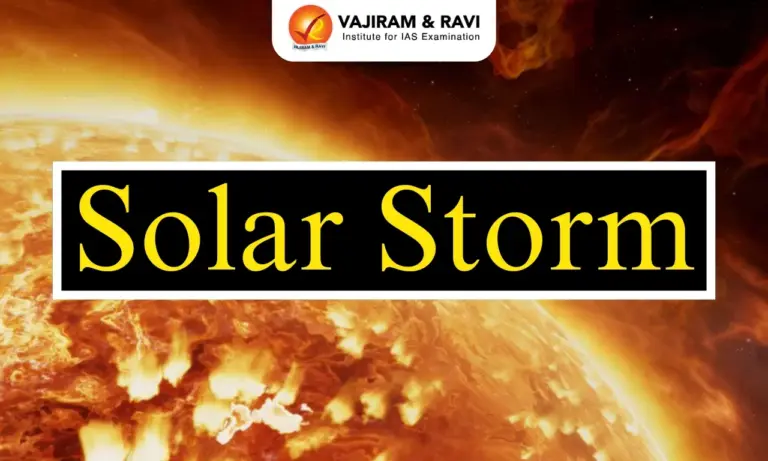
- A solar storm is a sudden explosion of particles, energy, magnetic fields, and material blasted into the solar system by the Sun.
- What Causes a Solar Storm?
- The Sun creates a tangled mess of magnetic fields.
- These magnetic fields get twisted up as the Sun rotates, with its equator rotating faster than its poles.
- Solar storms typically begin when these twisted magnetic fields on the Sun get contorted and stretched so much that they snap and reconnect (in a process called magnetic reconnection), releasing large amounts of energy.
- These powerful eruptions can generate any or all of the following:
- a bright flash of light called a solar flare.
- a solar radiation storm, or flurry of solar particles propelled into space at high speeds.
- an enormous cloud of solar material, called a coronal mass ejection, that billows away from the Sun.
- How Does a Solar Storm Affect Us?
- When directed toward Earth, a solar storm can create a major disturbance in Earth’s magnetic field, called a geomagnetic storm, that can produce effects such as radio blackouts, power outages, and beautiful auroras.
- They do not cause direct harm to anyone on Earth, however, as our planet’s magnetic field and atmosphere protect us from the worst of these storms.





What are Solar Flares?
- A solar flare is an intense burst of radiation, or light, on the Sun.
- These flashes span the electromagnetic spectrum — including X-rays, gamma rays, radio waves, and ultraviolet and visible light.
- Solar flares are the most powerful explosions in the solar system — the biggest ones can have as much energy as a billion hydrogen bombs.
What are Radiation Storms?
- Solar eruptions can accelerate charged particles — electrons and protons — into space at incredibly high speeds, initiating a radiation storm.
- The fastest particles travel so quickly they can zip across roughly 93 million miles from the Sun to Earth in about 30 minutes or less.
What are Coronal Mass Ejections (CMEs)?
- A CME is an enormous cloud of electrically charged gas, called plasma, that erupts from the Sun.
- A single CME can blast billions of tons of material into the solar system all at once.
- CMEs occur in the outer atmosphere of the Sun, called the corona, and often look like giant bubbles bursting from the Sun.
Key Facts about Aditya-L1
- It is the first space-based observatory-class Indian solar mission to study the Sun.
- It was launched on September 2, 2023, by the Indian Space Research Organisation (ISRO).
- The spacecraft is placed in a halo orbit around the Lagrangian point 1 (L1) of the Sun-Earth system, which is about 1.5 million km from the Earth.
- A satellite placed in the halo orbit around the L1 point has the major advantage of continuously viewing the Sun without any occultation/eclipse.
- This provides a greater advantage of observing the solar activities continuously.
- The spacecraft is carrying seven payloads to observe the photosphere, chromosphere, and outermost layers of the Sun using electromagnetic and particle detectors.
Source: NDTV

 Last updated on March, 2026
→ UPSC Final Result 2025 is now out.
→ UPSC has released UPSC Toppers List 2025 with the Civil Services final result on its official website.
→ Anuj Agnihotri secured AIR 1 in the UPSC Civil Services Examination 2025.
→ UPSC Marksheet 2025 is now out.
→ UPSC Notification 2026 & UPSC IFoS Notification 2026 is now out on the official website at upsconline.nic.in.
→ UPSC Calendar 2026 has been released.
→ Check out the latest UPSC Syllabus 2026 here.
→ UPSC Prelims 2026 will be conducted on 24th May, 2026 & UPSC Mains 2026 will be conducted on 21st August 2026.
→ The UPSC Selection Process is of 3 stages-Prelims, Mains and Interview.
→ Prepare effectively with Vajiram & Ravi’s UPSC Prelims Test Series 2026 featuring full-length mock tests, detailed solutions, and performance analysis.
→ Enroll in Vajiram & Ravi’s UPSC Mains Test Series 2026 for structured answer writing practice, expert evaluation, and exam-oriented feedback.
→ Join Vajiram & Ravi’s Best UPSC Mentorship Program for personalized guidance, strategy planning, and one-to-one support from experienced mentors.
→ Shakti Dubey secures AIR 1 in UPSC CSE Exam 2024.
→ Also check Best UPSC Coaching in India
Solar Storm FAQs
Q1. What is a solar storm?+
Q2. What causes a solar storm?+
Q3. What is a solar flare?+
Q4. What is a coronal mass ejection (CME)?+
Q5. Can solar storms directly harm people on Earth?+
Tags: prelims pointers solar storm upsc current affairs upsc prelims current affairs