About Sonoluminescence:
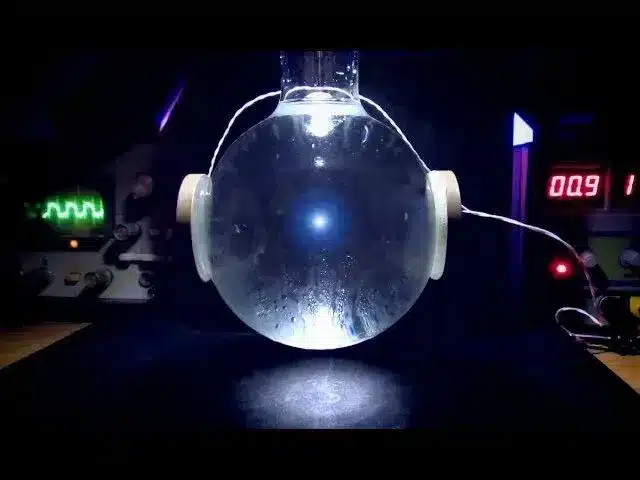
- Sonoluminescence is a fascinating phenomenon where small gas bubbles in a liquid emit a brief flash of light when exposed to intense sound waves.
- This phenomenon was first observed in 1934 by two German engineers studying sonar, a method of using sound waves for navigation similar to how bats operate.
How does sonoluminescence work?
- Sound wave interaction: The process begins when a tiny bubble trapped in a liquid is subjected to powerful sound waves.
- These waves cause the bubble to rapidly expand and contract due to alternating high and low-pressure phases.
- Extreme conditions: During the contraction phase, the bubble compresses so rapidly that its internal temperature skyrockets to several thousand kelvins.
- This extreme heat ionizes the gases inside the bubble, resulting in the emission of light energy for a fraction of a second—about a trillionth of a second.
Natural occurrence:
- Pistol Shrimp: Sonoluminescence isn’t confined to laboratory settings. In nature, the pistol shrimp (family Alpheidae) exhibits a similar effect.
- This shrimp has a specialized claw that snaps shut with remarkable speed, creating a high-velocity jet of water.
- This jet forms a low-pressure bubble that, upon collapsing, produces a loud sound, intense heat, and a brief flash of light.
Applications:
- Scientific curiosity: Sonoluminescence continues to captivate scientists due to its mysterious nature and potential applications.
While the phenomenon is primarily of academic interest, it has sparked discussions about its potential use in fields like thermonuclear fusion and acoustic imaging.
Q1. What is a semiconductor?
It is a substance that has specific electrical properties that enable it to serve as a foundation for computers and other electronic devices. It is typically a solid chemical element or compound that conducts electricity under certain conditions but not others.
Source: What is sonoluminescence? – The Hindu


 Last updated on Oct, 2026
→ UPSC 2027 Notification will be released on 13 January 2027 at upsconline.nic.in.
→ Check Nobel Prize 2026 Winners List here.
→ Download PIB PRiSM Monthly Magazine 2026 here.
→ Check UPSC Monthly Current Affairs Magazine The Recitals here.
→ Check out the latest UPSC Syllabus here.
→ Download UPSC Model Answers for Mains 2026
→ UPSC Mains Question Paper 2026 is out now for Essay & GS Paper 1, 2, 3 & 4.
→ UPSC Calendar 2027 has been released.
→ Enroll in Vajiram & Ravi’s UPSC Mains Test Series 2027 for structured answer writing practice, expert evaluation, and exam-oriented feedback.
→ Join Vajiram & Ravi’s UPSC Mentorship Program 2027 for personalized guidance, strategy planning, and one-to-one support from experienced mentors.
→ Go through the UPSC Mains Previous Year Papers to enhance your preparation.
→ UPSC has released UPSC Toppers List 2025 with the Civil Services final result on its official website.
→ Also check Best UPSC Coaching in India