What’s in today’s article?
- Introduction
- Why Grow Plants in Space?
- Challenges of Growing Plants in Space
- Techniques for Space Farming
- ISRO’s Experiment with Lobia
- Ideal Space Crops
- Significance of Space Farming
- Conclusion
Introduction
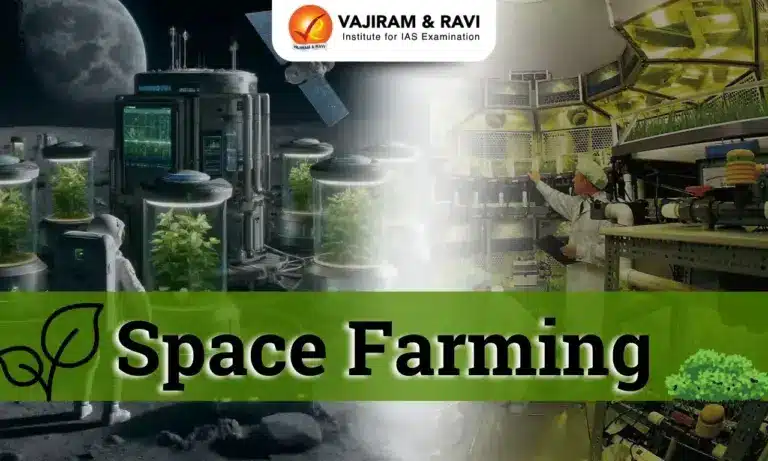
- The Indian Space Research Organisation (ISRO) achieved a significant milestone by successfully germinating lobia (black-eyed pea) seeds in space as part of its Compact Research Module for Orbital Plant Studies (CROPS).
- This development highlights the importance of cultivating plants in extra-terrestrial environments, paving the way for sustainable life on celestial bodies like the Moon and Mars.





Why Grow Plants in Space?
- As space missions extend over years, traditional food supplies fall short due to their limited shelf life and nutritional degradation over time.
- Growing plants in space addresses these challenges by:
- Sustaining Food Supply: Plants provide a renewable source of nutrition.
- Oxygen Production: Photosynthesis in plants releases oxygen, making the air aboard spacecraft breathable.
- Recycling Systems: Plants create a closed-loop system by recycling carbon dioxide and organic waste.
- Mental Health Benefits: Tending to plants helps reduce stress and enhances astronauts’ overall well-being.
Challenges of Growing Plants in Space
- Growing plants in space presents several obstacles, primarily due to the microgravity environment:
- Root Growth and Water Delivery:
- In microgravity, roots lack the directional pull of gravity and fail to grow downward.
- Water clings to surfaces rather than reaching the roots, complicating nutrient absorption.
- Radiation and Temperature Fluctuations:
- High levels of radiation can damage plant DNA and hinder growth.
- Extreme temperature variations in space require insulation to protect plants.
- Light Limitations:
- In regions of low sunlight, photosynthesis is disrupted, reducing oxygen production.
Techniques for Space Farming
- Scientists have developed innovative methods to grow plants in space:
- Hydroponics: Uses liquid solutions to deliver water and nutrients directly to plants, eliminating the need for soil.
- Aeroponics: Plants grow with their roots suspended in air, using mist for nutrient delivery. This method reduces water and fertiliser usage while eliminating the need for pesticides.
- Soil-like Media: Mimics terrestrial soil to support plant growth, often supplemented with slow-release fertilisers.
- The ‘Veggie’ system aboard the International Space Station (ISS), a space garden about the size of a carry-on bag, exemplifies these approaches.
ISRO’s Experiment with Lobia
- ISRO’s CROPS module functioned as a miniature greenhouse, simulating Earth-like conditions in space:
- Medium: Highly porous clay pellets were used, retaining water and providing nutrients via slow-release fertilisers.
- Light: Eight LEDs (four warm, four cool) simulated a 16-hour day and an 8-hour night for photosynthesis.
- Temperature and Atmosphere: Conditions were regulated between 20–30°C, with Earth-like air composition.
- Water Delivery: An electric valve controlled from Earth injected water into the soil-like medium.
- The seeds germinated on the fourth day, with leaves emerging a day later, demonstrating the success of the experiment.
Ideal Space Crops
- Plants are chosen based on their growth efficiency, nutrient content, and adaptability to confined environments. Common space crops include:
- Leafy Greens: Lettuce, spinach, and kale grow quickly and are nutrient-dense.
- Beans and Peas: Protein-rich and capable of fixing nitrogen in the medium.
- Root Vegetables: Radishes and carrots thrive in compact spaces.
- Grains: Wheat and rice are essential for long-term sustenance.
- Fruits: Tomatoes and strawberries offer a sweet, nutritious addition to space diets.
Significance of Space Farming
- Cultivating plants in space is a cornerstone of future interplanetary missions.
- By providing fresh food, recycling resources, and enhancing mental health, space-grown crops contribute to the sustainability of long-term extra-terrestrial habitats.
- Advances like ISRO’s CROPS experiment underscore India’s growing expertise in this critical field.
Conclusion
- The successful growth of lobia seeds in ISRO’s space module is a step forward in addressing the challenges of space farming.
- As humans prepare for extended missions and the colonisation of other planets, innovations in space agriculture will play a pivotal role in ensuring sustainability and self-sufficiency beyond Earth.
Q1. What is IN-SPACe?
IN-SPACe is a single-window, independent, nodal agency that functions as an autonomous agency in the Department of Space (DOS).
Q2. What is a stem in a plant?
A stem is one of two main structural axes of a vascular plant, the other being the root.
Souce : IE

 Last updated on March, 2026
→ UPSC Final Result 2025 is now out.
→ UPSC has released UPSC Toppers List 2025 with the Civil Services final result on its official website.
→ Anuj Agnihotri secured AIR 1 in the UPSC Civil Services Examination 2025.
→ UPSC Marksheet 2025 is now out.
→ UPSC Notification 2026 & UPSC IFoS Notification 2026 is now out on the official website at upsconline.nic.in.
→ UPSC Calendar 2026 has been released.
→ Check out the latest UPSC Syllabus 2026 here.
→ UPSC Prelims 2026 will be conducted on 24th May, 2026 & UPSC Mains 2026 will be conducted on 21st August 2026.
→ The UPSC Selection Process is of 3 stages-Prelims, Mains and Interview.
→ Prepare effectively with Vajiram & Ravi’s UPSC Prelims Test Series 2026 featuring full-length mock tests, detailed solutions, and performance analysis.
→ Enroll in Vajiram & Ravi’s UPSC Mains Test Series 2026 for structured answer writing practice, expert evaluation, and exam-oriented feedback.
→ Join Vajiram & Ravi’s Best UPSC Mentorship Program for personalized guidance, strategy planning, and one-to-one support from experienced mentors.
→ Shakti Dubey secures AIR 1 in UPSC CSE Exam 2024.
→ Also check Best UPSC Coaching in India