What’s in Today’s Article?
- Why in News?
- About the Subansiri River
- About the Subansiri Lower Hydroelectric Project (SLHEP)
- What Happened at Subansiri?
Why in News?
- A landslide has damaged part of the under-construction 2000 MW Lower Subansiri Hydroelectric project in Arunachal Pradesh and Assam which has affected the flow in the Subansiri river downstream.





About the Subansiri River
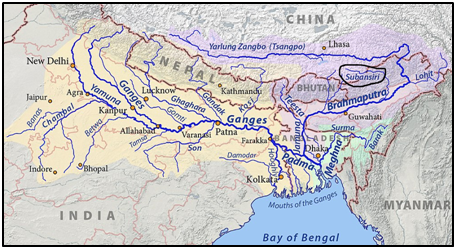
- The Subansiri River (Chayul Chu in Tibet) is a trans-Himalayan River and a tributary (right bank) of the Brahmaputra River.
- It flows through Tibet’s Lhuntse County in the Shannan Prefecture, and the Indian states of Arunachal Pradesh and Assam.
- The Subansiri is approx. 518 km (322 mi) long, with a drainage basin 32,640 square km (12,600 sq mi).
- It is the largest tributary of the Brahmaputra contributing 7.92% of the Brahmaputra’s total flow.
About the Subansiri Lower Hydroelectric Project (SLHEP)
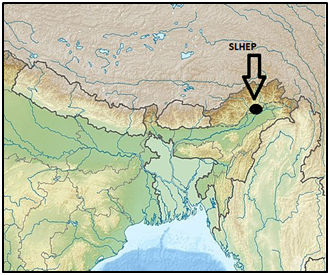
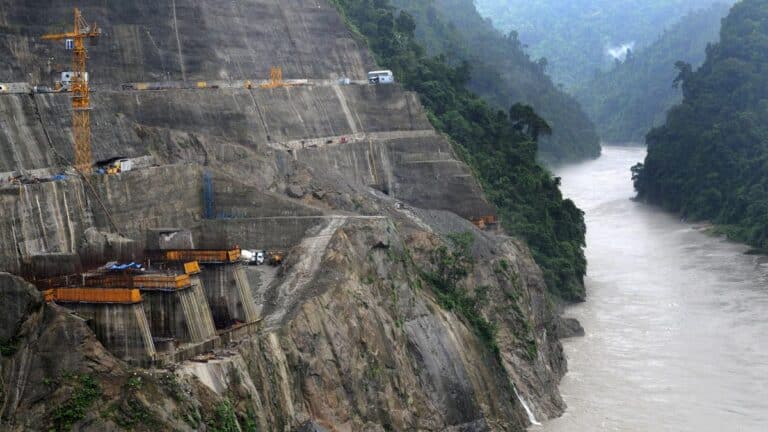
- The Subansiri Lower Dam, officially named SLHEP, is an under-construction gravity dam on the Subansiri River in North Eastern India on the borders of Arunachal Pradesh and Assam.
- A gravity dam is so called because it is their own weight that is responsible for resisting the thrust of the water.
- Described as a run-of-the-river project by National Hydroelectric Power Corporation (NHPC) Limited, the Project is expected to supply 2,000 MW of power (eight 250 MW units) when completed.
- Run-of-river hydro projects use the natural downward flow of rivers and micro turbine generators to capture the kinetic energy carried by water.
- NHPC Limited commenced construction work of the SLHEP in 2005 after obtaining forest clearance.
- The project has experienced several problems during construction to include landslides, re-design and opposition.
- Due to agitations and protests by local stakeholders, the project (which was expected to be complete in 2018) construction work was stalled between 2011 and 2019.
- The project construction resumed in 2019, after the clearance by National Green Tribunal (NGT) and is scheduled to begin operations from March 2024.
- It is notable that, if completed as planned, it will be the largest hydroelectric project in India.
What Happened at Subansiri?
- In a hydel project, a set of tunnels are built to carry water from the reservoir to the powerhouse.
- The water turns the turbines, and then goes back into the river.
- Once the power house is operational, this becomes the main path of the water, and the spillways (gates) are used occasionally.
- On October 27, the long delayed SLHEP suffered its latest setback after a large part of the hill on the left side of the dam collapsed into its reservoir. The landslide was the sixth to hit the dam site since April 2022.
- The deposits blocked the only functional diversion tunnel (DT) and stopped the flow of water downstream of the dam into the Subansiri river.
- The Central Electricity Authority (CEA), the statutory body that advises the government on policy relating to electricity systems, had recommended that the impact of the DTs on the slope stability of the project site should be examined.
- NHPC Ltd, which is implementing the Subansiri Lower Project, ignored the recommendation.
- According to the NHPC Ltd, no more assessment of landslide hazards and their impact was needed, and that necessary stabilisation measures have been carried out.
Q1) What are the causes of landslides in India?
Landslides refer to gravitational movements of mass of rock downwards on a slope. As per the GSI, 12.6% of the total land area in India are prone to landslides. 5 factors that trigger landslides in India: Deforestation, Shifting Cultivation, Heavy Rainfall and Earthquakes, Mining and Urbanisation.
Q2) What is the Indian capacity of hydro power generation?
In August 2023, hydropower capacity of about 46,865 MW (megawatt) accounted for roughly 11% of power generation capacity in India.
Source: How ignored landslide warnings led to Subansiri running dry

 Last updated on March, 2026
→ UPSC Final Result 2025 is now out.
→ UPSC has released UPSC Toppers List 2025 with the Civil Services final result on its official website.
→ Anuj Agnihotri secured AIR 1 in the UPSC Civil Services Examination 2025.
→ UPSC Marksheet 2025 is now out.
→ UPSC Notification 2026 & UPSC IFoS Notification 2026 is now out on the official website at upsconline.nic.in.
→ UPSC Calendar 2026 has been released.
→ Check out the latest UPSC Syllabus 2026 here.
→ UPSC Prelims 2026 will be conducted on 24th May, 2026 & UPSC Mains 2026 will be conducted on 21st August 2026.
→ The UPSC Selection Process is of 3 stages-Prelims, Mains and Interview.
→ Prepare effectively with Vajiram & Ravi’s UPSC Prelims Test Series 2026 featuring full-length mock tests, detailed solutions, and performance analysis.
→ Enroll in Vajiram & Ravi’s UPSC Mains Test Series 2026 for structured answer writing practice, expert evaluation, and exam-oriented feedback.
→ Join Vajiram & Ravi’s Best UPSC Mentorship Program for personalized guidance, strategy planning, and one-to-one support from experienced mentors.
→ Shakti Dubey secures AIR 1 in UPSC CSE Exam 2024.
→ Also check Best UPSC Coaching in India