Sunbird Latest News
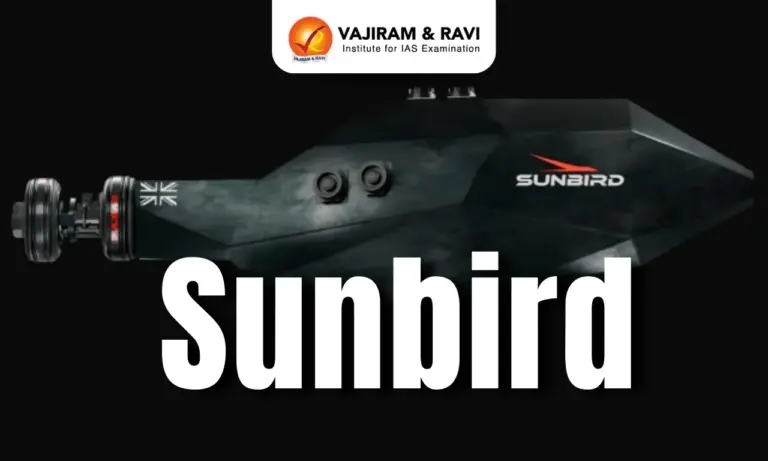
Sunbird is a nuclear fusion-powered rocket being developed by Pulsar Fusion, a British startup, to revolutionise interplanetary travel.
About Sunbird
- Sunbird could potentially reach speeds of up to 805,000 km/h, which is faster than the Parker Solar Probe (692,000 km/h), currently the fastest human-made object.
- This technology, if successful, could enable missions to Pluto in just 4 years and cut travel time to Mars by nearly half.
- It aims to revolutionize interplanetary travel by drastically reducing travel time to distant planets like Mars and Pluto.
- An orbital demonstration is scheduled for 2027, marking a major milestone in space propulsion technology.





What is Nuclear Fusion Propulsion?
- Nuclear Fusion replicates the energy generation process of stars, fusing atoms to release energy.
- Unlike fission, fusion is cleaner and offers higher energy output with lower radioactive waste.
Two Main Concepts in Nuclear Propulsion
|
Nuclear Thermal Propulsion (NTP) |
Nuclear Electric Propulsion (NEP) |
|
– It uses a nuclear reactor to heat liquid hydrogen (LH₂). – The hydrogen turns into plasma and is expelled through nozzles to generate thrust. – Offers higher exhaust velocity and can double or triple payload capacity compared to chemical rockets. – Earlier ground tests began in 1955, making it a well-researched concept. |
-It converts heat from a nuclear reactor into electrical energy. – Powers ion thrusters, which slowly build high speeds over long durations. – Components include:
– It can also work with solar panels, but a nuclear source ensures consistent energy beyond Mars |
Sunbird FAQs
Q1. What is a nuclear fusion-powered rocket?
Ans. A nuclear fusion-powered rocket is a theoretical spacecraft propulsion system that uses nuclear fusion reactions to generate thrust. It offers high specific impulse and sustained acceleration, enabling efficient interplanetary travel with minimal fuel requirements.
Q2. What is the Sunbird nuclear fusion rocket?
Ans. The Sunbird is a nuclear fusion rocket concept developed by UK-based Pulsar Fusion. It integrates a Dual Direct Fusion Drive (DDFD) to provide both thrust and electrical power, potentially enabling missions to Pluto in just four years and halving travel time to Mars.
Q3. How does the Sunbird rocket achieve propulsion?
Ans. The Sunbird uses compact linear fusion reactors that generate plasma through nuclear fusion. The escaping particles from this plasma serve as exhaust, propelling the spacecraft. It also provides up to 2 MW of electrical power for payloads.
Source: IE

 Last updated on March, 2026
→ UPSC Final Result 2025 is now out.
→ UPSC has released UPSC Toppers List 2025 with the Civil Services final result on its official website.
→ Anuj Agnihotri secured AIR 1 in the UPSC Civil Services Examination 2025.
→ UPSC Marksheet 2025 is now out.
→ UPSC Notification 2026 & UPSC IFoS Notification 2026 is now out on the official website at upsconline.nic.in.
→ UPSC Calendar 2026 has been released.
→ Check out the latest UPSC Syllabus 2026 here.
→ UPSC Prelims 2026 will be conducted on 24th May, 2026 & UPSC Mains 2026 will be conducted on 21st August 2026.
→ The UPSC Selection Process is of 3 stages-Prelims, Mains and Interview.
→ Prepare effectively with Vajiram & Ravi’s UPSC Prelims Test Series 2026 featuring full-length mock tests, detailed solutions, and performance analysis.
→ Enroll in Vajiram & Ravi’s UPSC Mains Test Series 2026 for structured answer writing practice, expert evaluation, and exam-oriented feedback.
→ Join Vajiram & Ravi’s Best UPSC Mentorship Program for personalized guidance, strategy planning, and one-to-one support from experienced mentors.
→ Shakti Dubey secures AIR 1 in UPSC CSE Exam 2024.
→ Also check Best UPSC Coaching in India