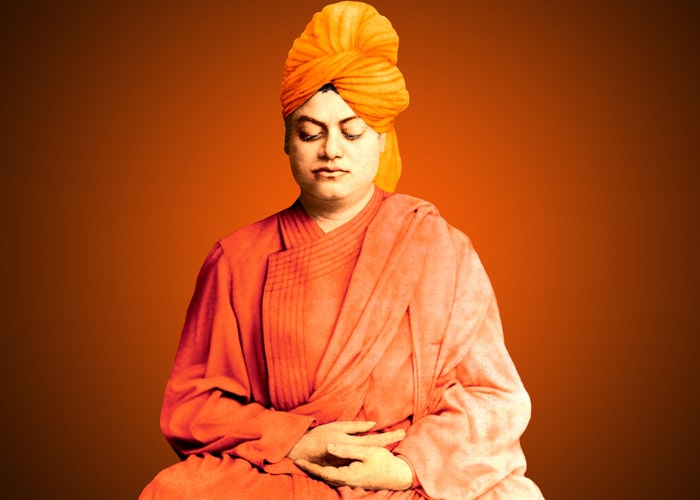
About Swami Vivekananda:
- Swami Vivekananda (1863 – 1902), born Narendranath Datta,was a Hindu monk and one of the most celebrated spiritual leaders of India.
- He was the foremost disciple of Sri Ramakrishna Paramhamsa and a world spokesperson for Vedanta.
- He was hailed as a Dhyana Sidha, a meditation expert, by his guru Ramakrishna Paramhamsa.
- He attempted to combine Indian spirituality with Western material progress, maintaining that the two supplemented and complemented one another.
- He believed that the path to self-purification is through helping others. He encouraged people to engage in selfless service and to work towards the betterment of society.
- Through his teachings on the four yogas, the harmony of religions, divinity of the soul, and serving humanity as God, Vivekananda gave spiritual aspirants paths to that realization.
- Vivekananda represented Hinduism at the 1893 World’s Parliament of Religions convened during the World’s Columbian Exposition in Chicago.
- After his first visit to the West, Swami Vivekananda went back to India and founded the Ramakrishna Order at Belur outside of Kolkata in 1897.
Ramakrishna Order:
- The Ramakrishna Order, with headquarters in Kolkata, is one of the largest and most respected religious orders in India today.
- The Order was inspired by the great Bengali saint, Sri Ramakrishna.
- Shortly before his death in 1886, Ramakrishna encouraged his young disciples to formally renounce the world by giving them the ochre cloth of renunciation.
- He entrusted the care of these young men to his foremost disciple, Swami Vivekananda, who later, in 1897, founded the Ramakrishna Order.
- The Ramakrishna Order was formed along two parallel lines: The Ramakrishna Math, which is primarily dedicated to spiritual development, and the Ramakrishna Mission, which is dedicated to social service.
Q1) What is Vedanta philosophy?
Vedanta is a school of philosophy within Hinduism dealing with the nature of reality, one of the six orthodox systems (darshans) of Indian philosophy and the one that forms the basis of most modern schools of Hinduism. The word Vedanta is a compound of veda, “knowledge;” and anta, “end, conclusion;” translating to “the culmination of the Vedas.” It applies to the Upanishads, which were commentaries on the Vedas, the earliest sacred literature of India, and to the school arising from the “study” (mimamsa) of the Upanishads.”
Source: Swami Vivekananda Death Anniversary: Remembering His Motivational Quotes, and Thoughts


 Last updated on Oct, 2026
→ UPSC 2027 Notification will be released on 13 January 2027 at upsconline.nic.in.
→ Check Nobel Prize 2026 Winners List here.
→ Download PIB PRiSM Monthly Magazine 2026 here.
→ Check UPSC Monthly Current Affairs Magazine The Recitals here.
→ Check out the latest UPSC Syllabus here.
→ Download UPSC Model Answers for Mains 2026
→ UPSC Mains Question Paper 2026 is out now for Essay & GS Paper 1, 2, 3 & 4.
→ UPSC Calendar 2027 has been released.
→ Enroll in Vajiram & Ravi’s UPSC Mains Test Series 2027 for structured answer writing practice, expert evaluation, and exam-oriented feedback.
→ Join Vajiram & Ravi’s UPSC Mentorship Program 2027 for personalized guidance, strategy planning, and one-to-one support from experienced mentors.
→ Go through the UPSC Mains Previous Year Papers to enhance your preparation.
→ UPSC has released UPSC Toppers List 2025 with the Civil Services final result on its official website.
→ Also check Best UPSC Coaching in India