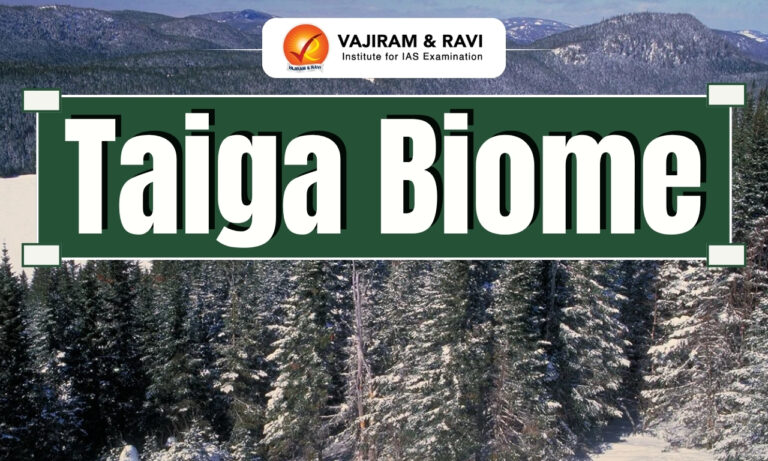
The Taiga Biome, also called the Boreal Forest, is the world’s largest terrestrial biome and forms a vast belt of mainly coniferous forests across the high latitudes of the Northern Hemisphere.
What is the Taiga Biome?
The Taiga Biome is a cold, coniferous forest biome found between the Arctic tundra in the north and temperate forests or grasslands in the south.
- It is also known as the Boreal Forest or Snow Forest and is associated with the sub-arctic or cool temperate continental climate.
- The word Taiga is of Russian/Turkic origin and is commonly associated with forest or land of little sticks, referring to the stunted trees found towards its northern margins.
- The biome is named after the vast forests of Siberia, where its largest continuous extent occurs.
Taiga Biome Distribution
The Taiga Biome forms a largely continuous circumpolar belt between about 50°N and 70°N, mainly across North America, Europe and Asia.
- In North America, it covers Alaska and much of inland Canada.
- In Europe, it occurs mainly across Norway, Sweden and Finland, with limited areas in the Scottish Highlands.
- In Asia, it extends across Russia, particularly Siberia, forming the largest and most continuous taiga region.
- Siberia contains an enormous belt of taiga extending for about 5,800 km from the Ural Mountains to the Pacific Ocean.
- The taiga is found almost entirely in the Northern Hemisphere because there is insufficient landmass between 50°S and 70°S to develop a comparable sub-arctic continental climate.
- Towards the north, the taiga gradually changes into Arctic tundra, while towards the south it changes into temperate forests or steppe/grasslands.


Taiga Biome Climate
The Taiga Biome has a sub-arctic climate characterised by long, severe winters and short, cool summers.
- Winters usually last for 6-8 months, with temperatures commonly falling below −30°C to −40°C, while extreme temperatures in interior Siberia may approach −50°C to −65°C.
- Summers are short and mild, generally lasting for only a few months, with temperatures around 10°C–20°C.
- The biome has one of the largest annual temperature ranges on Earth because of its strong continentality.
- Annual precipitation is relatively low to moderate, around 30-85 cm, with most precipitation occurring as snow in winter and light rain in summer.
- Long summer days and very short winter days result from the high latitude of the region.
- Coldness, rather than low precipitation, is the main climatic factor controlling the taiga ecosystem.
- The taiga climate is commonly represented by Koppen types Dfc, Dfd, Dwc and Dwd.
Taiga Biome Soil
The cold climate and slow decomposition produce thin, acidic and nutrient-poor soils, with podzol being the characteristic soil type.
- Podzol is an acidic, ash-grey soil produced through strong leaching under coniferous forests.
- Low temperatures slow down weathering and decomposition, causing partially decomposed conifer needles to accumulate on the forest floor.
- The acidic litter further reduces the availability of nutrients and limits undergrowth.
- Permafrost occurs across large parts of the northern taiga and can restrict drainage.
- Where drainage is poor, muskegs, which are shallow, waterlogged and spongy bogs, develop with mosses, sedges and stunted trees.
- Slow decomposition allows large quantities of organic carbon to accumulate in the soil, peat and permafrost.
Taiga Biome Vegetation
The Taiga Biome is dominated by coniferous, needle-leaved and cone-bearing trees that are adapted to severe cold and a short growing season.
- Major trees include spruce, pine, fir and larch, with hemlock occurring in some regions.
- Needle-shaped leaves reduce water loss and help trees survive physiological drought when soil water remains frozen.
- The conical shape and flexible branches allow snow to slide off and reduce damage from heavy snowfall.
- The dark green colour of needles helps absorb available sunlight during the short growing season.
- Most conifers are evergreen, allowing them to resume photosynthesis quickly when favourable conditions return.
- Important trees include birch, aspen and poplar, while larch or tamarack is a notable conifer that sheds its needles annually.
- The undergrowth is generally sparse because of low light, acidic soils and cold temperatures, but includes mosses, lichens and low shrubs such as blueberry, willow and alder.
- Closed-canopy taiga develops in wetter areas, while open or lichen taiga occurs in colder and drier areas near the tundra boundary.
- Montane taiga develops at high altitudes where conditions resemble those of high-latitude environments.
Taiga Biome Wildlife
The Taiga Biome supports a relatively low-diversity but highly specialised community of cold-adapted animals.
- Large mammals include moose, reindeer or caribou, brown bear, wolf and lynx.
- Smaller mammals include wolverine, fox, ermine, beaver and snowshoe hare.
- Many birds are migratory, arriving during summer when insects are abundant and leaving before the harsh winter.
- Finches, crossbills and sparrows are among the birds capable of remaining in the region throughout the year.
- Seasonal ponds created by melting snow provide breeding grounds for insects, which become an important food source for birds and rodents.
- Soil fauna is dominated by small organisms such as protozoans, nematodes, rotifers and tardigrades, while larger decomposers such as earthworms and millipedes are largely absent.
Taiga animals survive the harsh climate through migration, hibernation and insulation such as thick fur, feathers and fat reserves, while some species also develop seasonal white camouflage.
Taiga Biome Ecological and Economic Significance
The Taiga Biome is important for both global environmental stability and human economic activities because of its enormous forest area, carbon storage and natural resources.
- The taiga is a major terrestrial carbon store, with most of its stored carbon held in soil, peat and permafrost rather than living vegetation.
- Around 95% of the taiga’s stored carbon is estimated to occur in its soil, particularly in frozen peat and permafrost.
- Some estimates indicate that taiga permafrost stores about twice as much carbon as is currently present in the atmosphere, making its protection important for climate stability.
- The taiga contains around 18% of the world’s total biomass, reflecting its enormous geographical extent.
- Its forests are a major global source of softwood timber, supporting construction, pulp and paper industries in countries such as Russia, Canada and Scandinavia.
- Indigenous communities in Siberia and northern Canada depend on the taiga for hunting, fishing, trapping and small-scale forestry.
- Taiga regions, particularly in Russia and Canada, also contain important mineral, oil and natural gas resources, supporting extractive industries.
- The large seasonal vegetation cover also contributes to the regulation of carbon dioxide and oxygen in the atmosphere.
Threats to the Taiga Biome
The Taiga Biome is increasingly threatened by logging, climate change, wildfires, insect outbreaks and resource extraction, which can disrupt its carbon and ecological cycles.
- Large-scale logging and clear-cutting for timber, pulp and paper directly reduce natural forest cover.
- Illegal logging, particularly in parts of the Russian Far East, further threatens forest ecosystems.
- Replanting after logging often uses single-species monocultures, which can reduce biodiversity compared with natural forests.
- Climate change is particularly severe in high-latitude regions, where warming is occurring faster than the global average.
- Permafrost thaw can release stored carbon dioxide and methane, creating a positive feedback loop that further accelerates global warming.
- Thawing permafrost can also destabilise the ground, damage infrastructure and increase waterlogging.
- Warmer and drier conditions are increasing the risk and intensity of forest fires, releasing large amounts of stored carbon.
- Repeated fires can alter forest composition by favouring deciduous trees over conifers.
- Warmer winters allow pests such as bark beetles to survive and spread, damaging large areas of coniferous forest.
- Mining, oil and gas extraction cause habitat destruction, soil erosion, water pollution and fragmentation of wildlife habitats.
- Acid rain and industrial pollution can damage coniferous forests and increase soil acidification.
- Roads, settlements and industrial infrastructure cause habitat fragmentation, disrupting animal migration and breeding patterns.
Taiga Biome and Climate Change
Climate change poses a particularly serious threat to the taiga because warming affects both its forests and frozen carbon reserves. High-latitude warming can increase permafrost thaw, wildfires and insect outbreaks.
- Thawing permafrost releases carbon dioxide and methane, strengthening the greenhouse effect.
- More frequent and intense fires can release carbon stored in vegetation and soil and reduce the capacity of forests to act as carbon stores.
- Changes in temperature and moisture can shift the boundary between taiga, tundra and temperate vegetation.
- Therefore, degradation of the taiga can create a positive climate feedback, making the biome important for global climate policy.

 Last updated on Oct, 2026
→ UPSC 2027 Notification will be released on 13 January 2027 at upsconline.nic.in.
→ Check Nobel Prize 2026 Winners List here.
→ Download PIB PRiSM Monthly Magazine 2026 here.
→ Check UPSC Monthly Current Affairs Magazine The Recitals here.
→ Check out the latest UPSC Syllabus here.
→ Download UPSC Model Answers for Mains 2026
→ UPSC Mains Question Paper 2026 is out now for Essay & GS Paper 1, 2, 3 & 4.
→ UPSC Calendar 2027 has been released.
→ Enroll in Vajiram & Ravi’s UPSC Mains Test Series 2027 for structured answer writing practice, expert evaluation, and exam-oriented feedback.
→ Join Vajiram & Ravi’s UPSC Mentorship Program 2027 for personalized guidance, strategy planning, and one-to-one support from experienced mentors.
→ Go through the UPSC Mains Previous Year Papers to enhance your preparation.
→ UPSC has released UPSC Toppers List 2025 with the Civil Services final result on its official website.
→ Also check Best UPSC Coaching in India
Taiga Biome FAQs
Q1. What is the Taiga Biome?+
Q2. Where is the Taiga Biome found?+
Q3. What are the main features of the Taiga climate?+
Q4. What vegetation and soil are characteristic of the Taiga Biome?+
Q5. Why is the Taiga Biome important and threatened?+
Tags: taiga biome