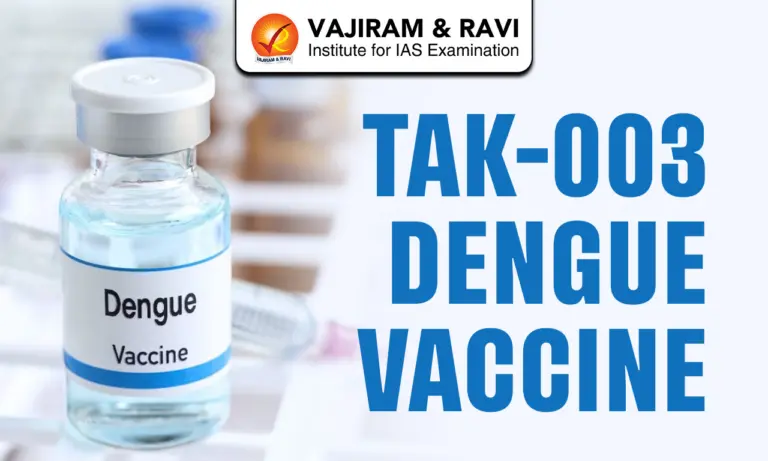
Takeda’s tetravalent dengue vaccine, TAK-003 (called ‘Qdenga’), recently received clearance from the Subject Expert Committee (SEC) under the Drugs Controller General of India (DCGI) for use among individuals aged 4 to 60 years.
About TAK-003 (Qdenga) Dengue Vaccine
- TAK-003 (Qdenga) is a dengue vaccine developed by the Japanese pharmaceutical company Takeda.
- It is a tetravalent dengue vaccine, designed to provide protection against all four dengue virus serotypes (DENV-1 to DENV-4).
- It is a disease-modifying vaccine, meaning it reduces severity but does not fully prevent infection.
- It has been tested on more than 28,000 participants globally and is already approved in over 40 countries.
- It has been approved in India by the Subject Expert Committee (SEC) under the Drugs Controller General of India (DCGI) for individuals aged 4 to 60 years.
TAK-003 (Qdenga) Dengue Vaccine Advantages
The approval of TAK-003 (Qdenga) Vaccine marks an important step in strengthening India’s dengue control strategy. It represents a shift from a reactive to a more preventive approach.
- Unlike earlier dengue vaccines, it does not require pre-vaccination screening for prior dengue infection, making it easier to administer in real-world conditions.
- The vaccine has demonstrated good safety and strong protection against severe dengue and hospitalisation.
- In a country like India, where healthcare systems often face pressure during dengue outbreaks, even a moderate reduction in severe cases can significantly reduce hospital burden and improve health outcomes, especially among children and adolescents.





TAK-003 (Qdenga) Dengue Vaccine Challenges and Limitations
While TAK-003 (Qdenga) Vaccine represents a significant advancement in dengue control, it is important to understand its limitations and the challenges associated with its use in the Indian context.
- Uneven effectiveness across serotypes: Dengue is caused by four different serotypes (DENV-1 to DENV-4), and protection against one does not ensure protection against others. In some cases, it may even increase the risk of severe disease on later infection, making vaccine development complex. TAK-003 (Qdenga) vaccine shows strong effectiveness against DENV-2 and reasonable protection against DENV-1, but its effectiveness against DENV-3 and DENV-4 appears to be lower, especially in people who have never had dengue before. This is important for India because all four serotypes are present, and DENV-3 is increasing, contributing around 20-30% of cases in some regions. This may reduce the vaccine’s overall effectiveness at the population level.
- Limited Impact on Transmission: TAK-003 is a disease-modifying vaccine rather than a transmission-blocking one. It reduces the severity of illness but does not prevent infection entirely, which means dengue outbreaks are likely to continue and vector control measures will remain indispensable.
- Cost and Accessibility Concerns: The vaccine requires two doses, and the total cost is expected to be Rs 6,000-12,000, which raises concerns about affordability and access, especially for poorer populations.
India’s Indigenous Dengue Vaccine Pipeline
TAK-003 (Qdenga) Vaccine may represent the first major step in India’s dengue vaccination efforts, but it is not the final solution.
- India is developing an indigenous dengue vaccine, ‘DengiAll’, in collaboration with Panacea Biotec and Indian Council of Medical Research (ICMR).
- DengiAll is based on the U.S. National Institutes of Health (NIH) TV003 platform.
- It is a single-dose vaccine designed to provide balanced protection against all four serotypes.
- Early data from similar vaccines indicate strong protection against severe dengue.
- If successful, DengiAll could be available in India by 2027, offering an improved solution for large-scale public health deployment.
Way Forward
A multi-pronged strategy combining vaccination, surveillance, and vector control will be essential for sustainable dengue control in India.
- India should focus on integrating vaccination with existing public health measures.
- TAK-003 can be used to reduce severe dengue cases and hospitalisation, particularly in high-burden regions, but it should not be seen as a standalone solution. There is a need to strengthen vector control measures such as eliminating mosquito breeding sites, insecticide use, and public awareness campaigns, as the vaccine does not prevent transmission and outbreaks may continue.
- Ensuring affordability and wider access will be important for improving coverage, especially among vulnerable populations.
- At the same time, post-marketing surveillance must be prioritised to assess real-world effectiveness across regions and serotype patterns.
- In the long term, India should remain open to adopting improved vaccines such as DengiAll, which may offer more balanced protection.

 Last updated on March, 2026
→ UPSC Final Result 2025 is now out.
→ UPSC has released UPSC Toppers List 2025 with the Civil Services final result on its official website.
→ Anuj Agnihotri secured AIR 1 in the UPSC Civil Services Examination 2025.
→ UPSC Marksheet 2025 is now out.
→ UPSC Notification 2026 & UPSC IFoS Notification 2026 is now out on the official website at upsconline.nic.in.
→ UPSC Calendar 2026 has been released.
→ Check out the latest UPSC Syllabus 2026 here.
→ UPSC Prelims 2026 will be conducted on 24th May, 2026 & UPSC Mains 2026 will be conducted on 21st August 2026.
→ The UPSC Selection Process is of 3 stages-Prelims, Mains and Interview.
→ Prepare effectively with Vajiram & Ravi’s UPSC Prelims Test Series 2026 featuring full-length mock tests, detailed solutions, and performance analysis.
→ Enroll in Vajiram & Ravi’s UPSC Mains Test Series 2026 for structured answer writing practice, expert evaluation, and exam-oriented feedback.
→ Join Vajiram & Ravi’s Best UPSC Mentorship Program for personalized guidance, strategy planning, and one-to-one support from experienced mentors.
→ Shakti Dubey secures AIR 1 in UPSC CSE Exam 2024.
→ Also check Best UPSC Coaching in India
TAK-003 (Qdenga) Dengue Vaccine FAQs
Q1. What is the TAK-003 (Qdenga) Vaccine?+
Q2. Who approved the TAK-003 (Qdenga) Dengue Vaccine in India?+
Q3. Who can take the TAK-003 (Qdenga) Dengue Vaccine?+
Q4. How does the TAK-003 (Qdenga) Dengue Vaccine work?+
Q5. Does the TAK-003 (Qdenga) Dengue Vaccine prevent dengue completely?+
Q6. What are the advantages of the TAK-003 (Qdenga) Dengue Vaccine?+
Q7. What are the limitations of the TAK-003 (Qdenga) Dengue Vaccine?+
Tags: medical science science and technology tak-003 (qdenga) dengue vaccine