About Tidal Disruption Event (TDE)
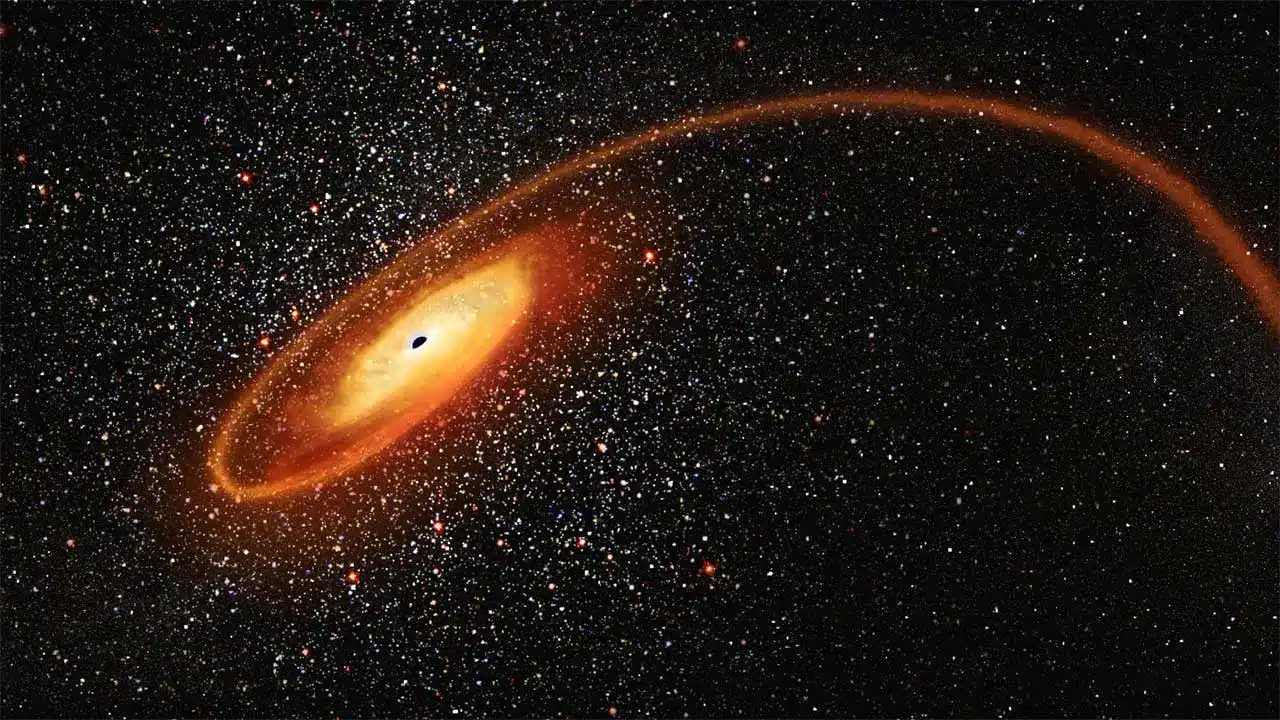
- Tidal disruption events (TDEs) are astronomical phenomena that occur when a star passes close enough to a supermassive black hole and is pulled apart by the black hole’s tidal forces, causing the process of disruption.
- Such tidally disrupted stellar debris starts raining down on the black hole and radiation emerges from the innermost region of accreting debris, which is an indicator of the presence of a TDE.
- How does a TDE typically unfold?
- Close Approach: A star in a galaxy approaches a black hole on a very close trajectory due to gravitational interactions within the galaxy.
- Tidal Forces: As the star gets closer to the black hole, the gravitational forces acting on it become increasingly uneven due to the difference in gravitational pull on the near side and far side of the star. These tidal forces can be strong enough to disrupt the star.
- Stellar Disruption: When the tidal forces exceed the self-gravitational forces holding the star together, it undergoes a process called “tidal disruption.” The star is stretched and eventually torn apart into a stream of gas and debris.
- Accretion Disk Formation: The debris from the disrupted star forms an accretion disk around the black hole. This disk is composed of hot gas and dust, and it spirals inwards towards the black hole.
- Energy Release: As the material in the accretion disk spirals inwards, it releases a tremendous amount of energy in the form of X-rays and ultraviolet radiation.
- Flares and Observations: TDEs are often observed as bright flares of radiation from the centre of a galaxy. These flares can last for several months to years, gradually fading as the disrupted star’s material is consumed by the black hole.
Q1) What is a Black Hole?
Black holes are regions in space where an enormous amount of mass is packed into a tiny volume. This creates a gravitational pull so strong that not even light can escape.Most black holes form from the remnants of a large star that dies in a supernova explosion. (Smaller stars become dense neutron stars, which are not massive enough to trap light.)
Source: Observations shed more light on the properties of the nearest tidal disruption event


 Last updated on Oct, 2026
→ UPSC 2027 Notification will be released on 13 January 2027 at upsconline.nic.in.
→ Check Nobel Prize 2026 Winners List here.
→ Download PIB PRiSM Monthly Magazine 2026 here.
→ Check UPSC Monthly Current Affairs Magazine The Recitals here.
→ Check out the latest UPSC Syllabus here.
→ Download UPSC Model Answers for Mains 2026
→ UPSC Mains Question Paper 2026 is out now for Essay & GS Paper 1, 2, 3 & 4.
→ UPSC Calendar 2027 has been released.
→ Enroll in Vajiram & Ravi’s UPSC Mains Test Series 2027 for structured answer writing practice, expert evaluation, and exam-oriented feedback.
→ Join Vajiram & Ravi’s UPSC Mentorship Program 2027 for personalized guidance, strategy planning, and one-to-one support from experienced mentors.
→ Go through the UPSC Mains Previous Year Papers to enhance your preparation.
→ UPSC has released UPSC Toppers List 2025 with the Civil Services final result on its official website.
→ Also check Best UPSC Coaching in India