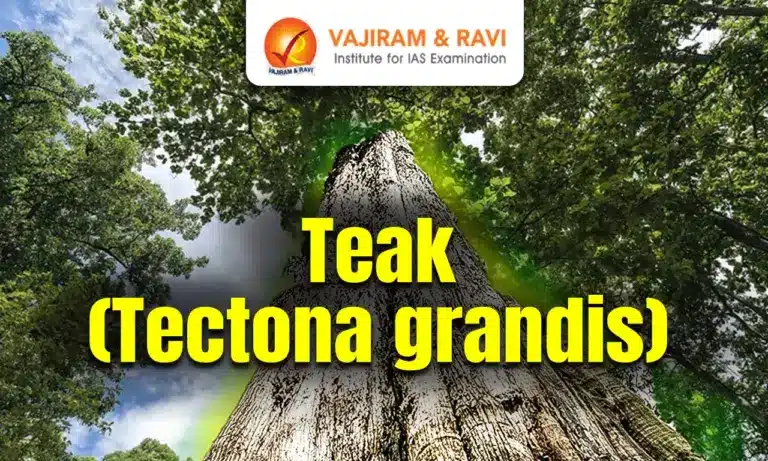
Teak (Tectona grandis) Latest News
Tissue-cultured teak is being promoted as a high-yield, fast-return solution to boost India’s timber cultivation and trade, raising debates about its productivity, economic viability, and ecological sustainability.
About Teak (Tectona grandis)
- Teak (Tectona grandis) is globally valued for its durability, strength, and resistance to pests and water, earning it the title of “king of timbers”.
- It is one of the world’s most valuable tropical hardwoods, extensively used in shipbuilding, construction, furniture, flooring, and musical instruments.
- India holds 35% of the world’s planted teak forests, with Asia accounting for over 95% of global teak resources.
- As per the FAO Global Teak Resources and Market Assessment 2022, Madhya Pradesh and Maharashtra have the largest areas of native teak forests.
Geographic Distribution
- Native to South and Southeast Asia, especially India, Myanmar, Thailand, Laos, and Indonesia.
- In India, teak is found in states like Madhya Pradesh, Maharashtra, Karnataka, Kerala, Tamil Nadu, Assam, and the Northeast region.
- Grows primarily in moist deciduous and mixed deciduous forests.
- Prefers well-drained soils and full sunlight; can grow up to 30–40 meters in height and live for hundreds of years.
Ecological and Structural Characteristics
- Large, deciduous tree with a straight, cylindrical trunk (1–1.5 m diameter).
- Leaves: Oblong, glossy, dark green; arranged in opposite pairs.
- Flowers: Small, white/cream, fragrant, borne in clusters.
- Wood colour: Golden brown to dark brown.
- Ecological role: Supports wildlife and biodiversity in native ecosystems.
Regulatory Context
- Green felling (commercial harvesting of trees) is prohibited in government forests under the Forest Conservation Act, 1980, and National Forest Policy, 1988.
- Hence, private teak plantations are key to meeting domestic and export demands.
Source: DTE






 Last updated on March, 2026
→ UPSC Final Result 2025 is now out.
→ UPSC has released UPSC Toppers List 2025 with the Civil Services final result on its official website.
→ Anuj Agnihotri secured AIR 1 in the UPSC Civil Services Examination 2025.
→ UPSC Marksheet 2025 is now out.
→ UPSC Notification 2026 & UPSC IFoS Notification 2026 is now out on the official website at upsconline.nic.in.
→ UPSC Calendar 2026 has been released.
→ Check out the latest UPSC Syllabus 2026 here.
→ UPSC Prelims 2026 will be conducted on 24th May, 2026 & UPSC Mains 2026 will be conducted on 21st August 2026.
→ The UPSC Selection Process is of 3 stages-Prelims, Mains and Interview.
→ Prepare effectively with Vajiram & Ravi’s UPSC Prelims Test Series 2026 featuring full-length mock tests, detailed solutions, and performance analysis.
→ Enroll in Vajiram & Ravi’s UPSC Mains Test Series 2026 for structured answer writing practice, expert evaluation, and exam-oriented feedback.
→ Join Vajiram & Ravi’s Best UPSC Mentorship Program for personalized guidance, strategy planning, and one-to-one support from experienced mentors.
→ Shakti Dubey secures AIR 1 in UPSC CSE Exam 2024.
→ Also check Best UPSC Coaching in India
Teak (Tectona grandis) FAQs
Q1. What is the botanical name of teak?+
Q2. Where is teak naturally found in India?+
Q3. Why is teak economically important?+
Tags: prelims pointers teak upsc prelims current affairs