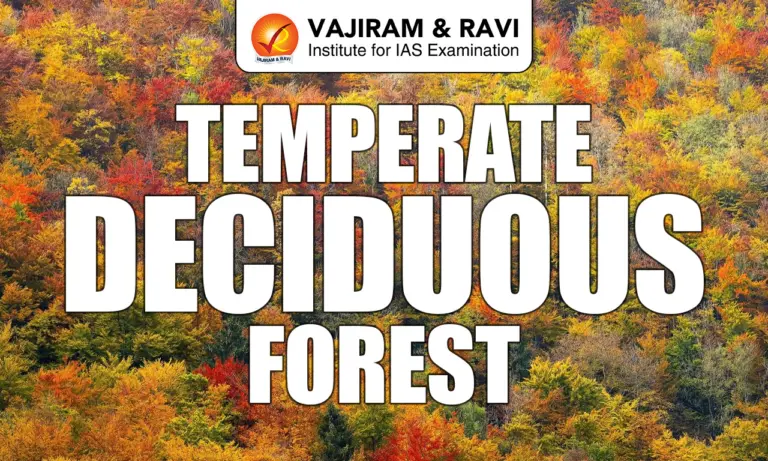
Temperate deciduous forests are found in the mid-latitudes, between tropical and polar regions. They are dominated by broad-leaved trees that shed their leaves in autumn and winter, which is why they are called deciduous forests. These forests experience four distinct seasons due to the influence of both warm and cold air masses. In autumn, leaves change color (yellow, red, orange) before falling as chlorophyll breaks down. They developed during the Cenozoic era (around 65 million years ago) and are mainly found in China, eastern USA, Canada, Japan, and Europe.
Temperate Deciduous Forests Distribution
- Temperate deciduous forests are found in both the Northern and Southern Hemispheres. However, the largest and most extensive forests are located in the Northern Hemisphere, especially in regions like North America, Europe, Russia, China, and Japan.
- In the Southern Hemisphere, these forests are present but are smaller in size. They can be found in parts of Australia, southern Asia, and South America, where the plant and animal life may differ from those in the Northern Hemisphere.
- These forests generally grow well in mountainous regions and areas with varied soil types, which support their growth and biodiversity.
Temperate Deciduous Forests Climate
- Temperate deciduous forests have a moderate climate with four distinct seasons, which are spring, summer, autumn, and winter. The weather changes clearly throughout the year, influencing the life of plants and animals.
- These regions experience cold winters and warm to hot summers. Rainfall is moderate and spread throughout the year, which supports dense vegetation. During autumn, trees lose their green color as chlorophyll breaks down, and leaves turn yellow, red, and orange before falling. In winter, trees remain leafless, and in spring, new leaves grow again.
- The falling leaves decompose and add nutrients to the soil, making it fertile. Climate conditions, especially mild winters, can increase the variety of tree species in these forests.
- Although mainly found in temperate regions, some deciduous forests are also present in tropical and subtropical areas.





Temperate Deciduous Forests Temperature
- The temperature in temperate deciduous forests varies with location, but overall they have a moderate temperature range. The average annual temperature is around 10°C (50°F).
- These regions experience cold winters, often with frost or snowfall, and warm summers. A key feature is the frost-free period, which usually lasts for about 120 to 250 days in a year. This period is important for plant growth and reproduction.
- Seasonal temperature changes are very clear, which is why trees shed their leaves in winter to conserve energy and grow new leaves in spring.
Temperate Deciduous Forests Precipitation
- Temperate deciduous forests receive moderate rainfall throughout the year, which supports the growth of trees and other vegetation. The average annual rainfall ranges between 75 to 150 cm (30–60 inches).
- Rainfall is generally well distributed, ensuring enough moisture for plants, animals, and soil. In many regions, snowfall occurs during winter, which also contributes to overall precipitation.
- This regular supply of water helps maintain dense vegetation and supports rich biodiversity in these forests.
Temperate Deciduous Forests Vegetation
Temperate deciduous forests have a rich and diverse plant life, mainly made up of autotrophs (producers). The vegetation is arranged in different layers, which help in better use of sunlight and nutrients.
- Forest Floor Layer: The lowest layer consists of lichens, mosses, ferns, wildflowers, and other small plants. The soil here is rich in organic matter like fallen leaves and animal waste, which is continuously decomposed by fungi, bacteria, and insects.
- Herb and Shrub Layer: Above the forest floor, there are herbaceous plants (soft-stem plants) and shrubs. These plants grow in limited sunlight and include bushes and young plants.
- Tree Layer (Canopy): The top layer is formed by tall hardwood trees like oak, maple, birch, beech, elm, and magnolia. These trees form a dense canopy. Some taller trees may rise above this layer (emergent layer).
- Mixed Vegetation: Along with deciduous trees, some coniferous trees like spruce, fir, and pine are also found in certain regions. In some areas, temperate deciduous forests gradually merge with the taiga (coniferous forests).
Temperate Deciduous Forests Fauna
The animals (consumers) in temperate deciduous forests must adapt to seasonal changes. During winter, many animals either hibernate (like bears) or migrate (like birds) to survive cold conditions and lack of food.
- Birds: Many birds migrate according to seasons. Common birds include robins, woodpeckers, owls, hawks, and eagles. They return in spring when trees grow leaves, providing shelter and food (insects).
- Mammals: These forests support both small and large mammals. Examples include squirrels, rabbits, beavers, raccoons, deer, bears, wolves, foxes, and even large animals like tigers and leopards in some regions.
- Reptiles and Amphibians: Animals like frogs, snakes, toads, and salamanders are common. They prefer moist environments and often live under logs or near water sources.
- Insects: Insects such as bees, butterflies, ants, and moths are very important as they help in pollination and form a major part of the food chain.
Deciduous Forests in India
- In India, the most common type of forest is the Tropical Deciduous Forest, also called Monsoon forest. These forests are found in areas where rainfall is moderate (about 70-200 cm annually) and show clear seasonal changes.
- Types of Deciduous Forests:
- Moist deciduous forests
-
- Dry deciduous forests.
- Moist Deciduous Forests: These are found in regions receiving 100-200 cm rainfall. They are located in areas like the Himalayan foothills, eastern slopes of the Western Ghats, and Odisha. Common trees include teak, sal, shisham, mahua and bamboo. These forests are dense and rich in biodiversity.
- Dry Deciduous Forests: These occur in areas with 70-100 cm rainfall. During the dry season, trees shed their leaves completely to conserve water. Important tree species include tendu, palas, amaltas, bel, khair, and axlewood.
- Key Features: These forests support a large variety of wildlife and are economically important for timber and forest products. They also play a major role in maintaining ecological balance.
Temperate Deciduous Forests Significance
Temperate deciduous forests are important for both the environment and human life, especially in hilly and temperate regions.
- Biodiversity Conservation: These forests support a wide variety of plants and animals, including birds, mammals, and insects adapted to seasonal changes.
- Climate Regulation: They help in absorbing carbon dioxide and maintaining the balance of gases in the atmosphere, thus reducing climate change impacts.
- Soil Protection: The trees prevent soil erosion, especially in mountainous areas, and improve soil fertility through leaf fall.
- Water Regulation: These forests help in maintaining the water cycle, supporting streams and rivers, and aiding groundwater recharge.
- Economic Importance: They provide timber, fuelwood, fruits, and medicinal plants, which are useful for local communities.
- Tourism and Recreation: Their seasonal beauty, especially during autumn (leaf fall), attracts tourists and supports eco-tourism.

 Last updated on March, 2026
→ UPSC Final Result 2025 is now out.
→ UPSC has released UPSC Toppers List 2025 with the Civil Services final result on its official website.
→ Anuj Agnihotri secured AIR 1 in the UPSC Civil Services Examination 2025.
→ UPSC Marksheet 2025 is now out.
→ UPSC Notification 2026 & UPSC IFoS Notification 2026 is now out on the official website at upsconline.nic.in.
→ UPSC Calendar 2026 has been released.
→ Check out the latest UPSC Syllabus 2026 here.
→ UPSC Prelims 2026 will be conducted on 24th May, 2026 & UPSC Mains 2026 will be conducted on 21st August 2026.
→ The UPSC Selection Process is of 3 stages-Prelims, Mains and Interview.
→ Prepare effectively with Vajiram & Ravi’s UPSC Prelims Test Series 2026 featuring full-length mock tests, detailed solutions, and performance analysis.
→ Enroll in Vajiram & Ravi’s UPSC Mains Test Series 2026 for structured answer writing practice, expert evaluation, and exam-oriented feedback.
→ Join Vajiram & Ravi’s Best UPSC Mentorship Program for personalized guidance, strategy planning, and one-to-one support from experienced mentors.
→ Shakti Dubey secures AIR 1 in UPSC CSE Exam 2024.
→ Also check Best UPSC Coaching in India
Temperate Deciduous Forests FAQs
Q1. What are Temperate Deciduous Forests?+
Q2. Where are Temperate Deciduous Forests mainly found?+
Q3. What type of climate do these forests have?+
Q4. What is the average temperature and rainfall?+
Q5. Which type of deciduous forests are common in India?+
Tags: geography geography notes Temperate Deciduous Forests