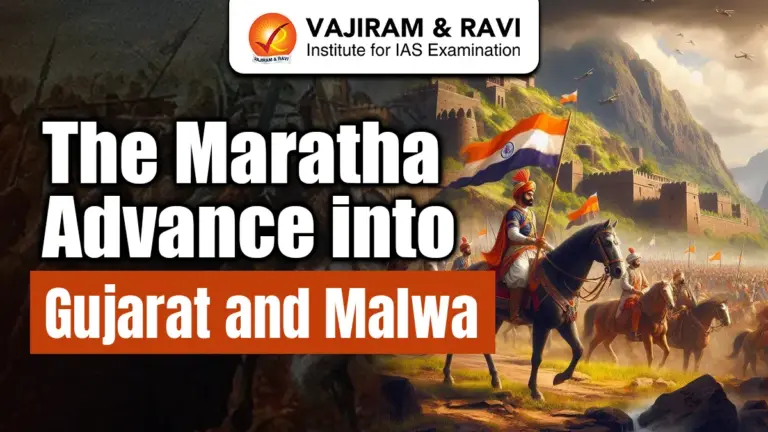
The Maratha Advance into Gujarat and Malwa marked a decisive phase in 18th century Indian politics, reflecting the systematic rise of Maratha power after Mughal decline. After Aurangzeb’s death in 1707, central authority weakened, creating space for regional forces. Under Shahu and Peshwa Baji Rao I, the Marathas transformed from raiders into territorial rulers. Their campaigns in Gujarat and Malwa were driven by fiscal demands for Chauth and Sardeshmukhi, strategic control over trade routes and the need to secure northern frontiers. These advances reshaped the balance of power in western and central India. By the 1730s, Maratha supremacy over the Deccan was recognized, while Gujarat and Malwa became pillars of Maratha power between 1720 and 1761.
The Maratha Advance into Gujarat
The Maratha advance into Gujarat progressed from fiscal claims to full annexation. Strategic pressure, negotiated settlements and repeated military interventions steadily dismantled Mughal authority, culminating in Maratha control over Ahmedabad and surrounding districts by the early 1750s.
Read about: Anglo Maratha War
First Phase of The Maratha Advance into Gujarat
The first phase of the Maratha Advance into Gujarat focused on legitimizing Maratha fiscal claims while consolidating limited territorial control.
- Recognition of Chauth Rights: In May 1726, Sarbuland Khan accepted Maratha claims to Chauth and Sardeshmukhi, marking the first formal Mughal acknowledgment of Maratha authority in Gujarat.
- Limited Administrative Focus: Peshwa Baji Rao prioritized Malwa and Deccan affairs, allowing Gujarat operations to proceed mainly through sardars rather than centralized campaigns.
- Southern Gujarat Control: By the late 1720s, Maratha sardars controlled 28 districts in southern Gujarat, ensuring steady revenue collection and weakening Mughal administrative reach.
- Return of Baji Rao in 1730: Baji Rao’s re-entry into Gujarat politics altered power equations, as Mughal governors promised fixed payments to secure Maratha military support.





Second Phase of The Maratha Advance into Gujarat
The second phase of the Maratha Advance into Gujarat emphasized consolidation through force and coordinated Maratha action.
- Territorial Enforcement by 1732: Marathas gained effective control over revenue districts, ensuring Chauth collection through direct presence rather than negotiated consent.
- Resistance by Gaekwar: The Mughal backed governor Gaekwar attempted to expel Maratha forces militarily but failed due to lack of coordination and popular support.
- Unified Maratha Response: The killing of a prominent Maratha sardar led to collective retaliation, displaying unity among Maratha factions operating in Gujarat.
- Retreat of Gujarat Forces: Unable to stabilize the province, opposing forces withdrew towards Marwar, leaving Marathas as the dominant power.
Third Phase of The Maratha Advance into Gujarat
The final phase of the Maratha Advance into Gujarat transformed de facto control into formal annexation.
- Shift from Revenue to Land: Maratha demands moved beyond Chauth to outright possession of Gujarat’s territories, reflecting confidence in sustained control.
- Imperial Sanction Pending: Only a written imperial grant was needed to legalize Maratha authority, indicating Mughal weakness rather than Maratha restraint.
- Appointment of Fakr-ud-Daulah: In 1749, the Mughals appointed Fakr-ud-Daulah as governor in a last attempt to recover Gujarat administratively.
- Fall of Ahmedabad in 1753: The capture of Ahmedabad led to the seize of Gujarat from Maratha.
Read about: Important Rulers of the Maratha Empire
The Maratha Advance into Malwa
The Maratha advance into Malwa unfolded through sustained military pressure against Mughal governors. Control over Chauth evolved into territorial partition among Maratha sardars, turning Malwa into a central base for northern expansion by the mid-eighteenth century.
First Phase of The Maratha Advance into Malwa
The first phase of the Maratha Advance into Malwa centered on asserting fiscal rights against determined Mughal resistance.
- Organized Campaign of 1723: Under Baji Rao, Marathas launched their first coordinated effort to enforce Chauth claims in Malwa.
- Appointment of Girdhar Bahadur: In June 1725, Girdhar Bahadur became Mughal subahdar, emerging as a resolute opponent of Maratha demands.
- Rejection of Negotiations: Despite Shahu’s directives, Girdhar Bahadur refused to allow Chauth collection, escalating tensions into open conflict.
- Prolonged Warfare: Continuous skirmishes across Malwa strained Mughal resources and tested Maratha mobility and endurance.
Second Phase of The Maratha Advance into Malwa
This phase witnessed decisive military victories and territorial restructuring.
- Battle of Amjhara 1728: The conflict culminated in November 1728 with the deaths of Girdhar Bahadur and Daya Ram, breaking Mughal resistance.
- Bundelkhand Campaign: Baji Rao’s invasion of Bundelkhand forced M. Khan Bangash to surrender conquered territories under military pressure.
- Territorial Concessions: Bangash exchanged territory and recognition of Maratha authority for political survival, strengthening Maratha influence.
- Partition of Malwa: Within three years, Malwa was divided among Maratha sardars, ensuring decentralized but effective control.
Third Phase of The Maratha Advance into Malwa
The third phase tested Maratha dominance against a united Mughal-Rajput alliance.
- Mughal Counteroffensive, 1734-35: Wazir Qamar-ud-Din and Khan-i-Dauran led massive forces aiming to expel Marathas beyond the Narmada.
- Rajput Participation: Leading rulers like Jai Singh, Abhai Singh and Durjan Sal joined the alliance, alarmed by Maratha raids into Rajputana.
- Numerical Superiority of Mughals: Combined forces numbered around 75,000 troops, dwarfing Maratha field armies in conventional strength.
- Battle of Toda Tank: Maratha light cavalry encircled and defeated the allied forces, proving mobility superior to numerical advantage.
- Battle of Bhopal (1737): The Maratha conquered Mughals, led by Peshwa Bajirao I. The victory resulted in the Treaty of Bhopal 1738, which made the Mughals hand over Malwa to the Marathas.
Read about: Battle of Bhima Koregaon
Maratha Rulers in Gujarat and Malwa Conquest
The conquest of Gujarat and Malwa was shaped by coordinated leadership rather than individual ambition.
- Shahu: As Chhatrapati, Shahu provided legitimacy and strategic direction, enabling Peshwas to pursue northern expansion confidently.
- Balaji Vishwanath: His 1719 negotiations secured imperial recognition of Maratha fiscal rights, laying the legal foundation for expansion.
- Peshwa Baji Rao I: Baji Rao’s military leadership transformed Chauth collection into territorial dominance through rapid cavalry campaigns.
- Maratha Sardars: Leaders like Holkar and Gaekwar administered conquered areas, ensuring revenue flow and local stability.

 Last updated on March, 2026
→ UPSC Final Result 2025 is now out.
→ UPSC has released UPSC Toppers List 2025 with the Civil Services final result on its official website.
→ Anuj Agnihotri secured AIR 1 in the UPSC Civil Services Examination 2025.
→ UPSC Marksheet 2025 is now out.
→ UPSC Notification 2026 & UPSC IFoS Notification 2026 is now out on the official website at upsconline.nic.in.
→ UPSC Calendar 2026 has been released.
→ Check out the latest UPSC Syllabus 2026 here.
→ UPSC Prelims 2026 will be conducted on 24th May, 2026 & UPSC Mains 2026 will be conducted on 21st August 2026.
→ The UPSC Selection Process is of 3 stages-Prelims, Mains and Interview.
→ Prepare effectively with Vajiram & Ravi’s UPSC Prelims Test Series 2026 featuring full-length mock tests, detailed solutions, and performance analysis.
→ Enroll in Vajiram & Ravi’s UPSC Mains Test Series 2026 for structured answer writing practice, expert evaluation, and exam-oriented feedback.
→ Join Vajiram & Ravi’s Best UPSC Mentorship Program for personalized guidance, strategy planning, and one-to-one support from experienced mentors.
→ Shakti Dubey secures AIR 1 in UPSC CSE Exam 2024.
→ Also check Best UPSC Coaching in India
The Maratha Advance into Gujarat and Malwa FAQs
Q1. Why did the Marathas advance into Gujarat and Malwa?+
Q2. Who played the most important role in Maratha expansion into these regions?+
Q3. When did the Marathas seize Gujarat from Mughals?+
Q4. What was the significance of the Battle of Amjhara?+
Q5. How did the conquest of Gujarat and Malwa impact Mughal power?+
Tags: the maratha advance into gujarat and malwa