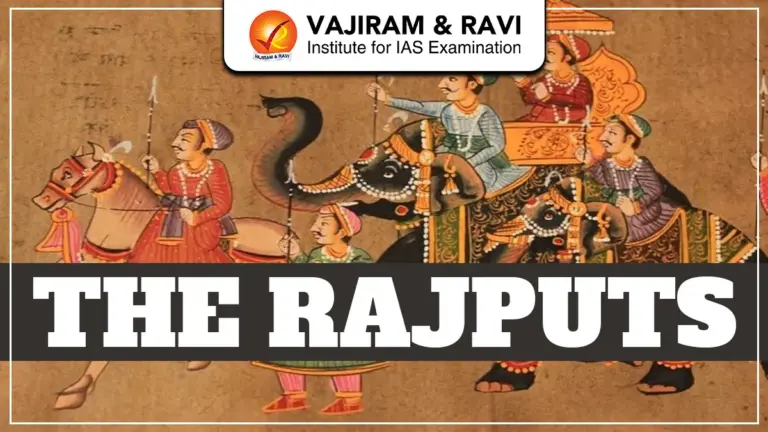
The Rajputs were a powerful group of warrior clans who dominated large parts of northern, western, and central India during the early medieval period. The word Rajput is derived from Rajaputra, meaning “son of a king”, which reflects their claim to royal and warrior ancestry. Rajputs considered warfare as their primary occupation and followed a strict code of honor, bravery, and loyalty.
From the 6th century CE onwards, Rajput rulers established numerous kingdoms across Rajasthan, Gujarat, Madhya Pradesh, Uttar Pradesh, Delhi, Punjab, Himachal Pradesh, Uttarakhand, and parts of present-day Pakistan and Afghanistan. Even until the 20th century, many princely states of India were ruled by Rajput dynasties.
The Rajputs Origin
The origin of the Rajputs is one of the most debated issues in early medieval Indian history because it combines legendary traditions, literary references, and historical processes. Rajputs did not emerge suddenly; they evolved over time as a distinct warrior aristocracy between the 6th and 9th centuries CE.
Kshatriya Lineage Theory
- Many Rajputs claimed descent from the ancient Kshatriyas of Vedic age, emphasizing purity of blood and royal ancestry.
- They associated themselves with the Solar (Suryavanshi) and Lunar (Chandravanshi) dynasties mentioned in the epics and Puranas.
- The word Rajput comes from Rajaputra, meaning “son of a king”, a term used by Sanskrit writers like Bana for elite warriors.
- The idea of thirty-six royal Rajput clans is found in Puranic and epic traditions, giving legitimacy to their ruling status.
- Rajputs also recognized a third lineage, the Agnivanshi, which symbolized divine and ritual origin.
Agnikula (Fire-Origin) Theory
- According to Chand Bardai’s Prithviraj Raso, four major Rajput clans, Parmar, Chauhan, Pratihara, and Chalukya, were born from a sacrificial fire pit (Agnikunda) at Mount Abu.
- Sage Vashistha is said to have performed the ritual to create warriors to defend Hindu society.
- This theory strengthened clan identity, social prestige, and political legitimacy among Rajputs.
- Historians regard this theory as mythical and symbolic, rather than factual history.
Aryan-Kshatriya Cultural Continuity Theory
- Ethnological and cultural practices of the Rajputs indicate strong roots in Aryan-Kshatriya traditions.
- Rituals such as the Ashvamedha sacrifice, sun worship, and strict adherence to Kshatriya codes were central to Rajput life.
- The practice of Sati reflected orthodox Hindu social values prevalent among upper castes.
- Due to cultural continuity, this theory is widely accepted by modern historians.
Foreign Origin and Assimilation Theory
- Some historians argue that certain Rajput clans descended from foreign tribes like the Sakas, Kushanas, Huns, and Gurjaras.
- These groups entered India between the 2nd and 6th centuries CE and gradually settled in northern India.
- Over time, they adopted Hindu religion, Sanskrit language, and local customs.
- Through Brahmanical rituals and political power, they were absorbed into the Kshatriya fold and later identified as Rajputs.
Caste Reorganization Theory
- The invasions of the Huns and allied tribes in the 5th–6th centuries CE caused major political and social disruption in northern India.
- Old ruling families collapsed, leading to a rearrangement of castes and power structures.
- Diverse warrior groups were merged into a single ruling class known as the Rajputs.
Major Rajput Dynasties and Kingdoms
1. Hindushahi Dynasty
- The Hindushahi dynasty ruled over parts of Afghanistan and the Punjab region, serving as a major Hindu power on India’s north-western frontier.
- Jayapala was the first Rajput ruler of the dynasty, succeeding the last Brahmin king Bhimdev, marking a shift from Brahmin to Rajput rule.
- Jayapala strongly resisted the invasions of Mahmud of Ghazni but was defeated in 1001 AD.
- Following his defeat, Jayapala immolated himself, reflecting the Rajput code of honor and sacrifice.
- His successor Anandapala continued resistance but was defeated by Mahmud in the Battle of Waihind (1008 AD).
- The dynasty declined thereafter, and its last ruler Bhimpala died in 1024 AD, ending Hindushahi rule by 1026 AD.
2. Chauhan (Chahamana) Dynasty
- The Chauhan dynasty ruled from 956 to 1192 AD, mainly over eastern Rajasthan, with Ajmer as their capital.
- The dynasty was founded by Simharaj, who is also credited with establishing the city of Ajmer.
- Over time, Chauhan rulers expanded their territory to include Delhi, Haryana, Punjab, parts of Uttar Pradesh, and Bundelkhand.
- Prithviraj Chauhan, the most prominent ruler, brought the dynasty to its greatest extent and military strength.
- He defeated Muhammad of Ghori in the First Battle of Tarain (1191 AD), showcasing Rajput military power.
- However, his defeat in the Second Battle of Tarain (1192 AD) marked the decline of Chauhan rule and opened the way for Turkish dominance in northern India.
3. Solanki Dynasty (Chalukya Dynasty of Gujarat)
- The Solanki dynasty ruled Gujarat from 945 to 1297 AD, with their capital at Anhilwara (Patan).
- The dynasty rose to prominence under Mulraj I, who consolidated Solanki power and laid a strong administrative foundation.
- Solanki rulers strengthened trade and commerce, making Gujarat an important economic region.
- They were great patrons of Hinduism and Jainism, encouraging religious harmony.
- The period witnessed remarkable temple architecture, reflecting artistic and cultural prosperity.
- Solanki rule declined towards the end of the 13th century due to internal weakness and external invasions.
4. Paramara Dynasty
- The Paramara dynasty was founded by Upendra (Krishnaraja) and ruled the Malwa region with capitals at Dhar and Ujjain.
- The greatest ruler of the dynasty was Raja Bhoja, under whom Malwa reached its peak of political and cultural glory.
- Raja Bhoja founded the city of Bhojpur and established the Bhojshala, a renowned centre of Sanskrit learning.
- The Paramaras were major patrons of Sanskrit scholars, poets, and scientists, and Bhoja himself was a celebrated scholar.
- Most Paramara rulers followed Shaivism and built numerous Shiva temples, while also supporting Jain scholars and institutions.
- Under Paramara rule, Malwa emerged as a leading centre of art, culture, and intellectual activity in early medieval India.
5. Chandela Dynasty
- The Chandela dynasty was founded by Jayasakthi and ruled the Bundelkhand region of central India.
- Their capital was Mahoba, which served as an important political and military center.
- The Chandelas are best known for their outstanding contributions to art and architecture.
- They constructed the famous Khajuraho temples, renowned for their intricate carvings and architectural excellence.
- These temples reflect religious tolerance, as both Shaiva and Vaishnava themes are prominently represented.
- The dynasty declined after repeated invasions and finally ended when Alauddin Khalji conquered Bundelkhand.
6. Gahadavala Dynasty
- The Gahadavala dynasty ruled the kingdom of Kannauj for nearly a century, beginning in the late 11th century AD.
- Kannauj emerged once again as an important political centre under Gahadavala rule.
- Jayachandra was the most powerful and last significant ruler of the dynasty.
- He faced invasions from the Ghurids, led by Qutb al-Din Aibak.
- Jayachandra was defeated and killed in the Battle of Chandawar (1194 AD).
- This defeat marked the end of Gahadavala rule and weakened Rajput dominance in the Gangetic plains.
7. Bundela Dynasty
- The Bundela dynasty ruled the Bundelkhand region from the 16th century AD onwards, emerging as a major regional power.
- Orchha, located in present-day Madhya Pradesh, served as their principal centre of administration and culture.
- The dynasty was founded by the Rajput ruler Hemkaran around 1048 AD.
- Bundela rulers frequently resisted Mughal authority but also formed alliances when politically necessary.
- The dynasty played an important role in shaping the political history of central India.
- Bundela rule declined after Orchha was captured by the Mughals under Aurangzeb, bringing their independence to an end.
8. Tomara Dynasty
- The Tomara dynasty was one of the early medieval Rajput ruling houses of northern India, known mainly from limited literary and numismatic sources.
- Puranic evidence suggests that their early settlements were located in the Himalayan region.
- Bardic traditions identify the Tomaras as one of the thirty-six Rajput clans.
- Anangapala, the most notable Tomara ruler, founded the city of Delhi (Dhillika) in the 11th century AD.
- In 1164 AD, Delhi was incorporated into the Chauhan (Chahamana) kingdom, though Tomara rulers continued as feudatories.
- Tomara authority finally ended with the Muslim conquest of Delhi in 1192–93 AD.





Society under the Rajputs
Religion
- The Rajputs were staunch followers of Hinduism, upholding traditional Vedic and Kshatriya religious practices.
- They also patronized other religions like Buddhism and Jainism, supporting religious tolerance and cultural diversity.
- The period saw the rise of the Bhakti movement, emphasizing devotion to deities such as Vishnu and Shiva, which influenced both the common people and the elite.
- Temples were not only centers of worship but also hubs for social, cultural, and educational activities.
Governance
- Rajput kingdoms had a feudal structure, with power decentralized across multiple estates and territories.
- Each kingdom was divided into Jagirs, which were land grants held by Jagirdars (local feudal lords) responsible for administration, revenue collection, and military service.
- The feudal setup created loyalty networks among clans, but also led to frequent inter-clan conflicts and limited central authority.
- Governance was largely based on customs and traditions, with no codified laws for the entire kingdom.
Major Literary Works
The Rajput period was a golden age for literature, with contributions in poetry, prose, and scholarly works:
- Kalhana’s Rajatarangini – Chronicles the history of Kashmir in Sanskrit verse, providing political, social, and cultural insights of rulers and battles.
- Jayadeva’s Gita Govindam – Devotional Sanskrit poem celebrating Krishna and Radha, influencing the Bhakti movement, temple music, and dance.
- Somadeva’s Kathasaritsagara – Extensive collection of folktales and legends reflecting society, customs, and moral values of the period.
- Chand Bardai’s Prithviraj Raso – Epic poem depicting the life, bravery, and military exploits of Prithviraj Chauhan, highlighting Rajput ideals.
- Bhaskara Charya’s Siddhanta Shiromani – Comprehensive work on mathematics and astronomy, including arithmetic, algebra, and planetary motion.
Rajasekhara’s Literary Works – Sanskrit texts like Karpuramanjari, Kavyamimamsa, and Balaramayana combining poetry, devotion, and literary theory.

 Last updated on March, 2026
→ UPSC Final Result 2025 is now out.
→ UPSC has released UPSC Toppers List 2025 with the Civil Services final result on its official website.
→ Anuj Agnihotri secured AIR 1 in the UPSC Civil Services Examination 2025.
→ UPSC Marksheet 2025 is now out.
→ UPSC Notification 2026 & UPSC IFoS Notification 2026 is now out on the official website at upsconline.nic.in.
→ UPSC Calendar 2026 has been released.
→ Check out the latest UPSC Syllabus 2026 here.
→ UPSC Prelims 2026 will be conducted on 24th May, 2026 & UPSC Mains 2026 will be conducted on 21st August 2026.
→ The UPSC Selection Process is of 3 stages-Prelims, Mains and Interview.
→ Prepare effectively with Vajiram & Ravi’s UPSC Prelims Test Series 2026 featuring full-length mock tests, detailed solutions, and performance analysis.
→ Enroll in Vajiram & Ravi’s UPSC Mains Test Series 2026 for structured answer writing practice, expert evaluation, and exam-oriented feedback.
→ Join Vajiram & Ravi’s Best UPSC Mentorship Program for personalized guidance, strategy planning, and one-to-one support from experienced mentors.
→ Shakti Dubey secures AIR 1 in UPSC CSE Exam 2024.
→ Also check Best UPSC Coaching in India
The Rajputs FAQs
Q1. Who were the Rajputs?+
Q2. What is the origin of Rajputs?+
Q3. Which were the major Rajput dynasties?+
Q4. What was the social structure under the Rajputs?+
Q5. What religions did the Rajputs follow?+
Tags: the rajputs