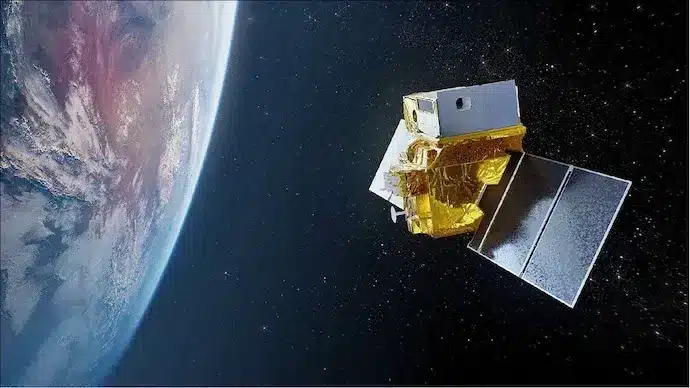
About TRISHNA Mission:
- The Thermal Infrared Imaging Satellite for High-resolution Natural Resource Assessment (TRISHNA) mission is a collaborative endeavor between the Indian Space Research Organisation (Isro) and the French Space Agency CNES.
- Objectives
- It is engineered to deliver high spatial and temporal resolution observations of Earth’s surface temperature, vegetation health, and water cycle dynamics.
- It will also help in a comprehensive assessment of urban heat islands, detection of thermal anomalies linked to volcanic activity and geothermal resources, and precise monitoring of snow-melt runoff and glacier dynamics.
- The mission will also provide valuable data on aerosol optical depth, atmospheric water vapor, and cloud cover.
- Payloads: TRISHNA satellite is equipped with two primary payloads.
- The Thermal Infra-Red (TIR) Payload: It is provided by CNES, features a four-channel long-wave infrared imaging sensor capable of high-resolution surface temperature and emissivity mapping.
- The Visible – Near Infra-Red – ShortWave Infra-Red (VNIR-SWIR) payload: It is developed by ISRO, includes seven spectral bands designed for detailed mapping of surface reflectance of VSWIR bands for generating important biophysical and radiation budget variables.
- The variables retrieved from the combination of payload data would help in solving surface energy balance to estimate surface heat fluxes.
- The satellite will operate in a sun-synchronous orbit at an altitude of 761 km, with a local time of 12:30 PM at the equator.
- This orbit will provide a spatial resolution of 57 meters for land and coastal areas and 1 km for oceanic and polar regions. The mission is designed for a 5-year operational life.
Q1; What is a Sun-synchronous Orbit?
It is a particular kind of polar orbit. Satellites in SSO, travelling over the polar regions, are synchronous with the Sun. This means they are synchronised to always be in the same ‘fixed’ position relative to the Sun. This means that the satellite always visits the same spot at the same local time.
Source: We are sharing state-of-the-art expertise with ISRO for Gaganyaan: French space agency chief






 Last updated on March, 2026
→ UPSC Final Result 2025 is now out.
→ UPSC has released UPSC Toppers List 2025 with the Civil Services final result on its official website.
→ Anuj Agnihotri secured AIR 1 in the UPSC Civil Services Examination 2025.
→ UPSC Marksheet 2025 is now out.
→ UPSC Notification 2026 & UPSC IFoS Notification 2026 is now out on the official website at upsconline.nic.in.
→ UPSC Calendar 2026 has been released.
→ Check out the latest UPSC Syllabus 2026 here.
→ UPSC Prelims 2026 will be conducted on 24th May, 2026 & UPSC Mains 2026 will be conducted on 21st August 2026.
→ The UPSC Selection Process is of 3 stages-Prelims, Mains and Interview.
→ Prepare effectively with Vajiram & Ravi’s UPSC Prelims Test Series 2026 featuring full-length mock tests, detailed solutions, and performance analysis.
→ Enroll in Vajiram & Ravi’s UPSC Mains Test Series 2026 for structured answer writing practice, expert evaluation, and exam-oriented feedback.
→ Join Vajiram & Ravi’s Best UPSC Mentorship Program for personalized guidance, strategy planning, and one-to-one support from experienced mentors.
→ Shakti Dubey secures AIR 1 in UPSC CSE Exam 2024.
→ Also check Best UPSC Coaching in India