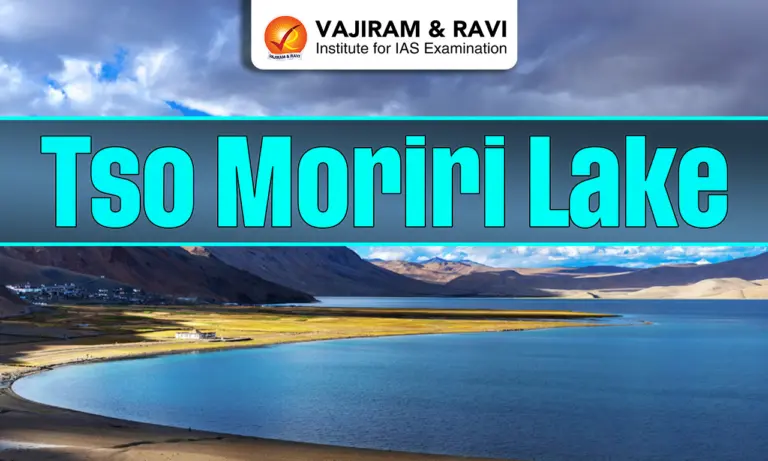
Tso Moriri Lake is a high altitude lake located in the Changthang Plateau of Ladakh at an elevation of about 4,522 to 4,595 metres above sea level. It is surrounded by snow covered mountains and cold desert landscapes. The lake is among the largest high altitude lakes entirely within Indian territory. Its blue waters, rare wildlife, migratory birds and peaceful surroundings make it one of the most ecologically important wetlands in the Trans Himalayan region.
Tso Moriri Lake Features
Tso Moriri Lake is known for its extreme altitude, cold desert climate, brackish waters and isolated Himalayan geography.
- Location and Setting: Tso Moriri lies in the remote Rupshu Valley of Changthang district in Ladakh, around 220-250 km southeast of Leh near the Indo-China border and the Line of Actual Control.
- Height: The lake stands at nearly 4,522-4,595 metres above sea level. It stretches about 19-29 km in length and varies between 3-8 km in width across different sections.
- Largest Inland High Altitude Lake: Tso Moriri is regarded as the largest high altitude lake located completely within Indian territory and forms an important part of Ladakh Range.
- Geological Formation: The lake is situated on Ordovician rock formations and is classified as a “remnant lake,” meaning it represents the remains of a much larger prehistoric lake system.
- Water Characteristics: Tso Moriri is an endorheic lake with no external drainage outlet. High evaporation and enclosed drainage make its waters slightly brackish, alkaline and nutrient poor.
- Glacial Feeding Streams: The lake receives water mainly from glacial streams such as Karzok Phu, Gyama Phu and Phirse Phu, which create marshlands and wetlands around their deltas.
- Climate Conditions: The region experiences cold desert conditions. Summer temperatures vary between 0°C and 30°C, while winter temperatures can drop between -10°C and -40°C with heavy freezing.
- Mountain Peaks: Elevated peaks exceeding 6,000 metres surround the lake, including Mentok Kangri and Lungser Kangri, creating a highly isolated and scenic geographical environment.
- Surface and Depth: Tso Moriri covers nearly 120 square kilometres and has a maximum recorded depth of about 40 metres or nearly 344 feet in some studies.
- Cultural Importance: The lake is sacred to local Ladakhi Buddhist communities. Nearby Korzok Monastery, nearly 400 years old, remains an important spiritual and cultural centre in the region.
- Tourism: Tso Moriri is less crowded than Pangong Lake due to its remote location. The lake attracts trekkers, photographers, bird watchers and nature tourists during May to September.
Tso Moriri Lake Biodiversity
The fragile ecosystem of Tso Moriri supports rare Himalayan flora, migratory birds and threatened wildlife species adapted to harsh cold desert conditions.
Fauna
- Bird Habitat: Tso Moriri supports nearly 34 bird species, including several endangered and migratory waterbirds that use the lake as breeding and nesting grounds.
- Black Necked Crane Habitat: The globally threatened Black necked Crane breeds around the wetlands of Tso Moriri, making the lake ecologically significant outside the Tibetan Plateau.
- Bar Headed Goose Breeding Site: Tso Moriri serves as the sole breeding ground in India for the Bar headed Goose, a bird famous for flying across the Himalayas.
- Other Avifauna: Brown headed gulls, Great Crested Grebes, Ferruginous Pochards, Ruddy Shelducks, Common Redshanks, Brahminy ducks and Lesser Sand Plovers are commonly recorded around the lake.
- Mammalian Wildlife: The surrounding Changthang region supports Tibetan gazelles, Kiang or Tibetan wild ass, Himalayan marmots, Tibetan wolves, Eurasian lynx and Bharal or blue sheep.
- Snow Leopard Presence: The endangered Snow Leopard inhabits higher mountain ranges near the lake, although sightings remain extremely rare due to the harsh terrain.
Flora
- Marsh and Alpine Vegetation: Vegetation includes alpine steppe grasses, sedges, Potamogeton species, Carex, Primula, Caragana, Astragalus, willow, sea buckthorn, juniper and wild rose.
- Cold Desert Ecology: Despite sparse vegetation and low biomass, the ecosystem supports pastoral communities and livestock such as yaks, sheep, goats and horses maintained by Changpa nomads.
Community
- Changpa Community: The Changpa pastoral community depends on surrounding grasslands for grazing and maintains traditional lifestyles linked closely with the fragile environment of Tso Moriri.


Tso Moriri Lake Conservation
Growing tourism, grazing pressure, waste generation and infrastructure development are creating ecological stress on the fragile Tso Moriri wetland ecosystem.
- Tourism Pressure: Since road connectivity improved after 1990, tourist numbers have increased significantly, disturbing breeding birds and increasing environmental pressure around sensitive wetland areas.
- Waste Pollution: Lack of proper garbage disposal facilities has resulted in dumping of plastic and waste into streams, burrows and nearby wetlands causing ecological degradation.
- Disturbance to Wildlife: Unregulated jeep safaris, tourist movement and camping activities disturb nesting birds, marmots, kiang populations and other vulnerable wildlife species.
- Pasture Degradation: Increased livestock grazing and expansion of Pashmina goat rearing have created pressure on limited grasslands and reduced natural forage availability.
- Trekking Impacts: Trekking groups often establish camps in pasturelands rather than barren zones, leading to trampling of vegetation and long term ecological damage.
- Threat from Stray Dogs: Unleashed dogs around settlements and camps attack nesting birds and destroy eggs, especially affecting Black necked Cranes and other waterbirds.
- Cultural Changes: Expanding tourism has altered traditional lifestyles of Changpa communities and contributed to gradual erosion of local cultural practices and heritage.
- Conservation Reserve Protection: The Indian government established the Tso Moriri Wetland Conservation Reserve to regulate tourism, restrict hunting and protect biodiversity.
- Tso Moriri Conservation Trust: The Tso Moriri Conservation Trust was formed in 2003 with support from the World Wide Fund For Nature local office in Leh for lake conservation activities.
- Community Participation: Local communities actively participate in waste management, habitat restoration, environmental awareness programmes and sustainable tourism initiatives around the lake region.
- Scientific Conservation Efforts: Wildlife Institute of India and conservation organisations conduct ecological surveys, biodiversity monitoring and awareness campaigns for long term environmental protection.
Tso Moriri Lake Ramsar Site
Tso Moriri gained global recognition because of its ecological importance, unique biodiversity and role in conserving Himalayan wetland ecosystems. It is one of the designated Ramsar Sites in India.
- Ramsar Designation: Tso Moriri was designated as a Wetland of International Importance under the Ramsar Convention in November 2002 and formally recognised in 2003.
- Highest Ramsar Site: The lake holds the distinction of being the highest Ramsar Site in the world, surpassing Salar de Tara in Chile in terms of elevation.
- Conservation Reserve: The wetland is officially protected as the Tso Moriri Wetland Conservation Reserve under environmental conservation measures in Ladakh.
- Closed Basin Wetland: The lake represents a rare high altitude closed drainage basin wetland with saline and oligotrophic water conditions unique to cold desert ecosystems.
- Global Significance: Tso Moriri remains one of the most important protected wetlands in the Himalayan region due to its biodiversity, climate sensitivity and ecological uniqueness.

 Last updated on Oct, 2026
→ UPSC 2027 Notification will be released on 13 January 2027 at upsconline.nic.in.
→ Check Nobel Prize 2026 Winners List here.
→ Download PIB PRiSM Monthly Magazine 2026 here.
→ Check UPSC Monthly Current Affairs Magazine The Recitals here.
→ Check out the latest UPSC Syllabus here.
→ Download UPSC Model Answers for Mains 2026
→ UPSC Mains Question Paper 2026 is out now for Essay & GS Paper 1, 2, 3 & 4.
→ UPSC Calendar 2027 has been released.
→ Enroll in Vajiram & Ravi’s UPSC Mains Test Series 2027 for structured answer writing practice, expert evaluation, and exam-oriented feedback.
→ Join Vajiram & Ravi’s UPSC Mentorship Program 2027 for personalized guidance, strategy planning, and one-to-one support from experienced mentors.
→ Go through the UPSC Mains Previous Year Papers to enhance your preparation.
→ UPSC has released UPSC Toppers List 2025 with the Civil Services final result on its official website.
→ Also check Best UPSC Coaching in India
Tso Moriri Lake FAQs
Q1. Where is Tso Moriri Lake located?+
Q2. Why is Tso Moriri Lake famous?+
Q3. What is the altitude of Tso Moriri Lake?+
Q4. Which birds are found at Tso Moriri Lake?+
Q5. When was Tso Moriri declared a Ramsar Site?+
Tags: geography geography notes tso moriri lake