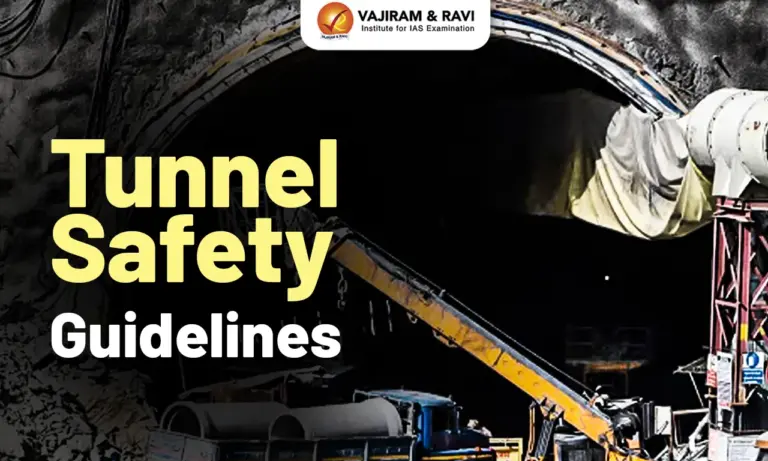
Tunnel Safety Guidelines Latest News
- On November 12, 2023, the Silkyara Bend–Barkot Tunnel on NH-134 (Char Dham Mahamarg Pariyojana) collapsed, trapping 41 workers for 17 days.
- Though all were rescued safely, the incident exposed systemic weaknesses in tunnel planning, geological assessment, and emergency preparedness, especially in fragile Himalayan terrain.
- In response, the Ministry of Road Transport and Highways (MoRTH) issued comprehensive guidelines to prevent and mitigate road tunnel collapses, particularly relevant for strategic and border area connectivity projects.
Why Tunnel Safety Matters
- Tunnels enable seamless connectivity in mountainous, snow-bound, eco-sensitive, congested and border areas.
- India’s expanding highway network under strategic and Char Dham projects has increased tunnelling activity, raising geological and safety risks.





Key Provisions of the New Guidelines
- Strengthening planning (DPR, GBR and risk register):
- Issues identified: Many Detailed Project Reports (DPRs) reduced to procedural formalities. Inadequate geological and geotechnical investigations.
- Guidelines:
- Project authority responsible for verifying correctness of geological investigations.
- Mandatory preparation of Geotechnical Baseline Report (GBR), risk register (hazards, risks, mitigation measures).
- Principle of risk allocation: “Risk shall be borne by the party best equipped to manage it.”
- GBR and risk register to be shared with bidders to ensure transparency and realistic costing.
- Geological realities and design challenges:
- Issues:
- Tunnel design is critical as ground itself acts as a support system.
- Predicting ground properties from limited tests is an oversimplification, especially in the Himalayas.
- Poor investigations lead to time overruns, cost escalation, and safety failures.
- Special conditions to be assessed: Squeezing and swelling ground, rock bursts, shallow cover zones, tunnels below perennial streams/nalas, hot water ingress, and toxic/flammable gases (long tunnels).
- Issues:
- Tunnelling technologies (NATM vs TBM):
- NATM (New Austrian Tunnelling Method): “Design-as-you-go” approach, suitable for non-uniform rock conditions, controlled blasting, and mandatory excavation and support sheet for each round.
- TBM (Tunnel Boring Machine): Used in uniform geological stretches, requires vigilance against roof collapse and water ingress.
- Collapse risk zoning and safety infrastructure: Tunnels to be classified into collapse-risk zones. High-risk zones must include Np-4 escape pipe (minimum 0.9 m diameter), mobile rescue containers, fixed rescue containers, minimum 24-hour survival capacity.
- Emergency response and human capacity:
- Shift managers must be trained as first responders.
- Emergency Response Plan (ERP): Prepared in advance, updated weekly based on site conditions.
India’s Tunnel Infrastructure Snapshot
- According to MoRTH’s reply in Parliament (December 12, 2024), a total of 42 tunnels covering 60.37 km in length in 27 projects of National Highways have been completed to date.
- Apart from this, 57 tunnels covering 93.96 km in length are currently under implementation in 37 projects on NHs in the country.
- 3 tunnels covering 9.68 km in length have been approved for construction in 3 projects at an estimated cost of Rs 1,962 crore.
- One 6-lane project in Maharashtra costing Rs 4501 crore, including the construction of 2 tunnels having a total length of 3.47 km, has been apprised by Public Private Partnership Appraisal Committee (PPPAC).
Challenges and Way Forward
- Weak DPR quality: Institutionalise scientific, data-driven DPRs.
- Complex Himalayan geology: Integrate real-time geological monitoring.
- Inadequate on-site emergency preparedness: Strengthen capacity-building of site managers. Periodic independent safety audits.
- Coordination gaps during rescue operations: Clear role definition for –
- Incident commander (District Magistrate)
- Construction agencies
- Local administration
- NDRF/SDRF commanders
- The Armed Forces must ensure coordination, technical support, and responder safety.
- Use guidelines as a template: For other infrastructure sectors (metros, hydropower).
Conclusion
- The Silkyara tunnel collapse was a watershed moment in India’s infrastructure journey.
- MoRTH’s new guidelines mark a shift from procedural compliance to risk-based engineering, emphasising geological realism, accountability, and human safety.
- Effective implementation will be crucial to ensuring that India’s push for strategic connectivity and infrastructure-led growth does not come at the cost of lives and sustainability.
Source: IE

 Last updated on March, 2026
→ UPSC Final Result 2025 is now out.
→ UPSC has released UPSC Toppers List 2025 with the Civil Services final result on its official website.
→ Anuj Agnihotri secured AIR 1 in the UPSC Civil Services Examination 2025.
→ UPSC Marksheet 2025 is now out.
→ UPSC Notification 2026 & UPSC IFoS Notification 2026 is now out on the official website at upsconline.nic.in.
→ UPSC Calendar 2026 has been released.
→ Check out the latest UPSC Syllabus 2026 here.
→ UPSC Prelims 2026 will be conducted on 24th May, 2026 & UPSC Mains 2026 will be conducted on 21st August 2026.
→ The UPSC Selection Process is of 3 stages-Prelims, Mains and Interview.
→ Prepare effectively with Vajiram & Ravi’s UPSC Prelims Test Series 2026 featuring full-length mock tests, detailed solutions, and performance analysis.
→ Enroll in Vajiram & Ravi’s UPSC Mains Test Series 2026 for structured answer writing practice, expert evaluation, and exam-oriented feedback.
→ Join Vajiram & Ravi’s Best UPSC Mentorship Program for personalized guidance, strategy planning, and one-to-one support from experienced mentors.
→ Shakti Dubey secures AIR 1 in UPSC CSE Exam 2024.
→ Also check Best UPSC Coaching in India
Tunnel Safety Guidelines FAQs
Q1. How did the Silkyara tunnel collapse influence India’s approach to road tunnel safety?+
Q2. What is the significance of the Geotechnical Baseline Report (GBR) in tunnel projects?+
Q3. Why is tunnelling in the Himalayas particularly challenging compared to other regions?+
Q4. What is the difference between NATM and TBM as per MoRTH guidelines?+
Q5. How do MoRTH’s new guidelines strengthen emergency preparedness in tunnel projects?+
Tags: mains articles port security tunnel safety guidelines upsc current affairs upsc mains current affairs