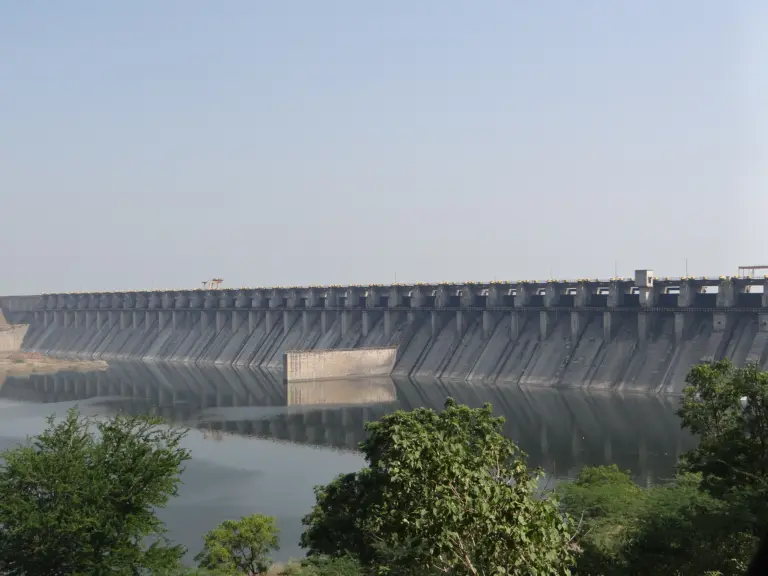
About Ujani Dam:
- It is located on the Bhima River near Ujjani village in Solapur district of the state of Maharashtra.
- It is an earth-fill cum masonry gravity dam.
- It was constructed between 1977 and 1980 with the primary objective of providing irrigation water and hydroelectric power to the region.
- With a total length of 2,534 m, the Ujani Dam is founded on massive basaltic rock formations and comprises a central portion, which is the spillway dam of 602m in length.
- The dam has a height of 63 meters.
- With a storage capacity of 117 thousand million cubic feet (TMC), the dam has a live storage of 54 TMC, and 63 TMC is dead storage.
- Power Generation Capacity: 12MW
- Pollution: The water quality of the Ujani Dam is very bad as it contains hazardous pollutants from Pune and many other small cities located on the banks of the Bhima River or its tributaries.
Key Facts about Bhima River:
- The Bhima River (also known as the Chandrabagha River) is a major river in southwest India.
- It is a major tributaryof the Krishna River.
- Course:
- It originates in the Bhimashankar hills near Karjat on the western side of the Western Ghats, in the Pune District of Maharashtra.
- Bhima flows southeast through the states of Maharashtra, Karnataka, and Telangana.
- It merges into the Krishna River at Kadlur (Raichur) in Karnataka.
- This 861 km-long river has the Western Ghats on the west, the Balaghat Range in the north, and the Mahadeo Hills in the south.
- The total basin area of the river is 48,631 sq. km, out of which 75 percent lie in thestate of Maharashtra.
- Major tributaries are the Sina and Nira rivers.
- Pandharpur is an important pilgrimage centre located on the right bank of the Bhima River.
Q1: What is a gravity dam?
A gravity dam is a type of dam structure that is primarily designed to resist the force of gravity and hold back water or other materials. It relies on its own weight and mass to counteract the horizontal pressure exerted by the water or other materials it is retaining. Gravity dams are among the oldest and most common types of dams used for various purposes, including water supply, irrigation, flood control, and hydroelectric power generation.
Source: 6 Drown As Boat Capsizes In Dam Backwaters In Pune






 Last updated on March, 2026
→ UPSC Final Result 2025 is now out.
→ UPSC has released UPSC Toppers List 2025 with the Civil Services final result on its official website.
→ Anuj Agnihotri secured AIR 1 in the UPSC Civil Services Examination 2025.
→ UPSC Marksheet 2025 is now out.
→ UPSC Notification 2026 & UPSC IFoS Notification 2026 is now out on the official website at upsconline.nic.in.
→ UPSC Calendar 2026 has been released.
→ Check out the latest UPSC Syllabus 2026 here.
→ UPSC Prelims 2026 will be conducted on 24th May, 2026 & UPSC Mains 2026 will be conducted on 21st August 2026.
→ The UPSC Selection Process is of 3 stages-Prelims, Mains and Interview.
→ Prepare effectively with Vajiram & Ravi’s UPSC Prelims Test Series 2026 featuring full-length mock tests, detailed solutions, and performance analysis.
→ Enroll in Vajiram & Ravi’s UPSC Mains Test Series 2026 for structured answer writing practice, expert evaluation, and exam-oriented feedback.
→ Join Vajiram & Ravi’s Best UPSC Mentorship Program for personalized guidance, strategy planning, and one-to-one support from experienced mentors.
→ Shakti Dubey secures AIR 1 in UPSC CSE Exam 2024.
→ Also check Best UPSC Coaching in India