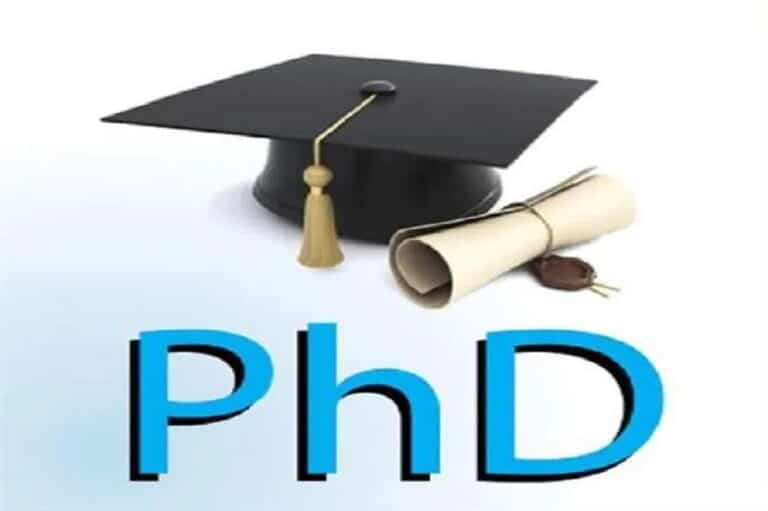
About University Grants Commission’s (UGC) new regulations on PhD degrees:
- Under the new rules, UGC has made a series of significant modifications to the eligibility requirements, admissions process, and evaluation methodologies governing doctoral programmes in colleges and universities.
Highlights:
- Students who have completed a four-year undergraduate course will be eligible for direct admission to a doctorate programme.
- Candidate should have a minimum of 75 per cent marks in “aggregate or its equivalent grade on a point scale wherever the grading system is followed”.
- In case the candidate does not have 75 per cent marks in a four-year undergraduate program, she has to pursue a one-year master’s programme and score at least 55 per cent.
- The new Rules discontinue the Phil programme altogether. However, that will have no bearing on those holding or pursuing M.Phil degrees currently.
- Universities and colleges will be free to admit students through the NET (National Eligibility Test)/JRF (Junior Research Fellowship) qualification route as well as entrance exams at the level of the institutions.
- If an individual institution can holds its own entrance tests to admit students, then the candidates need not write the NET or similar exams. The “entrance test shall consist of 50 per cent research methodology and 50 per cent subject specific”.
- Where the selection is done by entrance tests conducted by individual universities, a weightage of 70 per cent will be given to performance in the written test, and 30 per cent to the interview.
- UGC has introduced a new requirement for PhD scholars, irrespective of discipline, to train in teaching / education/ pedagogy/ writing related to their chosen subject during their doctoral period. They may also be assigned four to six hours per week of teaching/ research assistantship for conducting tutorial or laboratory work and evaluations.
- It is no longer required to publish research articles in peer-reviewed publications or present in conferences.
- Working professionals can now enrol in part-time PhD programmes. The institute will require a “No Objection Certificate (NOC)” from the appropriate authority in the organisation where the candidate is employed. The NOC should clearly mention that she is permitted to pursue studies on a part-time basis.
Source : Indian Express







 Last updated on April, 2026
→ UPSC Final Result 2025 is now out.
→ UPSC has released UPSC Toppers List 2025 with the Civil Services final result on its official website.
→ Anuj Agnihotri secured AIR 1 in the UPSC Civil Services Examination 2025.
→ UPSC Marksheet 2025 is now out.
→ UPSC Notification 2026 & UPSC IFoS Notification 2026 is now out on the official website at upsconline.nic.in.
→ UPSC Calendar 2026 has been released.
→ Check out the latest UPSC Syllabus 2026 here.
→ UPSC Prelims 2026 will be conducted on 24th May, 2026 & UPSC Mains 2026 will be conducted on 21st August 2026.
→ The UPSC Selection Process is of 3 stages-Prelims, Mains and Interview.
→ Prepare effectively with Vajiram & Ravi’s UPSC Prelims Test Series 2026 featuring full-length mock tests, detailed solutions, and performance analysis.
→ Enroll in Vajiram & Ravi’s UPSC Mains Test Series 2026 for structured answer writing practice, expert evaluation, and exam-oriented feedback.
→ Join Vajiram & Ravi’s Best UPSC Mentorship Program for personalized guidance, strategy planning, and one-to-one support from experienced mentors.
→ Shakti Dubey secures AIR 1 in UPSC CSE Exam 2024.
→ Also check Best UPSC Coaching in India