Government vs Social Media Platforms on Safe Harbour Doctrine

Safe Harbour Doctrine

Safe Harbour Doctrine Latest News

  • The Centre defended before the Karnataka High Court its expanded use of Section 79 of the Information Technology (IT) Act (which provides for safe harbour doctrine) and the Sahyog Portal to regulate and remove online content by intermediaries such as social media platforms. 
  • The case stems from a legal challenge filed by social media platform X (formerly Twitter) against alleged government overreach in content takedown mechanisms.

Legal Framework and the Challenge

  • Section 79 vs Section 69A of the IT Act:
    • Section 79: Provides “safe harbour” to intermediaries protecting them from liability for third-party content, but this is withdrawn if intermediaries do not comply with takedown notices.
    • Section 69A: Grants power to block content only on specific grounds (e.g. national security, public order), backed by procedural safeguards under the IT (Procedure and Safeguards for Blocking Access of Information by Public) Rules, 2009.
  • X’s argument: The government is misusing Section 79 to issue blocking orders which are only permitted under Section 69A; Sahyog Portal is termed a “censorship portal.”

The Sahyog Portal and Government’s Justification

  • Purpose and scope of Sahyog Portal:
    • Developed under I4C (Indian Cyber Crime Coordination Centre) of the Union Home Ministry.
    • As of March 2025, 38 intermediaries including Google, Amazon, Apple, Telegram, YouTube onboarded; Meta enabled API access.
    • X has refused onboarding, citing legal overreach.
  • Government's stand:
    • Algorithmic content curation is distinct from traditional editorial control, hence needs new regulation.
    • Algorithms amplify harmful content rapidly without oversight, unlike editors in newspapers or TV.
    • Anonymity and pseudonymity on platforms increase incitement risks and shield accountability.
    • Thus, a wider net under Section 79 is essential to tackle a broad class of ‘unlawful content’ beyond what is specified in Section 69A.

Algorithmic Curation vs Traditional Media

  • Key government arguments:
    • Algorithms automatically boost certain content to a wider audience—this lacks any editorial discretion.
    • No transparency or accountability in algorithmic decision-making.
    • Traditional media had built-in gatekeeping functions, ensuring a certain quality control.

Constitutional Perspective and Societal Impact

  • Free speech vs reasonable restrictions:
    • Section 69A deals only with content that falls under Article 19(2) i.e., reasonable restrictions to free speech.
    • The government argues that Section 79 enables actions beyond this scope to address all unlawful content under any law.
    • Emphasis placed on balancing freedom of expression with the right of society and state to prevent harm, maintain public order, and ensure national security.

Conclusion

  • The Centre is asserting its regulatory authority over digital intermediaries through an expanded interpretation of Section 79, citing the unique risks of algorithmic amplification and anonymity. 
  • The case is a significant legal milestone in defining the contours of safe harbour doctrine, online free speech, platform responsibility, and the role of the State in digital governance.

Source: IE

Safe Harbour Doctrine FAQs

Q1: How does the government distinguish algorithmic curation by social media from traditional editorial processes?

Ans: The government argues that algorithmic curation operates at a massive scale without human discretion or transparency, unlike traditional media editors.

Q2: What are the constitutional and legal tensions between Section 69A and Section 79 of the IT Act?

Ans: While Section 69A authorizes content blocking, use of Section 79 via the Sahyog Portal expands takedown powers to broader categories of unlawful content.

Q3: What are the key concerns raised by social media platform X against the Sahyog Portal?

Ans: X challenges the legality of using Section 79 to issue takedown orders through the Sahyog Portal, contending that such actions undermine safe harbour protections.

Q4: How anonymity and algorithmic amplification on digital platforms pose new governance challenges?

Ans: These facilitate the spread of extreme or false content without accountability, necessitating proactive state intervention to uphold public order and national security.

Q5: To what extent can the restriction of online content under Section 79 be justified?

Ans: The government contends that takedown actions under Section 79 are constitutionally valid under the doctrine of reasonable restrictions in Article 19(2).


Swachh Survekshan 2024-25 – Ahmedabad Tops as India’s Cleanest City

Swachh Survekshan 2024-25

Swachh Survekshan 2024-25 Latest News

  • In a landmark shift in India's cleanliness rankings, Ahmedabad has been declared the cleanest city in the country under the Swachh Survekshan 2024-25, the annual sanitation survey conducted by the Ministry of Housing and Urban Affairs (MoHUA). 
  • This is the first time Ahmedabad has secured the top spot, as the consistent chart-topper Indore transitions into a newly created ‘Swachh Bharat Super League 1.0’, recognising its sustained excellence in urban sanitation.

About Swachh Survekshan

  • Launched in 2016 under the Swachh Bharat Mission-Urban (SBM-U), Swachh Survekshan is the world’s largest urban sanitation survey. It evaluates cities on multiple parameters, including:
    • Citizen feedback
    • Waste segregation and processing
    • Open defecation-free (ODF) status
    • Cleanliness in public areas
    • Municipal innovation and digital monitoring
  • The 2024-25 edition of the survey covered over 4,500 Urban Local Bodies (ULBs), with over 12 crore citizen responses, making it one of the most participatory surveys of its kind globally.

Key Rankings and New Categories Introduced

  • Top Cleanest Cities (Population >1 lakh)
    • Ahmedabad (Gujarat)
    • Bhopal (Madhya Pradesh)
    • Surat (Gujarat)
    • Indore, which has topped the charts for six consecutive years, has now been elevated to the Swachh Bharat Super League 1.0 category, introduced to reward cities that have maintained exemplary standards for an extended period.
  • Cleanest Ganga Towns
    • Varanasi (Uttar Pradesh) - Retained its position as the cleanest Ganga town for the fourth consecutive year
    • Prayagraj and Bijnor also featured among the top three
  • Cleanest Cities (Population <1 lakh)
    • Sasvad (Maharashtra) - Cleanest among cities with under 1 lakh population
    • Lonavala and Vita followed closely
  • Best Performing States
    • Maharashtra ranked as the best-performing state overall
    • Madhya Pradesh and Chhattisgarh followed as second and third respectively

Gujarat’s Remarkable Performance

  • Gujarat’s cities made an impressive mark in the survey, with Ahmedabad, Surat, and Rajkot ranking in the top 10 cleanest cities. The consistent investment in waste processing, mechanised road sweeping, and citizen engagement platforms has paid off.
  • Ahmedabad Municipal Corporation has focused on:
    • Scientific processing of nearly 100% of its solid waste
    • Door-to-door waste collection across all wards
    • Citizen apps for cleanliness reporting and grievance redressal
    • These efforts contributed significantly to its ascent to the top rank this year.

Innovations in Survey 2024-25

  • The Swachh Survekshan 2024-25 introduced some key innovations:
    • AI-Based Tools for validation of cleanliness parameters
    • Swachhta League for Youth engagement
    • Special Emphasis on legacy waste management and city beautification
    • Star Rating for Garbage Free Cities (GFC) updated alongside Survekshan rankings
  • The assessment also used real-time data from Integrated Command and Control Centres (ICCCs) to monitor sanitation activities in urban areas.

Recognition Beyond Rankings

  • In addition to city and state rankings, special recognitions were awarded:
    • Cleanest Cantonment Board: Mhow (Madhya Pradesh)
    • Best Citizen Feedback Response: Chandigarh
    • Best Innovation in Sanitation: Navi Mumbai for circular economy initiatives
    • Cleanest State Capital: Bhopal

Implications for Urban Governance

  • Swachh Survekshan has emerged not only as a cleanliness ranking tool but also as a key driver for competitive federalism, inspiring states and cities to enhance urban governance.
  • The annual exercise has helped:
    • Institutionalise waste segregation and recycling
    • Improve behavioural change communication
    • Foster innovation and public-private partnerships in sanitation
  • It has also catalysed job creation in the waste management sector and promoted entrepreneurship in circular economy ventures.

Source: IE | PIB

Swachh Survekshan 2024-25 FAQs

Q1: Which city was declared the cleanest in India under Swachh Survekshan 2024-25?

Ans: Ahmedabad was declared the cleanest city in India in the 2024-25 edition.

Q2: What is the Swachh Bharat Super League 1.0?

Ans: It is a new category introduced to honour cities like Indore that have consistently maintained top cleanliness rankings.

Q3: Which state ranked highest in overall cleanliness performance?

Ans: Maharashtra ranked as the best-performing state in Swachh Survekshan 2024-25.

Q4: Which city retained the title of cleanest Ganga town?

Ans: Varanasi retained its position as the cleanest Ganga town for the fourth year in a row.

Q5: What are the key focus areas in Swachh Survekshan 2024-25?

Ans: The survey focused on waste processing, citizen feedback, digital monitoring, legacy waste management, and innovation in sanitation.

Scientists Detect Record-Breaking Black Hole Merger Through Gravitational Waves

Black Hole Merger Discovery

Black Hole Merger Discovery Latest News

  • Scientists have detected gravitational waves from the largest black hole merger ever observed. 
  • Such mergers are rare but release immense energy, sending ripples—gravitational waves—across spacetime. These waves, predicted by Einstein’s General Relativity in 1915, are extremely weak and only detectable from major cosmic events like black hole collisions.
  • The latest discovery, given the name GW231123, is exceptional because it involves the biggest black holes to have been observed in any such event.

Why This Black Hole Merger Discovery Is Unique

  • Scientists have detected gravitational waves from the merger of two unusually large black holes—one 140 times and the other 100 times the mass of the Sun—forming a new black hole about 225 times larger than the Sun
    • In general, a black hole is a region in Space where the pulling force of gravity is so strong that neither matter nor light can ever escape.
  • This size range, between 100 and 150 solar masses, defies current scientific theories, which suggest stars that are large typically don’t collapse into black holes. 
    • Stars in this size range are believed to end their lives in powerful explosions, not by collapsing into black holes, according to current scientific theories.
  • Adding to the surprise, one of the black holes was spinning near the maximum speed allowed by Einstein’s General Theory of Relativity. 
  • This discovery not only breaks previous records for black hole mergers but also challenges existing models of black hole formation and the life cycle of massive stars, offering fresh insights into the structure and evolution of the universe.

Gravitational Waves: A New Window to Understand the Universe

  • Before 2015, scientists mainly relied on electromagnetic waves—like light, X-rays, and radio waves—to study the universe. 
  • However, vast portions of the cosmos, especially those involving dark matter and dark energy, remain invisible to these methods. 
  • Black holes are a prime example; their existence was known, but they couldn’t be directly observed. 
  • The discovery of gravitational waves changed this. Generated by massive cosmic events such as black hole mergers, these ripples in spacetime can now be detected on Earth using highly sensitive instruments. 
  • Though all moving objects create gravitational waves, only those from extremely large events are strong enough to reach us. 
  • Gravitational waves offer scientists a new kind of vision, revealing previously hidden aspects of the universe.

LIGO and the Expansion of Gravitational Wave Detection

  • The first-ever detection of gravitational waves in 2015 was achieved by two LIGO observatories in the United States. 
  • Since then, additional detectors like Virgo in Italy and KAGRA in Japan have joined the effort, forming the LVK (LIGO-Virgo-KAGRA) collaboration, which made the latest major discovery. 
  • To strengthen this global network, a third LIGO observatory is planned in India, called LIGO-India. However, the project has faced significant delays. 
    • Originally scheduled to begin operations in 2024, final government approval and a budget of ₹2,600 crore were only secured in 2023. 
  • The Department of Atomic Energy has identified Hingoli district in Maharashtra as the site for the observatory. 

Source: IE | IE | LIGO

Black Hole Merger Discovery FAQs

Q1: Why is the latest black hole merger significant?

Ans: It involves two black holes merging into one 225 times the Sun’s mass, breaking previous records.

Q2: What makes this black hole merger unique?

Ans: The black holes were in a mass range scientists didn’t expect to collapse into black holes under current theories.

Q3: How do gravitational waves help scientists?

Ans: Gravitational waves provide insights into previously invisible cosmic events like black hole mergers, expanding our understanding of the universe.

Q4: What is the LVK collaboration?

Ans: It’s a global network including LIGO, Virgo, and KAGRA observatories, working together to detect gravitational waves worldwide.

Q5: What is the status of LIGO-India?

Ans: LIGO-India has faced delays; construction in Maharashtra is now expected to finish by April 2030 with government support.

India Challenges Double Standards Over Russian Oil Trade Amid US Sanctions Threat

India Russian Oil Trade

India Russian Oil Trade Latest News

  • India firmly dismissed concerns over possible U.S. sanctions on its Russian oil trade. 
  • Petroleum Minister Hardeep Singh Puri emphasized India’s diversified oil imports—from 27 to 40 countries—and said India would handle any challenges. 
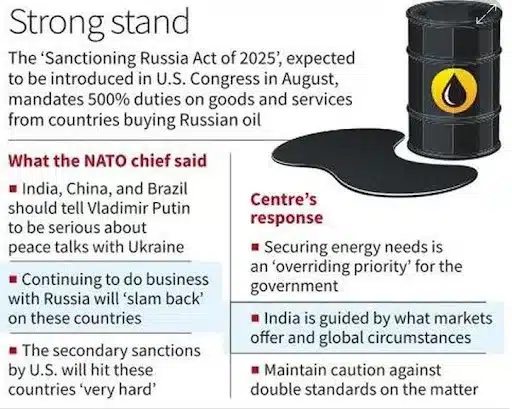
  • On the same day, MEA warned against “double standards,” stressing India’s priority is securing affordable energy for its people based on market availability and global conditions
  • These remarks came after NATO chief Mark Rutte suggested countries buying Russian oil could face U.S. secondary sanctions aimed at pressuring Russia over the Ukraine war.

New US Sanctions Threat Looms Over India’s Russian Oil Trade

  • The United States is signaling tougher measures against countries trading with Russia, directly impacting India. 
  • US President Donald Trump, now taking a firmer stance on Russia, has warned of imposing “secondary sanctions” if Moscow does not end its war in Ukraine within 50 days. 
  • This would mean penalties targeting Russia’s key trading partners like India, China, and Brazil. 
  • NATO chief Mark Rutte also cautioned India, urging Delhi to pressure Russia into peace talks to avoid facing severe economic fallout. 
  • In addition, the US Congress is considering a bill that would impose up to 500% tariffs on buyers of Russian energy
  • These moves reflect growing Western frustration as existing sanctions have not crippled Russia’s economy, largely because of its ongoing trade with countries including India.

Should India Be Concerned About New US Sanctions

  • India’s trade with Russia has grown sharply, reaching a record $68.7 billion in FY 2024–25—almost six times the pre-pandemic figure. 
  • India’s key imports from Russia include crude oil, petroleum products, fertilizers, and coal, with oil purchases rising significantly after Western sanctions on Moscow in 2022. 
    • In May 2025 alone, India imported $4.42 billion worth of crude from Russia. 
  • While this raises concern over potential US sanctions, India maintains it has diversified its oil sources and can shift suppliers if necessary
  • Moreover, there’s skepticism over whether former President Trump would follow through on such harsh measures, especially since India and the US are negotiating a trade deal that sanctions would disrupt
  • Another factor is China—Russia’s largest trade partner—making it uncertain if the US would risk escalating tensions with Beijing again. 
  • Finally, targeting Russian oil buyers could unsettle global energy markets, causing blowback for the US and its allies as well.

Mixed Reactions in the West to Trump’s New Russia Sanctions Plan

  • Trump’s proposed 50-day deadline for Russia to end the Ukraine war and threats of secondary sanctions have drawn a mixed response in the West. 
  • Some welcome his tougher stance, seeing it as a shift from his earlier reluctance to support Ukraine. 
  • However, many worry the deadline could backfire—giving Russia time to seize more Ukrainian territory and strengthen its bargaining power. 
  • Critics also point out that Trump’s proposals lack clear details and timelines. 
  • Meanwhile, his core MAGA (Make America Great Again) supporters feel betrayed, viewing this move as a departure from Trump’s pledge to avoid foreign entanglements.

Source: IE | TH | ToI

India Russian Oil Trade FAQs

Q1: Why is India concerned about new US sanctions?

Ans: US plans secondary sanctions on Russian oil buyers, directly affecting India’s growing trade ties with Russia.

Q2: How large is India’s trade with Russia now?

Ans: India’s trade with Russia reached $68.7 billion in FY 2024–25, nearly six times the pre-pandemic trade volume.

Q3: What is NATO’s position on India’s oil trade?

Ans: NATO chief cautioned India, suggesting sanctions could hit hard if Russia doesn’t end its war within 50 days.

Q4: What are India’s options if sanctioned?

Ans: India claims to have diversified oil sources and can shift suppliers if US sanctions disrupt Russian oil purchases.

Q5: How has the West reacted to Trump’s sanctions plan?

Ans: Reactions are mixed—some welcome tougher Russia stance, others fear it could backfire or contradict MAGA promises.

Enquire Now