EPFO Withdrawals Surge: Frequent Claims Threaten India’s Retirement Security

EPFO Withdrawals

EPFO Withdrawals Latest News

  • The Employees’ Provident Fund Organisation (EPFO) is easing withdrawal rules but introducing a 25% minimum balance requirement to curb excessive withdrawals.
  • Data shows that nearly half of EPFO members have less than ₹20,000 in their accounts at final settlement. 
  • Frequent withdrawals during employment are eroding retirement savings, prompting the EPFO to act to preserve members’ long-term corpus.

Growing Concern Over Small Retirement Corpus

  • The Employees’ Provident Fund Organisation (EPFO) is introducing a 25% minimum balance requirement while liberalising withdrawals.
  • A review of its data shows a worrying trend — nearly half of EPFO members have less than ₹20,000 in their accounts at the time of final settlement.
  • This reflects how frequent withdrawals during employment are eroding long-term retirement savings.

Surge in Withdrawals After Job Loss

  • About 95% of withdrawal claims are made immediately after unemployment, even though nearly half of these members rejoin the EPFO later.
  • This suggests that many employees use the EPF corpus as a short-term financial cushion, undermining its purpose as a retirement fund.

EPFO: Key Trends

  • Low-Income Dominance in EPFO Membership
    • The EPFO’s data highlights the income profile of its members:
      • 65% contribute based on a monthly wage of ₹15,000 or less, the ceiling for mandatory EPF coverage.
      • The remaining 35% contribute voluntarily, earning above ₹15,000 per month.
    • This indicates that the majority of EPFO members belong to the lower-income formal workforce.
    • Overall, the organisation manages 30 crore accounts, with 7 crore active contributors and a corpus exceeding ₹26 lakh crore.
  • Most Members Have Minimal Savings at Exit
    • The shortfall is widespread even at higher thresholds:
      • 75% of members have less than ₹50,000, and
      • 87% have under ₹1 lakh at final settlement.
    • This underscores how premature withdrawals prevent employees from building a meaningful retirement fund.
  • Premature Settlements on the Rise
    • In 2024–25, out of 52.95 lakh final settlement claims, a massive 95% were premature withdrawals, made just two months after unemployment.
    • Of these, 24.21 lakh members (46%) rejoined establishments and resumed EPF contributions later.
    • Such repeated withdrawals and re-entries point to a pattern of financial insecurity and limited social safety nets among formal workers.
  • Partial Withdrawals Surge
    • Since 2017, the EPFO has relaxed withdrawal rules, allowing auto-processed claims and no document proof for advances.
    • This has led to a surge in partial withdrawals, especially for illness, housing, and special circumstances.

Impact on Pension Eligibility and Benefits

  • Most premature withdrawals by members cited unemployment under para 69(2) of the EPF Scheme, 1952, which allows full withdrawal after two months of job loss.
  • Frequent or premature final settlements break EPF membership continuity, harming long-term benefits under the Employees’ Pension Scheme (EPS), 1995.
  • Such breaks lead to:
    • Ineligibility for family pension in case of death.
    • Lower pension payouts at retirement or superannuation.
      • To qualify for pension, a member must complete at least 10 years of pensionable service.

New Withdrawal Norms and Minimum Balance Rule

  • To streamline and discourage excessive withdrawals, EPFO has reduced withdrawal categories from 13 to 3:
    • Essential Needs – illness, education, marriage.
    • Housing Needs.
    • Special Circumstances.
  • Key changes include:
    • Introduction of a 25% minimum balance requirement.
    • Increased withdrawal frequency for education (10 times) and marriage (5 times).
    • Up to 3 illness-related and 2 special-circumstance withdrawals per financial year.

Backlash and Government Clarification

  • The changes drew criticism from opposition leaders and EPF members.
  • They argued that workers were being denied access to their own savings, calling it “a subsidy at the cost of the middle class.”
  • Following the backlash, the Labour Ministry clarified:
    • Members can still withdraw 75% of their corpus immediately after job loss.
    • The remaining 25% must stay as minimum balance, but full withdrawal is allowed after 12 months of unemployment.

EPFO’s Concern: Long-Term Pension Security

  • Officials defend the changes, saying frequent withdrawals hurt members’ pension prospects and undermine retirement security.
  • They emphasised that premature withdrawals reduce future pension benefits, warning that India’s ageing population will depend heavily on their own contributions for financial stability.

Source: IE

EPFO Withdrawals FAQs

Q1: Why is EPFO introducing a 25% minimum balance rule?

Ans: To discourage frequent withdrawals that drain retirement savings and ensure members retain a portion of their corpus for long-term financial security.

Q2: What does EPFO data reveal about member savings?

Ans: Nearly 50% of members have less than ₹20,000 at final settlement, and 87% have under ₹1 lakh, showing inadequate retirement accumulation.

Q3: Why are premature withdrawals increasing?

Ans: About 95% of settlements occur right after unemployment, as workers treat EPF savings as short-term emergency funds rather than retirement assets.

Q4: How do frequent withdrawals affect pension eligibility?

Ans: Repeated withdrawals break EPF continuity, reducing pension amounts and sometimes disqualifying members from family or retirement pensions under the EPS.

Q5: What new changes has EPFO made to withdrawal norms?

Ans: Withdrawal categories have been reduced to three—essential needs, housing, and special circumstances—with a mandatory 25% minimum balance retained.


Government Tightens Online Content Blocking Rules, Adds Senior-Level Oversight

Content Blocking

Content blocking Latest News

  • The Ministry of Electronics and IT is amending its content blocking rules. Under the new rules, only senior officials at the Centre and state levels can issue content removal notices under Section 79(3)(b) of the Information Technology Act, 2000.
  • This aims to ensure greater accountability and prevent misuse of online blocking powers.

New Safeguards for Content Blocking

  • The Ministry of Electronics and IT (MeitY) is amending the Information Technology Rules, 2021 to ensure that only senior officials can issue online content blocking notices under Section 79(3)(b) of the IT Act, 2000.
  • This means that content removal requests sent to platforms like YouTube, Instagram, and X (formerly Twitter) will now be authorised only by:
    • Joint Secretary (JS) or an equivalent officer at the Centre or state level,
    • Director-level officers where no JS exists, and
    • In police departments, Deputy Inspector General (DIG) or above, specifically authorised.
  • Each order must specify:
    • The legal basis and statutory provision,
    • The nature of the unlawful act, and
    • The specific URL or digital location of the content to be removed.
  • Additionally, all such orders will undergo a monthly review by an officer not below the rank of Secretary, such as the IT Secretary (Centre) or Home/IT Secretaries (State).
  • The amendments will come into effect from November 15, and a Template Blocking Order will be provided to central and state agencies for uniformity in issuing lawful takedown notices.

Rule 3(1)(d): The Basis for Safeguards

  • The new rules focus on Rule 3(1)(d) of the Information Technology (Intermediary Guidelines and Digital Media Ethics Code) Rules, 2021, which allows officials to flag specific online content.
  • When a government notice is issued under this rule, social media platforms lose “safe harbour” protections—meaning they may be held legally responsible for user-generated content unless they justify or remove it.
  • Officials clarified that such notices are not direct takedown orders but warnings indicating that safe harbour protections no longer apply to the flagged content.

Reason for the Amendment

    • According to a senior official, in some states, junior police officers such as sub-inspectors and assistant sub-inspectors had been issuing blocking notices to social media companies.
    • The new amendment seeks to prevent misuse of power by restricting this authority to senior officers, thereby ensuring greater accountability and transparency.
  • Experts say that the move would ensure all blocking orders are reasoned, justified, and issued by senior officials.

Background: X’s Legal Challenge

  • Elon Musk’s X (formerly Twitter) had earlier challenged the government’s use of Rule 3(1)(d), calling it unconstitutional and arbitrary, claiming it enabled local police officers to issue “censorship” orders nationwide.
  • However, the Karnataka High Court recently upheld the government’s authority to empower officials under this rule.
  • Officials clarified that the new amendments are not a response to X’s case, though they do address some of its concerns by formally restricting who can issue such orders and mandating detailed justifications.

Section 79(3)(b) vs Section 69A

  • Section 79(3)(b): Allows the government to direct platforms to remove any unlawful content, failing which they can lose safe harbour protection (legal immunity for user-generated content).
  • Section 69A: Permits blocking content only if it affects sovereignty, integrity, defence, or security of India.
  • The new changes bring more clarity, accountability, and uniformity in applying Section 79(3)(b), aiming to balance content regulation with due process.

Source: IE | TH | CNBC

Content Blocking FAQs

Q1: What is the new amendment to content blocking rules?

Ans: Only senior officers—Joint Secretary or DIG and above—can now issue blocking notices to social media platforms under Section 79(3)(b) of the IT Act.

Q2: Why was this amendment needed?

Ans: Junior officers were misusing the law to send content takedown orders. The amendment ensures accountability and transparency through senior-level oversight.

Q3: When will the new rules take effect?

Ans: The amendments will come into effect on November 15, ensuring stricter procedures for lawful and reasoned takedown notices.

Q4: What is the difference between Section 79(3)(b) and Section 69A?

Ans: Section 79(3)(b) covers unlawful content broadly, while Section 69A applies only to content threatening India’s sovereignty, defence, or security.

Q5: Was the change linked to X’s legal challenge?

Ans: No, but the new rules address similar concerns by restricting takedown authority to senior officials and requiring detailed justifications for each notice.

Govt Proposes Mandatory Labelling of AI-Generated Content

AI-Generated Content

AI-Generated Content Latest News

  • The Ministry of Electronics and Information Technology has proposed amendments to the IT Rules, 2021, making it mandatory to label and declare AI-generated content on social media platforms to curb deepfakes and misinformation.

Rise of AI-Generated Content in India

  • India is witnessing a rapid surge in the use of artificial intelligence (AI) for content creation across social media, advertising, and entertainment. 
  • However, this rise has also sparked concerns about synthetic content, especially deepfakes, which use AI to fabricate hyper-realistic images, audio, and videos. 
  • These manipulations blur the line between reality and fiction, often being used for political propaganda, financial fraud, and reputational damage.
  • Deepfakes gained national attention in 2023, after a digitally altered video of an actor went viral, prompting widespread outrage and a strong government response. 
  • Prime Minister Narendra Modi termed deepfakes a new “crisis,” emphasising the need for regulatory intervention.

News Summary

  • The draft amendment to the IT Rules, 2021, seeks to make it mandatory for creators and platforms to declare and label AI-generated content, including text, audio, video, and images, uploaded to the internet. 
  • The proposal aims to enhance transparency, protect users from misinformation, and safeguard democratic discourse in the digital space.

Key Provisions of the Proposed Rules

  • Mandatory Self-Declaration by Creators:
    • Users uploading content on social media platforms like YouTube, Instagram, and X (formerly Twitter) must declare whether their content is synthetically generated.
  • Dual Labelling Mechanism:
    • Platforms must ensure that AI-generated content carries two visible markers:
    • An embedded label or watermark within the content itself, covering at least 10% of the visual or audio duration.
    • A platform-level label displayed wherever the content appears online.
  • Platform Accountability:
    • If users fail to make such declarations, social media companies will be responsible for proactively detecting and labelling AI-generated content using technical measures and automated tools.
  • Definition of Synthetic Content:
    • The draft defines synthetically generated information as “information artificially or algorithmically created, generated, modified, or altered using a computer resource in a manner that appears reasonably authentic or true.”
  • Consequences of Non-Compliance:
    • Platforms that fail to verify and label synthetic content may lose their legal immunity under Section 79 of the IT Act, which currently shields intermediaries from liability for third-party content.
  • Metadata and Identifier Requirement:
    • AI-generated material must be embedded with a unique metadata identifier that remains permanent and traceable, ensuring accountability in case of misuse.
  • Scope of Application:
    • The draft applies not only to popular social platforms but also to AI content creation tools such as OpenAI’s Sora and Google’s Gemini, which must implement built-in watermarking and labelling systems.

Rationale Behind the Proposal

  • According to IT Minister Ashwini Vaishnaw, the move addresses growing public concern about the misuse of synthetic content for manipulation. He stated:
    • “People are using prominent personalities’ images and creating deepfakes that affect personal lives and cause social misconceptions. In a democracy, users should know what is real and what is synthetic.”
  • The ministry’s explanatory note underlines that generative AI has the potential to create convincing falsehoods, leading to reputational harm, election interference, and financial fraud. 
  • By mandating clear disclosure, the government seeks to empower users to make informed judgments about the authenticity of content.
  • This marks a significant shift in India’s digital governance approach. Earlier, the government relied on general impersonation and fraud provisions under the Information Technology Act, 2000, but the increasing sophistication of AI tools has necessitated specific regulatory safeguards.

International Context and Comparative Framework

  • India’s move aligns with global trends in AI regulation.
    • China introduced similar AI labelling laws in 2025, requiring clear visual tags and hidden watermarks on AI-generated media, including chatbots and synthetic videos.
    • The European Union’s AI Act mandates transparency in AI interactions, requiring users to be notified when engaging with AI-generated content.
    • The United States is developing federal guidelines for content authenticity, while tech firms such as Meta, Google, and OpenAI have pledged voluntary watermarking standards.
  • India’s draft rules, therefore, position it among the early adopters of a legally binding framework to combat misinformation in the age of generative AI.

Implementation Challenges and Future Outlook

  • While the proposal has received broad support, experts caution about implementation complexity. Identifying AI-generated content in real-time, especially across diverse formats and languages, requires advanced detection infrastructure.
  • Moreover, the challenge of balancing regulation with innovation remains. Excessive compliance burdens could deter small creators and startups in India’s fast-growing AI ecosystem, valued at over $12 billion by 2030.
  • To address this, the government has invited public and industry feedback on the draft until November 6, 2025, signalling its intent to refine the framework before final notification.
  • If executed effectively, the labelling rule could become a global model for responsible AI governance, ensuring that technological progress does not come at the cost of truth and public trust.

Source: TH | IE

AI-Generated Content FAQs

Q1: What do the new IT draft rules propose for AI-generated content?

Ans: The draft mandates labelling and disclosure of AI-generated content on all digital platforms.

Q2: Who will be responsible for labelling AI-generated content?

Ans: Both content creators and social media platforms must ensure accurate disclosure and labelling.

Q3: What happens if a platform fails to comply with these rules?

Ans: Non-compliant platforms risk losing their legal immunity under Section 79 of the IT Act.

Q4: Why has the government proposed these amendments?

Ans: To counter misinformation, deepfakes, and manipulation caused by synthetic media.

Q5: How do these rules compare globally?

Ans: India’s proposal is in line with similar AI-labelling initiatives by China, the EU, and the U.S.

16th BRICS Summit 2024 in Kazan: Key Insights and Significance

16th BRICS Summit 2024 in Kazan: Key Insights and Significance

What’s in today’s article?

  • Why in News?
  • What is BRICS?
  • Role of BRICS: An Analysis
  • 16th BRICS Summit
  • Significance of Kazan in Russia

Why in News?

Prime Minister Narendra Modi is currently in Russia for the 16th BRICS Summit, along with Chinese President Xi Jinping and South African President Cyril Ramaphosa. The summit is hosted by Russian President Vladimir Putin in the city of Kazan.

What is BRICS?

  • BRICS, in its earlier format, brought together 5 major emerging economies – Brazil, Russia, India, China and South Africa.
    • In 2023, during the 15th BRICS Summit, held in South Africa, six countries were invited to join the alliance.
    • These were - Iran, the United Arab Emirates, Saudi Arabia, Argentina, Egypt, and Ethiopia.
  • Before, expanding in 2023, BRICS as a platform represents 42% of the world population, 30% of the world’s territory, 23% of global GDP, and around 18% of world trade.
  • The aim of the alliance is to challenge the economic and political monopoly of the West. 
    • The group sets priorities and has discussions once every year during the BRICS summit, which members take turns hosting.

Role of BRICS: An Analysis

  • Successes/achievements
    • Economic Cooperation and Trade
      • BRICS has encouraged greater trade and investment among member countries. 
      • There has been a rise in intra-BRICS trade, contributing to stronger economic links.
      • The group has emphasized reducing dependency on Western financial systems and enhancing their own economic resilience, with a focus on creating more inclusive growth models.
    • New Development Bank (NDB)
      • A major milestone for BRICS is the establishment of the New Development Bank (NDB) in 2014, with a capital of $100 billion. 
      • The bank provides funding for infrastructure and sustainable development projects within BRICS and other developing nations.
      • The NDB has successfully financed numerous projects in member countries, including investments in renewable energy, urban development, and social infrastructure.
    • Contingent Reserve Arrangement (CRA)
      • BRICS established a CRA with a $100 billion reserve pool to provide financial support to members facing short-term liquidity pressures.
      • The CRA aims to provide a safety net and safeguard member economies from external economic shocks.
    • Political Influence and Multilateral Engagement
      • BRICS has become an influential political bloc, advocating for a more multipolar world order and greater representation of developing countries in global institutions like the United Nations, International Monetary Fund (IMF), and World Bank.
    • Technical Cooperation
      • BRICS has established mechanisms for cooperation in technology, science, and innovation. 
      • Initiatives like the BRICS Science, Technology, and Innovation Framework Programme aim to enhance collaboration in research, innovation, and technical fields.
      • There have been joint efforts in health, agriculture, and disaster management, showcasing the group's commitment to addressing global challenges.
  • Challenges Faced by BRICS
    • Economic Disparities Among Members
      • The BRICS nations are economically diverse, with varying development levels, economic structures, and political systems. 
      • This disparity sometimes hinders consensus on key issues, as the priorities and interests of each member can differ significantly.
    • Geopolitical Rivalries
      • Geopolitical tensions, especially between China and India, have sometimes strained intra-BRICS relationships, impacting the group's cohesion. 
      • Territorial disputes and regional interests can influence the decision-making process.
    • Relationship with Western Powers
    • Relationship of BRICS with Western powers is complex, as BRICS countries often have differing strategies regarding the West.
    • Both China and Russia are now viewing the West with a lot more suspicion than before. This is due to Russia - Ukraine War and frequent roadblocks in US-China ties.
    • India, meanwhile, has been deepening its relations in spheres of economy and technology with the US.
    • Slow Progress on Institutional Reforms
      • Despite advocating for a more democratic and multipolar global order, progress on reforming global institutions like the IMF and UN has been slow. 
      • The group's influence is often limited by entrenched global power structures.
    • China’s Economic Dominance
      • China, as the largest economy within BRICS, often has a dominant influence on the group's economic agenda. 
      • This can create an imbalance and generate concerns among other member states about Beijing's increasing sway in the bloc's decision-making.

16th BRICS Summit

  • Host – Russia (16th BRICS summit is being held in Kazan, one of Russia's largest and wealthiest cities).
  • Agenda
    • The central theme uniting BRICS members is their disillusionment with Western-led global governance, particularly in the economic sphere. 
    • This sentiment has intensified following the sanctions on Russia after its 2022 invasion of Ukraine, which raised concerns among Global South nations about the West potentially using global financial tools as weapons. 
    • In response, BRICS aims to reduce reliance on the US dollar and the SWIFT financial system, from which Russian banks were excluded in 2022. 
      • In 2023, Brazil's President Lula proposed a trading currency for BRICS, though experts expressed doubts about its feasibility. 
      • Instead, the focus is shifting to using national currencies for bilateral trade, reducing exposure to currency fluctuations and dependence on the dollar.
      • Additionally, China has developed a limited alternative to SWIFT, while countries like Turkey and Brazil are increasing their gold reserves. 
      • Currency swaps for energy deals are also gaining popularity, all reflecting a desire for greater financial autonomy from the West.

Significance of Kazan in Russia

  • Kazan: Russia’s Emerging Third Capital
    • Known for its strong petrochemicals, military industry, and rapidly expanding IT sector, Kazan was branded Russia's third capital in 2009. 
    • This designation highlights its status as a cultural and economic hub alongside Moscow and St Petersburg.
  • Kazan’s Significance in Russia’s Demographic Changes
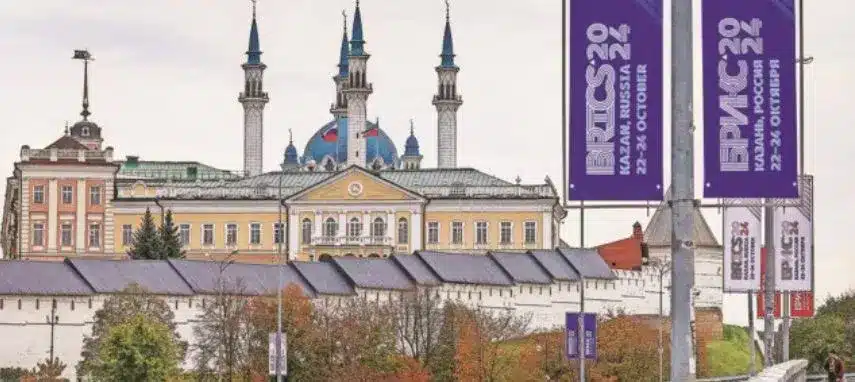
    • Kazan, located 900 km east of Moscow at the confluence of the Volga and Kazanka rivers, is the capital of the Republic of Tatarstan. 
    • The city’s population is almost evenly split between ethnic Russians (48.6%) and Tatars (47.6%), a predominantly Muslim Turkic ethnic group. 
    • This demographic balance makes Kazan a symbol of Russia's evolving identity as a multi-ethnic and multi-religious nation.
  • Cultural Symbols in Kazan
    • Kazan’s diversity is visible in its city kremlin, a fortified complex housing the Orthodox Annunciation Cathedral alongside the Kul Sharif Mosque, one of Europe's largest. 
    • The mosque, initially destroyed by Ivan the Terrible in the 16th century, was reconstructed in 2005 with assistance from Saudi Arabia and the UAE.

Q.1. What are the main achievements of BRICS in recent years?

BRICS has made significant strides in economic cooperation, establishing the New Development Bank, and launching the Contingent Reserve Arrangement for financial stability. It also plays a pivotal role in promoting a multipolar global order and advocating for the inclusion of developing countries in global institutions.

Q.2. Why was Kazan chosen as the host city for the 16th BRICS Summit?

Kazan was selected for its emerging status as Russia's third capital, symbolizing the country’s cultural diversity. Its mix of ethnic Russians and Tatars, along with significant investments in modernization, made it an ideal representation of Russia's evolving national identity.

News: Hosting the BRICS summit: Why Kazan in Tatarstan matters in Putin’s Russia | Aljazeera | Indian Express

Enquire Now