SC Safeguards Lawyer-Client Privilege

Lawyer-Client Privilege

Lawyer-Client Privilege Latest News

  • The Supreme Court of India has reinforced the lawyer-client confidentiality privilege under Section 132 of the Bharatiya Sakshya Adhiniyam (BSA), 2023.
  • The apex court issued directions to prevent investigating agencies from summoning advocates representing accused persons—except under specific legal exceptions. 
  • This judgment upholds constitutional protections against self-incrimination and ensures that professional confidence between advocates and clients remains sacrosanct.

Background and Case Origin

  • The case stemmed from an appeal against a Gujarat High Court order which refused to quash a police summons to a lawyer in a loan dispute.
  • The issue gained prominence after the Enforcement Directorate (ED) summoned senior advocates in cases involving their clients, prompting a suo motu intervention by the Supreme Court.
  • The ED later withdrew its notices, but the Court chose to address the recurring problem of investigating agencies summoning advocates.

Key Judicial Observations

  • Upholding the advocate-client privilege:
    • The Court emphasized that the facts or circumstances of a crime or the content of an FIR cannot be sought from an advocate representing an accused.
    • Such attempts reflect the failure of the investigating agency to independently gather evidence.
    • Section 132 of BSA mirrors constitutional protection under Article 20(3) — protection against self-incrimination.
  • Role of the investigating agencies:
    • The onus lies on investigators to find independent evidence of guilt.
    • Summoning lawyers to disclose client information violates professional confidence and infringes fundamental rights.
  • Judicial criticism of the High Court:
    • The Gujarat High Court’s refusal to quash the summons was termed “flawed and erroneous”, amounting to abdication of inherent powers.
    • The SC cautioned “gallant investigating officers” against impulsive transgressions into privileged communication.

Statutory References and Legal Basis

  • Section 132, BSA 2023: Protects professional communication between advocate and client; privilege belongs to the client.
  • Sections 175 and 179, Bharatiya Nagarik Suraksha Sanhita (BNSS) 2023: Do not empower authorities to compel disclosure of privileged lawyer-client communication.
  • Section 94, BNSS 2023: Governs production of digital devices—must be produced before the jurisdictional court.
  • Section 528, BNSS 2023: Allows judicial review of summons issued to advocates.
  • Section 134, BSA 2023: Protects communications to legal advisors (applicable to in-house counsels).

Supreme Court’s Key Directions

  • Protection from summons: Investigating Officers or SHOs cannot summon advocates representing accused persons to obtain case details, except under valid exceptions of Section 132.
  • Conditions for valid summons: Any summons must -
    • Explicitly state the exception invoked under Section 132.
    • Receive written consent and satisfaction of a superior officer (SP rank or above).
    • Be subject to judicial review under Section 528 of BNSS.
  • Digital device protocol: If a digital device is required - 
    • It must be produced before the jurisdictional court.
    • The court must hear the advocate and client, protecting data of other clients.
    • Examination shall occur in the presence of the advocate, client, and technical expert.
  • Scope of privilege:
    • The privilege extends to advocates engaged in litigation or non-litigious matters.
    • In-house counsels are not covered under Section 132 but protected under Section 134 for employer-legal advisor communications.
    • Documents in the possession of an advocate are not privileged unless they contain confidential communications.

Significance of Judgment

  • Reinforcement of constitutional morality:
    • Strengthens Article 20(3) protections against self-incrimination.
    • Upholds Rule of Law and due process in criminal investigation.
  • Recognition of the advocate’s role: 
    • The judgment highlights the “sublime and profound role” of advocates in defending individual liberty and maintaining justice.
    • Reaffirms the sanctity of the legal profession as an essential component of democracy.

Way Forward

  • Training for investigating officers: Regular sensitization on legal privileges and constitutional limits to ensure lawful investigation.
  • Codified SOPs for digital evidence: Clear guidelines for obtaining and handling lawyers’ digital devices to prevent privacy breaches.
  • Judicial oversight mechanisms: Strengthening pre-approval processes for issuing summons under exceptions to maintain accountability.
  • Protection for legal professionals: Bar Councils and legal associations should monitor misuse of summons and intervene proactively.

Conclusion

  • The Supreme Court’s verdict in this case marks a significant reaffirmation of the lawyer-client privilege as a cornerstone of India’s criminal justice system
  • By insulating advocates from undue pressure and illegal summons, the Court safeguards both professional ethics and the constitutional rights of accused persons. 
  • The decision not only reinforces faith in the rule of law but also sets a precedent ensuring that investigations respect the dignity and independence of the legal profession.

Source: IE

Lawyer-Client Privilege FAQs

Q1: How does Section 132 of the BSA, 2023, reinforce the constitutional protection against self-incrimination under Article 20(3)?

Ans: Section 132 protects confidential communications between advocate and client, ensuring that no lawyer is compelled to disclose privileged information.

Q2: What is the significance of the SC’s recent judgment in preventing the misuse of investigative powers against advocates?

Ans: The judgment curbs arbitrary summons to lawyers by enforcing procedural checks, protecting legal privilege, preserving the independence of the legal profession.

Q3: What are the implications of the SC’s directions on digital evidence handling by advocates under the BNSS, 2023?

Ans: The Court mandated that digital devices of advocates must be produced before courts, not police, ensuring judicial oversight and clients’ confidentiality.

Q4: Why did the SC find the Gujarat HC’s stance “flawed and erroneous” in refusing to quash the police summons to a lawyer?

Ans: Because the HC failed to uphold the rule against non-disclosure and neglected its inherent powers to protect the lawyer-client privilege under Section 132 of BSA.

Q5: In what ways does the SC judgment strengthen the role of advocates as a pillar of justice and civil liberty in India?

Ans: By reaffirming lawyer-client privilege, the Court upheld their essential role in defending individual rights and ensuring fair trial standards.

India Signs 10-Year Defence Framework with the U.S.

Defence Framework

Defence Framework Latest News

  • India and the United States have entered a new phase in their strategic and defence partnership with the signing of a 10-year “Framework for the India-U.S. Major Defence Partnership”.
  • The agreement was formalised on the sidelines of the 12th ASEAN Defence Ministers’ Meeting-Plus (ADMM-Plus) in Kuala Lumpur.

Background of India-U.S. Defence Cooperation

  • Defence cooperation between India and the U.S. has been one of the strongest pillars of their bilateral relationship, evolving steadily over the past two decades. 
  • The partnership began taking concrete shape with the 2005 Defence Framework Agreement, renewed in 2015, which emphasised joint military exercises, maritime security, and defence trade.
  • Since then, both countries have established foundational agreements to enhance interoperability and information sharing:
    • LEMOA (2016): Enabled reciprocal access to military facilities for logistics support.
    • COMCASA (2018): Facilitated secure communications between the two militaries.
    • BECA (2020): Enabled the exchange of geospatial intelligence and mapping data.
    • SOSA (2024): Ensured the security of supply chains in critical defence materials.
  • The signing of the 2025 Framework extends this cooperation into the next decade, institutionalising long-term collaboration in defence manufacturing, joint technology development, and strategic coordination in the Indo-Pacific.

Highlights of the 10-Year Defence Framework

  • The newly signed framework outlines an ambitious roadmap for comprehensive defence collaboration between India and the United States. Key highlights include:
    • Unified Policy Direction: The framework provides a structured policy roadmap to enhance collaboration across military, industrial, and technological domains.
    • Technology and Industrial Cooperation: Both sides have agreed to expand cooperation in co-production and co-development of advanced defence systems, with an emphasis on indigenous manufacturing in India under the “Make in India, Make for the World” initiative.
    • Information and Intelligence Sharing: Strengthening intelligence exchange and coordination mechanisms to counter emerging security threats, including cyber and maritime challenges.
    • Joint Military Exercises: Continuation and expansion of regular bilateral and multilateral exercises such as Yudh Abhyas, Malabar, and Tiger Triumph.
    • Regional Security Commitment: Reinforcing a joint vision for a free, open, and rules-based Indo-Pacific, with deterrence against coercive activities in the region.

Significance of the Defence Partnership

  • The new defence framework comes at a crucial juncture in global geopolitics. 
  • The Indo-Pacific has become the epicentre of strategic competition, with China’s assertive posturing and growing influence prompting deeper security cooperation among like-minded nations. The framework thus serves multiple strategic purposes:
    • Enhancing Regional Stability: Reinforces India’s position as a net security provider in the Indo-Pacific.
    • Boosting Defence Technology Transfer: Encourages U.S. firms to invest and collaborate in India’s defence production ecosystem, particularly under the Initiative on Critical and Emerging Technology (iCET).
    • Mitigating Supply Chain Risks: Reduces dependence on singular sources of defence imports by diversifying technology and production partnerships.
    • Countering Trade Tensions: Despite Washington’s imposition of 50% tariffs on Indian goods, both countries have demonstrated that strategic and defence cooperation remain insulated from trade-related friction.

The Indo-Pacific and Strategic Convergence

  • The 10-year defence roadmap aligns closely with the shared vision of maintaining peace, freedom of navigation, and sovereignty in the Indo-Pacific region
  • Both nations, along with partners in the Quad (India, U.S., Japan, and Australia), aim to ensure that the region remains free from coercive dominance.
  • By integrating India more deeply into global defence supply chains and security dialogues, the framework enhances New Delhi’s strategic leverage while contributing to the U.S. vision of integrated deterrence in Asia.

Source: TH | IE

Defence Framework FAQs

Q1: What is the new India-U.S. Defence Framework about?

Ans: It is a 10-year roadmap to enhance cooperation in defence technology, joint production, and strategic coordination between India and the U.S.

Q2: Where was the 10-year Defence Framework signed?

Ans: The agreement was signed in Kuala Lumpur during the 12th ASEAN Defence Ministers’ Meeting-Plus (ADMM-Plus).

Q3: What are the key focus areas of the framework?

Ans: The framework focuses on co-production, information sharing, joint exercises, and ensuring a free and open Indo-Pacific.

Q4: How does the framework impact India’s defence industry?

Ans: It will promote technology transfer and boost indigenous manufacturing under India’s “Make in India” initiative.

Q5: How does this framework strengthen the Indo-Pacific strategy?

Ans: It reinforces collaboration for regional stability and counters coercive actions in the Indo-Pacific through joint deterrence mechanisms.

MGNREGS in West Bengal: Why It Was Halted and How It Could Restart

MGNREGS

MGNREGS Latest News

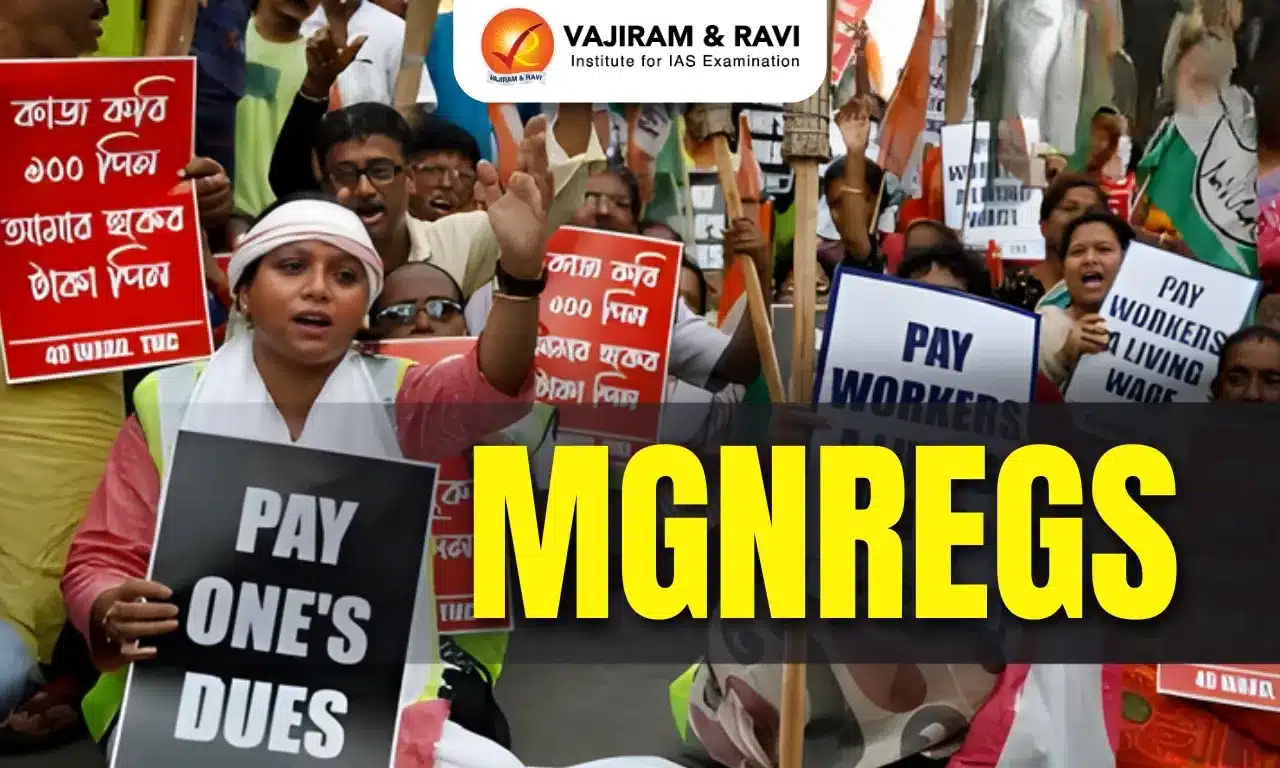
  • The Supreme Court has allowed the resumption of the Mahatma Gandhi National Rural Employment Guarantee Scheme (MGNREGS) in West Bengal after a suspension of three and a half years.
  • Under the MGNREGA Act, 2005, rural adults willing to do unskilled manual work are legally entitled to 100 days of wage employment annually, with funding shared in a 90:10 ratio between the Centre and the State, and the Centre covering all wages.
  • Before the Centre suspended the scheme in 2022, West Bengal ranked among the top-performing states, with 51–80 lakh families benefiting from it each year between 2014-15 and 2021-22.
  • The Supreme Court dismissed the Centre’s plea challenging the Calcutta High Court’s order that directed the scheme to resume from August 1, 2025, clearing the way for its implementation to restart.

Why MGNREGS Was Stopped in West Bengal

  • The Centre suspended MGNREGS funds to West Bengal from March 2022, citing “non-compliance with central directives” under Section 27 of the MGNREGA Act, 2005.
  • According to the Ministry of Rural Development, inspections revealed financial irregularities, execution of non-permissible works, splitting of projects, and a lack of transparency and accountability in implementation
  • Despite repeated warnings, no significant improvement was observed.
  • The state government persistently demanded resumption of the scheme. When the Centre refused, the state moved the Calcutta High Court, which ordered MGNREGS to resume from August 1, 2025.
  • The Centre appealed to the Supreme Court, but recently, a bench of Justices Vikram Nath and Sandeep Mehta dismissed the plea, clearing the way for the scheme’s restart in the state.

MGNREGS Likely to Resume Soon in West Bengal After SC Order

  • With the Supreme Court dismissing the Centre’s plea, the Ministry of Rural Development (MoRD) now has no option but to restart MGNREGS in West Bengal.
  • The ruling is a major setback for the ministry, which had earlier resisted resuming the scheme.
  • In December 2024, MoRD had stated that West Bengal must meet compliance requirements before funds for MGNREGS and PMAY-G could be released. 
    • The Centre had halted funding for both schemes in 2022, citing corruption in implementation.
  • Now, after the SC’s decision, the ministry is expected to begin procedural steps to restore funds and resume MGNREGS operations in the state.

Labour Budget Clearance Key to Restarting MGNREGS in West Bengal

  • The first step toward restarting MGNREGS in West Bengal is the approval of the state’s labour budget by the Ministry of Rural Development (MoRD). The state has already approached the ministry for this clearance.
  • The labour budget outlines the expected demand for unskilled work and lists projects to be undertaken in a financial year. It is approved by an Empowered Committee headed by the Union Rural Development Secretary.
  • Once approved, states can generate fund requests through NREGASoft, the scheme’s Management Information System (MIS). 
  • The MoRD then releases funds based on the agreed labour budget.
  • Normally, these approvals are completed by January each year, but West Bengal’s labour budget has not been cleared since 2021-22, when funding was suspended. 
  • Approval of this budget is therefore essential for resuming MGNREGS operations in the state.

West Bengal’s Pending Dues Under Rural Development Schemes

  • According to West Bengal government sources, about ₹18,000 crore in dues are pending from the Centre under three major rural development schemes:
    • MGNREGS, 
    • Pradhan Mantri Awas Yojana-Gramin (PMAY-G), and 
    • Pradhan Mantri Gram Sadak Yojana (PMGSY).
  • However, the Central government reports a lower figure. 
    • In a Rajya Sabha reply in December 2023, then Rural Development Minister stated that ₹13,965 crore was pending as the Central share for MGNREGS and PMAY-G combined.
  • The gap between the two estimates highlights the ongoing disagreement between the Centre and the state over the exact amount owed to West Bengal under these key welfare programmes.

Source: IE

MGNREGS FAQs

Q1: Why was MGNREGS suspended in West Bengal?

Ans: The Centre stopped funds in 2022 citing financial irregularities, non-compliance, and lack of transparency under Section 27 of the MGNREGA Act.

Q2: What did the Supreme Court decide?

Ans: The SC dismissed the Centre’s plea, upholding the Calcutta HC’s order to resume MGNREGS from August 1, 2025.

Q3: What is required to restart MGNREGS in West Bengal?

Ans: The first step is approval of the state’s labour budget by the Rural Development Ministry, after which funds can be released.

Q4: How much money is owed to West Bengal?

Ans: The state claims ₹18,000 crore in pending dues, while the Centre acknowledges about ₹13,965 crore under MGNREGS and PMAY-G.

Q5: What happens next after the SC order?

Ans: The Rural Development Ministry must now complete procedural steps to restore funds and restart work under MGNREGS in the state.

How India Could Become a $30 Trillion Economy by 2048

$30 Trillion Economy

$30 Trillion Economy Latest News

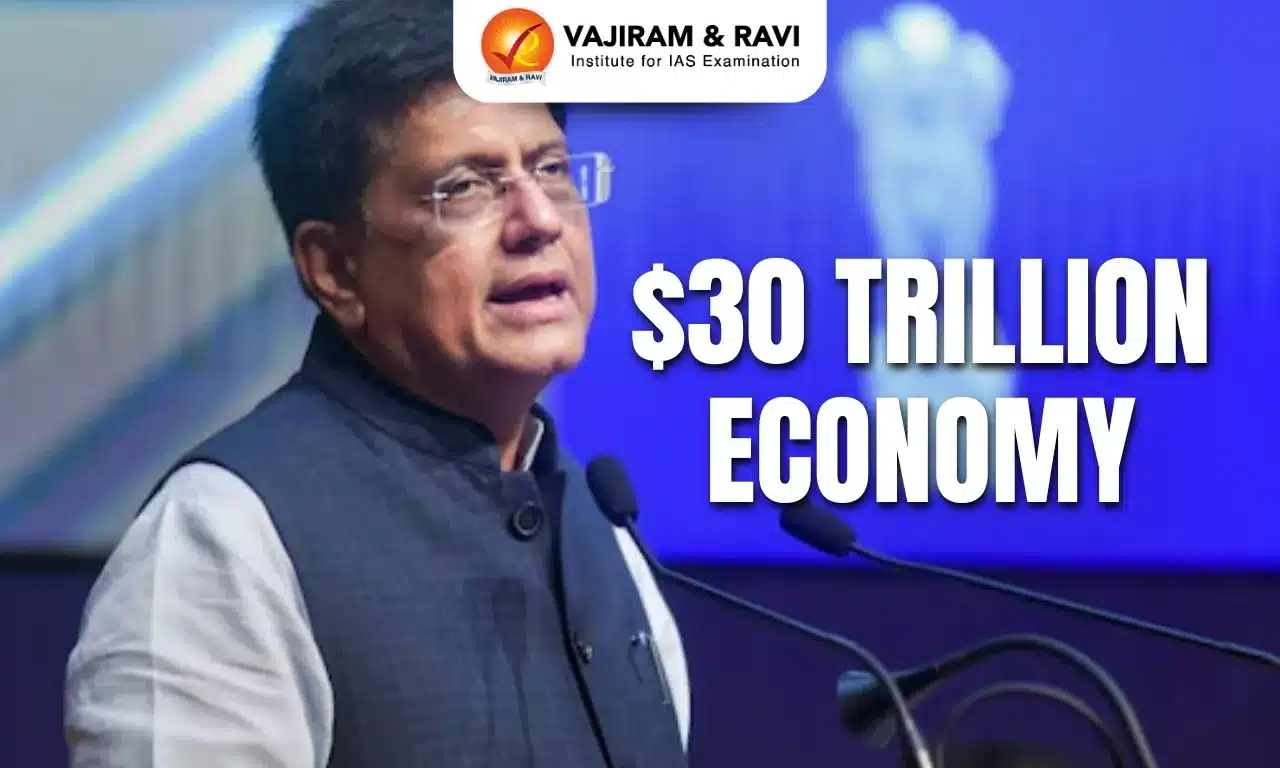
  • At the Berlin Global Dialogue, Commerce and Industry Minister Piyush Goyal asserted that India will be a $30 trillion economy within 20–25 years, shaping how the country negotiates trade deals.
  • Goyal argued that while the US economy is currently eight times larger, the gap will narrow significantly over the next 25 years
  • His statement underlines India’s growing economic confidence and its aim to negotiate trade agreements from a position of strength, aligned with its long-term growth trajectory. 

Understanding the Size of an Economy

  • The size of an economy is measured by its Gross Domestic Product (GDP) — the total market value of all goods and services produced within a country in a year.
  • GDP reflects a nation’s economic strength and global influence, much like a scoreboard that tracks overall performance. A larger GDP indicates greater production, spending, and prosperity.
  • As of end-2024, the US GDP stood at $29.2 trillion, while India’s GDP in the 2023–24 financial year was $3.9 trillion
    • To compare, the US state of California alone had a GDP of $4.1 trillion.
  • An easy analogy: GDP is like the total runs scored by a cricket team over a season — the higher the runs (output), the stronger and more successful the team (economy).

How a Country’s GDP Is Used For Comparison

  • Globally, GDP is expressed in US dollar terms to allow easy comparison between countries.
  • To calculate this, a nation’s GDP in local currency (rupees, in India’s case) is divided by the rupee–dollar exchange rate.
  • The GDP discussed internationally is usually the nominal GDP, which includes the effect of inflation — unlike real GDP, which adjusts for it.
  • Projecting future GDP, therefore, depends on two factors:
    • India’s nominal GDP in rupees, and
    • The rupee–dollar exchange rate.
  • For example, India’s GDP in 2024 was about Rs 330 trillion. If the exchange rate had remained ₹65 per US dollar (as in 2014), India would have been a $5 trillion economy.
  • However, since the rate weakened to ₹84 per dollar, the GDP in dollar terms was only $3.9 trillion.

Assessing the Validity of $30 Trillion Projection

  • The Minister’s projection of India becoming a $30 trillion economy in the next 25 years appears realistic, based on past trends.
  • Looking back, from 2000 to 2024, India’s nominal GDP grew at a compounded annual growth rate (CAGR) of 11.9%, while the rupee depreciated against the US dollar at a CAGR of 2.7%.
  • If India maintains the same growth and currency depreciation rates over the next 25 years, its GDP would surpass $30 trillion by 2048 — around 27 years from now, which aligns closely with Goyal’s prediction.

Why $30 Trillion Target Faces Challenges

  • While projecting future growth using past trends seems reasonable, India’s economic momentum has slowed since 2014.
  • Over the past 11 years, India’s nominal GDP has grown at a CAGR of 10.3%, lower than the 11.9% average of the previous 25 years.
  • Meanwhile, the rupee’s depreciation has slightly accelerated to 3.08%, compared to 2.7% earlier.
  • This means slower economic growth combined with faster currency weakening.
  • If these recent trends continue, India’s GDP would reach $30 trillion only around 2055, not by 2048, pushing Goyal’s target back by nearly a decade.

The Real Impact of a Slower Growth Rate

  • The timeline difference between India reaching a $30 trillion economy by 2048 or 2055 may appear small — just 7 to 8 years — but the financial impact is huge.
  • If India continues growing at the pace of the past 25 years, by 2055 its economy would be 75% larger than what it would be if it grew at the slower rate of the past 11 years.
  • In short, even a slight dip in growth momentum over time can lead to massive differences in economic size when projected over decades.

India Must Sustain Higher Growth to Realize Its $30 Trillion Vision

  • The analysis shows that each decade’s performance matters — even small changes in growth rates can cause huge long-term differences in economic size.
  • Although it’s normal for growth to slow as economies mature, India is still relatively small compared to the US and China and cannot afford a slowdown yet.
  • To make the $30 trillion goal credible, India must accelerate its growth rate and maintain strong, consistent economic momentum over the coming decades.

Source: IE | BS

$30 Trillion Economy FAQs

Q1: What did Piyush Goyal say about India’s economy?

Ans: He said India will become a $30 trillion economy in 20–25 years, emphasizing long-term confidence in the country’s growth potential.

Q2: What does GDP measure?

Ans: GDP represents the total value of goods and services produced within a country, reflecting its overall economic size and global influence.

Q3: How is GDP calculated in dollar terms?

Ans: GDP in rupees is divided by the rupee–dollar exchange rate. A weaker rupee lowers GDP’s dollar value even if domestic output rises.

Q4: Is the $30 trillion target realistic?

Ans: Yes, if India maintains a 11.9% GDP growth and 2.7% rupee depreciation, the economy could cross $30 trillion by 2048

Q5: What could delay India’s $30 trillion milestone?

Ans: Slower growth since 2014 and a faster rupee decline could push the goal to 2055, showing how small rate shifts have large effects.

Enquire Now