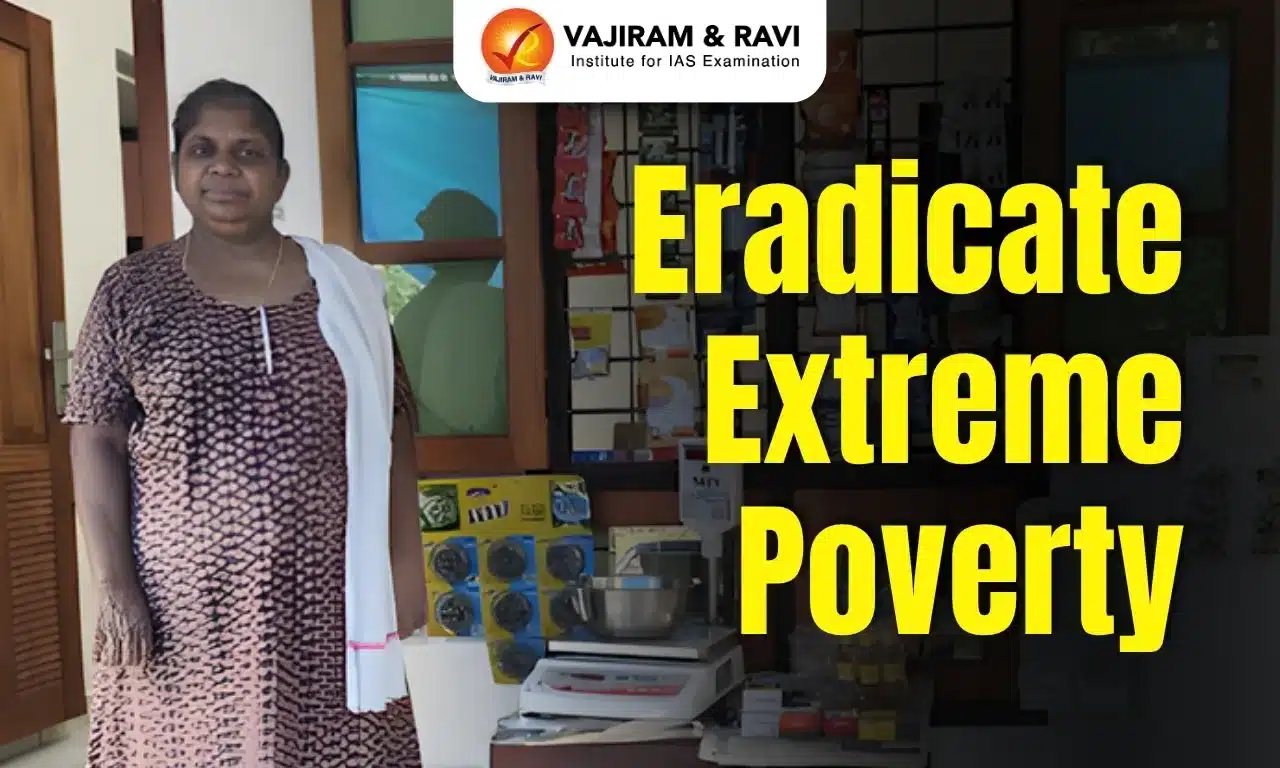
Kerala Becomes India’s First State to Eradicate Extreme Poverty

Eradicate Extreme Poverty

Eradicate Extreme Poverty Latest News

  • On Kerala Piravi Day or Kerala Day (November 1, 2025), Chief Minister Pinarayi Vijayan declared that Kerala has eradicated extreme poverty, making it the first Indian state to achieve this milestone. 
  • The achievement follows a targeted four-year effort under the Extreme Poverty Eradication Programme (EPEP) led by the Left Democratic Front (LDF) government.
  • This marks a significant development in India’s poverty alleviation journey, offering insights into localized, data-driven, participatory governance models, and aligning with UN Sustainable Development Goal 1 (No Poverty).

Understanding Extreme Poverty

  • Global definition:
    • As per the World Bank’s (June 2025) revision, anyone living on less than $3 per day (2021 PPP) is considered to be in extreme poverty. Earlier, the benchmark was $2.15/day (2017 PPP).
    • The poverty line for:
      • Lower-middle-income countries - $4.20/day
      • Upper-middle-income countries - $8.30/day
  • Difference between poverty and extreme poverty:
    • Those earning below $4.20 but above $3 are poor, not extremely poor.
    • Extreme poverty captures the most deprived segment in terms of basic human needs—food, shelter, health, and education.

India’s Position in the Global Context

  • World Bank estimates (2025):
    • 838 million people globally lived in extreme poverty in 2022 (using $3/day standard).
    • In India:
      • Extreme poverty declined from 16.2% (2011–12) to 2.3% (2022–23).
      • About 171 million people were lifted out of extreme poverty.
  • Drivers of improvement: Rising employment and urbanization. For example, urban unemployment reduced to 6.6% (Q1 FY24/25) — lowest since 2017–18.
  • Persistent challenges:
    • Youth unemployment: 13.3% (29% among graduates).
    • Gender disparity: Female employment rate 31%.
    • Informality: 77% of non-farm jobs and most farm jobs remain informal.
    • Critics argue that official poverty reduction estimates may not fully capture multidimensional deprivations.

Measuring Poverty in India - The Multidimensional Approach

  • NITI Aayog’s Multidimensional Poverty Index (MPI):
    • It is based on Alkire-Foster methodology (Global MPI), and uses 12 indicators across three dimensions -
        • Health: nutrition, child mortality, maternal health.
        • Education: years of schooling, school attendance.
        • Standard of living: housing, sanitation, assets, and cooking fuel.
  • Kerala’s broader poverty reduction journey:
    • NITI Aayog’s 2021 MPI: Kerala’s poverty rate was 0.7% — lowest in India.
    • Poverty declined from 59.8% in the 1970s to near zero due to successive governments’ welfare policies in education, health, and social security.
    • However, Kerala’s extreme poverty identification method differed from the NITI Aayog’s MPI framework.

Kerala’s Model - Extreme Poverty Eradication Programme (EPEP)

  • Launch and implementation:
    • Announced in 2021, soon after the LDF government began its second term.
    • The Local Self-Government Department was the nodal agency.
    • Around 4 lakh personnel—officials, elected representatives, and volunteers—were trained.
  • Identification process:
    • Initial identification: 1.18 lakh families.
    • After verification and migration checks: 59,000 families confirmed.
    • Criteria: Income, health, housing, and food insecurity.
  • Key interventions:
    • Housing: 4,677 homeless families identified; 4,005 provided homes under Life Mission Scheme.
    • Food security: 20,648 families lacking stable food access were given meals by local bodies.
    • Essential documents and services: Under Avakasam Athivegam (Rights Fast) campaign, families were ensured access to - Aadhaar, voter ID, bank accounts, MGNREGS job cards, social pensions, electricity, and LPG connections.
  • Institutional collaboration:
    • Local governance, community participation, and data verification ensured inclusivity.
    • Opposition parties also extended bipartisan support for implementation.

Significance of Kerala’s Achievement

  • Kerala becomes the first Indian state to claim zero extreme poverty.
  • Reflects success of localized planning, micro-level targeting, and welfare convergence.
  • Reinforces Kerala’s legacy in human development, education, and social justice.

Critical Perspectives and Challenges

  • Tribal representation concerns:
    • Adivasi Gothra Mahasabha alleged that only 5% of identified families were Scheduled Tribes, despite high deprivation among Paniya, Adiya, and Kattunaikkar communities in Wayanad and Attappady.
    • Criticism of survey methodology for not ensuring tribal-specific inclusion parameters.
  • Labour and welfare gaps: ASHA workers criticized the government’s poverty claims, demanding better honorarium (₹223/day). The government responded by increasing their pay by ₹1,000/month.
  • Sustainability challenge: LSGD is now planning Phase II to ensure beneficiaries do not relapse into poverty, focusing on long-term livelihood stability.

Way Forward

  • Institutionalise micro-planning: Integrate micro-level data systems within broader State and NITI Aayog MPI frameworks.
  • Tribal and marginal inclusion: Create dedicated tribal sub-plans to ensure fair representation and land rights.
  • Livelihood security: Focus on job creation, skill development, and micro-enterprise financing to prevent relapse into poverty.
  • Sustainability audits: Regular monitoring and impact assessment of rehabilitated families.
  • National replication: Kerala’s model offers a template for other states—combining decentralised governance, data-based targeting, and community-driven execution.

Conclusion

  • Kerala’s EPEP marks a milestone in India’s fight against extreme poverty — showcasing how decentralised governance, human-centric micro-planning, and participatory implementation can transform lives. 
  • While political criticism and inclusivity gaps persist, the model provides a replicable framework for sustainable and equitable poverty eradication in India.
  • By blending welfare delivery with dignity and empowerment, Kerala reaffirms its place as a social development pioneer.

Source: TH | IE

Eradicate Extreme Poverty FAQs

Q1: What is the significance of Kerala’s EPEP in the context of India’s pursuit of SDG 1 (No Poverty)?

Ans: Kerala’s EPEP operationalises SDG 1 through decentralised governance, making it a replicable model for eliminating multidimensional poverty.

Q2: How did Kerala’s decentralised governance structure contribute to the success of the EPEP initiative?

Ans: Empowered local self-governments led surveys, designed micro-plans, coordinated interdepartmental support, etc.

Q3: What distinguishes Kerala’s approach to identifying extreme poverty from national and global frameworks?

Ans: Unlike the World Bank or NITI Aayog’s MPI indices, Kerala used four locally relevant parameters—food, health, income, and housing.

Q4: What is the role of community participation and inter-departmental coordination in the effective implementation of EPEP?

Ans: Collaborations among departments, Kudumbashree collectives, and local citizens facilitated housing, health, and livelihood solutions.

Q5: What are the key criticisms and challenges associated with Kerala’s declaration of being free from extreme poverty?

Ans: Critics cite inadequate tribal inclusion, labour welfare gaps, and political contestation, underscoring the need for sustained monitoring and equitable targeting.
Why Stampedes Keep Repeating in India: Lessons from 2025 Tragedies

Stampedes

Stampedes Latest News

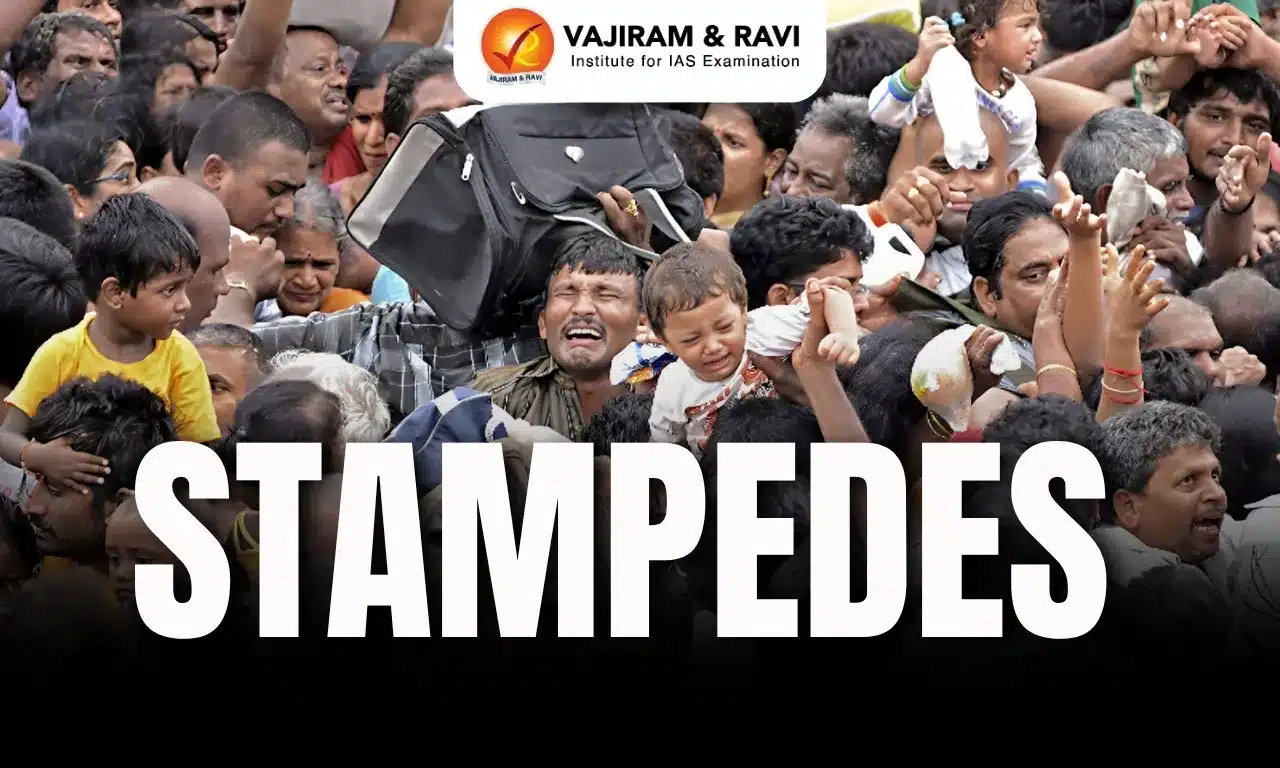
  • At least nine people, including children, were killed in a stampede at the Venkateswara Swamy temple in Kasibugga, Srikakulam district, on November 1, during Ekadashi celebrations.
  • This marks the third major stampede in Andhra Pradesh this year. Earlier, seven people died in April at Visakhapatnam’s Simhachalam temple after a wall collapse during Akshaya Tritiya, and six were killed in January at Tirupati while queuing for special darshan tickets.
  • Across India, such stampedes at temples, religious festivals, and public gatherings have claimed around 100 lives in 2025 alone, pointing to persistent lapses in crowd management and safety planning.

Stampedes in 2025: From Victory Rallies to Holy Gatherings

  • Bengaluru IPL Victory Parade Turns Fatal - In June 2025, a victory celebration for the Royal Challengers Bangalore (RCB) near Chinnaswamy Stadium turned tragic when a stampede killed at least 12 people.
  • Religious Processions End in Tragedy - In May, a religious yatra at Goa’s Shree Lairai Devi Temple in Shirgaon village saw a stampede that killed several devotees.
    • Similarly, in January, at least 30 pilgrims died and over 60 were injured during the Mauni Amavasya bath at the Kumbh in Prayagraj, where poor crowd control was cited as a key factor.
  • Railway Station Rush Adds to Toll - In February, another major tragedy struck when 18 people died and dozens were injured at the New Delhi Railway Station.
    • The stampede occurred late at night as Kumbh pilgrims tried to board a crowded Prayagraj-bound train.

Understanding Why Stampedes Occur

  • As per the crowd dynamics experts, people in dense crowds often don’t realise danger until it’s too late.
  • Crowd behaviour is shaped by non-verbal cues like body language, and emotions spread through observation rather than panic contagion. 
  • In densely packed spaces, where personal space is limited (as in India), reaction time shortens, increasing the risk of sudden collapses.

The Deadly Domino Effect

  • In most stampedes, the main cause of death is compressive asphyxia — when pressure on the chest and ribs prevents people from breathing.
  • Once someone stumbles and falls, others trip over them, creating a domino effect that leads to pile-ups and trampling.

Why Prevention Fails

  • Stampedes turn deadly when authorities underestimate crowd size, fail to anticipate localised crushes, or lack quick-response protocols.
  • A tightly packed crowd, without controlled entry and exit routes, becomes a ticking time bomb, where one small disturbance can spiral into mass casualties within seconds.

Preventing Stampedes: Lessons India Must Learn

  • According to the National Crime Records Bureau (NCRB) report “Accidental Deaths and Suicides in India,” between 2000 and 2022, 3,074 people lost their lives in stampedes across the country.
  • Over the past three decades, nearly 4,000 stampede incidents have been recorded, with the NCRB systematically collecting such data since 1996.

Global Comparison

  • Stampedes are not unique to India. For instance, in 2022, a Halloween celebration in South Korea turned deadly, and in 2010, Germany’s Love Parade festival saw a similar tragedy.
  • However, unlike in India, such incidents rarely recur abroad because authorities quickly learn lessons and introduce strict safety protocols to prevent repetition.

Why India Fails to Improve

  • India’s large population gatherings, combined with a frequent disregard for safety norms and crowd control rules, make it far more vulnerable.
  • The issue is not just administrative but deeply societal — marked by poor enforcement, lack of accountability, and a casual public attitude toward rules — allowing tragedies to repeat year after year despite mounting casualties.

Source: IE | TH | ToI

Stampedes FAQs

Q1: Why do stampedes occur frequently in India?

Ans: Overcrowding, poor planning, and lack of emergency coordination during religious events or rallies often trigger chaotic, deadly crushes.

Q2: What happened in the Andhra Pradesh temple stampede?

Ans: Nine people died when a railing collapsed at a crowded temple in Kasibugga during Ekadashi, reflecting poor crowd control.

Q3: What are common causes of death in stampedes?

Ans: Most victims die from compressive asphyxia — pressure on the chest prevents breathing — rather than from trampling alone.

Q4: How does India compare with other countries?

Ans: While stampedes occur globally, countries like Germany and South Korea prevent repeats by enforcing strict safety reforms after each incident.

Q5: What reforms are needed to prevent stampedes?

Ans: India must improve event planning, limit entry points, ensure rapid crowd flow monitoring, and instil public respect for safety regulations.

Inside Southeast Asia’s Scam Compounds: How Cybercrime Hubs Trap Victims

Scam Compounds

Scam Compounds Latest News

  • Around 500 Indian citizens who recently escaped the KK Park cybercrime hub in Myawaddy, Myanmar, near the Thailand border, are being repatriated by the Indian government. 
  • The episode underscores the rapidly growing crisis of transnational scam centres in Southeast Asia, where thousands are trafficked or coerced into running online fraud operations across the region.

KK Park: Myanmar’s Infamous Scam Hub on the Thai Border

  • KK Park is one of the most notorious scam centres located in Myawaddy township, Karen State, on the Myanmar–Thailand border
  • It is controlled by the Border Guard Force (BGF) led by warlord Saw Chit Thu, who is closely linked to Myanmar’s junta chief, Min Aung Hlaing.
  • Recently, after reports of illegal Starlink internet use at these scam centres, the Myanmar junta carried out a so-called “raid” at KK Park. 
  • While the raid was mostly symbolic, it caused panic among thousands of low-level workers, many of whom escaped the compound and queued at the border hoping to cross into Thailand. 
  • Locals said the BGF coordinated the operation with the junta, highlighting the deep collusion between military authorities and criminal networks.

Inside the Scam Centre Business Model

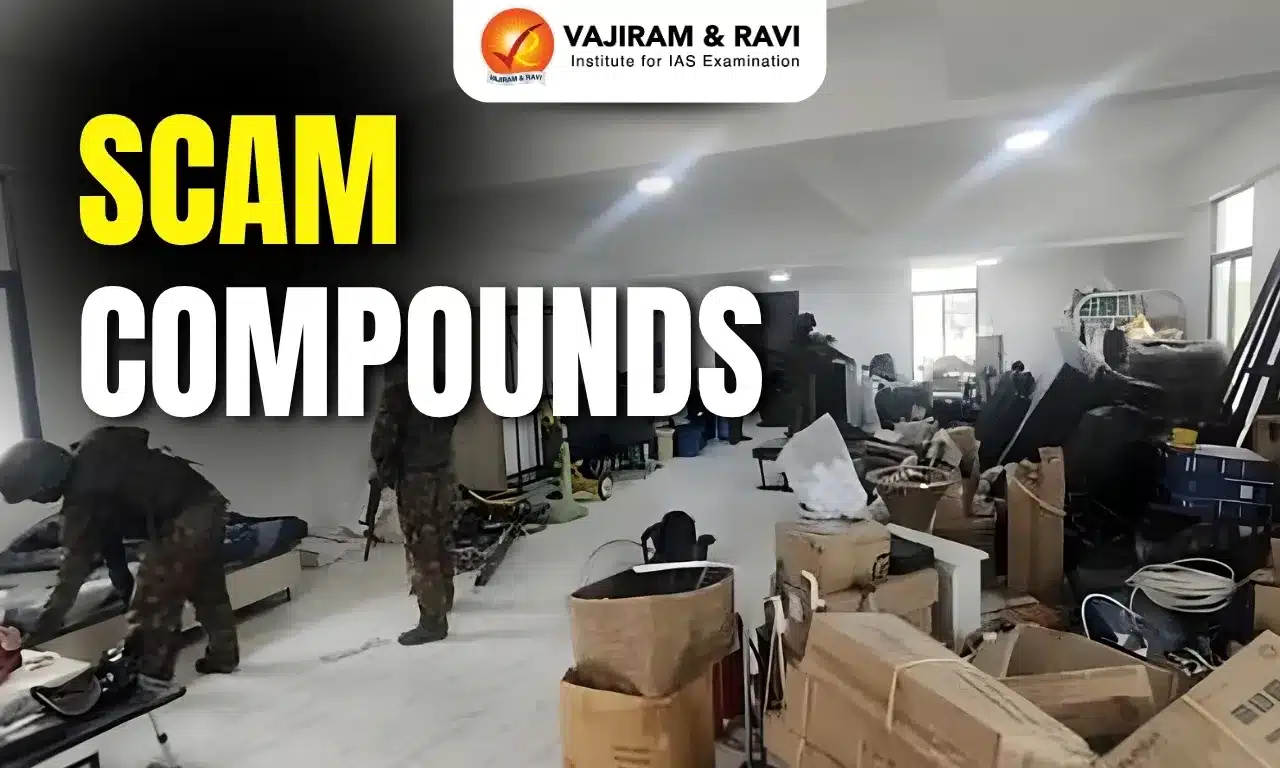
  • According to the Global Initiative Against Transnational Organized Crime (GI-TOC), scam centres are large, jail-like compounds where thousands of people are trafficked and forced to commit cybercrimes. 
  • These facilities operate like factories — highly organised, guarded, and profit-driven.

How Victims Are Trapped

  • Scammers post fake job ads online for high-paying IT or marketing roles. 
  • Victims — mostly from India, China, Vietnam, the Philippines, Africa, and Latin America — are flown to major hubs like Bangkok and then smuggled across borders into Myanmar or Cambodia.
  • Once inside, their passports are seized, and they are told they’ve been “sold” and must work to repay a fake debt. 
  • Under constant watch, they face 12-hour workdays and threats of torture — including beatings, electric shocks, starvation, and solitary confinement — if they resist.

Common Types of Scams

  • The most notorious scheme is “pig butchering”— a mix of romance and investment scams. 
    • Scammers build emotional trust with targets online, pretend to offer profitable crypto investments, and show fake early profits to gain confidence. 
    • Once the victim invests larger sums, the scammers vanish with all the money.
  • Other common frauds include impersonation scams (posing as police or bank officers) and sextortion or blackmail scams.

Myanmar’s Central Role in Southeast Asia’s Scam Network

  • According to the UN Office on Drugs and Crime (UNODC), large-scale online scam centres thrive in lawless border regions and militia-controlled zones across Southeast Asia. 
  • Myanmar has become a key example, where weak governance and armed groups have created “failed state” conditions that allow such operations to flourish.

The Border Guard Force (BGF) System

  • In the mid-2000s, Myanmar’s military created the Border Guard Force (BGF) scheme.
  • It allowed ethnic militias in areas like Kokang (Chinese border) and Karen State (Thai border) to keep their weapons and local control in return for loyalty to the junta.
  • Min Aung Hlaing, the current junta chief who led the 2021 coup, strengthened this arrangement. 
  • He was even photographed conferring ranks on BGF leaders such as Saw Chit Thu, many of whom are deeply involved in scam operations.

The Coup Expanded Criminal Empires

  • After the 2021 coup, the junta’s partners — including the BGF — were given free rein to expand illicit businesses, such as scam compounds and human trafficking networks. 
  • The junta “taxed” these illegal profits to fund its war effort, further embedding corruption and crime in the system.

China’s Reaction and Operation 1027

  • Until 2024, most scam victims were Chinese citizens, making it a domestic issue for Beijing.
  • Frustrated with the junta’s inaction, China quietly supported Operation 1027 in late 2023, where the Three Brotherhood Alliance (ethnic armed groups) launched a major offensive to shut down BGF-run scam centres in northern Shan State
  • The junta lost significant territory, and over 41,000 suspects were handed over to China.

The Shift Southward

  • Despite this crackdown, the scam industry did not end — it moved. 
  • Operations shifted south toward the Thai border, including Myawaddy, Mandalay, and Yangon, and began targeting new victims outside China, including India and other countries.

Indians Trapped and Targeted in Southeast Asia’s Scam Crisis

  • India has been hit both as a victim and a target of the growing scam hub network in Southeast Asia.
  • Hundreds of Indians have been trafficked through fake overseas job offers and forced into cybercrime operations. 
  • In March 2025, the Indian Air Force rescued 283 citizens from Thailand, while over 1,600 Indians have been repatriated from Myanmar’s scam compounds since July 2022. 
  • The 500 who recently escaped KK Park are part of this continuing trend.
  • According to External Affairs Minister S. Jaishankar, India is deeply concerned about these cyber scam centres that have entrapped Indian nationals.
  • At the same time, Indians have also become major targets of “pig butchering” and impersonation scams, turning the issue into both a consular emergency and a domestic cyber security challenge.

Source: TH | UNODC

Scam Compounds FAQs

Q1: What are Southeast Asia’s scam compounds?

Ans: They are heavily guarded complexes where trafficked victims are forced to run online scams like investment, romance, or impersonation frauds under criminal control.

Q2: Where are these scam hubs mainly located?

Ans: Most operate along the Myanmar-Thailand and Cambodia borders, in lawless areas controlled by militias or local armed groups.

Q3: How are victims recruited into scam centres?

Ans: Traffickers lure jobseekers through fake online offers for IT or marketing roles, then seize passports and coerce them into cybercrime.

Q4: What is the “pig butchering” scam?

Ans: It’s a fake romance-investment fraud where victims are tricked into investing in fraudulent crypto schemes before scammers vanish with their money.

Q5: How has India been affected?

Ans: Hundreds of Indians have been trafficked into scam centres, while others have become online fraud victims — turning it into both a consular and security issue.

ISRO to Launch India’s Heaviest Communication Satellite

Communication Satellite

Communication Satellite Latest News

  • The Indian Space Research Organisation (ISRO) is preparing to launch CMS-03, its heaviest communication satellite ever to be launched from Indian soil, on November 2, 2025, aboard the LVM3-M5 (Launch Vehicle Mark-3).

About the CMS-03 Satellite

  • The CMS-03 satellite, weighing 4,410 kg, is designed as a multiband communication satellite that will provide secure and high-bandwidth communication coverage over a wide region, including the Indian subcontinent and surrounding oceanic areas. 
  • It will be placed in a Geosynchronous Transfer Orbit (GTO) of approximately 29,970 km x 170 km from the Earth’s surface.
  • This mission marks the first time ISRO will launch a satellite exceeding 4,000 kg to a GTO from Indian soil. 
  • Previously, India’s heavier communication satellites, such as GSAT-11 (5,854 kg) and GSAT-20 (4,700 kg) were launched by Arianespace or SpaceX due to payload limitations. 
  • With CMS-03, ISRO achieves a new benchmark in self-reliant satellite launches.
  • The satellite will serve critical communication needs, particularly for defence and strategic applications, providing encrypted data relay for the Indian Armed Forces.

LVM3-M5: India’s Most Powerful Rocket

  • The LVM3, also known as GSLV Mk-III, is India’s most powerful and reliable launch vehicle. 
  • The 43.5-meter-tall three-stage rocket is designed to carry up to 4,000 kg payloads to GTO and 8,000 kg to Low Earth Orbit (LEO).
  • Structure and Design
    • First Stage (S200) - Two massive solid rocket boosters provide the initial thrust for lift-off.
    • Second Stage (L110) - A liquid-propellant stage powered by twin Vikas engines.
    • Third Stage (C25 Cryogenic Engine) - The most advanced component, using liquid hydrogen (LH2) and liquid oxygen (LOX) to provide the high thrust needed for orbit insertion.
  • This launch vehicle has been developed using entirely indigenous technologies, including the C25 cryogenic stage, giving India full autonomy in launching heavy satellites. 
  • The LVM3 has had a 100% success rate so far, including the landmark Chandrayaan-3 mission, which made India the first country to land near the lunar south pole in 2023.

Advancements and Future Upgrades

  • ISRO is continuously enhancing the performance of the LVM3. With the C25 cryogenic stage currently providing 20 tonnes of thrust using 28,000 kg of propellant, ISRO plans to replace it with a more powerful C32 cryogenic stage, capable of carrying 32,000 kg of fuel and producing 22 tonnes of thrust.
  • Additionally, ISRO is developing a semi-cryogenic engine, which will replace the L110 liquid stage with a kerosene and liquid oxygen-based engine. 
  • This will increase payload capacity to 10,000 kg in LEO, a crucial requirement for India’s upcoming Gaganyaan human spaceflight programme and the proposed Bharatiya Antariksh Station (India’s space station).

Significance of the Mission

  • Self-Reliance in Heavy Satellite Launches
    • Until now, India has relied on foreign space agencies to launch heavy communication satellites. 
    • The CMS-03 launch demonstrates that India can now independently launch 4-tonne-class satellites, significantly reducing costs and ensuring strategic autonomy.
  • Strategic and Military Capability
    • CMS-03’s secure communication bands will serve as a key enabler for India’s defence communication network, linking naval, air, and ground assets through encrypted signals. 
    • It will enhance situational awareness, real-time data exchange, and maritime domain monitoring across the Indian Ocean Region.
  • Boost to Gaganyaan Mission
    • The same LVM3 vehicle, in its human-rated version (HRLV), will be used for the Gaganyaan mission, which aims to send Indian astronauts into space. This launch thus serves as another validation of the LVM3’s reliability and adaptability.
  • Paving Way for Space Station Missions
    • The upgraded versions of LVM3 will support future missions such as the Bharatiya Antariksh Station and Lunar Module Launch Vehicle (LMLV), which ISRO plans to use for deep-space and lunar missions carrying payloads up to 80,000 kg in LEO.

Track Record of LVM3

  • The LVM3 rocket has completed seven successful missions to date, including the launches of Chandrayaan-2, Chandrayaan-3, and several GSAT satellites. 
  • Compared to its predecessor, GSLV Mk-II, which had multiple failures, LVM3 stands out as ISRO’s most reliable heavy-lift vehicle.
  • This success rate makes it the preferred launch vehicle for both national and international missions, cementing India’s reputation as a global space technology leader.

Source: TH | IE

Communication Satellite FAQs

Q1: What is the CMS-03 satellite?

Ans: CMS-03 is a multiband communication satellite weighing 4,410 kg, designed to provide secure communication services, including for military applications.

Q2: What rocket is being used to launch CMS-03?

Ans: The CMS-03 satellite will be launched aboard ISRO’s LVM3-M5 rocket, also known as GSLV Mk-III.

Q3: Why is the CMS-03 mission significant?

Ans: It marks India’s first launch of a satellite weighing over 4,000 kg to a geosynchronous transfer orbit from Indian soil.

Q4: How does LVM3 differ from ISRO’s PSLV?

Ans: LVM3 is designed for heavy payloads up to 4,000 kg in GTO, whereas PSLV is optimized for lighter payloads to low-Earth orbits.

Q5: What are ISRO’s future plans for the LVM3 rocket?

Ans: ISRO plans to upgrade the LVM3 with a more powerful C32 cryogenic stage and semi-cryogenic engines for future human and deep-space missions.

Enquire Now