
150 Years of Vande Mataram: History, Evolution, and National Significance Explained

Vande Mataram

Vande Mataram Latest News

  • Parliament held a special discussion to mark 150 years of Vande Mataram, a song deeply woven into India’s freedom movement yet continuously debated for its religious imagery and political interpretations. Prime Minister Narendra Modi opened the Lok Sabha debate on this.
  • The commemoration comes amid fresh political contention over the song’s origins, symbolism, and the decisions made by national leaders regarding its usage. 
  • Once a patriotic hymn in Bankimchandra Chattopadhyay’s novel, Vande Mataram evolved into a rallying cry for nationalism, though concerns over its later stanzas led the Congress in 1937 to officially adopt only the first two.
  • In the Constituent Assembly, the song was ultimately accorded “equal honour and status” with the National Anthem.

Origins of Vande Mataram

  • According to a historical account cited by the PIB, Bankimchandra Chattopadhyay composed Vande Mataram around 1875. 
  • The song gained prominence when his novel Anandamath was serialized in Bangadarshan magazine in 1881.
  • Sri Aurobindo wrote in Bande Mataram (1907) that the hymn captured the spirit of patriotic devotion.

Literary Context: Anandamath

  • Anandamath tells the story of the Santanas, ascetic warriors committed to liberating the motherland from oppression. 
  • Their loyalty is to Bharat Mata, represented as a personified motherland rather than a religious deity.

Symbolism of the Three Mothers

  • In the Santanas’ temple, three forms of the Mother are depicted:
    • The Mother That Was – powerful and magnificent
    • The Mother That Is – weakened and suffering
    • The Mother That Will Be – rejuvenated and triumphant
  • These images symbolised India’s past glory, present subjugation, and envisioned future resurgence.

From song to slogan: Birth of a nationalist cry

  • By the early 20th century, Vande Mataram transformed from a literary hymn into one of the most powerful rallying cries of India’s nationalist movement.

Central Role in the Swadeshi and Anti-Partition Movement

  • After Lord Curzon’s 1905 partition of Bengal, the song became the emotional and political heartbeat of mass resistance.
  • It energised:
    • Boycott campaigns
    • Protest marches
    • Newspapers and political groups adopting its name
  • A historic moment came in 1906 at Barisal, where over 10,000 Hindus and Muslims marched together shouting Vande Mataram, demonstrating its early inclusive appeal.
  • Key leaders who popularised it included:
    • Rabindranath Tagore
    • Bipin Chandra Pal
    • Sri Aurobindo, whose writings elevated the phrase into a spiritual and political call for self-rule.

Colonial Repression Against the Slogan

  • Worried by its ability to mobilise masses, the British authorities attempted to suppress it by:
    • Fining students
    • Conducting police lathi-charges
    • Banning public marches
    • Threatening expulsion from schools and colleges
  • Across Bengal and the Bombay Presidency, chanting Vande Mataram became an act of bold nationalist defiance.

Vande Mataram on the Global Stage

  • In 1907, Madam Bhikaji Cama unfurled the first Indian tricolour at Stuttgart, with Vande Mataram written across it — marking its symbolic arrival on the international platform.

The song and the Indian National Congress

  • The Indian National Congress not only appreciated Vande Mataram culturally but also adopted it formally in its national ceremonies.

1896: Tagore’s Iconic Rendition

  • At the Calcutta Congress session, Rabindranath Tagore sang Vande Mataram, giving the song national prominence and embedding it in the Congress’s cultural identity.

1905: Formal Adoption During the Swadeshi Movement

  • In Varanasi, the Congress formally adopted Vande Mataram for all-India events.
  • This came at the height of the anti-partition protests, when the song had already become the anthem of political awakening throughout the country.

1937: Congress Working Committee Removes Later Stanzas

  • By the 1930s, debates over the song’s Hindu goddess imagery became more pronounced.
  • To maintain a broad, inclusive national movement, the Congress Working Committee (CWC) decided in 1937 to use only the first two stanzas, which were considered free of sectarian symbolism.
  • Muslim leaders had objected to the later stanzas, arguing they evoked explicitly religious imagery inappropriate for a national movement meant to represent all communities.

Constituent Assembly’s Resolution: Equal Status for Vande Mataram (1950)

  • In 1950, the Constituent Assembly faced no conflict between Jana Gana Mana and Vande Mataram when deciding national symbols.
  • On January 24, 1950, Assembly President Dr. Rajendra Prasad formally declared:
    • Jana Gana Mana would be the National Anthem.
    • Vande Mataram, due to its historic significance in the freedom struggle, would receive equal honour and status.
  • The announcement was met with applause and no objections from any member.
  • This dual recognition balanced inclusivity with historical reverence—preserving national unity through the anthem while enshrining Vande Mataram as a pillar of India’s independence movement.

Source: ToI | IE | IT

Vande Mataram FAQs

Q1: What is the historical origin of Vande Mataram?

Ans: Bankimchandra Chattopadhyay composed Vande Mataram around 1875, later popularised through his novel Anandamath and embraced as a patriotic hymn during early nationalist movements.

Q2: How did Vande Mataram become a nationalist slogan?

Ans: During the Swadeshi movement after Bengal’s 1905 partition, it became a mass rallying cry, uniting communities in protest marches and inspiring millions across India.

Q3: Why did Congress adopt only the first two stanzas in 1937?

Ans: To maintain inclusivity, Congress restricted usage to two stanzas free of goddess imagery, addressing concerns from Muslim leaders over religious overtones.

Q4: What was the Constituent Assembly’s decision on Vande Mataram?

Ans: On January 24, 1950, the Assembly accorded Vande Mataram equal honour and status alongside the National Anthem, acknowledging its role in the freedom struggle.

Q5: Why does Vande Mataram remain debated today?

Ans: Its historical importance is undisputed, but debates continue regarding religious imagery in later stanzas and its suitability as an inclusive national symbol.
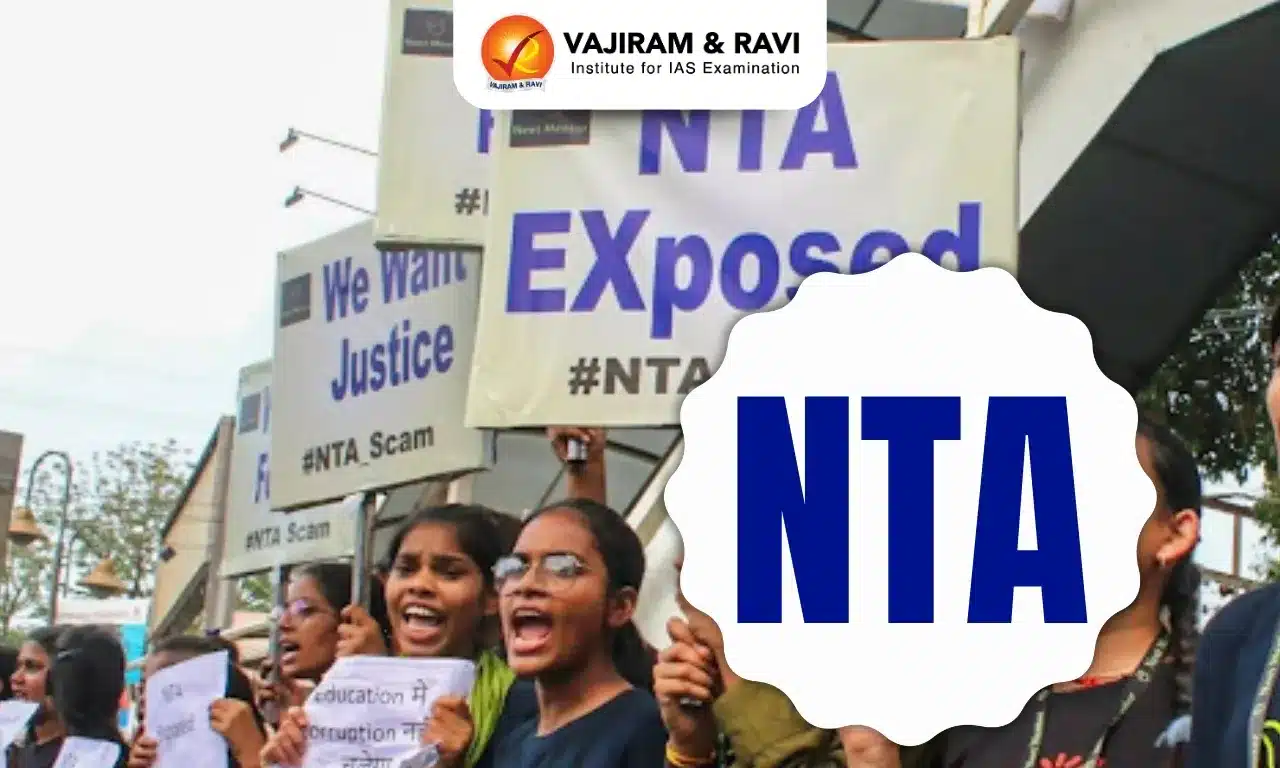
NTA Under Scrutiny: House Panel Flags Major Exam Lapses and Calls for Reform

NTA

NTA Latest News

  • A Parliamentary Standing Committee has sharply criticised the National Testing Agency (NTA), stating that it “has not inspired much confidence” and must urgently improve its functioning.
  • The panel highlighted repeated delays in exam results, especially CUET, and noted that despite collecting a surplus of ₹448 crore over six years, the NTA has not built adequate in-house capacity to conduct tests independently. 
  • The committee urged the agency to strengthen its systems, infrastructure, and accountability mechanisms to ensure reliable and timely examinations.

About National Testing Agency

  • The National Testing Agency (NTA) was established in 2017 as an autonomous, self-sustaining organisation under the Education Ministry (formerly HRD Ministry).
  • It is registered under the Societies Registration Act, 1860 and comes under the RTI Act.
  • Before its creation, UGC, CBSE, and central universities like DU and JNU conducted their own entrance exams.

Origins: When Was NTA First Envisioned

  • The idea for a national exam-conducting body dates back to the 1992 Programme of Action under NEP 1986.
  • In 2010, a committee of IIT directors recommended establishing such an agency through legislation, inspired by the Educational Testing Service (ETS), USA.
  • The government formally announced NTA in 2017, and the Cabinet approved its creation soon after.

Exams Conducted by NTA

  • NTA conducts India’s major entrance examinations, including:
    • Top Undergraduate Entrance Exams
      • JEE Main – Engineering admissions
      • NEET-UG – Medical admissions
      • CUET-UG – Admissions to undergraduate programmes in central universities
      • Over 50 lakh candidates appear for these three exams annually.
    • Other Major Exams
      • CUET-PG – Postgraduate admissions
      • UGC-NET – Eligibility for assistant professor, JRF, and PhD
      • CSIR UGC-NET – PhD admission in science disciplines
      • CMAT, Hotel Management JEE, GPATEntrance exams for DU, JNU, IIFT, ICAR, and others

House Panel Flags Serious Concerns Over NTA’s Functioning

  • The Parliamentary Standing Committee on Education has sharply criticised the National Testing Agency (NTA), stating that it has “not inspired much confidence” and must urgently improve its performance. 
  • The panel noted chronic delays, errors, and administrative lapses in major national examinations.

Repeated Delays and Exam Irregularities

  • The committee observed that NTA delayed CUET results for multiple years, disrupting university admissions and academic calendars.
  • Out of 14 exams conducted in 2024, at least five faced major issues:
    • UGC-NET, CSIR-NET, NEET-PG were postponed
    • NEET-UG faced paper leaks
    • CUET results were delayed
    • JEE Main 2025 had 12 incorrect questions withdrawn after answer key errors
  • The panel warned that such incidents erode students’ trust in the testing system.

NTA’s Financial Surplus Should Be Used for Capacity Building

  • NTA collected ₹3,512.98 crore in six years and spent ₹3,064.77 crore, leaving a surplus of ₹448 crore.
  • The committee recommended that this money be used to:
    • Build in-house capability to conduct exams independently
    • Strengthen regulatory oversight of outsourced vendors

Preference for Pen-and-Paper Exams

  • Citing CBSE and UPSC’s decades-long track record, the panel expressed support for pen-and-paper exams, noting they have been “leak-proof for several years” — implying computer-based testing may be more vulnerable.

Recommendation to Recognise Sonam Wangchuk’s Institute

  • The committee encouraged the UGC to evaluate Sonam Wangchuk’s Himalayan Institute of Alternatives, Ladakh, noting its innovative model and potential for replication across India.

Observation Regarding UGC

  • Draft UGC Regulations 2025 
    • Opposition fears they increase the Chancellor/Visitor’s control over Vice-Chancellor appointments.
    • Committee recommended detailed discussions with CABE (Central Advisory Board of Education) before finalising rules.
  • UGC Leadership Vacuum
    • The UGC Chairperson post has remained vacant since April 2025
    • Committee urges urgent appointment
  • UGC Equity Regulations 2025
    • Panel noted delays and recommended:
    • Inclusion of OBC harassment under caste-based discrimination
    • Addition of disability as a discrimination axis
    • Clear categorisation of discriminatory acts to avoid subjective interpretation

Source: IE | TH | ToI

NTA FAQs

Q1: Why did the House Committee criticise the NTA?

Ans: The committee cited repeated exam delays, paper leaks, answer key errors, and mismanagement, concluding that NTA has “not inspired much confidence” in recent years.

Q2: What financial recommendation did the panel make to NTA?

Ans: It urged the NTA to use its ₹448-crore surplus to build in-house testing capability and improve vendor oversight for more reliable exam administration.

Q3: Which major exams faced issues under NTA recently?

Ans: UGC-NET, CSIR-NET and NEET-PG were postponed, NEET-UG saw paper leaks, and CUET results were delayed; JEE Main had errors needing question withdrawal.

Q4: What reforms were suggested regarding UGC regulations?

Ans: The panel advised wider consultations via CABE, urgent appointment of a UGC Chairperson, and clearer anti-discrimination provisions including OBC and disability inclusion.

Q5: Why did the committee highlight pen-and-paper exams?

Ans: It argued that CBSE and UPSC paper-based exams have remained leak-proof for years, suggesting greater reliability compared to computer-based testing vulnerabilities.

Neurotechnology – Opportunities, Challenges and Global Context

Neurotechnology

Neurotechnology Latest News

  • A recent report discusses how neurotechnology, particularly Brain-Computer Interfaces (BCIs), is emerging as a frontier domain. 

Understanding Neurotechnology: A New Technological Frontier

  • Neurotechnology refers to the use of engineered tools that can record, monitor, or influence neural activity
  • The field sits at the convergence of neuroscience, Artificial Intelligence, engineering, and computing, and is rapidly redefining how humans interact with machines. 
  • At the core is the Brain-Computer Interface, a system that decodes neural signals and translates them into digital actions, enabling users to control prosthetics, wheelchairs, computers or even robotic limbs.
  • Neurotechnology is evolving across two broad areas:
    • Diagnostic and Neuroscience Research Tools
      • Devices that map brain activity to study neurological disorders, cognitive function, or behavioural patterns.
    • Therapeutic and Assistive Technologies
      • Systems enabling paralysed patients to move prosthetics, aiding stroke rehabilitation, and stimulating targeted brain circuits for conditions such as Parkinson’s disease, depression, or epilepsy.
  • Some experimental work globally has gone even further, such as lab experiments connecting the brains of mice to exchange simple information, underlining both the potential and the ethical complexity of the field.

Significance of Neurotechnology for India

  • India faces a growing neurological disease burden, with the share of non-communicable and injury-related neurological disorders rising between 1990 and 2019, and stroke emerging as the single largest contributor. 
  • Key reasons India needs neurotechnology
    • High disease burden: Millions live with paralysis, spinal cord injuries, Parkinson’s disease, or depression, conditions where BCIs and neural stimulation therapies could be transformative.
    • Mental health needs: Targeted stimulation could reduce long-term reliance on psychotropic medication.
    • Economic & innovation potential: Neurotechnology sits at the intersection of biotech, semiconductors, and AI, three sectors where India is actively expanding capabilities.
    • Strategic advantage: Early investments could position India as a global hub similar to how it scaled IT and pharmaceuticals.

India’s Emerging Strengths in Neurotechnology

  • Academic Contributions
    • IIT Kanpur recently unveiled a BCI-based robotic hand, aiding stroke rehabilitation.
    • The National Brain Research Centre (NBRC), Manesar, and the Brain Research Centre at IISc Bengaluru are serving as major neuroscience research nodes.
  • Industry and Start-up Landscape
    • The start-up Dognosis is using neurotechnology to study brain signals in trained dogs, hoping to apply scent-recognition neural patterns toward early human cancer detection, a novel application highlighted in the report.
  • These developments reflect a budding ecosystem that can be strengthened with policy, funding, and industry collaboration.

Global Developments and Their Implications for India

  • United States
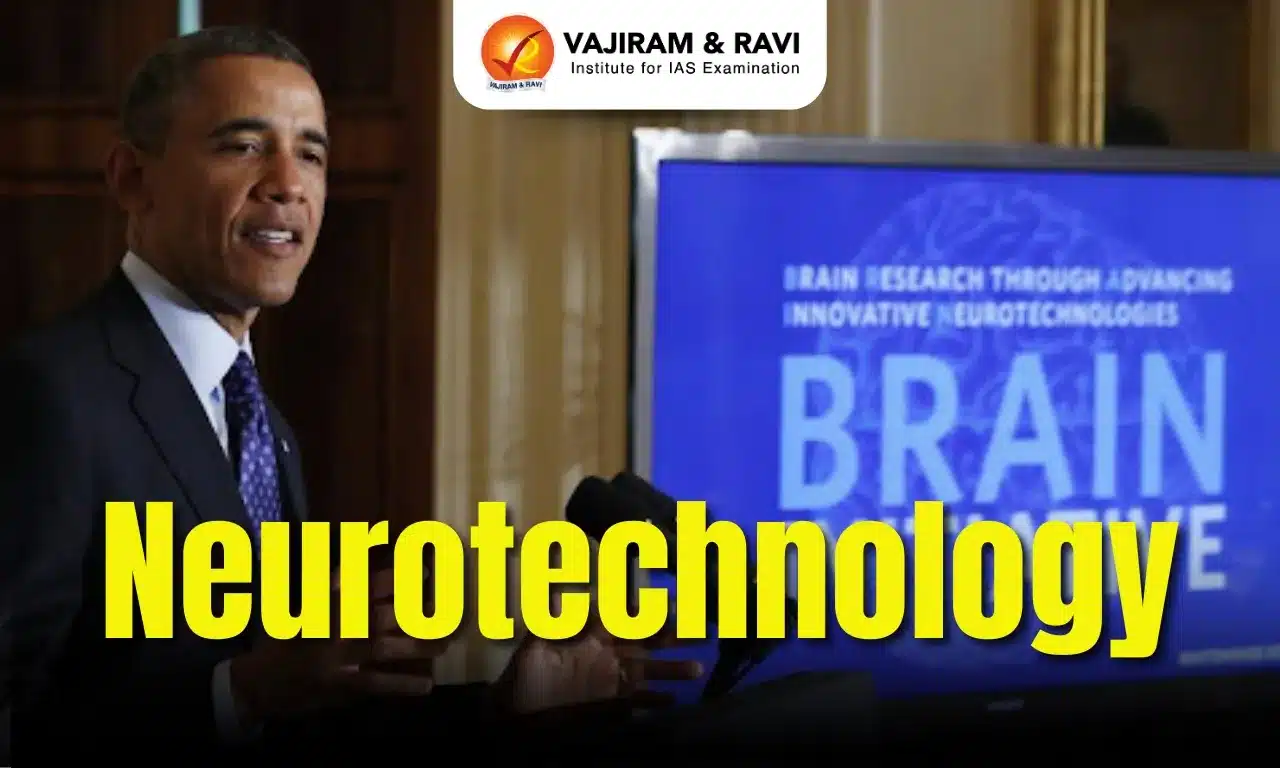
    • The BRAIN Initiative, launched in 2013, is one of the strongest global programmes. 
    • Neuralink, in 2024, received FDA approval for human trials and has demonstrated early restoration of prosthetic-driven motor movement in paralysed individuals. 
  • China
    • The China Brain Project (2016-2030) focuses on cognition research, brain-inspired AI, and treating neurological disorders.
  • Europe & Latin America
    • The EU and Chile are pioneering neurorights legislation, recognising the potential risks of brain-data exploitation and autonomy loss.
  • For India, these trends underscore the need to develop both technological capacity and an ethical, regulatory architecture suited to its social and economic context.

Regulatory and Ethical Challenges for India

  • Without adequate regulation, neurotechnology could bring risks such as:
    • Privacy violations (brain data is the most intimate data known)
    • Manipulation of neural activity
    • Misuse for surveillance or military advantage
    • Inequitable access, worsening health disparities
  • The study stresses the importance of:
    • Public engagement to understand societal concerns
    • Tailored regulatory pathways depending on whether BCIs are diagnostic, therapeutic, or enhancement-oriented
    • Ethics frameworks ensuring user autonomy and data consent
    • A specialised regulatory pathway that evaluates BCIs on both technical safety and ethical dimensions is essential for responsible innovation.

Source: TH

Neurotechnology FAQs

Q1: What is neurotechnology?

Ans: Neurotechnology refers to tools that record, monitor, or influence brain activity to diagnose, treat, or augment human capabilities.

Q2: What is a Brain-Computer Interface (BCI)?

Ans: A BCI is a system that decodes brain signals into digital commands to control external devices.

Q3: Why is neurotechnology important for India?

Ans: India faces a high neurological disease burden, making BCIs crucial for rehabilitation and mental health solutions.

Q4: Which Indian institutes are leading neurotechnology research?

Ans: IIT Kanpur, NBRC Manesar, and IISc Bengaluru are major contributors.

Q5: What regulatory challenge does India face in this field?

Ans: India must create tailored, ethical regulatory pathways to govern BCIs and protect neural data.

Enquire Now
