Identifying BS-VI Vehicles: How India Is Separating Clean Cars from Polluting Ones

BS-VI

BS-VI Latest News

  • The Delhi government has tightened vehicular pollution controls amid severe air quality, bringing renewed focus on Bharat Stage (BS) emission norms. 
  • Non-BS VI private vehicles registered outside Delhi have been barred from entering the city.
  • Fuel stations will now sell fuel only to vehicles with a valid Pollution Under Control Certificate (PUCC). 
  • Non-compliant vehicles face a fine of ₹20,000, while even BS-VI vehicles can be fined ₹10,000 if they lack a valid PUCC.
  • These measures target emissions from older, more polluting vehicles as part of efforts to curb worsening air pollution in the Capital.

Bharat Stage (BS) Emission Norms

  • Bharat Stage (BS) emission norms are India’s legally enforced standards to regulate air pollutants emitted by motor vehicles. 
  • Framed by the Ministry of Environment, Forest and Climate Change (MoEFCC) and implemented by the Central Pollution Control Board (CPCB), these norms are broadly aligned with European emission standards (Euro norms) and apply to all new vehicles manufactured and sold in the country.

Evolution of Bharat Stage Norms

  • India has progressively tightened vehicular emission standards to address worsening urban air pollution:
    • BS I – Introduced nationwide in 2000
    • BS II – 2001 (Delhi first), nationwide by 2005
    • BS III – Nationwide by 2010
    • BS IV – Nationwide by 2017
    • BS VI – Implemented directly from BS IV in April 2020, skipping BS V

Pollutants Regulated

  • BS norms prescribe upper limits for key vehicular pollutants, including:
    • Carbon Monoxide (CO)
    • Hydrocarbons (HC)
    • Nitrogen Oxides (NOx)
    • Particulate Matter (PM)
  • Each successive BS standard tightens these limits significantly.

Other Features

  • Advanced emission-control technologies, such as:
    • Diesel Particulate Filters (DPF)
    • Selective Catalytic Reduction (SCR)
    • On-board diagnostics (OBD)
  • More realistic testing aligned closer to real driving conditions.

Significance of Bharat Stage Norms

  • Public health protection by reducing pollutants linked to respiratory and cardiovascular diseases.
  • Environmental benefits, including lower smog formation and black carbon emissions.
  • Technological upgradation of India’s automobile industry.
  • Global alignment, improving export competitiveness of Indian vehicles.

Why Delhi Has Mixed-Standard Vehicles

  • Delhi’s mixed BS fleet exists because the Capital adopted stricter norms earlier than the rest of India due to severe air pollution. 
  • Delhi implemented BS II in 2001, BS III in 2005 and BS IV in 2010—well ahead of national timelines. 
  • Although BS VI became mandatory nationwide in April 2020, vehicles from other states with older standards continue to enter the city, resulting in a mix of emission norms on Delhi’s roads.

Why Older Vehicles Contribute More to Air Pollution

  • Older vehicles emit significantly higher levels of harmful pollutants because they lack advanced emission-control technologies. 
  • Diesel vehicles, in particular, release large amounts of nitrogen oxides and fine particulate matter, major contributors to smog and respiratory and cardiovascular diseases.
  • They also emit volatile organic compounds that form secondary pollutants in the atmosphere. 
  • In addition, black carbon from diesel exhaust not only damages public health but also accelerates climate warming, making older vehicles especially polluting.

Scale of Older, High-Polluting Vehicles in Delhi-NCR

  • A significant share of vehicles in Delhi-NCR remains highly polluting. 
  • Government assessments indicate that nearly 37% of vehicles in the region comply only with older Bharat Stage I, II or III norms, making them major contributors to the air quality crisis.

BS VI vs BS IV: What Changed in Emission Standards

  • BS VI emission norms impose far tighter pollution limits than BS IV. 
  • For petrol vehicles, nitrogen oxide (NOx) limits are reduced by about 25%. 
  • For diesel vehicles, NOx emissions must fall by nearly 68%, while particulate matter (PM) emissions are cut by around 82%.
  • BS VI vehicles also run on much cleaner, low-sulphur fuel, enabling advanced emission-control technologies to operate effectively. 
  • In addition, BS VI introduces more stringent testing procedures, closer to real-world driving conditions, to ensure lower on-road emissions.

Source: IE | HT

BS-VI FAQs

Q1: What are Bharat Stage (BS) emission norms?

Ans: Bharat Stage emission norms are India’s vehicle pollution standards, aligned with European norms, regulating emissions like NOx, CO and particulate matter to protect public health.

Q2: When did BS-VI norms become mandatory in India?

Ans: BS-VI norms were implemented nationwide from April 1, 2020, skipping BS-V, marking a major leap toward cleaner fuels and advanced emission-control technologies.

Q3: How can vehicle owners check BS-VI compliance?

Ans: BS-VI compliance can be verified on the vehicle’s Registration Certificate, owner’s manual, authorised service centres, or through the VAHAN portal using the number plate.

Q4: Why are older vehicles more polluting?

Ans: Older vehicles lack modern emission-control systems, emitting higher nitrogen oxides, particulate matter and black carbon, which worsen smog and increase respiratory and cardiovascular risks.

Q5: Why does Delhi still have mixed-standard vehicles?

Ans: Delhi adopted stricter BS norms earlier than the rest of India, but vehicles from other states still enter daily, resulting in a mix of BS-I to BS-VI vehicles.
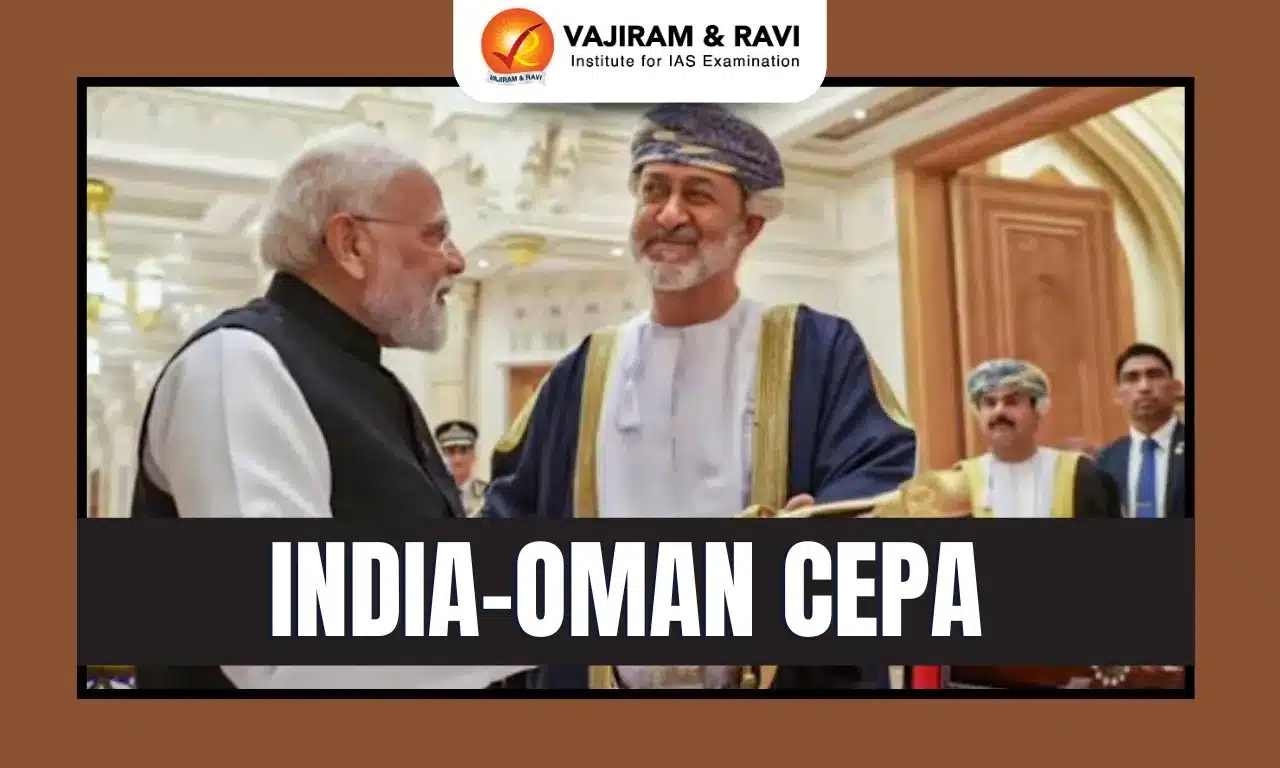
India–Oman CEPA Explained: Tariff-Free Access, Services Boost and Strategic Gains

India-Oman CEPA

India-Oman CEPA Latest News

  • India has signed a trade deal with Oman to expand export opportunities in West Asia amid growing trade barriers in the US and EU, including tariffs and carbon taxes.
  • The signing of the India-Oman Comprehensive Economic Partnership Agreement (CEPA) aligns with India’s strategy of accelerating free trade agreements to diversify markets as uncertainty persists over a US trade deal. 
  • The deal gains added significance as negotiations with the broader Gulf Cooperation Council stalled, making Oman the second GCC member, after the UAE, to conclude a trade agreement with India.

Strategic Context of the CEPA

  • Oman’s first FTA in nearly two decades.
  • India’s second comprehensive Gulf FTA, after the UAE (2022).
    • India’s sixth free trade pact in the past five years, following deals with Mauritius, the UAE, Australia, the EFTA bloc and the UK. 
  • Bilateral trade at around $10.5 billion, dominated by energy imports.
  • The agreement focuses on durable economic integration, not short-term trade spikes.

India–Oman CEPA: Key Features

  • Recently, India and Oman signed a Comprehensive Economic Partnership Agreement (CEPA), in Muscat.
  • Under this agreement, Oman will grant duty-free access on 98.08% of tariff lines, covering 99.38% of India’s exports to Oman.
  • India will liberalise tariffs on 77.79% of its tariff lines, covering 94.81% of imports from Oman.
  • Oman’s strategic location positions it as a hub for: Wider GCC markets; Eastern Europe, Central Asia, and Africa.
  • Oman already has duty-free access to the US under its FTA, enhancing indirect opportunities.

Market Access and Tariff Liberalisation

  • For Indian Exports
    • Full tariff elimination for labour-intensive sectors, including:
      • Gems & jewellery, textiles, leather, footwear
      • Sports goods, plastics, furniture
      • Agriculture and food products
      • Engineering goods, pharmaceuticals, medical devices, automobiles
    • Expected to boost MSMEs, artisans, women-led enterprises, and employment.
  • Sensitive Products Excluded by India
    • Agricultural products (dairy, tea, coffee, rubber, tobacco)
    • Gold and silver bullion, jewellery
    • Certain labour-intensive items like footwear and sports goods
    • Scrap of several base metals

Enhanced Mobility of Professionals (Mode 4)

  • This is a major highlight of the CEPA.
  • Intra-Corporate Transferees quota increased from 20% to 50%.
  • Contractual Service Suppliers’ stay extended: From 90 days → 2 years, extendable by another 2 years.
  • More liberal entry and stay for skilled professionals in:
    • Accountancy, taxation, architecture
    • Medical and allied services

Boost to the Services Sector

  • Oman offers substantial commitments across key services, including:
    • Computer and IT services
    • Business and professional services
    • Audio-visual services
    • R&D, education, and health services
  • CEPA allows 100% FDI by Indian companies in major services sectors in Oman via commercial presence.
  • Future discussions agreed on social security coordination, once Oman’s contributory system is operational.

India–Oman Trade: Strategic Gateway and Market Access

  • Oman, though smaller and less diversified than the UAE, holds strategic importance for India as a trade hub connecting West Asia and Africa. 
  • With annual imports of about $40 billion, Oman relies heavily on imported machinery while remaining a major energy exporter.
  • India exported $4.06 billion worth of merchandise to Oman in 2024-25, which made up 0.93% of India’s total exports that year. 
  • It imported $6.5 billion worth of goods from Oman, comprising 0.91% of India’s total imports in 2024-25.

Export Opportunities for India

  • Indian exports to Oman have doubled over the past five years. 
  • Key exports include machinery and parts, aircraft, rice, iron and steel articles, beauty and personal care products, ceramics, and petroleum products such as naphtha and petrol. 
  • Zero-duty access on 98% of Oman’s tariff lines under the CEPA is expected to boost competitiveness, especially for industrial goods, though sustained growth will depend on quality upgrades and product differentiation.

Oman’s Trade Profile and Energy Linkages

  • Oman’s main exports include crude oil, LNG, fertilisers, and chemical inputs like methanol and anhydrous ammonia—critical for India’s energy and industrial sectors and already subject to low tariffs under existing FTAs. 
  • Oman also has a US FTA (since 2009), enabling duty-free access for many products into the American market.

Services Trade and Professional Mobility

  • India stands to gain significantly in services. Oman’s global services imports total $12.52 billion, with India holding a 5.31% share
  • The CEPA includes strong commitments across IT, business and professional services, R&D, education, health, and audio-visual sectors.

Petroleum and Mineral-Based Trade

  • India’s Exports to Oman
    • Petroleum products: 35.1%
    • Processed minerals: 9.2%
    • Aircraft and parts, cosmetics, basmati rice together form major shares.
  • India’s Imports from Oman
    • Crude oil and petroleum gases: 38%
    • Fertilisers: 16.3%
    • Acyclic alcohols and ammonia are key imports.
    • Over two-thirds of imports concentrated in energy and fertiliser-related products.

Source: IE | TH | IT

India-Oman CEPA FAQs

Q1: What is the India–Oman CEPA?

Ans: The India–Oman Comprehensive Economic Partnership Agreement is a bilateral free trade pact providing extensive tariff liberalisation, services access and investment facilitation between the two countries.

Q2: How much tariff access has Oman offered India?

Ans: Oman has granted duty-free access on 98.08% of tariff lines, covering 99.38% of India’s exports, significantly improving market access for Indian goods.

Q3: Which Indian sectors benefit most from the CEPA?

Ans: Labour-intensive sectors such as textiles, gems and jewellery, leather, pharmaceuticals, engineering goods, automobiles and agricultural products gain full tariff elimination.

Q4: Why is Mode-4 mobility significant in this agreement?

Ans: Oman expanded Mode-4 commitments, raising intra-corporate transferee quotas to 50% and extending service suppliers’ stay to up to four years.

Q5: Why is Oman strategically important for India’s trade?

Ans: Oman serves as a gateway to GCC markets, Africa and Central Asia, complementing India’s UAE FTA and strengthening regional supply chains.

Strengthening India’s Semiconductor Self-Reliance – DHRUV64

Semiconductor

Semiconductor Latest News

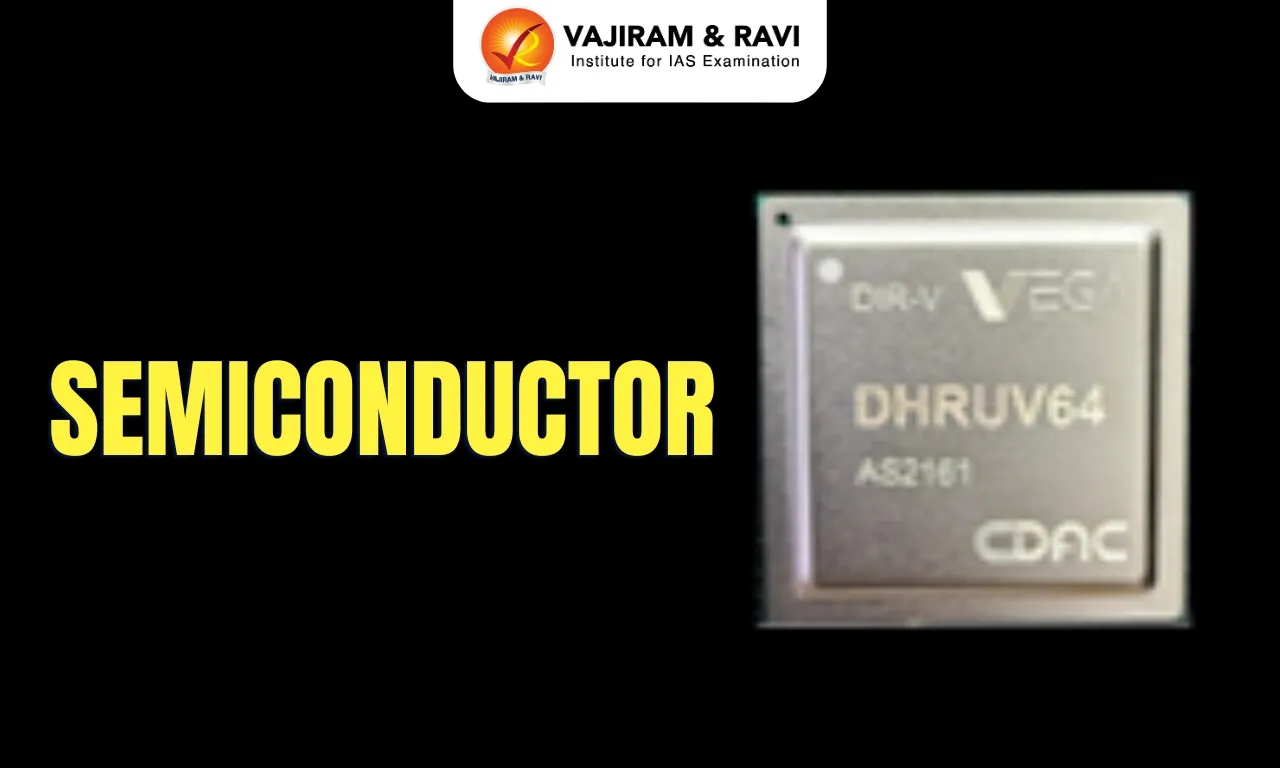
  • In December 2025, the Ministry of Electronics and Information Technology (MeitY) announced the launch of DHRUV64, a fully indigenous microprocessor developed by the Centre for Development of Advanced Computing (C-DAC). 
  • The processor is projected as a critical milestone in India’s efforts to build a domestic semiconductor and processor ecosystem and reduce dependence on imported chip technologies.

Background: India and the Semiconductor Challenge

  • India is one of the world’s largest consumers of electronic devices and processors, yet it remains heavily dependent on foreign-designed chips and global supply chains. 
  • Microprocessors form the core of modern digital infrastructure, powering telecommunications, industrial automation, defence systems, automobiles, and consumer electronics. 
  • Dependence on imported processors exposes India to supply disruptions, export controls, and cybersecurity vulnerabilities.
  • Recognising this strategic vulnerability, the Government of India has consistently pushed for “homegrown processor technology” as part of its broader vision of technological sovereignty and digital resilience.

About DHRUV64

  • DHRUV64 is a 64-bit, dual-core general-purpose microprocessor developed by C-DAC under MeitY’s Microprocessor Development Programme
  • Operating at a clock speed of 1 GHz, it is designed to strike a balance between computational capability and energy efficiency.
  • Unlike simple microcontrollers used for basic sensing tasks, DHRUV64 is capable of running modern operating systems and handling more complex workloads. 
  • Its intended applications range from consumer electronics to industrial automation and embedded systems, where reliability and integration matter more than peak computing power.

Technical Significance of the Processor

  • From a technological perspective, DHRUV64 does not compete with high-end smartphone or laptop processors that feature multiple cores, advanced GPUs, and high clock speeds. 
  • Instead, it targets sectors such as telecommunications equipment, industrial controllers, routers, and automotive modules, where stable performance, long lifecycle support, and secure architectures are crucial.
  • Such sectors value hardware-software integration and predictable behaviour rather than raw speed. 
  • This makes DHRUV64 relevant for strategic and infrastructure-related applications rather than mass consumer devices.

Role of RISC-V and the DIR-V Programme

  • A key feature of DHRUV64 is that it is based on the RISC-V instruction set architecture. 
    • RISC-V is an open-source instruction set, meaning that its design rules are publicly available and can be used without paying licensing fees.
  • This openness allows countries like India to design processors without dependence on proprietary architectures controlled by foreign companies. 
  • RISC-V is also modular, enabling designers to customise processors for specific tasks such as security, performance, or energy efficiency.
  • DHRUV64 is part of the Digital India RISC-V (DIR-V) programme, which aims to develop a portfolio of indigenous processors for civilian, industrial, and strategic uses. 
  • Earlier processors under this ecosystem include SHAKTI (IIT-Madras), AJIT (IIT-Bombay), VIKRAM (ISRO-SCL), and THEJAS processors developed by C-DAC.

Concerns and Information Gaps

  • Despite its strategic importance, MeitY’s announcement leaves several critical questions unanswered. 
  • The government has not provided detailed performance benchmarks, memory architecture details, or power efficiency metrics, which are essential for industrial adoption.
  • There is also limited clarity on fabrication details, such as the manufacturing foundry, process node, yields, and long-term reliability. 
  • Additionally, the term “fully indigenous” remains ambiguous, as it can refer to different aspects such as design, toolchains, fabrication, or ownership of intellectual property.
  • The absence of a clear deployment roadmap, operating system support, and government procurement plans may slow industry adoption in the short term.

Way Forward for India’s Chip Ecosystem

  • DHRUV64 must be viewed as a foundational step rather than a finished solution. 
  • Its success will depend on the creation of a supporting ecosystem that includes developer boards, software tools, skilled manpower, and anchor government demand.
  • Complementary initiatives such as Chips to Startup Programme, Design Linked Incentive Scheme, and the India Semiconductor Mission are critical to building fabrication capacity, nurturing startups, and expanding semiconductor talent in India.
  • The long-term goal is to enable Indian consumers and industries to adopt indigenous processors without compromising on cost, security, or reliability.

Source: TH

Semiconductor FAQs

Q1: What is DHRUV64?

Ans: DHRUV64 is a 64-bit indigenous microprocessor developed by C-DAC under MeitY.

Q2: Which architecture does DHRUV64 use?

Ans: It is based on the open-source RISC-V instruction set architecture.

Q3: Why is DHRUV64 important for India?

Ans: It reduces dependence on imported processors and strengthens technological sovereignty.

Q4: What are the main applications of DHRUV64?

Ans: Telecommunications equipment, industrial automation, embedded systems, and strategic sectors.

Q5: Which programme does DHRUV64 belong to?

Ans: It is part of the Digital India RISC-V (DIR-V) programme.

Securities Markets Code Bill 2025 – Towards a Unified, Principle-Based Securities Regulation

Securities Markets Code Bill 2025

Securities Markets Code Bill 2025 Latest News

  • The Union Finance Minister recently tabled the Securities Markets Code Bill 2025 in the Lok Sabha, as announced earlier in the Union Budget 2021–22. The Bill has been referred to the Standing Committee on Finance for detailed examination. 
  • It seeks to consolidate, rationalise and modernise India’s securities market laws to enhance investor protection, ease of doing business, and capital mobilisation in a technology-driven financial ecosystem.

Securities Market in India

  • It is a vital part of the nation's financial system, facilitating the flow of capital from savers to those who need it for productive investments. 
  • It is a sophisticated, technology-driven ecosystem regulated primarily by the Securities and Exchange Board of India (SEBI).

Core Features of the Bill

  • Consolidation of securities laws:
    • The Bill replaces three major legislations - the Securities Contracts (Regulation) Act (SCRA), 1956; the SEBI Act, 1992; and the Depositories Act, 1996.
      • SEBI Act, 1992: It established SEBI as an independent statutory body and endowed it with regulatory and enforcement authority.
      • SCRA, 1956: It provides the legal framework for the regulation of stock exchanges and contracts in securities, aiming to prevent undesirable speculation.
      • Depositories Act, 1996: It legalises the electronic (dematerialized) holding and transfer of securities, reducing the risks associated with physical certificates.
    • The objective is to eliminate overlap, duplication, and obsolete provisions and create a uniform securities law framework.
  • Expanded and strengthened SEBI board:
    • Board strength increased from 9 to 15 members.
    • Composition - Chairperson, 2 Central Government nominees, 1 RBI nominee (ex-officio), and 11 other members (minimum 5 whole-time members, up from 3).
    • The objective is institutional capacity enhancement and improved regulatory governance.
  • Decriminalisation and rationalisation of offences:
    • Minor, procedural and technical violations shifted to civil penalties.
    • Criminal punishment restricted to serious offences such as insider trading and trading on material non-public information.
    • It aligns with ease of doing business and compliance burden reduction.
  • Classification of contraventions:
    • Category I – Fraudulent and unfair trade practices - No criminal liability, civil penalties applicable.
    • Category II – “Market Abuse” - Serious violations affecting market integrity and public interest. May attract civil penalties and criminal liability.
  • Time limitation on inspection: No inspection permitted if 8 years have elapsed since the date of contravention. It ensures legal certainty and closure.
  • Conflict of interest and accountability:
    • Mandatory disclosure of direct and indirect interests, including those of family members.
    • Members must recuse themselves in case of conflict.
    • SEBI empowered to remove board members for non-compliance or conflict of interest.
    • This provision strengthens ethical governance and transparency.
  • Investor protection measures:
    • Mandatory investor charter by SEBI.
    • Establishment of investor grievance redressal mechanism.
    • Direction to market intermediaries and issuers to adopt similar mechanisms.
    • It will reinforce trust and retail participation.
  • Delegation and regulatory coordination: 
    • SEBI is empowered to delegate registration-related functions to Market Infrastructure Institutions (MIIs) and Self-Regulatory Organisations (SROs).
    • Framework for inter-regulatory coordination for listing of “other regulated instruments”, interoperability across market platforms.
    • The provision supports market deepening and innovation.

Key Challenges and Way Forward

  • Opposition raised concerns over: 
    • Excessive concentration of powers in SEBI, potential violation of the principle of separation of powers.
    • Government response: Issues can be examined by the Standing Committee on Finance.
  • Risk of over-centralisation of regulatory authority: Clear articulation of checks and balances on SEBI’s powers.
  • Ambiguity regarding subordinate legislation: Transparent and consultative framing of subordinate legislation (SEBI rules, regulations, circulars).
  • Balancing: Faster adjudication with effective deterrence. Capacity building for effective enforcement under the new code.
  • Ensuring accountability: While delegating powers to MIIs and SROs. Periodic review to align with evolving fintech and digital markets.

Conclusion

  • The Securities Markets Code Bill 2025 represents a major structural reform aimed at creating a simplified, coherent and future-ready securities regulatory framework. 
  • While the Bill seeks to balance market efficiency with integrity, its ultimate success will depend on robust parliamentary scrutiny, transparent rule-making, and effective institutional safeguards against regulatory overreach.

Source: TH | IE

Securities Markets Code Bill 2025 FAQs

Q1: What is the rationale behind the Securities Markets Code Bill 2025?

Ans: To create a uniform, principle-based regulatory framework by eliminating duplication, and reducing compliance burden.

Q2: How does the Bill attempt to balance ease of doing business with market integrity?

Ans: By decriminalising minor procedural violations while retaining stringent penalties for market abuse and insider trading affecting public interest.

Q3: What is the significance of expanding the SEBI Board under the Securities Markets Code Bill, 2025?

Ans: Increasing the board strength with more whole-time members enhances institutional capacity, regulatory governance, etc.

Q4: Why are conflict-of-interest provisions under the Bill important for regulatory credibility?

Ans: Mandatory disclosure, recusal, and removal provisions ensure transparency, ethical governance, and independence of the regulator.

Q5: How does the Bill strengthen investor protection in India’s capital markets?

Ans: Through a mandated Investor Charter, structured grievance redressal mechanisms, and improved regulatory coordination across market institutions.

Enquire Now