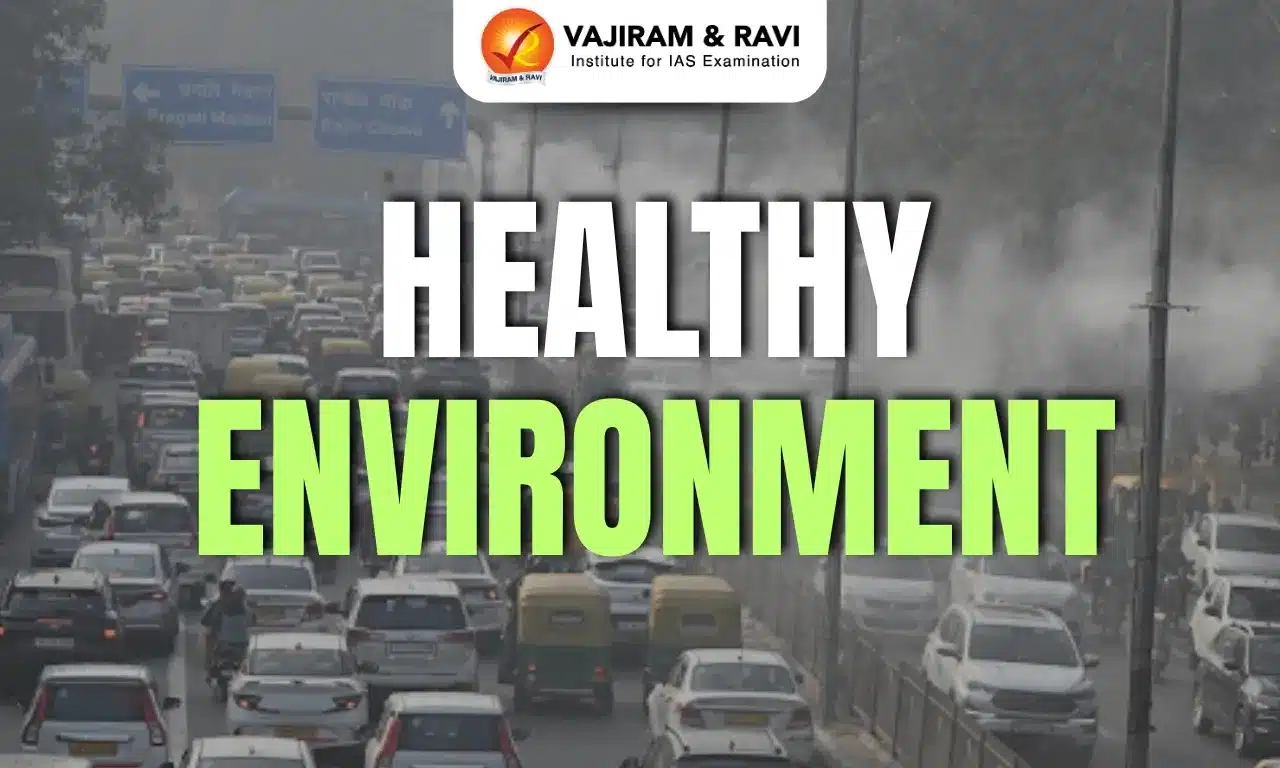
Right to a Healthy Environment in India – Explained

Healthy Environment

Healthy Environment Latest News

  • Rising air pollution in Delhi-NCR has renewed debate on recognising the right to a healthy environment as an explicit constitutional right.

Background: Environmental Degradation and Public Health

  • India faces recurring environmental crises, particularly during winter months, when air pollution levels in Delhi-NCR deteriorate sharply due to vehicular emissions, industrial activity, fossil fuel use, construction dust, waste burning, and agricultural residue burning. 
  • These conditions severely affect public health, leading to respiratory illnesses, cardiovascular diseases, and reduced life expectancy. 
  • The persistent nature of such crises has highlighted gaps in policy enforcement and raised questions about the legal responsibility of the State to protect environmental health.

Particulate Matter and Health Risks

  • Among various pollutants, particulate matter is considered the most harmful. PM10 particles can enter the respiratory system, while finer PM2.5 particles penetrate deep into the lungs and bloodstream. 
  • Diesel particulate matter, a sub-category of PM2.5, is especially toxic and poses serious risks to children and vulnerable populations. 
  • In response to worsening air quality, the Commission for Air Quality Management (CAQM) has strengthened the Graded Response Action Plan (GRAP), mandating school closures and staggered office timings during severe pollution phases, indicating growing administrative recognition of environmental health risks.

Constitutional Basis of Environmental Protection

  • Although the original Constitution did not explicitly guarantee environmental rights, judicial interpretation has expanded the scope of Article 21 (Right to Life) to include the right to a clean and healthy environment. 
  • This interpretation was gradually developed through landmark judgments, beginning with Maneka Gandhi v. Union of India (1978), which broadened the meaning of “life” beyond mere physical existence.
  • Subsequently, constitutional amendments strengthened environmental responsibility. 
  • Article 48A (Directive Principles) places a duty on the State to protect and improve the environment, while Article 51A(g) imposes a fundamental duty on citizens to safeguard natural resources. 
  • Together, these provisions create a shared constitutional obligation toward environmental protection.

Role of Judiciary and Public Interest Litigation

  • Since the mid-1980s, rapid industrialisation and liberalisation have intensified environmental degradation, prompting judicial intervention. 
  • The judiciary has played a proactive role by using Public Interest Litigations (PILs) under Articles 32 and 226 to address environmental harm. 
  • Courts have consistently balanced development needs with environmental sustainability, reinforcing the idea that economic growth cannot come at the cost of ecological destruction.
  • The Environment (Protection) Act, 1986, further strengthens this framework by defining the environment as an interconnected system of air, water, land, and living beings. 
  • Judicial rulings have clarified that the right to live with dignity includes the right to pollution-free air and water, making environmental protection an enforceable legal concern.

Environmental Principles in Indian Jurisprudence

  • Indian environmental law has adopted key global principles to deal with ecological harm. 
  • The principle of absolute liability was introduced to address industrial disasters involving hazardous substances, ensuring that enterprises bear full responsibility for damage regardless of fault.
  • The precautionary principle requires preventive action even in the absence of scientific certainty, while the polluter pays principle mandates that polluters bear the cost of environmental damage. 
  • These principles, affirmed by the judiciary, emphasise prevention, accountability, and sustainable development as core governance values.

Public Trust Doctrine and State Responsibility

  • The public trust doctrine reinforces the idea that natural resources are held by the State in trust for the people. 
  • Under this doctrine, the State cannot exploit environmental resources for private or commercial gain at the cost of public interest. 
  • Constitutional provisions under Article 39 further support community ownership of material resources and equitable distribution for public welfare.
  • Recent judicial recognition of climate change impacts has expanded environmental rights further. 
  • The Supreme Court’s acknowledgement of protection against adverse climate effects as part of Articles 21 and 14 reflects the evolving nature of environmental constitutionalism in India.

Need for Explicit Constitutional Recognition

  • Despite progressive judicial interpretation, the absence of an explicit fundamental right to a healthy environment limits enforceability. 
  • Since rights must be linked to Part III for direct claims, the article argues for formally incorporating the right to a clean and healthy environment into the Constitution. 
  • Such recognition would clearly define State accountability and citizen responsibility, strengthening environmental governance in an era of climate uncertainty.

Source: TH

Healthy Environment FAQs

Q1: How is the right to a healthy environment linked to Article 21?

Ans: It has been judicially interpreted as part of the right to life and human dignity.

Q2: What role does CAQM play in air pollution control?

Ans: CAQM implements measures like GRAP to manage air quality in Delhi-NCR.

Q3: What is the polluter pays principle?

Ans: It requires polluters to bear the cost of environmental damage they cause.

Q4: What is the public trust doctrine?

Ans: It holds that the State manages natural resources as a trustee for the public.

Q5: Why is explicit constitutional recognition being suggested?

Ans: To strengthen enforceability and ensure clear State responsibility for environmental protection.


Internationalisation of Higher Education in India – NITI Aayog’s Roadmap under NEP 2020

Internationalisation of Higher Education in India

Internationalisation of Higher Education in India Latest News

  • NITI Aayog released a report titled “Internationalisation of Higher Education in India: Prospects, Potential, and Policy Recommendations”.
  • The report aligns with the National Education Policy (NEP) 2020 and comes soon after the introduction of the Viksit Bharat Shiksha Adhishthan Bill, 2025, which aims to overhaul higher education regulation.
  • The focus is on correcting the severe imbalance between inbound and outbound student mobility and positioning India as a global education and research hub.

Rationale for Internationalisation

  • In 2024, for every 1 international student studying in India, 28 Indian students went abroad (1:28 ratio).
  • As of 2022, India hosted only about 47,000 international students, despite a 518% increase since 2001.
  • Forecasts suggest 7.89–11 lakh international students by 2047, depending on policy intensity.
  • Internationalisation is seen as crucial for knowledge diplomacy, talent circulation, reducing brain drain, and economic sustainability.

Key Findings of the Report

  • Economic and strategic concerns:
    • Outward remittances under RBI’s Liberalised Remittance Scheme (LRS) increased by about 2000% in the last decade.
    • Indian students’ overseas education expenditure is projected at ₹6.2 lakh crore by 2025 (~2% of GDP).
    • This spending equals about 75% of India’s trade deficit (FY 2024–25).
    • Concentration of 8.5 lakh out of 13.5 lakh outbound students in high-income countries (USA, UK, Australia).
    • Over 16 lakh Indians renounced citizenship since 2011, indicating long-term talent loss.
  • Perception and institutional gaps:
    • 41% of institutes cited limited scholarships/financial aid as a key barrier.
    • 30% institutes flagged perception of education quality in India.
    • Other constraints include inadequate international infrastructure, limited global programme offerings, weak international student support systems, and cultural adaptation challenges.

Major Policy Recommendations

  • Strategic and financial measures:
    • Bharat Vidya Kosh: As a national research sovereign wealth fund (suggesting a $10 billion corpus, of which 50% can be raised from diaspora/philanthropy + 50% from Centre).
    • Vishwa Bandhu scholarship: To attract foreign students. 
    • Vishwa Bandhu fellowship: To attract foreign research talent and faculty.
    • Bharat ki AAN (Alumni Ambassador Network): To leverage diaspora Indians who have studied at top India universities into acting as ambassadors for Indian higher education.
  • Mobility and global partnerships:
    • Europe’s Erasmus+ like programme
      • To suggest the creation of a “multilateral academic mobility framework” tailored to specific country groupings like ASEAN, BRICS, BIMSTEC, etc.
      • This could be called the “Tagore framework”, named after Asia’s first Nobel laureate, Rabindranath Tagore.
    • Promotion of “campus within campus” and more international campuses in India.
  • Regulatory and governance reforms:
    • Easier entry–exit norms for foreign students and faculty.
    • Fast-track tenure pathways for foreign faculty.
    • Competitive, internationally benchmarked salaries.
    • Single-window clearance system for visas, bank accounts, tax IDs, housing and administrative needs.
    • Alignment with non-binding internationalisation frameworks under the proposed Manak Parishad (Standards Council).
  • Branding, rankings and outreach:
    • Expansion of NIRF parameters to include outreach and inclusivity, globalisation and partnerships.
    • Bharat ki AAN: Mobilising Indian diaspora alumni as global ambassadors of Indian HEIs.
  • Curriculum and academic culture: Updated and globally relevant curricula. Emphasis on international research collaboration and cross-cultural learning ecosystems.

Methodology of the Study

  • Online survey of 160 Indian institutions.
  • Key informant interviews with 30 institutions across 16 countries.
  • National Workshop at IIT Madras.
  • Transnational Education Roundtable in the UK.

Challenges Identified and Way Forward

  • Persistent quality perception gap: Leverage diaspora capital, soft power, and civilisational knowledge.
  • Fragmented regulatory ecosystem: Ensure policy coherence between NEP 2020, regulatory reforms, and global engagement.
  • Weak internationalisation culture: Treat internationalisation as a strategic national priority, not merely an academic reform.
  • Risk of continued brain drain and capital flight: Shift from student export model to a global education destination model.

Conclusion

  • The NITI Aayog’s roadmap underscores that internationalisation of higher education is central to India’s economic resilience, strategic autonomy, and soft power projection. 
  • India can transform from a net exporter of students to a global knowledge hub, in line with the aspirations of NEP 2020 and Viksit Bharat 2047.

Source: TH

Internationalisation of Higher Education in India FAQs

Q1: Why does the NITI Aayog consider the current inbound–outbound student mobility ratio (1:28) a strategic concern for India?

Ans: It reflects severe brain drain, capital outflow, and long-term erosion of India’s global competitiveness and knowledge sovereignty.

Q2: What is the significance of the proposed Bharat Vidya Kosh in the internationalisation of Indian higher education?

Ans: It aims to create a $10 billion research sovereign wealth fund to attract global talent, strengthen research capacity, etc.

Q3: How does the proposed “Tagore Framework” align with India’s foreign policy and soft power objectives?

Ans: It integrates education diplomacy with India’s regional and global engagement.

Q4: Why has NITI Aayog recommended expanding NIRF ranking parameters under NEP 2020?

Ans: To incentivise institutions to internationalise, collaborate globally, and improve international perception of Indian higher education.

Q5: How does the internationalisation of higher education contribute to the vision of Viksit Bharat?

Ans: By reducing brain drain, retaining capital, enhancing research excellence, and strengthening India’s global knowledge leadership.

Redrawing the Aravallis: New Definition, Exclusions, and Environmental Concerns

Aravallis

Aravallis Latest News

  • Amid criticism over the government’s new definition of the Aravalli Hills, the Environment Ministry said there was no immediate ecological threat and that the range remains protected, with mining allowed in only 0.19% of its total area. 
  • While the government has paused new mining leases pending further study, critics argue that official assurances do not address disputed court submissions or broader environmental threats beyond mining.

New Aravalli Definition: What Changes and Why It Matters

Measuring Aravali Hills

  • A new definition of the Aravalli Hills, approved by the Supreme Court in November 2025, classifies only landforms rising 100 metres or more above local relief—along with their slopes and adjoining areas—as part of the range. 
  • Critics argue that using local profile instead of a standard baseline could exclude large stretches of the Aravallis from protection. 
  • The Environment Ministry has said that no new mining leases will be granted until a detailed study is completed under the court’s order.

What Remains Protected in the Aravallis

  • Several parts of the Aravallis continue to enjoy strong legal protection, including tiger reserves, national parks, wildlife sanctuaries, eco-sensitive zones, notified wetlands, and compensatory afforestation plantations. 
  • These areas remain closed to mining or development unless explicitly permitted under wildlife or forest laws, regardless of whether they fall within the revised Aravalli definition.

Protection Is Not Always Permanent

  • However, such safeguards can be revised or diluted. 
  • A recent attempt by the Centre and Rajasthan to redefine the boundaries of the Sariska tiger reserve—which could have opened nearby areas to mining—was halted only after intervention by the Supreme Court, highlighting the fragility of regulatory protection.

How the New Benchmark Still Includes Some Areas

  • The new benchmark does not exclude all landforms below 100 metres. 
  • Any landform rising at least 100 metres above its local profile qualifies as part of the Aravalli Hills. 
  • Moreover, if two such hills are within 500 metres, the intervening land—regardless of its elevation—will also be treated as part of the Aravalli range.

What the New Aravalli Definition Excludes

  • The new parameters exclude large areas earlier identified as Aravalli under the Forest Survey of India (FSI) 3-degree slope formula, which classifies land as Aravalli if it lies above a state’s minimum elevation (115 m in Rajasthan) and has a slope of at least 3 degrees. 
  • Rajasthan—home to nearly two-thirds of the Aravalli range—faces the biggest exclusions.

Entire Districts Dropped from the Aravalli List

  • Several districts earlier counted among the 34 Aravalli districts across Gujarat, Rajasthan, Haryana, and Delhi are now excluded. Notably:
    • Sawai Madhopur (Ranthambhore Tiger Reserve; Aravalli–Vindhya convergence),
    • Chittorgarh (UNESCO World Heritage fort on an Aravalli outcrop),
    • Nagaur (where FSI mapped 1,110 sq km as Aravalli),
  • are missing from the updated list submitted to the Supreme Court.

Overstated Extent and the Mining Claim

  • While the government cited mining as limited to 0.19% of a 1.44 lakh sq km Aravalli expanse, this figure effectively covers the entire landmass of the 34 listed districts, not the actual hill range. 
  • Under the FSI method, the Aravallis span 40,483 sq km across 15 districts of Rajasthan—about 33% of those districts’ area.

Scale of Exclusion Under the 100-Metre Benchmark

  • Applying the new 100-metre local relief definition would exclude 99.12%—1,17,527 of 1,18,575—of the Aravalli hills (including slopes and surroundings) identified by the FSI in these 15 districts, dramatically shrinking the range’s officially recognised footprint.

What the Centre Told the Supreme Court

  • The Environment Ministry informed the Supreme Court that the 100-metre definition would include a larger area of the Aravallis than the 3-degree slope formula used by the Forest Survey of India (FSI). 
  • This was despite the FSI flagging concerns that the new benchmark would exclude vast tracts earlier identified as Aravalli.

Argument Based on District Averages

  • The Ministry argued that in 12 of the 34 Aravalli districts, the average slope is below 3 degrees—implying these districts would be excluded under the FSI method. 
  • Critics note this averages plains with hills, understating the slopes of actual hilly areas and thereby weakening the comparison.

Local Profile as the Baseline

  • The Ministry told the court that elevation would be measured from the local profile rather than a standardised reference point (such as Rajasthan’s lowest elevation of 115 m used by the FSI).
  • Using local profiles can exclude even 100-metre-high hills if surrounding terrain is already elevated (saddles), potentially shrinking the officially recognised Aravalli footprint despite claims to the contrary.

Inclusion vs Exclusion: The Core of the Aravalli Debate

  • Limits of the Mining Argument
    • The government has highlighted that only a small fraction of the Aravallis would be legally open to mining.
    • However, concerns persist about illegal mining, the future expansion of mining in areas excluded by the 100-metre definition, and the cumulative ecological impact of individual mining blocks on surrounding landscapes.
  • Environmental Risks Beyond Mining
    • Mining is not the only threat. 
    • By de-recognising large hilly tracts, especially in the Delhi NCR, where Aravalli ranges taper in height, the new definition could open vast areas to real estate and infrastructure development, posing serious environmental risks.
  • Committee’s Rationale: Avoiding ‘Over-Inclusion’
    • The ministry-led committee told the Supreme Court that not every hill is Aravalli and not every part of Aravalli is hilly, warning against “inclusion errors” if slope alone is used to define boundaries. 
    • It argued for caution in wrongly categorising non-Aravalli land.
  • Critics’ Concern: Exclusion Takes Priority
    • While acknowledging non-hilly stretches, the submission places greater emphasis on preventing inclusion of extra areas rather than on the risk of excluding genuine Aravalli landscapes, raising concerns that environmental protection may be weakened in the process.

Source: IE

Aravallis FAQs

Q1: What is the new Aravalli Hills definition?

Ans: The new Aravalli Hills definition recognises only landforms rising 100 metres above local relief, along with their slopes and adjoining areas, as part of the range.

Q2: Why is the new Aravalli definition controversial?

Ans: Critics argue that using local relief instead of a standard baseline could exclude most Aravalli hills earlier identified by the Forest Survey of India.

Q3: What areas remain protected despite the new definition?

Ans: Tiger reserves, wildlife sanctuaries, national parks, eco-sensitive zones, wetlands, and compensatory afforestation lands remain protected under forest and wildlife laws.

Q4: What does the new definition exclude from Aravalli protection?

Ans: Large tracts earlier identified under the FSI’s 3-degree slope method, including major districts in Rajasthan, Haryana, Gujarat, and Delhi, may be excluded.

Q5: Why does the inclusion–exclusion debate matter?

Ans: Excluding genuine Aravalli landscapes could enable mining, real estate, and infrastructure expansion, weakening ecological protection beyond the immediate mining footprint.

India–New Zealand FTA Finalised: Key Gains in Trade, Investment, and Mobility

India–New Zealand FTA

India–New Zealand FTA Latest News

  • India and New Zealand have concluded talks on a free trade agreement, granting India tariff-free access to New Zealand’s market, attracting $20 billion in investment over 15 years, and aiming to double bilateral trade to $5 billion within five years. 
  • The FTA will be formally signed in the first half of 2026.

India–New Zealand Bilateral Relations

  • India and New Zealand established diplomatic relations in 1952 and share enduring ties rooted in Commonwealth membership, common law traditions, and democratic governance. 
  • Sporting links—especially cricket, hockey, and mountaineering—and tourism have long fostered goodwill between the two societies.

Strategic Vision and Policy Frameworks

  • New Zealand has identified India as a priority partner through initiatives such as “Opening Doors to India” (2011) and the NZ Inc. India Strategy. 
  • This was further deepened by the “India–NZ 2025: Investing in the Relationship” strategy, envisioning a more enduring strategic partnership across political, economic, and people-centric domains.

Trade and Economic Ties

  • New Zealand is India's 11th largest two-way trading partner.
    • India-New Zealand total trade in 2023-24 was valued at US$ 1.75 billion.
  • Key trade sectors: Education, tourism, dairy, food processing, pharmaceuticals, renewable energy, and critical minerals.
  • Indian exports to NZ: Pharmaceuticals, precious metals & gems, textiles, motor vehicles, and non-knitted apparel.
  • Indian imports from NZ: Logs, forestry products, wool, edible fruit & nuts.

Defence and Maritime Cooperation

  • Defence ties are expanding steadily:
    • Regular naval visits and port calls by Indian Navy ships.
    • High-level naval leadership exchanges.
    • Cooperation under Combined Task Force-150, with Indian Navy personnel contributing while NZ leads the task force.
  • These engagements support maritime security and Indo-Pacific stability.

Education and Knowledge Partnerships

  • India is the second-largest source of international students in NZ (≈8,000 students).
  • Collaboration through:
    • NZ Centre at IIT Delhi
    • Joint research projects in cancer, robotics, cybersecurity, waste management, and medical technology
    • Education cooperation agreements with GIFT City and IIM Ahmedabad

People-to-People and Cultural Ties

  • Indian-origin population in NZ: ~292,000, with Hindi as the fifth most spoken language.
  • Vibrant celebration of Indian festivals and strong presence of Indian cultural institutions.
  • Deep sporting connections, including shared mountaineering heritage linked to Sir Edmund Hillary.

India–New Zealand Free Trade Agreement: A New Phase in Bilateral Ties

  • India and New Zealand have concluded a Free Trade Agreement (FTA), ending negotiations that began in March 2025.
  • FTA talks were launched during Luxon’s visit to India, and the deal was finalised in a record nine months, reflecting strong political commitment and a shared goal of deepening bilateral relations.

India–New Zealand Free Trade Agreement: Key Highlights

  • The FTA is expected to double bilateral trade within five years, deepen economic engagement, and strengthen cooperation beyond trade—covering defence, education, sports, innovation, and people-to-people ties.

Investment and Market Access Gains

  • Investment: New Zealand will invest $20 billion in India over 15 years. 
  • Healthcare: A dedicated health and traditional medicine annex—New Zealand’s first such agreement with any country—facilitates trade in health services.

Tariff Liberalisation

  • 95% of New Zealand’s exports will see tariffs eliminated or reduced.
  • 57% of exports to India will be duty-free from day one, rising to 82% on full implementation; the remaining 13% will see significant tariff cuts.
  • India protected sensitive sectorsno concessions on dairy, onions, sugar, spices, edible oils, rubber, rice, wheat, and soya.

Boost to Jobs and Exports

  • The FTA is expected to lift labour-intensive sectors—apparel, leather, textiles, rubber, footwear, home décor—and promote exports of automobiles, auto components, machinery, electronics, electricals, and pharmaceuticals.

Mobility and Services Access

  • 5,000 temporary employment visas annually for Indian professionals, valid up to three years.
  • India gains market access across 118 services sectors and MFN status in 139 sectors, expanding opportunities for Indian professionals.
    • Most Favoured Nation (MFN) status is a key WTO principle that requires countries to treat all WTO members equally in trade.
  • Coverage includes IT, engineering, healthcare, education, construction, and niche roles like AYUSH practitioners, yoga instructors, chefs, and music teachers—strengthening services trade and workforce mobility.

Source: TH | MEA | ToI

India–New Zealand FTA FAQs

Q1: What is the India–New Zealand FTA about?

Ans: The India–New Zealand FTA is a comprehensive trade pact aimed at tariff liberalisation, investment growth, services access, and deeper economic and strategic cooperation.

Q2: How will the India–New Zealand FTA impact trade and investment?

Ans: The agreement aims to double bilateral trade to $5 billion in five years and bring $20 billion in New Zealand investment into India over 15 years.

Q3: Which sectors benefit most from the India–New Zealand FTA?

Ans: Labour-intensive sectors like textiles, leather, footwear, and apparel, along with automobiles, electronics, machinery, and pharmaceuticals, are expected to gain significantly.

Q4: How does the FTA protect Indian farmers?

Ans: India has excluded sensitive agricultural products such as dairy, rice, wheat, sugar, onions, edible oils, and soya from tariff concessions to protect farmers’ interests.

Q5: What mobility benefits does the India–New Zealand FTA provide?

Ans: The FTA allows 5,000 temporary work visas annually for Indian professionals across IT, healthcare, education, construction, AYUSH, and creative sectors.

Enquire Now