
Digital Trails and Policing in India: How Data Is Reshaping Crime Detection

Digital Trails in Policing

Digital Trails in Policing Latest News

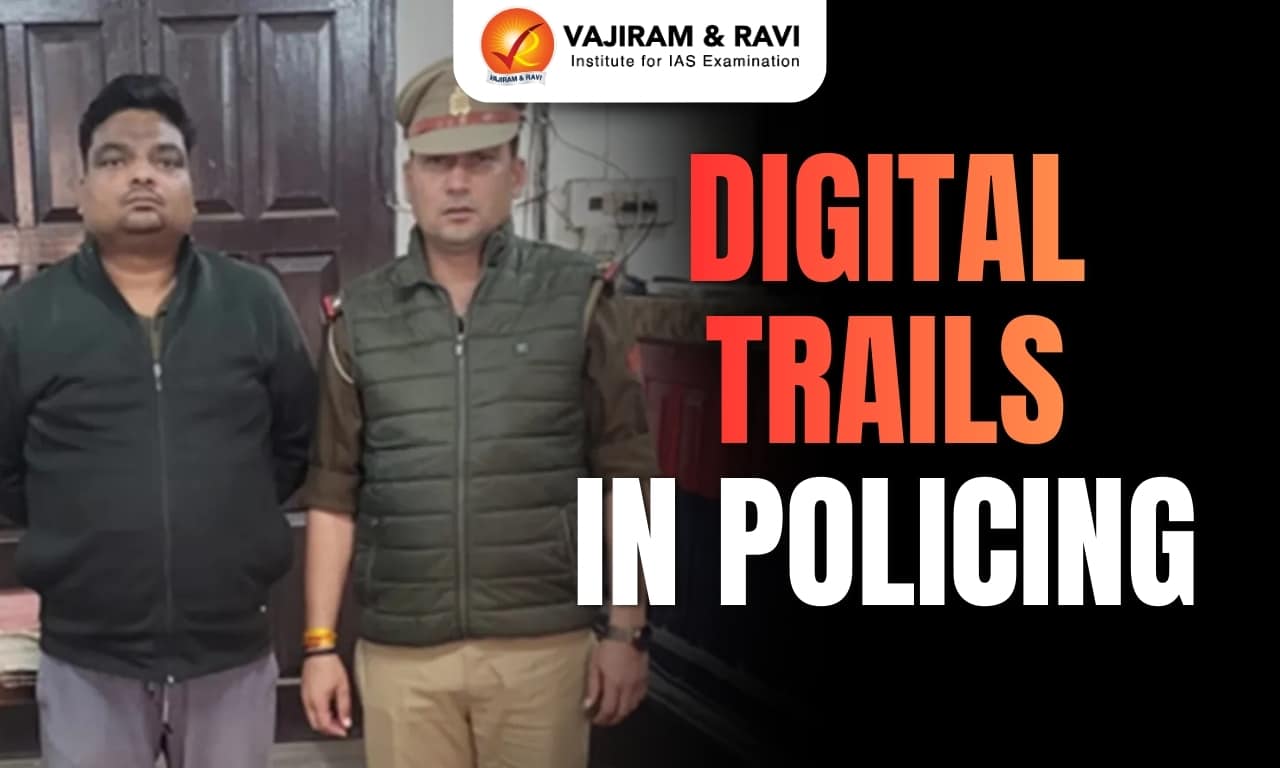
  • The arrest of Ravindra Soni, alleged mastermind of the ₹1,000-crore BlueChip Group scam, highlights how digital footprints are transforming policing in India
  • Tracked down in Dehradun after a year on the run, Soni was caught not through traditional surveillance but via a food delivery order. 
  • The case underscores law enforcement’s growing use of everyday digital data—OTPs, delivery logs, and e-commerce histories—to trace suspects, showing how routine online activity now leaves an electronic trail that can unravel even sophisticated criminal networks.

The BlueChip Scam: How a Global Investment Fraud Unfolded

  • Ravindra Soni, in 2021, founded the BlueChip Group, claiming to trade in forex and commodities like gold, oil, and metals. The firm drew investors from India, the UAE, Malaysia, Canada, and Japan.
  • By 2024, investigators found the operation to be an elaborate fraud, with the company disappearing along with investors’ money. 
  • After nearly a year on the run, Soni was traced back to India and arrested in Dehradun on November 30, when police tracked him via a food delivery. 
  • Authorities allege he ran multiple investment fronts, with the scam’s scale estimated at up to ₹1,000 crore.

Digital Residue as Evidence: A New Tool for Law Enforcement

  • Investigators are increasingly using digital residue—data from everyday apps and services—as key evidence. 
  • In a ₹5,300-crore GST fraud, uncovered in May 2024, seemingly minor data points such as OTPs from food-delivery apps and FASTag alerts helped map suspect movements and expose networks of fake firms and forged tax credits.

Tracking Evasion Tactics

  • Suspects tried to evade detection by frequently changing phones, SIM cards, and hotel identities, keeping devices switched off except to receive OTPs. This pattern itself became a tell. 
  • FASTag toll data was used to trace luxury vehicles along the Delhi–Noida–Lucknow corridor, narrowing locations despite constant digital churn.

Multi-App Linkages Crack Cyber Rings

  • In October, Delhi Police dismantled a ₹22 lakh cyber-fraud network after a nine-day, 1,800-km operation across four states. 
  • WhatsApp data indicated overseas operations from Malaysia, while footprints from Flipkart, Swiggy, and Zomato helped identify suspects despite frequent location changes.

Legal Pathways for Data Sharing

  • Most apps’ privacy policies permit data sharing with law enforcement when required to investigate or prevent illegal activity or to comply with legal processes—making such digital traces admissible and actionable.

Beyond Financial Crime: Global Parallels

  • The evidentiary shift isn’t limited to financial cases. 
  • In the United States, prosecutors investigating the 2025 Palisades Fire in California used digital evidence to build their case. 
  • They cited the suspect’s interactions with ChatGPT, including questions about starting fires and AI-generated images of burning landscapes. 
  • These digital records were used to link the accused to the fire, which burned over 23,000 acres and destroyed thousands of homes.

Regulatory Changes to Tackle Digital Crime

  • Cybersecurity incidents in India have surged from 10.29 lakh in 2022 to 22.68 lakh in 2024, reflecting the growing scale and sophistication of digital crime. 
  • The financial impact is also rising, with cyber fraud losses of ₹36.45 lakh reported on the National Cyber Crime Reporting Portal by February 2025.

SIM-to-Device Binding for Messaging Apps

  • To curb misuse of digital platforms, the Department of Telecommunications (DoT) has directed messaging services like WhatsApp, Telegram, and Signal to enforce SIM-to-device binding. 
  • These apps must remain continuously linked to the SIM used at registration and deny access if the device does not contain that SIM.

New Legal Basis: Telecommunication Cybersecurity Amendment Rules, 2025

  • The Centre is using powers under the Telecommunication Cybersecurity Amendment Rules, 2025 to regulate digital identifiers more tightly. 
  • The rules introduce the concept of a Telecommunication Identifier User Entity (TIUE).
  • A TIUE is any non-telecom entity that uses telecommunication identifiers, such as mobile numbers, to identify users. 
  • This means apps that require phone numbers for registration fall within the regulatory scope.

Possible Expansion Beyond Messaging Apps

  • The current directive targets messaging platforms.
  • However, experts note that the broad TIUE definition could extend to other services, including food delivery apps like Swiggy and Zomato, since they also rely on mobile numbers for user onboarding.

Source: IE

Digital Trails in Policing FAQs

Q1: What are digital trails in policing?

Ans: Digital trails in policing refer to data from everyday digital activities like OTPs, delivery logs, FASTag records, and app usage used to track suspects and crimes.

Q2: How did digital data help crack the BlueChip scam?

Ans: Investigators traced the accused through food delivery orders and mobile OTP patterns, showing how routine digital activity can expose large financial frauds.

Q3: How are OTPs and FASTag data used by police?

Ans: OTPs reveal device usage patterns, while FASTag toll data helps track vehicle movement, enabling police to map suspect travel despite SIM or phone changes.

Q4: What regulatory steps has India taken to control digital crime?

Ans: India has introduced SIM-to-device binding, TIUE classification, and stricter telecom cybersecurity rules to regulate digital identifiers and curb misuse.

Q5: What are the concerns around digital trails in policing?

Ans: While effective, digital trails raise privacy and surveillance concerns, as more apps may be required to share user data with law enforcement agencies.


LVM3-M6 Mission: Why ISRO’s Heaviest Launch Is a Test of Capability and Cost

LVM3-M6

LVM3-M6 Latest News

  • The Indian Space Research Organisation (ISRO) is set to launch the LVM-3 rocket carrying its heaviest-ever satellite, BlueBird Block-2 (≈6,100 kg).
  • The satellite will be placed into a low Earth orbit (LEO) of about 520 km roughly 15 minutes after liftoff. 
  • BlueBird Block-2 will be the largest commercial communications satellite deployed in LEO to date. Designed by AST SpaceMobile, the satellite is part of a constellation aimed at direct-to-mobile connectivity. 
  • Unlike traditional satellites that rely on ground stations, this system will communicate directly with standard smartphones, enabling 4G/5G voice and video calls, messaging, streaming, and data access globally.

LVM3: India’s Heavy-Lift Launch Vehicle

  • The Launch Vehicle Mark-3 (LMV3) is a three-stage launch vehicle weighing about 640 tonnes and standing 43.5 metres tall. 
  • Developed over decades, it represents the peak of India’s launch vehicle engineering.

S200 Solid Strap-On Boosters: Power at Lift-Off

  • The first stage comprises two S200 solid-propellant boosters, among the most powerful solid rockets in use worldwide. 
  • They provide the massive thrust needed at lift-off to overcome gravity and pass through Earth’s dense lower atmosphere.

L110 Liquid Core Stage: Controlled Acceleration

  • After booster separation, the L110 liquid stage takes over, using hypergolic propellants for smooth, controllable thrust. 
  • This stage plays a crucial role in shaping the satellite’s trajectory and reflects India’s long-standing expertise in liquid propulsion.

C25 Cryogenic Upper Stage: Precision and Efficiency

  • The C25 cryogenic stage burns supercooled liquid oxygen and hydrogen stored below –180°C. 
  • It is India’s largest and most advanced cryogenic engine, offering high efficiency, longer burn duration, and precise orbit insertion—key to technological self-reliance achieved after decades of effort.

ISRO’s Push to Optimise LVM3 Engines

  • ISRO is upgrading the LVM3 to meet human-rating requirements for Gaganyaan and to increase lift capacity for modules of the proposed Bharatiya Antariksh Station
  • This involves adding redundancies for safety and boosting overall performance.

More Thrust from the Cryogenic Upper Stage

  • ISRO is enhancing the cryogenic upper stage, which provides nearly 50% of the velocity needed for geosynchronous missions. 
  • The current C25 stage carries 28,000 kg of propellant and produces 20 tonnes of thrust. 
  • The planned C32 stage will carry 32,000 kg of fuel, increasing thrust to 22 tonnes, enabling heavier payloads.

Switch to a Semi-Cryogenic Second Stage

  • The agency is considering replacing the liquid-propellant second stage with a semi-cryogenic engine using refined kerosene and liquid oxygen. 
  • This change would lower costs, improve efficiency, and raise LEO payload capacity from ~8,000 kg to ~10,000 kg, a configuration likely for space-station module launches.

Bootstrap Reignition for Multi-Orbit Missions

  • To support missions deploying satellites into multiple orbits, ISRO is developing bootstrap reignition for cryogenic engines. 
  • This allows the upper stage to restart without external gases (like helium), reducing system mass and increasing payload capability—especially valuable for LEO constellation missions.

Significance of LVM3-M6 Mission

  • The LVM3-M6 / BlueBird Block-2 mission is a dedicated commercial launch using ISRO’s LVM3 rocket to deploy the BlueBird Block-2 communication satellite of AST SpaceMobile. 
    • It represents the sixth operational flight of the LVM3 launch vehicle.
  • This is ISRO’s third commercial mission with the LVM-3, after launching OneWeb satellites in 2022–23. 
  • With alternatives like SpaceX’s Falcon-9 and European Space Agency’s Ariane-6 available, the launch is a chance for ISRO to prove it can deliver heavy launches at lower cost.

Expanding the LVM-3’s Role

  • Originally designed for geosynchronous missions (~36,000 km), the LVM-3 has now proven versatile in low Earth orbit (LEO) deployments. 
  • This marks the third LEO mission for the vehicle, reflecting its evolution from the earlier GSLV-Mk3.

Operational Readiness and Turnaround Time

  • The launch follows the CMS-03 mission on November 2, making it the shortest gap between two LVM-3 launches. 
  • It tests ISRO’s ability to assemble and execute heavy missions rapidly, a key metric for commercial reliability.

Record-Breaking Payload

  • At 6,100 kg, the BlueBird payload is ISRO’s heaviest satellite ever placed into orbit, surpassing the cumulative OneWeb payloads (~5,700 kg) to LEO and the 4,410 kg CMS-03 sent to geosynchronous transfer orbit last month.

Strategic Momentum

  • This is the second year since 2023 that ISRO flies two LVM-3 missions in a single year, underscoring growing cadence, capability, and confidence in India’s heavy-lift launch ecosystem.

Source: IE | ISRO | MC

LVM3-M6 FAQs

Q1: What is the LVM3-M6 mission?

Ans: The LVM3-M6 mission is a dedicated commercial launch by ISRO to place the BlueBird Block-2 satellite into low Earth orbit using the LVM3 rocket.

Q2: Why is the LVM3-M6 mission significant for ISRO?

Ans: It carries ISRO’s heaviest-ever payload at 6,100 kg and tests India’s ability to conduct heavy commercial launches at a competitive cost.

Q3: What makes the BlueBird Block-2 satellite unique?

Ans: BlueBird Block-2 enables direct-to-mobile connectivity, allowing 4G/5G calls, texts, and data directly on smartphones without ground relay stations.

Q4: How does LVM3 compare with other heavy-lift launch vehicles?

Ans: LVM3 competes with SpaceX’s Falcon-9 and ESA’s Ariane-6, offering a lower-cost alternative for heavy satellite launches to LEO and GTO.

Q5: How does LVM3-M6 support India’s future space plans?

Ans: The mission strengthens ISRO’s readiness for Gaganyaan, Bharatiya Antariksh Station modules, and global commercial satellite launches.

India’s Export Concentration Across States – Explained

Export Concentration

Export Concentration Latest News

  • Recent analysis of RBI State-wise export data shows that India’s export growth is increasingly concentrated in a few States, exposing structural imbalances in regional development.

Overview of India’s Export Performance

  • India’s export numbers appear robust at the national level, even amid a weakening rupee. 
  • However, a disaggregated view reveals that export growth is not evenly distributed across States. 
  • According to the RBI Handbook of Statistics on Indian States (2024-25), a small group of States accounts for a disproportionately large share of India’s total exports. 
  • This pattern challenges the long-held assumption that export expansion naturally leads to broad-based industrialisation and employment growth across regions.

Concentration of Exports Among a Few States

  • India’s export geography is increasingly dominated by five States, Maharashtra, Gujarat, Tamil Nadu, Karnataka, and Uttar Pradesh, which together contribute nearly 70% of the national export basket. 
  • Half a decade ago, their share was around 65%, indicating a steady rise in concentration.
  • This trend reflects a core-periphery pattern, where coastal and industrially advanced States integrate more deeply into global supply chains, while large parts of northern and eastern India remain marginalised. 
  • The rising Herfindahl-Hirschman Index (HHI) of export concentration signals growing regional imbalance rather than convergence.
    • The HHI is used by anti-trust agencies that possess the mandate to promote competition. It is calculated by squaring the market share of each producer in the market and then comparing the sum to a scale.

Structural Reasons Behind Regional Divergence

  • Several structural factors explain why exports are clustering instead of dispersing:
    • First, global trade conditions have changed. The era of labour-intensive, low-skill manufacturing as a pathway to development is narrowing. 
    • Global merchandise trade growth has slowed, and capital now seeks regions with high economic complexity rather than just cheap labour.
    • Second, export-leading States possess dense industrial ecosystems, logistics, skilled labour, supplier networks, and financial depth that reinforce agglomeration. 
    • Firms benefit from spatial clustering, making it costly to relocate to less-developed regions.
    • Third, hinterland States suffer from persistent deficits in infrastructure, human capital, and institutional capacity, preventing them from entering complex global value chains.

Shift from Labour-Intensive to Capital-Intensive Exports

  • A key insight from the analysis is that India’s export growth is increasingly capital-intensive rather than labour-absorbing. 
  • Data from the Annual Survey of Industries (2022-23) shows that while fixed capital investment grew by over 10%, employment growth lagged behind at about 7%.
  • Fixed capital per worker has risen sharply, indicating capital deepening. As a result, exports generate value without proportionate job creation. 
  • This breaks the traditional development link where exports absorb surplus labour from agriculture into manufacturing.

Employment Outcomes and Labour Market Trends

  • The Periodic Labour Force Survey (PLFS) reinforces this concern. Manufacturing’s share in total employment has stagnated around 11.6-12%, despite record export values. 
  • This suggests a collapse in the employment elasticity of exports.
  • Most new export-linked jobs are concentrated in capital-intensive hubs, such as electronics clusters in Tamil Nadu or Noida, rather than dispersed factory employment across the hinterland. 
  • Wage share in Net Value Added has also declined, indicating that productivity gains accrue more to capital than to workers.

Financial and Institutional Constraints in Hinterland States

  • Regional inequality is further deepened by financial asymmetries. Credit-Deposit (CD) ratios in export-leading States often exceed 90%, ensuring local recycling of savings into industry. 
  • In contrast, States like Bihar and eastern Uttar Pradesh have CD ratios below 50%, implying capital outflow to already developed regions.
  • This creates a vicious cycle: weaker States lose capital, struggle to build industrial capacity, and remain excluded from export growth.

Rethinking Exports as a Development Metric

  • The evidence suggests a structural shift; exports are no longer a driver of development but an outcome of prior development. 
  • States do not export their way into prosperity; they export because they already possess industrial and institutional strength.
  • This raises important policy questions. Treating export growth as a proxy for inclusive development risks overlooking employment generation, regional equity, and human capital outcomes.

Source: TH

Export Concentration FAQs

Q1: Which States dominate India’s exports?

Ans: Five States, Maharashtra, Gujarat, Tamil Nadu, Karnataka, and Uttar Pradesh, account for nearly 70% of India’s exports.

Q2: What does export concentration indicate?

Ans: It indicates regional imbalance and agglomeration of economic activity rather than uniform development.

Q3: Why are exports becoming capital-intensive?

Ans: Global trade now favours economic complexity, automation, and advanced supply chains over cheap labour.

Q4: Has export growth increased manufacturing jobs?

Ans: No, manufacturing employment has stagnated despite rising export values.

Q5: Why is export growth a weak proxy for inclusive development?

Ans: Because it reflects existing industrial strength and capital intensity, not broad-based job creation or regional convergence.

Enquire Now

