Karbi Anglong Violence – Land Rights, Sixth Schedule Autonomy and Ethnic Tensions

Karbi Anglong Violence

Karbi Anglong Violence Latest News

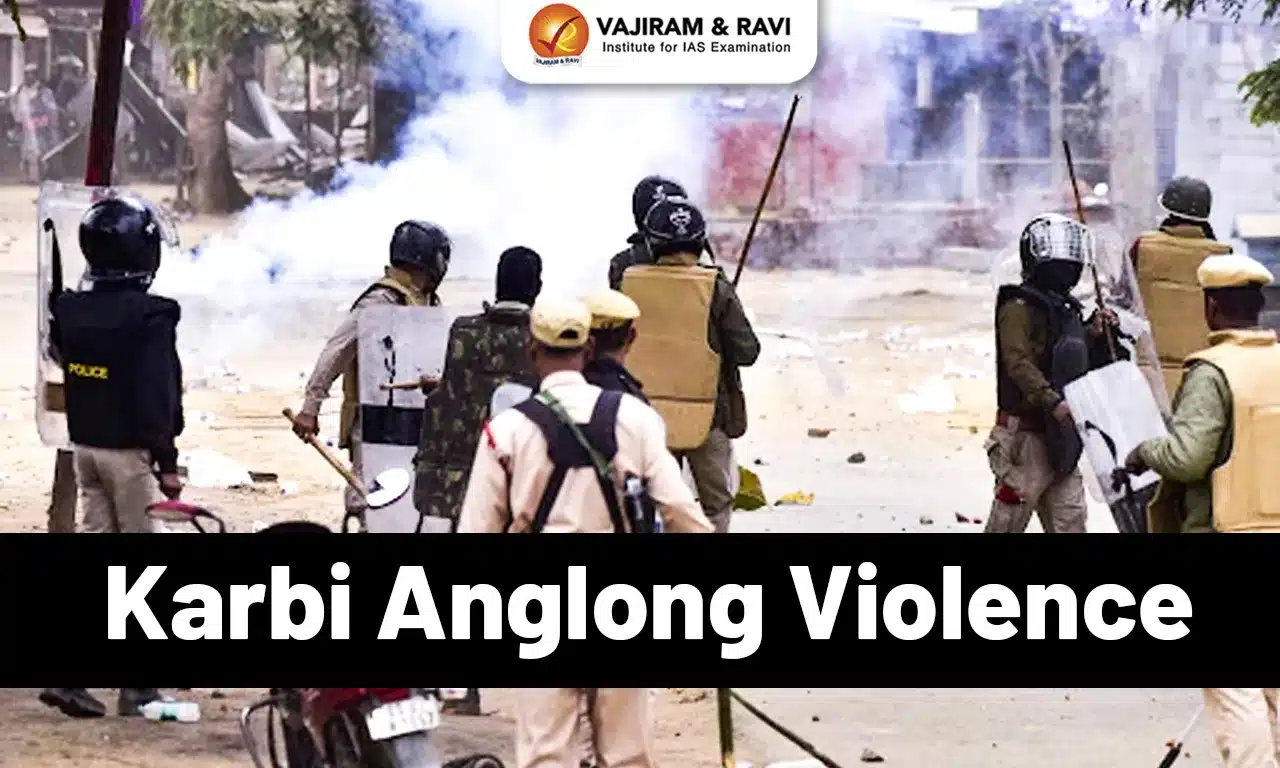
  • Fresh violence erupted in West Karbi Anglong district of Assam, leading to two deaths, multiple injuries, arson of shops and markets, suspension of mobile internet services, and imposition of prohibitory orders.
  • The unrest is rooted in long-standing disputes over land rights, particularly encroachment on grazing reserve lands under the jurisdiction of the Karbi Anglong Autonomous Council (KAAC).

Immediate Trigger of the Violence

  • Hunger strike over grazing lands:
    • For over two weeks, nine Karbi protesters were on a fast unto death at Phelangpi in West Karbi Anglong.
    • Their demand - eviction of alleged encroachers from PGR (Professional Grazing Reserve) lands and VGR (Village Grazing Reserve) lands.
    • These lands are traditionally reserved for livestock grazing, dating back to British colonial land policies, and are crucial for tribal livelihoods.
  • Perception of arrest: When protesters were shifted to Guwahati for medical reasons, locals believed they were arrested, triggering stone-pelting, arson, and escalation into widespread violence.

Background of the Karbi Anglong Dispute

  • Sixth Schedule and autonomous governance:
    • Karbi Anglong and West Karbi Anglong are tribal-majority hill districts governed under the Sixth Schedule of the Constitution.
    • The KAAC enjoys powers over land, forest management, and local governance, aimed at protecting tribal identity and resources.
  • History of insurgency:
    • Since the late 1980s, Karbi insurgent groups have operated in the region.
    • The original demand was for a separate Karbi state, which later moderated to greater autonomy under KAAC.
    • The legacy of insurgency has deepened hostility towards ‘outsiders’.

The Land Question - PGR and VGR

  • Encroachment vs settlement claims:
    • Karbi tribal bodies allege large-scale illegal settlement on grazing lands.
    • Settlers (Biharis, Bengalis, Nepalis) claim residence for decades, seeking regularisation.
    • For example, KAAC identified 1,983 families encroaching in Hawaipur mouza, and reported 103 families encroaching in Phuloni circle.
  • Political flashpoint:
    • Protests intensified after a Bihari Nonia community organisation submitted a memorandum to the President of India, demanding legalisation of settlers.
    • Karbi groups viewed this as a threat to Sixth Schedule protections.

Legal Constraints on Evictions

  • KAAC issued 15-day eviction notices. However, evictions were stalled due to a PIL pending in the Gauhati High Court.
  • Authorities cited risk of contempt of court if evictions proceeded during judicial consideration.

Challenges and Way Ahead

  • Conflict between customary rights and settlers’ claims: Transparent rehabilitation or relocation policy for long-settled non-tribal populations.
  • Weak enforcement of Sixth Schedule: Legal clarity on status and protection of PGR and VGR lands. Strengthening KAAC capacity for land governance and conflict resolution.
  • Judicial delays: Time-bound judicial resolution of PILs related to land disputes.
  • Mistrust between administration and local communities: Dialogue-based approach involving tribal bodies, settlers, and state authorities.
  • Risk of ethnic polarisation: Early warning and community policing mechanisms to prevent escalation.

Conclusion

  • The Karbi Anglong violence underscores the fragile balance between tribal autonomy, land rights, and demographic pressures in Sixth Schedule areas. 
  • Without institutional clarity, sensitive governance, and inclusive conflict resolution, such disputes risk recurring, threatening social cohesion, constitutional safeguards, and internal security in Northeast India. 
  • Addressing land issues through rule of law and participatory governance is essential for lasting peace.

Source: IE

Karbi Anglong Violence FAQs

Q1: How the Sixth Schedule aims to protect tribal land rights in Assam?

Ans: It empowers autonomous councils like KAAC to safeguard tribal land and governance.

Q2: What role did PGR and VGR lands play in triggering the recent unrest in West Karbi Anglong?

Ans: The dispute arose over alleged encroachment on PGR and VGR lands reserved for tribal livelihoods.

Q3: What is the link between historical insurgency and present-day ethnic tensions in Karbi Anglong?

Ans: Past insurgency rooted in demands for autonomy has sustained distrust against ‘outsiders’.

Q4: Why have eviction drives in Karbi Anglong become legally and politically contentious?

Ans: Evictions are stalled due to pending PILs in the Gauhati High Court, creating a legal-administrative impasse.

Q5: How can a balanced administrative approach resolve land conflicts in Sixth Schedule areas?

Ans: A mix of judicial clarity, protection of tribal land rights, rehabilitation of genuine settlers, etc., is essential for durable peace.
Structural and Policy Constraints to Manufacturing in India

Manufacturing in India

Manufacturing in India News

  • India’s persistent lag in manufacturing growth has come under focus due to renewed debate on structural constraints, wage dynamics, and their impact on industrial competitiveness. 

Manufacturing and Structural Transformation

  • Manufacturing has historically played a central role in economic development by absorbing surplus labour, driving productivity growth, and enabling exports. 
  • Countries such as China and South Korea used manufacturing-led growth to transition from low-income to middle- and high-income economies. 
  • In contrast, India’s structural transformation has followed an atypical path, with services expanding rapidly while manufacturing’s share in GDP has remained broadly stagnant.
  • Despite beginning the 20th century at levels comparable to several East Asian economies, India did not experience a sustained manufacturing boom. 
  • Instead, growth increasingly shifted toward services such as software, finance, and business process outsourcing. 
  • This divergence raises important questions about the structural weaknesses of India’s industrialisation strategy.

India’s Manufacturing Performance

  • Manufacturing’s share in India’s GDP has remained roughly constant over decades and has recently ceded further ground to services. 
  • While India has witnessed pockets of industrial success, these have not translated into large-scale employment generation or broad-based technological upgrading. 
  • This underperformance becomes more apparent when compared with China and South Korea, where manufacturing expanded both in scale and sophistication.
  • The limited growth of manufacturing has also constrained India’s ability to absorb low-skilled labour from existing agriculture, contributing to informal employment and underemployment. 
  • As a result, India faces the challenge of high economic growth without commensurate job creation in productive sectors.

Role of Public Sector Wages

  • One explanation for India’s manufacturing stagnation lies in the wage structure shaped by public sector policies. 
  • Experts argue that relatively high government salaries drew workers away from manufacturing, pushing up economy-wide wages. 
  • Manufacturing firms, operating with lower productivity levels, found it difficult to match these wages, reducing their competitiveness.
  • Higher public sector incomes also increased demand for domestic goods and services, raising prices. 
  • This indirectly hurt manufacturing by making domestically produced goods less competitive compared to imports. Over time, these dynamics weakened incentives for industrial expansion and discouraged firms from scaling up operations.

Dutch Disease Framework

  • Traditionally, Dutch disease describes how a resource boom, such as oil or gas, raises wages and appreciates the currency, harming manufacturing exports. 
  • In India’s case, the analogy is applied to non-tradable government services rather than natural resources.
  • Expansion of the public sector with high wages raised domestic prices and led to a real exchange rate appreciation, even without changes in the nominal exchange rate. 
  • This made imports cheaper and domestic manufacturing less competitive, reducing demand for locally produced goods. 
  • Thus, policy-driven wage increases functioned similarly to a resource windfall in weakening manufacturing.

Technology and Productivity Constraints

  • A key question emerging from this analysis is why Indian manufacturing failed to respond through technological upgrading. 
  • Economic theory suggests that high wages can induce innovation, pushing firms to adopt labour-saving technologies and improve productivity. 
  • This process played a crucial role in historical industrialisation in countries like Britain, Germany, and Japan.
  • In India, however, manufacturing firms did not sufficiently invest in technology or capital-intensive production. 
  • Instead, many industries continued to rely on abundant cheap labour, limiting productivity growth. 
  • This failure to move up the value chain meant that manufacturing could neither sustain higher wages nor compete effectively in global markets.

Uneven Growth and Rising Inequality

  • India’s growth story has been marked by strong performance in services alongside weak wage growth for a large segment of workers. 
  • Even in fast-growing sectors such as software and platform-based services, entry-level wages have stagnated over long periods. 
  • Many modern Indian “unicorns” depend more on labour reserves than on genuine technological innovation.
  • This pattern has contributed to rising income inequality. While the private sector has generated wealth and entrepreneurship, its growth has been uneven and insufficiently linked to mass employment creation. 
  • Manufacturing’s stagnation thus reflects deeper issues in India’s development trajectory, including inadequate diffusion of technology and skills.

Implications for Economic Policy

  • The lag in manufacturing has significant implications for India’s long-term growth and employment prospects. 
  • Without a strong industrial base, India risks premature deindustrialisation, where services dominate before manufacturing reaches maturity. 
  • This limits job creation for semi-skilled workers and constrains export diversification.
  • Policy responses need to focus on improving manufacturing productivity, encouraging technological adoption, and aligning wage growth with productivity gains. 
  • Investments in skills, infrastructure, and industrial clusters are critical to revive manufacturing as a driver of inclusive growth.

Source: TH

Manufacuring in India FAQs

Q1: Why has manufacturing remained weak in India?

Ans: India’s manufacturing has lagged due to policy-driven wage pressures, low productivity, and limited technological upgrading.

Q2: What is the Dutch disease in the Indian context?

Ans: It refers to how high public sector wages raised prices and reduced manufacturing competitiveness, similar to a resource boom.

Q3: How does India differ from China and South Korea?

Ans: Unlike these countries, India did not experience sustained manufacturing-led industrialisation.

Q4: Why did manufacturing not respond through innovation?

Ans: Firms relied on cheap labour instead of investing in productivity-enhancing technologies.

Q5: What are the long-term risks of weak manufacturing?

Ans: It limits job creation, increases inequality, and constrains India’s structural transformation.

Bureau of Port Security – Strengthening India’s Coastal Security

Port Security

Port Security Latest News

  • The Union government has constituted the Bureau of Port Security as a statutory body under the Merchant Shipping Act, 2025, to strengthen port and maritime security governance.

India’s Maritime and Coastal Landscape

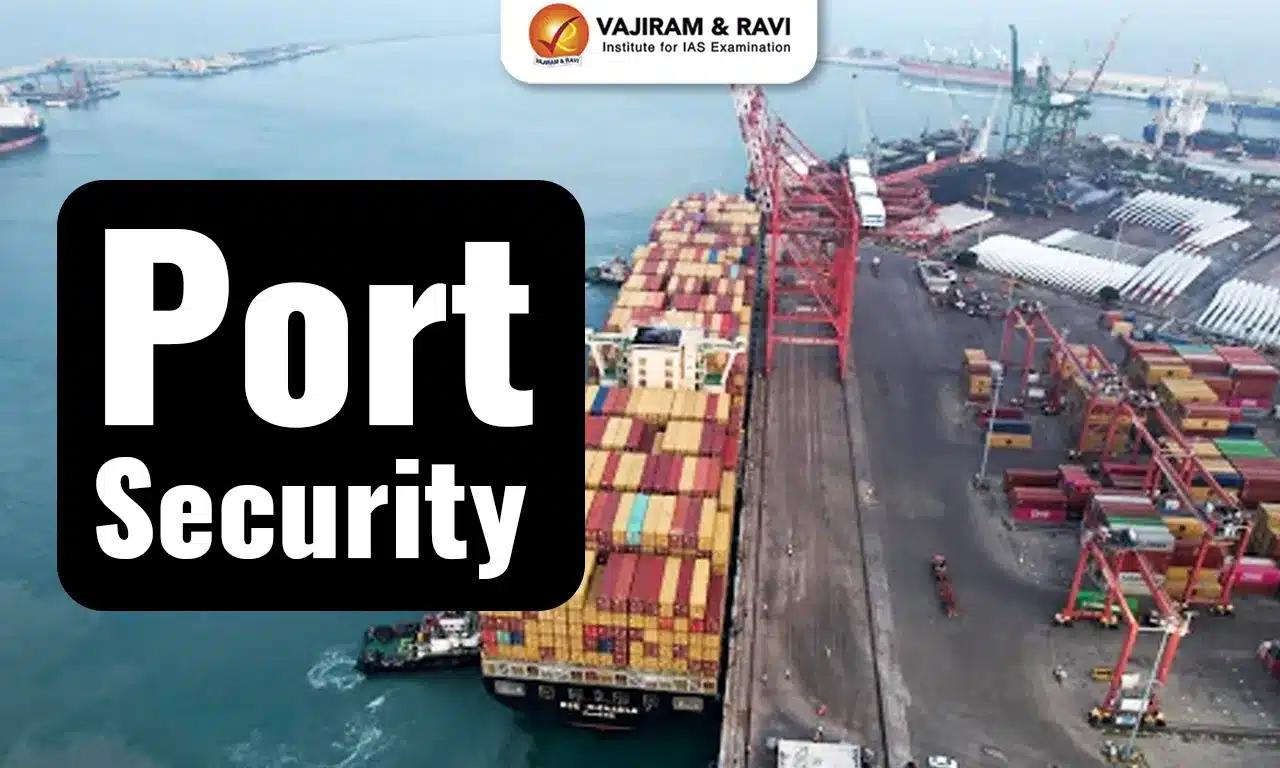
  • India has a long coastline of over 7,500 km and a rapidly expanding maritime economy. 
  • As of 2025, the country has 12 major ports and 217 non-major ports, of which 66 are cargo-handling ports, while the rest largely serve fishing and coastal activities. 
  • Major ports, administered by the Union government, handle more than half of India’s maritime cargo traffic. 
  • In recent years, India has witnessed a sharp rise in port capacity, coastal shipping, and inland waterway cargo movement.
  • This growth has significantly enhanced India’s trade connectivity and logistics efficiency, but it has also increased exposure to security threats such as smuggling, terrorism, cyber intrusions, and illegal migration through maritime routes. 
  • Ensuring secure ports and vessels has therefore emerged as a key national security priority.

Need for a Dedicated Port Security Authority

  • Until recently, India’s coastal and port security responsibilities were distributed across multiple agencies, including the Indian Navy, Coast Guard, CISF, State maritime police, and port authorities. 
  • While operational agencies remain crucial, the absence of a single statutory body for regulatory oversight and coordination often leads to gaps in communication, duplication of efforts, and uneven implementation of security standards.
  • Recognising these challenges, the government decided to establish a specialised institution that could function as the nodal regulator for port and ship security, similar to how aviation security is governed in India.

Bureau of Port Security: Mandate and Structure

  • The Bureau of Port Security (BoPS) has been constituted under Section 13 of the Merchant Shipping Act, 2025, as a statutory body. 
  • It functions under the Ministry of Ports, Shipping and Waterways and is modelled on the Bureau of Civil Aviation Security (BCAS).
  • The BoPS is responsible for regulatory oversight relating to the security of ships, port facilities, and maritime infrastructure. 
  • Its role is not operational in nature but focuses on standard-setting, compliance, coordination, and supervision across both major and non-major ports.

Key Functions of the Bureau of Port Security

  • The BoPS addresses a wide range of maritime security concerns. 
  • These include maritime terrorism, arms and drug trafficking, human trafficking, illegal migration, piracy, poaching, and other illicit activities carried out through sea routes.
  • A notable feature of the BoPS is its emphasis on cybersecurity. 
  • With ports increasingly dependent on digital systems, the Bureau is expected to monitor and protect port IT infrastructure from cyber threats, in coordination with national cybersecurity agencies.
  • The BoPS has the legal authority to ensure compliance with international obligations such as the International Ship and Port Facility Security (ISPS) Code, which mandates minimum security standards for ports and vessels engaged in international trade.

Role of CISF and Security Implementation

  • Under the BoPS framework, the Central Industrial Security Force (CISF) has been designated as a recognised security organisation. 
  • The CISF will prepare standardised security plans, conduct security assessments, and train private security agencies deployed at ports.
  • Security measures are to be implemented in a graded and risk-based manner, taking into account factors such as vulnerability, trade volume, location, and threat perception. This approach aims to balance security needs with ease of doing business.

Maritime Growth and Strategic Context

  • India’s maritime sector has expanded rapidly over the last decade. Cargo handled at ports increased from 974 million tonnes in 2014 to nearly 1,600 million tonnes by 2025. 
  • Ship turnaround time has halved, and coastal shipping volumes have more than doubled. Inland waterway cargo movement has increased eightfold during the same period.
  • The creation of the BoPS aligns with the Maritime India Vision 2030, which seeks to develop world-class port infrastructure, promote green shipping, and ensure a safe and secure maritime ecosystem.

Concerns and Criticism

  • Some coastal States have expressed concerns that recent port legislation, including the Indian Ports Act, 2025, increases Union government control over non-major ports, raising questions related to maritime federalism. 
  • There are also criticisms regarding wide inspection powers granted to port officials under the new legal framework, though these concerns relate to legislation as a whole rather than the BoPS specifically.

Source: TH

Port Security FAQs

Q1: What is the Bureau of Port Security?

Ans: It is a statutory body established under the Merchant Shipping Act, 2025 for regulatory oversight of port and ship security.

Q2: Which ministry oversees the BoPS?

Ans: The Ministry of Ports, Shipping and Waterways.

Q3: What international standard does the BoPS enforce?

Ans: The International Ship and Port Facility Security (ISPS) Code.

Q4: Which force supports BoPS in port security planning?

Ans: The Central Industrial Security Force (CISF).

Q5: Why is cybersecurity important for ports?

Ans: Modern ports rely heavily on digital systems, making them vulnerable to cyber threats.

Tunnel Safety Guidelines – Lessons from the Silkyara Collapse

Tunnel Safety Guidelines

Tunnel Safety Guidelines Latest News

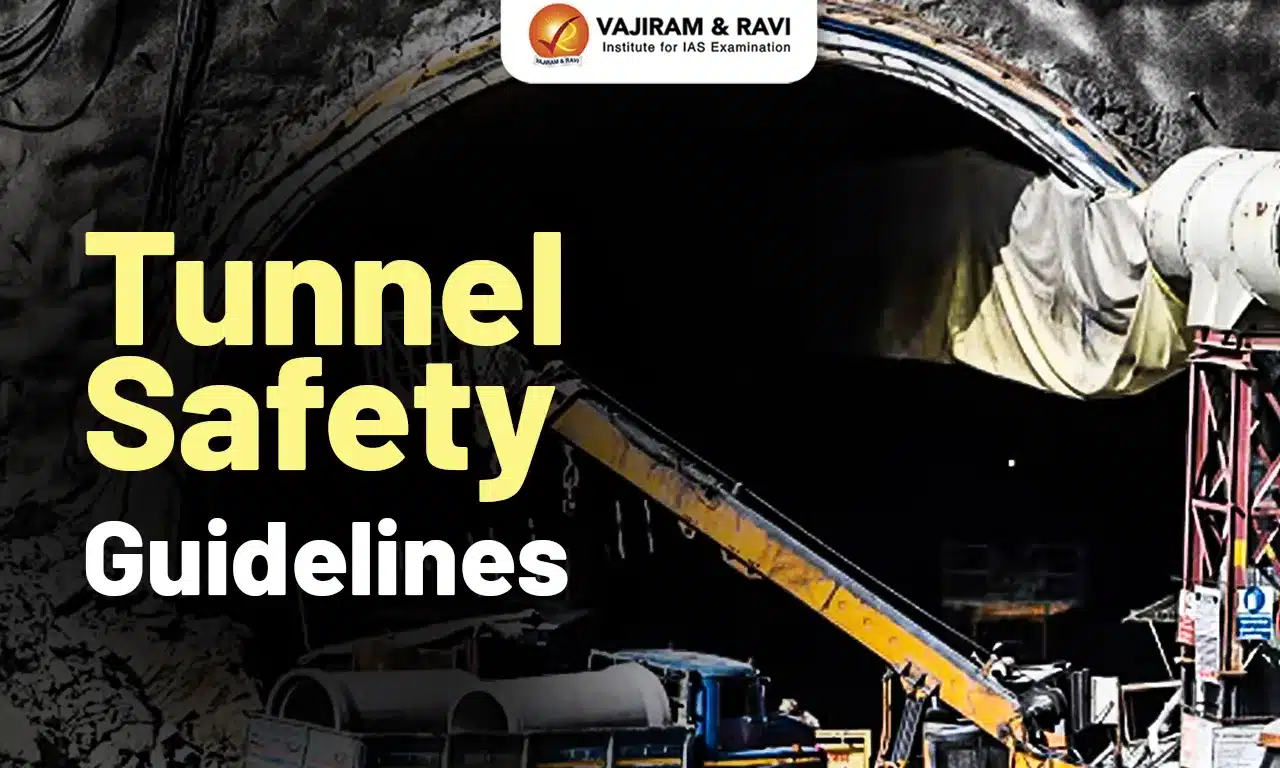
  • On November 12, 2023, the Silkyara Bend–Barkot Tunnel on NH-134 (Char Dham Mahamarg Pariyojana) collapsed, trapping 41 workers for 17 days. 
  • Though all were rescued safely, the incident exposed systemic weaknesses in tunnel planning, geological assessment, and emergency preparedness, especially in fragile Himalayan terrain.
  • In response, the Ministry of Road Transport and Highways (MoRTH) issued comprehensive guidelines to prevent and mitigate road tunnel collapses, particularly relevant for strategic and border area connectivity projects.

Why Tunnel Safety Matters

  • Tunnels enable seamless connectivity in mountainous, snow-bound, eco-sensitive, congested and border areas.
  • India’s expanding highway network under strategic and Char Dham projects has increased tunnelling activity, raising geological and safety risks.

Key Provisions of the New Guidelines

  • Strengthening planning (DPR, GBR and risk register):
    • Issues identified: Many Detailed Project Reports (DPRs) reduced to procedural formalities. Inadequate geological and geotechnical investigations.
  • Guidelines: 
    • Project authority responsible for verifying correctness of geological investigations.
    • Mandatory preparation of Geotechnical Baseline Report (GBR), risk register (hazards, risks, mitigation measures).
    • Principle of risk allocation: “Risk shall be borne by the party best equipped to manage it.”
    • GBR and risk register to be shared with bidders to ensure transparency and realistic costing.
  • Geological realities and design challenges:
    • Issues:
      • Tunnel design is critical as ground itself acts as a support system.
      • Predicting ground properties from limited tests is an oversimplification, especially in the Himalayas.
      • Poor investigations lead to time overruns, cost escalation, and safety failures.
    • Special conditions to be assessed: Squeezing and swelling ground, rock bursts, shallow cover zones, tunnels below perennial streams/nalas, hot water ingress, and toxic/flammable gases (long tunnels).
  • Tunnelling technologies (NATM vs TBM):
    • NATM (New Austrian Tunnelling Method): “Design-as-you-go” approach, suitable for non-uniform rock conditions, controlled blasting, and mandatory excavation and support sheet for each round.
    • TBM (Tunnel Boring Machine): Used in uniform geological stretches, requires vigilance against roof collapse and water ingress.
  • Collapse risk zoning and safety infrastructure: Tunnels to be classified into collapse-risk zones. High-risk zones must include Np-4 escape pipe (minimum 0.9 m diameter), mobile rescue containers, fixed rescue containers, minimum 24-hour survival capacity.
  • Emergency response and human capacity:
    • Shift managers must be trained as first responders.
    • Emergency Response Plan (ERP): Prepared in advance, updated weekly based on site conditions.

India’s Tunnel Infrastructure Snapshot

  • According to MoRTH’s reply in Parliament (December 12, 2024), a total of 42 tunnels covering 60.37 km in length in 27 projects of National Highways have been completed to date. 
  • Apart from this, 57 tunnels covering 93.96 km in length are currently under implementation in 37 projects on NHs in the country.
  • 3 tunnels covering 9.68 km in length have been approved for construction in 3 projects at an estimated cost of Rs 1,962 crore. 
  • One 6-lane project in Maharashtra costing Rs 4501 crore, including the construction of 2 tunnels having a total length of 3.47 km, has been apprised by Public Private Partnership Appraisal Committee (PPPAC).

Challenges and Way Forward

  • Weak DPR quality: Institutionalise scientific, data-driven DPRs.
  • Complex Himalayan geology: Integrate real-time geological monitoring.
  • Inadequate on-site emergency preparedness: Strengthen capacity-building of site managers. Periodic independent safety audits. 
  • Coordination gaps during rescue operations: Clear role definition for -
    • Incident commander (District Magistrate)
    • Construction agencies
    • Local administration
    • NDRF/SDRF commanders
    • The Armed Forces must ensure coordination, technical support, and responder safety.
  • Use guidelines as a template: For other infrastructure sectors (metros, hydropower).

Conclusion

  • The Silkyara tunnel collapse was a watershed moment in India’s infrastructure journey. 
  • MoRTH’s new guidelines mark a shift from procedural compliance to risk-based engineering, emphasising geological realism, accountability, and human safety. 
  • Effective implementation will be crucial to ensuring that India’s push for strategic connectivity and infrastructure-led growth does not come at the cost of lives and sustainability.

Source: IE

Tunnel Safety Guidelines FAQs

Q1: How did the Silkyara tunnel collapse influence India’s approach to road tunnel safety?

Ans: It exposed systemic flaws in DPR preparation and risk management, prompting MoRTH to issue comprehensive guidelines.

Q2: What is the significance of the Geotechnical Baseline Report (GBR) in tunnel projects?

Ans: GBR provides a realistic reference of ground conditions, improves risk allocation, and reduces disputes, cost overruns, and safety failures.

Q3: Why is tunnelling in the Himalayas particularly challenging compared to other regions?

Ans: Due to complex and unpredictable geology involving squeezing ground, rock bursts, water ingress, and shallow cover zones.

Q4: What is the difference between NATM and TBM as per MoRTH guidelines?

Ans: NATM follows a “design-as-you-go” approach for variable geology, while TBM is suited for long stretches of uniform rock formations.

Q5: How do MoRTH’s new guidelines strengthen emergency preparedness in tunnel projects?

Ans: By mandating risk zoning, escape pipes, rescue containers, trained shift managers, and regularly updated Emergency Response Plans.

Enquire Now