
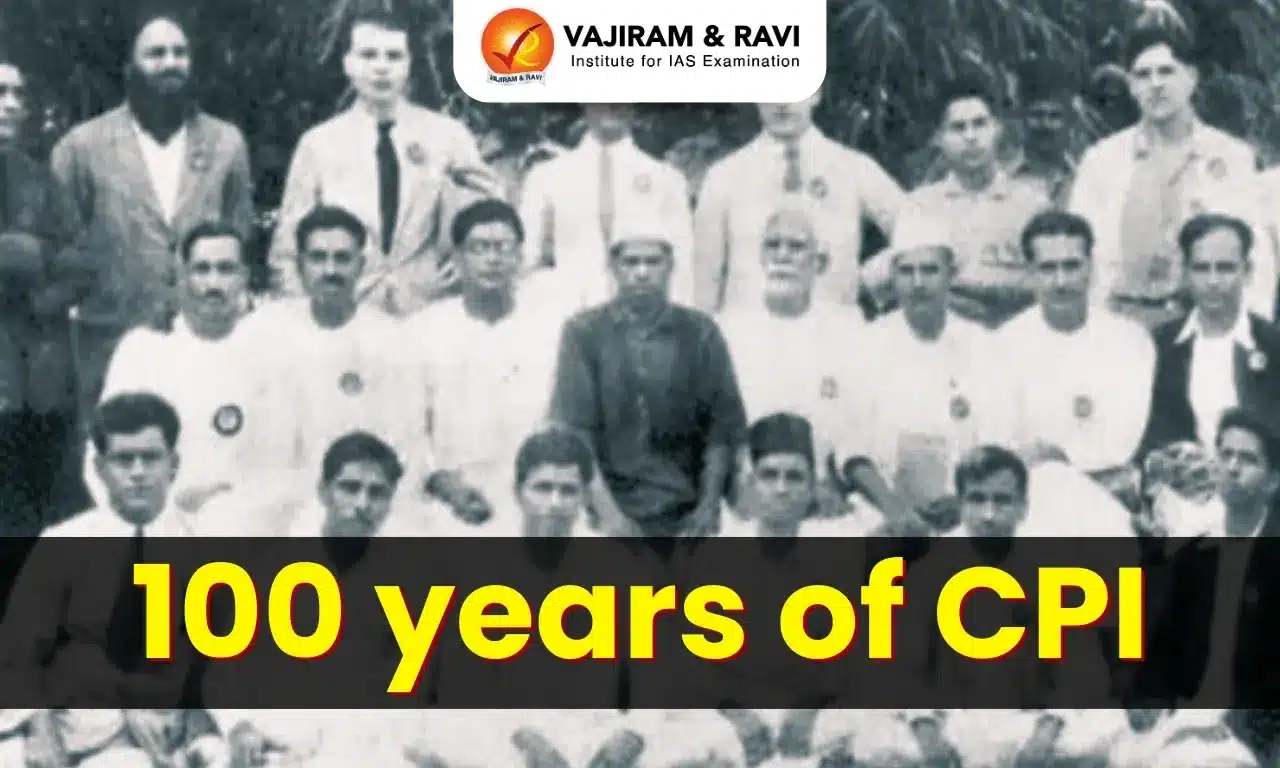
100 Years of CPI: Origins, Ideology, Freedom Struggle and Constitutional Legacy

100 Years of CPI

100 years of CPI Latest News

  • The Communist Party of India (CPI) has completed 100 years, tracing its origins to the Kanpur conference of December 26, 1925. 
  • The milestone has renewed attention on how communism took root in India, its ideological influences, organisational evolution, and role in the freedom struggle.

Global Antecedents of Indian Communism

  • The roots of communism lie in European political upheavals after the French Revolution (1789) and Napoleonic Wars (1796–1815), which polarised society between defenders of monarchy and advocates of republican change.
  • The Industrial Revolution intensified inequalities, creating fertile ground for socialist ideas.
  • Karl Marx, writing in 19th-century Europe, argued for a transition from capitalism to socialism.
  • While Marx expected socialist revolutions in advanced capitalist societies, the first successful socialist revolution occurred in Russia in 1917, a relatively backward, Tsarist empire.
  • The Russian Revolution combined anti-feudal, anti-capitalist, and anti-imperialist elements, making it especially attractive to colonised countries like India.

Three Political Strands Behind CPI’s Formation

  • Indian communism emerged from three distinct but converging strands:

The MN Roy–Comintern Strand

  • MN Roy, a revolutionary who lived in the US, Mexico, Berlin, and later the USSR, played a pivotal role.
  • He attended the 1920 Comintern (Communist International) meeting as India’s representative.
  • The Comintern assessed how communism could adapt to colonial conditions, influencing Indian communists.
  • There were other groups of diasporic Indian revolutionaries active in Berlin, led by Virendranath Chattopadhyay, and Kabul, led by Raja Mahendra Pratap.

Independent Left Groups in India

  • Separate Left formations emerged in Lahore (Ghulam Hussain), Bombay (S A Dange), Calcutta (Muzaffar Ahmad), and Madras (Singaravelu Chettiar).
  • These groups operated independently but shared anti-imperialist and socialist goals.

Worker–Peasant Organisations

  • Trade unions and peasant bodies such as the All-India Trade Union Congress (AITUC), formed in 1920, provided a mass base.
  • These organisations linked socialism with labour and agrarian struggles.

Origin Story: Tashkent vs Kanpur Debate

  • 1920, Tashkent
    • Four Indian revolutionaries (including MN Roy and Abani Mukherji) set up a Communist Party under Comintern influence.
    • Aim: liberate India from British rule and establish socialism.
    • However, it lacked support from Indian-based Left groups and the diaspora.
  • 1925, Kanpur Conference
    • Indian communist groups organised a national conference in Kanpur, resolving to form the Communist Party of India.
    • Objectives included:
      • Ending British rule
      • Establishing a workers’ and peasants’ republic
      • Socialising the means of production and distribution
  • Key ideological divide
    • The CPI(M) later traced its origins to Tashkent (1920), emphasising internationalism.
    • The CPI identified Kanpur (1925) as the foundation, highlighting the Indian component of communism.

Social Reform and Anti-Oppression Stance

  • Early Communists opposed not only colonial exploitation but also caste oppression and patriarchy. 
  • At Kanpur, conference chair M Singaravelu condemned untouchability. 
  • The CPI became the first organisation to bar members of communal bodies, underscoring its secular and inclusive ethos.

Role in the Freedom Struggle (1925–1947)

  • 1925–28: Communists were active in organising workers’ and peasants’ movements.
  • 1929: Leaders were arrested in the Meerut Conspiracy Case, accused of organising railway strikes; many were jailed or deported.
  • 1930s: Communists worked with the Congress Socialist Party in a United Front against imperialism.
  • 1939: The United Front collapsed due to ideological and political differences.
  • Post-1945: Communists led major peasant struggles, especially in Bengal and Telangana.

Shaping the Constitution and Mass Mobilisation

  • Communist influence was evident in Constituent Assembly debates on land reforms, workers’ rights, and protections for backward classes. 
  • Movements like the Telangana Rebellion showcased commitment to agrarian justice. 
  • The CPI mobilised society through organisations such as the All India Trade Union Congress, All India Kisan Sabha, All India Students’ Federation, and the Progressive Writers’ Association, embedding ideals of liberty, equality, fraternity, and justice in post-Independence discourse.

Post-Independence Trajectory

  • After 1947, Indian communists followed divergent paths:
    • Some adopted armed, insurrectionary strategies.
    • Others chose the parliamentary democratic route, seeking power through elections.
  • These differences eventually led to splits within the communist movement, most notably in 1964 (CPI–CPI(M) split).

Source: IE | IE

100 years of CPI FAQs

Q1: Why is 100 years of CPI significant?

Ans: The centenary marks the CPI’s formation in 1925 and renews focus on its role in India’s freedom struggle, social reform movements, and constitutional development.

Q2: What global ideas influenced the CPI?

Ans: European political upheavals, Marxist thought, the Industrial Revolution, and the 1917 Russian Revolution deeply shaped the ideological foundations of Indian communism.

Q3: What were the main strands behind CPI’s formation?

Ans: Indian communism emerged from the MN Roy–Comintern strand, independent Left groups across cities, and mass worker–peasant organisations like AITUC.

Q4: How did CPI contribute to India’s independence movement?

Ans: CPI organised workers and peasants, demanded Poorna Swaraj early, faced colonial repression, and led major struggles such as those in Bengal and Telangana.

Q5: How did CPI influence the Indian Constitution?

Ans: Communists shaped debates on land reforms, workers’ rights, and social justice, reinforcing constitutional values of equality, fraternity, and economic rights.


Four New Regional Airlines in India: Why Success Is Uncertain Despite NOCs

Regional Airlines

Regional airlines Latest News

  • The Ministry of Civil Aviation has issued no-objection certificates (NOCs) to two new regional airlines—Al Hind Air and FlyExpress—bringing the total number of proposed regional carriers to four. 
  • Two others, Air Kerala and Shankh Air, received NOCs last year but are yet to secure Air Operator Certificates (AOCs) and begin flights.
  • While the government is keen to expand domestic aviation in one of the world’s fastest-growing markets, the regional airline segment remains high-risk, with a history of more failures than successes.

What an NOC Allows—and How It’s Granted

  • Issued by the Ministry of Civil Aviation, an NOC lets applicants set up offices, hire staff, and pursue further approvals. 
  • It’s granted after assessing financial soundness, operational plans, and security clearances, and is typically valid for three years.

Duopoly Worries After IndiGo Disruption

  • The announcement of new regional airlines comes weeks after a major operational disruption at IndiGo, which renewed concerns about India’s airline duopoly.
  • Together, IndiGo and the Air India group command over 90% of the domestic market, heightening risks from over-concentration.
  • In this context, the NoC is being read as a signal to encourage competition, though experts urge caution.

New Entrants Unlikely to Shift Market Shares

  • While fresh regional players are a positive signal, experts doubt they will significantly dent the dominance of the two majors. 
  • The tougher question is whether these startups can survive India’s unforgiving aviation economics.

The New Regional Players

  • Al Hind Air: Backed by the Kerala-based Al Hind Group; plans a regional commuter model using ATR-72 turboprops.
  • FlyExpress: Plans yet to be detailed publicly.
  • Air Kerala: Envisions an ultra-low-cost carrier (ULCC) connecting tier-2 and tier-3 cities to major hubs with turboprops; despite an NOC last year, it has struggled to induct aircraft—required for an AOC from the Directorate General of Civil Aviation.
  • Shankh Air: Promoted by UP-based entrepreneur; aims to operate regional routes within and beyond Uttar Pradesh from the upcoming Noida International Airport, with operations planned in the coming months.

Why Regional Airlines Struggle in India

  • Despite a few successes—Star Air, Fly91, and government-owned Alliance Air—India’s regional aviation space has seen many collapses. 
  • Past failures include Paramount Airways, Air Pegasus, TruJet, Zoom Air, Air Carnival, Air Costa, Air Mantra, and Air Odisha. 
  • More recently, Fly Big suspended operations in October.

Structural Challenges in the Market

  • India is a tough aviation market, especially for small carriers. 
  • High price sensitivity, thin profit margins, high debt, and dollar-denominated costs (fuel, leasing, maintenance) favour large airlines with scale, efficient fleets, and deep pockets. 
  • Most regional airlines lack the financial resilience to withstand shocks.

Demand Constraints at Smaller Airports

  • Regional routes often suffer from limited and seasonal demand, while most passenger traffic remains concentrated at major hubs. 
  • This makes load factors volatile and route planning risky for small carriers.

Financing and Revenue Limitations

  • Without backing from a major airline group, regional carriers struggle to access finance and debt, as lenders perceive higher risk. 
  • Short-haul routes also face stiff competition from trains and road transport, and offer fewer opportunities for ancillary revenues like belly cargo.

What Could Improve Viability

  • There is cautious optimism that a growing, upwardly mobile middle class could improve regional airline prospects. 
  • Success will hinge on lean operations, serving genuinely underserved regions, building dominance in specific geographies, and—crucially—strong financial backing to sustain operations through inevitable downturns.

Source: IE | LM

Regional airlines FAQs

Q1: Why are regional airlines in India in the news?

Ans: The government has issued NOCs to new regional airlines, raising hopes of competition amid concerns over IndiGo–Air India dominance.

Q2: Does an NOC allow an airline to start flying?

Ans: No. An NOC only permits initial setup. Airlines must obtain an Air Operator Certificate after inducting aircraft and completing regulatory checks.

Q3: Why is India’s aviation market tough for regional airlines?

Ans: High price sensitivity, thin margins, dollar-linked costs, debt burdens, and intense competition favour large airlines over small regional carriers.

Q4: Why can’t new regional airlines break the duopoly?

Ans: Experts say small airlines lack scale, capital, and resilience to challenge IndiGo and Air India, which together control over 90% of domestic capacity.

Q5: What could improve the viability of regional airlines?

Ans: Lean operations, focus on underserved routes, strong regional presence, and solid financial backing could improve survival chances as demand matures.

Linking NATGRID with NPR – Implications for Internal Security and Privacy

NATGRID

NATGRID Latest News

  • The government has linked the National Intelligence Grid (NATGRID) with the National Population Register (NPR), enabling security agencies to access family-wise data of nearly 119 crore residents.

Background: National Intelligence Grid (NATGRID)

  • The National Intelligence Grid (NATGRID) is a secure and integrated data-sharing platform developed to assist law enforcement and intelligence agencies in India. 
  • Conceived after the 26/11 Mumbai terror attacks, NATGRID aims to enable real-time access to multiple government and private databases for faster investigation and intelligence gathering.
  • Operationalised in recent years, NATGRID links datasets such as banking transactions, telecom records, travel data, vehicle registration, and identity documents. 
  • Initially restricted to a limited number of central agencies, access has now been expanded to include State police forces, particularly officers of Superintendent of Police rank and above.
  • The core objective of NATGRID is to overcome information silos between agencies and improve coordination in tackling terrorism, organised crime, financial fraud, and transnational criminal networks.

National Population Register (NPR)

  • The National Population Register is a comprehensive database containing demographic and family-wise details of residents in India. 
  • It was first compiled during the 2011 Census and later updated in 2015 through door-to-door enumeration. 
  • The NPR includes information such as name, age, gender, address, and family relationships.
  • The NPR is considered the first step towards the creation of a National Register of Citizens (NRC), although the government has clarified that no decision has been taken to update the NPR during the forthcoming Census exercise. 
  • Despite this, the NPR remains one of the largest repositories of personal data in the country.

News Summary

  • The Union Home Ministry has linked NATGRID with the NPR, allowing authorised police and security agencies to access family-wise details of nearly 119 crore residents through a secure platform. 
  • This integration enables investigators to trace relationships, household details, and identity linkages while probing criminal or terror-related cases. 
  • According to officials, upgraded analytical tools within NATGRID, such as “Gandiva”, can perform entity resolution, facial recognition, and multi-source data analysis. 
  • If a suspect’s image or identity detail is available, the system can match it with databases such as telecom KYC, driving licences, vehicle registrations, and travel records, thereby reducing investigation time.
  • Requests on NATGRID are categorised as non-sensitive, sensitive, and highly sensitive. 
  • Financial records, tax data, and banking information fall under the highly sensitive category, with access subject to additional safeguards. 
  • Each query is logged, the purpose must be specified, and senior officers provide oversight to ensure accountability.
  • The government has encouraged States to make wider use of NATGRID for intelligence-led policing and faster resolution of criminal cases.

Significance for Internal Security

  • The integration of NATGRID with NPR significantly strengthens India’s internal security framework. 
  • By enabling real-time access to verified demographic and relational data, security agencies can identify suspects, dismantle organised crime networks, and track terror financing more efficiently.
  • The move also supports coordinated action between central and State agencies, especially in counter-terrorism operations, narcotics control, and financial crime investigations. 
  • From a governance perspective, it reflects India’s shift towards technology-driven policing and data-based decision-making.

Concerns Related to Privacy and Civil Liberties

  • Despite its security benefits, the NATGRID–NPR linkage has raised concerns about data privacy and potential misuse. 
  • Since agencies can access vast amounts of personal data without necessarily registering a First Information Report (FIR), critics argue that this could weaken procedural safeguards.
  • India currently lacks a fully operational data protection law, which makes issues of consent, proportionality, and redress mechanisms especially relevant. 
  • The government has maintained that strict access controls, audit trails, and hierarchical approvals are in place, but the debate highlights the need to balance national security with individual rights.

Way Forward

  • To ensure public trust, the use of NATGRID must be accompanied by robust legal safeguards, clear accountability mechanisms, and parliamentary oversight. 
  • The operationalisation of a comprehensive data protection framework will be critical in defining limits on data access and ensuring proportional use.
  • For India, the challenge lies in leveraging technology to enhance security while upholding constitutional values of privacy and due process.

Source: TH

NATGRID FAQs

Q1: What is NATGRID?

Ans: NATGRID is a secure data-sharing platform that allows law enforcement agencies to access multiple databases for intelligence and investigation.

Q2: What information does the NPR contain?

Ans: The NPR stores family-wise demographic details of residents collected during Census-related exercises.

Q3: Why was NATGRID linked with NPR?

Ans: To enable faster access to verified family and identity data for security and criminal investigations.

Q4: Who can access NATGRID data?

Ans: Access is currently available to authorised central agencies and State police officers of Superintendent rank and above.

Q5: What is the main concern with this integration?

Ans: The primary concern relates to privacy, data misuse, and the absence of a comprehensive data protection law.

Enquire Now

