
Himachal Apple Import Duty: Why Farmers Want 100% Protection

Himachal Apple Import Duty

Himachal Apple Import Duty Latest News

  • Himachal Pradesh Chief Minister has urged the Centre to raise import duty on foreign apples from 50% to 100% and impose a seasonal ban on imports from July to November to protect about 2.5 lakh apple farmers. Apples account for nearly 80% of the state’s fruit output. 
  • The demand follows the Centre’s decision to cut import duty on New Zealand apples to 25% for April–August under the India–New Zealand FTA. 
  • Jammu and Kashmir has echoed similar concerns, warning that rising imports add to existing challenges faced by domestic apple growers.

India Cuts Import Duty on New Zealand Apples Under FTA

  • Under the India–New Zealand Free Trade Agreement, India has reduced import duty on New Zealand apples from 50% to 25% under a quota system. 
  • The quota starts at 32,500 tonnes in the first year and rises to 45,000 MT by the sixth year. 
  • Imports must meet a minimum import price of $1.25 (₹113.6) per kg, while shipments beyond the quota will continue to attract the higher 50% duty.

Apple Production in India: J&K and Himachal at the Core

  • India produces around 28 lakh metric tonnes (LMT) of apples annually. 
  • Jammu & Kashmir dominates output with about 20 LMT, followed by Himachal Pradesh at 5–6 LMT. 
  • The remaining production comes from Uttarakhand and a few north-eastern states, where cultivation is still nascent.
  • The apple economy is valued at roughly ₹12,000 crore in J&K and ₹4,500 crore in Himachal Pradesh, making growers in these two states the most vulnerable to increased imports and tariff concessions.

Farmers’ Concerns Over Cheaper Imports

  • Apple growers are worried about the overlap between New Zealand’s export window and India’s off-season market. 
  • In India, apples are harvested between July and November, while off-season sales depend on cold storage and Controlled Atmosphere (CA) facilities. 
  • New Zealand, however, harvests apples between January/February and May, allowing it to supply fresh apples when Indian farmers sell stored produce.

Impact on Domestic Prices and Sales

  • Farmers warn that lower import duties will make foreign apples cheaper than domestic produce, directly affecting sales. 
  • In Jammu & Kashmir, high-density varieties like Gala arrive in June, while Royal Delicious reaches markets by September. 
  • Since the duty cut applies from April to August, growers fear significant losses during peak marketing periods.

Threat to Market Share

  • Orchardists from Himachal Pradesh and Jammu & Kashmir argue that cheaper imports will depress domestic prices, reduce market share.
  • It will hit farmers hardest during the off-season, undermining incomes in India’s key apple-producing regions.

Challenges Beyond Import Competition

  • Climate Stress and Falling Yields - Apple production in HP and J&K has been hit hard by climate change, erratic weather, reduced snowfall, prolonged dry spells, floods, cloudbursts and landslides. 
    • These factors have weakened orchards and lowered productivity.
  • Rising Disease Burden - Changing climatic conditions have led to a surge in plant diseases such as fire blight, apple scab, powdery mildew, sooty blotch and bitter rot. 
    • Reduced snowfall and higher temperatures have worsened water scarcity, increasing disease vulnerability during dry seasons.
  • Production Losses and Quality Decline - In 2023, Himachal’s apple output fell to 4.84 LMT, nearly 28% lower than 2022, following devastating floods. 
    • Although production recovered to 6.87 LMT in 2025, excessive rainfall and disasters caused quality deterioration, with nearly 1 LMT rejected for poor size and quality.
  • Infrastructure and Transport Bottlenecks - Logistical disruptions have compounded farmers’ problems. 
    • The prolonged closure of the Jammu–Srinagar National Highway (NH-44) due to landslides last year stranded hundreds of trucks during peak harvest, delaying market access and causing losses.

Farmers’ Demands for Protection

  • Given these cumulative pressures, farmers’ groups have demanded 100% import duty on foreign apples, a July–November import ban, special category protection, and higher subsidies. 
  • They argue that unlike countries such as New Zealand, where apple farming is heavily subsidised and insured, Indian growers receive limited direct support.
  • Farmer leaders stress that instead of increasing exposure to foreign competition, the government should focus on targeted support, productivity enhancement, and resilience-building for domestic apple growers.

Source: IE

Himachal Apple Import Duty FAQs

Q1: Why is the Himachal apple import duty in news?

Ans: The Himachal apple import duty is debated after the state sought a hike to 100% and a seasonal ban to protect farmers from cheaper New Zealand imports.

Q2: What triggered concerns over the Himachal apple import duty?

Ans: Concerns rose after India cut duty on New Zealand apples to 25% under an FTA, increasing competition during India’s apple marketing season.

Q3: How many farmers depend on the Himachal apple economy?

Ans: Around 2.5 lakh farmers depend on apples in Himachal Pradesh, making the Himachal apple import duty crucial for rural incomes.

Q4: Why are New Zealand apples a threat to Indian growers?

Ans: They enter India when domestic apples rely on storage, undercutting prices if the Himachal apple import duty remains low.

Q5: What additional challenges do apple farmers face besides imports?

Ans: Climate change, diseases, transport disruptions, and falling yields compound risks, intensifying demands for higher Himachal apple import duty.

Combating ‘Digital Arrest’ Scams – Kill Switch and Fraud Insurance as India’s New Digital Safety Nets

Digital Arrest

Digital Arrest Latest News

  • India is witnessing a sharp rise in digital frauds, particularly the phenomenon of “digital arrest” scams, leading to massive financial losses and erosion of trust in digital payments. 
  • In response, a high-level inter-departmental committee (IDC) constituted by the Ministry of Home Affairs (MHA) is examining systemic solutions, including a transaction “kill switch” and a fraud insurance mechanism. 

‘Digital Arrest’ Scams

  • Meaning:
    • Cyber-enabled fraud: Fraudsters impersonate law enforcement officials via video calls. Victims are shown fake IDs, arrest warrants, and threatened with arrest. Leaked personal data is used to build credibility.
    • Social engineering: Victims are kept under psychological pressure for hours and coerced into transferring money to mule accounts.
  • Estimated losses: Victims across India are believed to have collectively lost nearly Rs 3,000 crore to digital arrest scams, prompting the Supreme Court to take suo motu cognizance of the issue.

Key Proposals Under Consideration

  • Transaction ‘Kill Switch’:
    • An emergency button embedded in UPI apps, and banking/payment applications.
    • Once activated all banking and financial transactions are instantly frozen, preventing further outflow of funds during suspected fraud.
    • It aims to create last-mile consumer protection, and real-time intervention in fraud scenarios.
  • Tracking and blocking fraudulent transactions: Exploring systems to identify suspicious transactions, prevent instant splitting of funds into multiple mule accounts, and address rapid laundering techniques used by fraud networks.
  • Fraud insurance mechanism:
    • Proposal to introduce insurance coverage for fraud-related losses in banking.
    • Driven by increasing scale and sophistication of digital frauds, and recognition that traditional audits and compliance are insufficient.
    • RBI’s evolving stance - Shift from viewing fraud as merely a compliance issue to a systemic and balance-sheet risk.

Insurance Framework Involved

  • The IDC is chaired by Special Secretary (Internal Security), MHA, with representatives from:
    • Ministry of Electronics and Information Technology (MeitY), 
    • Department of Telecommunications (DoT), 
    • Ministry of External Affairs (MEA), 
    • Department of Financial Services (DFS), 
    • Ministry of Law & Justice (MoLJ), 
    • Ministry of Consumer Affairs (MoCA), 
    • Reserve Bank of India (RBI), 
    • CBI, NIA, Delhi Police, and 
    • The Indian Cyber Crime Coordination Centre (I4C) (with the CEO, I4C acting as Member-Secretary).
  • Additionally: MeitY met major IT intermediaries (Google, WhatsApp, Telegram, Microsoft) earlier.

Role of RBI and Insurance Sector

  • RBI observations:
    • There were 23,879 fraud cases involving an amount of Rs 34,771 crore as of 2024-25. 
    • The RBI’s Payment Vision 2025 report has proposed studying the feasibility of setting up a Digital Payment Protection Fund (DPPF) to provide security cover to defrauded customers and payment instrument issuers.
  • Expert view: Existing cyber insurance does not cover first-party fraud losses, especially those caused by customer manipulation.
  • Preferred option - Insurance pool model:
    • Backed by contributions from banks, insurers and potentially supported by regulatory frameworks – that could spread fraud risk across the system.
    • This will be similar to terrorism insurance pools in several countries. 
    • Such a structure would help manage tail risks while keeping premiums affordable.

Key Challenges and Way Ahead

  • Operational complexity: Avoiding misuse or accidental triggering of the kill switch.
    • Technology-based safeguards - AI-driven fraud detection and transaction velocity checks.
  • Interoperability: Uniform adoption across banks, UPI platforms, and fintech apps.
    • Strengthened coordination - Banks–Insurers–Regulators–Tech platforms partnership.
  • Moral hazard: Risk of reduced consumer vigilance if insurance is guaranteed.
    • Consumer awareness - Nationwide campaigns on digital arrest scams.
  • Regulatory coordination: RBI, IRDAI, MeitY, and banks must act in sync. 
    • Regulatory clarity - Clear SOPs for kill switch activation and reversal.
    • Legal backing - Amendments to IT and banking regulations for rapid response.
  • Coverage gaps: Current cyber insurance inadequate for social engineering frauds.
    • Insurance innovation - Creation of a fraud insurance pool under IRDAI leadership.

Conclusion

  • India’s rapid digitalisation has outpaced traditional risk-control mechanisms, making digital fraud a systemic threat rather than a mere compliance issue. 
  • The proposed initiatives represent a paradigm shift towards proactive, consumer-centric and system-wide protection. 
  • If implemented with robust safeguards, regulatory coordination and public awareness, these measures can significantly enhance the resilience and credibility of India’s digital financial ecosystem.

Source: IE

Digital Arrest FAQs

Q1: What are ‘digital arrest’ scams?

Ans: Digital arrest scams are cyber-enabled social engineering frauds where criminals impersonate law enforcement to coerce victims.

Q2: How does the proposed ‘transaction kill switch’ strengthen consumer protection?

Ans: It provides real-time consumer empowerment by instantly freezing all financial transactions during suspected fraud.

Q3: Why are traditional banking controls insufficient to tackle modern digital frauds?

Ans: They are reactive, whereas modern digital frauds are fast, distributed, and driven by social engineering.

Q4: What is the rationale for a fraud insurance pool in India’s banking system?

Ans: It spreads systemic digital fraud risk across banks and insurers, manages tail risks, and ensures affordable protection.

Q5: How does a high-level inter-departmental committee reflect India’s governance approach to cyber fraud?

Ans: It reflects a whole-of-government approach, integrating institutions to address cyber fraud holistically.

Pax Silica and India – Securing Critical Technology Supply Chains

Pax Silica

Pax Silica Latest News

  • India is likely to be invited to join the U.S.-led Pax Silica initiative aimed at securing global semiconductor, AI, and critical mineral supply chains.

Understanding Pax Silica

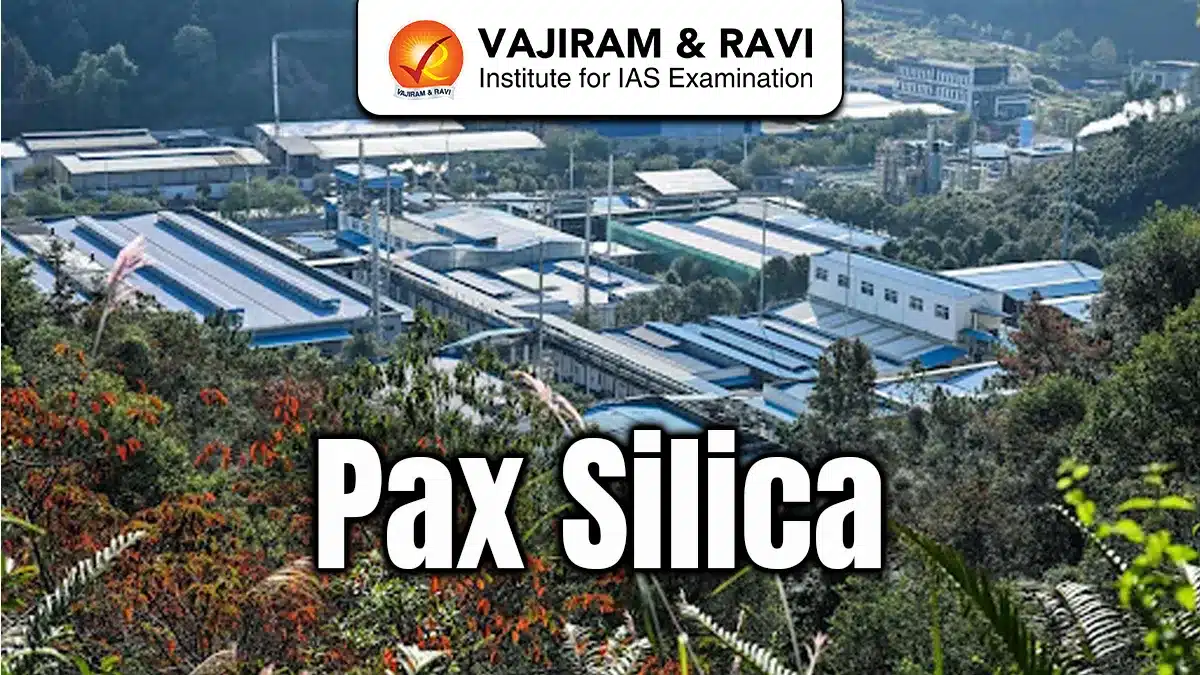
  • Pax Silica is a multilateral initiative launched by the United States in December 2025 to secure supply chains of critical technologies such as semiconductors, artificial intelligence (AI), and rare earth elements (REEs). 
  • The term “Pax” denotes peace, while “Silica” refers to silicon-based semiconductor technologies, symbolising a stable and cooperative global technology order.
  • The Pax Silica Declaration emphasises three core objectives: 
    • Reducing coercive economic dependencies, 
    • Ensuring secure global technology and AI supply chains, and 
    • Building trusted digital infrastructure. 
  • The initiative reflects growing concerns that over-dependence on a single country for critical inputs can expose economies to geopolitical coercion.

Global Context Behind Pax Silica

  • The global economy is witnessing a shift where advanced technologies such as AI, semiconductors, and digital infrastructure are becoming central to economic and strategic power. 
  • At the same time, supply chains for rare earths and critical minerals remain highly concentrated.
  • China currently dominates the global supply of rare earth elements and processing capabilities. 
  • In recent years, it has used export restrictions as a strategic tool, including suspending REE exports following tariff disputes with the U.S. India too faced disruptions in rare-earth magnet supplies, affecting its automobile and electronics industries.
  • The COVID-19 pandemic further exposed vulnerabilities of globally fragmented and concentrated supply chains, prompting countries to pursue diversification and resilience strategies.

Key Members of Pax Silica

  • The Pax Silica grouping brings together technologically advanced and resource-rich countries. 
  • Key participants include the United States and Japan as technology leaders; Australia as a major lithium and rare-earth exporter; the Netherlands for advanced lithography technologies; South Korea for memory chip manufacturing; and Singapore for semiconductor fabrication.
  • Israel contributes expertise in AI software, defence technologies, and cybersecurity, while the United Kingdom hosts one of the world’s largest AI markets. 
  • Gulf countries such as Qatar and the UAE add financial strength through sovereign investment funds. 
  • Canada, the European Union, OECD, and Taiwan currently participate as observers.

India’s Strategic Relevance

  • India is not yet a formal member but is expected to be invited soon. India brings several strengths to Pax Silica. 
  • It has one of the world’s most robust digital public infrastructures, a rapidly growing AI market, and a large pool of skilled technology professionals.
  • The Government of India has also launched the India Semiconductor Mission and national AI initiatives with significant financial support. 
  • Investments by Indian firms such as the Tata Group and foreign companies like Micron indicate growing confidence in India’s semiconductor ecosystem. 
  • Additionally, a steady return of skilled Indian professionals trained abroad could strengthen domestic capabilities.

Existing Supply Chain Initiatives Involving India

  • India has already taken steps to enhance supply chain resilience. In 2021, it joined Australia and Japan in launching the Supply Chain Resilience Initiative
  • India is also part of the Quad’s Critical Minerals Initiative, aimed at securing emerging technology supply chains.
  • Collaborations with Japan, Singapore, and Israel in semiconductor manufacturing further position India as a credible partner in Pax Silica-aligned ecosystems.

Challenges for India in Joining Pax Silica

  • Despite the opportunities, India faces challenges. Pax Silica members are largely high-income U.S. allies, whereas India would be the first developing country and non-ally strategic partner in the grouping. 
  • This may create expectation gaps on policy alignment and strategic responses.
  • India also prioritises strategic autonomy and may resist frameworks that constrain independent foreign or economic policy choices. 
  • Moreover, India may seek to protect its nascent semiconductor and AI industries through subsidies, procurement preferences, and calibrated import controls, policies that may not fully align with the current U.S. policy environment.

Strategic Implications and the Road Ahead

  • The emergence of Pax Silica signals the likelihood of two parallel global technology supply chains, one centred around China and the other around Pax Silica countries. 
  • Given India’s long-standing technological collaboration with Western economies and recent supply disruptions from China, aligning with Pax Silica appears strategically advantageous.
  • However, India is expected to proceed cautiously, engaging in dialogue to ensure that participation strengthens domestic capabilities without compromising strategic autonomy or development priorities.

Source : TH

Pax Silica FAQs

Q1: What is Pax Silica?

Ans: Pax Silica is a U.S.-led initiative aimed at securing global semiconductor, AI, and critical mineral supply chains.

Q2: Why is Pax Silica important for India?

Ans: It can help India reduce dependence on China and strengthen its semiconductor and AI ecosystems.

Q3: Which countries are part of Pax Silica?

Ans: Members include the U.S., Japan, Australia, South Korea, the Netherlands, Singapore, and others.

Q4: What challenges could India face in joining Pax Silica?

Ans: Balancing strategic autonomy, policy flexibility, and expectations of high-income member countries.

Q5: How does Pax Silica impact global geopolitics?

Ans: It signals the emergence of competing technology supply chains led by China and Pax Silica countries.

Trump Trade Wars: How U.S. Protectionism Is Strengthening China

Trump Trade Wars

Trump Trade Wars Latest News

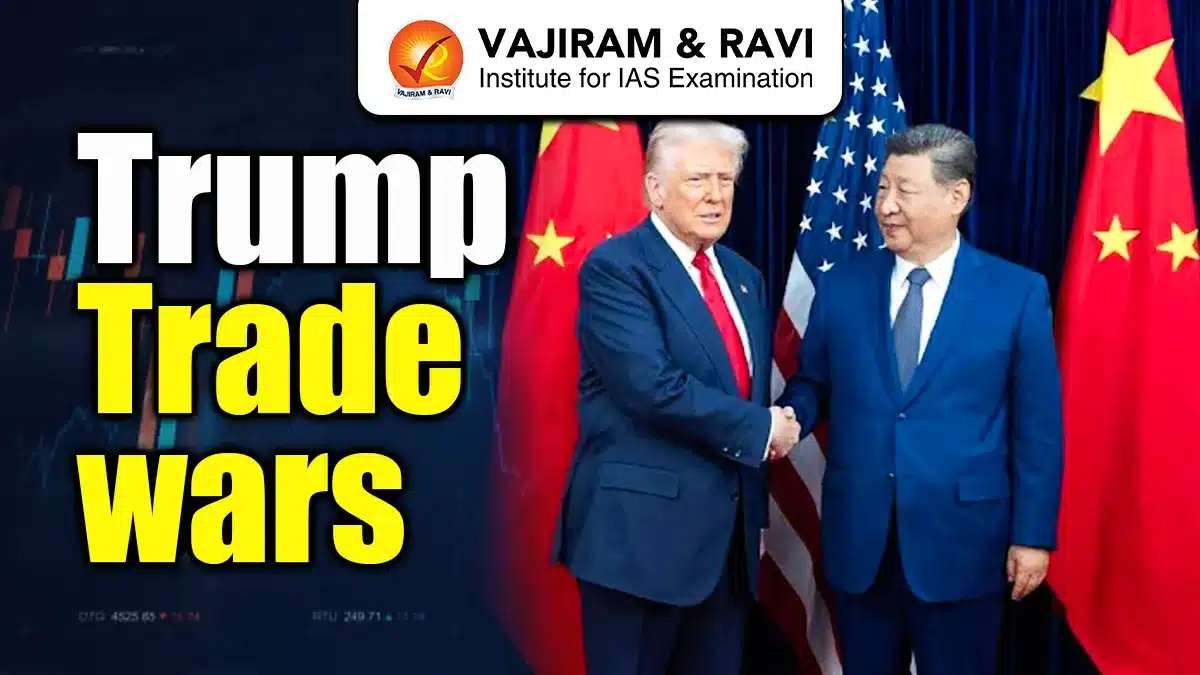
  • US President Donald Trump’s second term has triggered sweeping geopolitical and economic disruptions, with his aggressive trade and foreign policies paradoxically strengthening China’s global economic position.
  • In his first year back in office, President Trump signed hundreds of executive orders, launched a renewed trade war, withdrew the US from key international institutions, ordered mass deportations, and undertook military actions in Yemen, Iran, and Nigeria, reshaping global stability.

Trump’s Upheaval and its Unintended Impact

  • From Ally to Threat: Europe’s Shock - Where Russia once dominated Europe’s threat perception, the US has now emerged as a major source of uncertainty, unsettling transatlantic relations and altering Europe’s strategic calculations.
  • Markets Signal Global Anxiety - Rising geopolitical and economic instability under Trump has driven investors toward safe-haven assets, pushing gold and silver prices to record highs amid fears linked to US policy unpredictability.
  • The China Paradox - Despite Trump’s intent to isolate China through trade curbs and technology restrictions, China has emerged economically stronger, benefiting from a record trade surplus that surged to historic highs by December 2025.
    • China achieved 5% economic growth in 2025, meeting official targets. A booming trade surplus offset domestic challenges such as weak consumption and a prolonged property crisis, even amid tariff pressures.
    • Rather than retreating, China responded to US pressure by deepening integration with global markets, reinforcing its position in international trade and reshaping global trade relationships.

Canada–China Reset After Years of Strain

  • Canadian Prime Minister Mark Carney’s visit to Beijing marked a pivotal reset in bilateral ties after nearly a decade of diplomatic chill
  • Canada and China agreed on tariff reductions for Canadian canola and seafood, and limited access for Chinese EVs to the Canadian market.
  • During the visit, Carney and Chinese President Xi Jinping signalled the start of a “new strategic partnership”, reflecting a pragmatic turn driven by shifting global trade dynamics and shared economic interests.

Beijing Draws Global Leaders

  • Carney’s trip fits into a broader pattern of world leaders re-engaging with China. 
  • South Korean President Lee Jae Myung visited Beijing earlier this month, the first such visit since 2019. 
  • UK Prime Minister Keir Starmer and German Chancellor Friedrich Merz are also expected to visit soon.
  • As the US retreats from its traditional role as the anchor of global trade under President Trump, countries are increasingly bypassing Washington to deepen partnerships with China and among themselves, reshaping the global economic order.

Global Supply Chains Are Stretching, Not Shrinking

  • Recent analysis by the analysts shows that global trade is reconfiguring rather than retreating. 
  • Average trade distances are at record highs, with expanding flows across Asia, West Asia and Africa more than offsetting reduced US trade.
  • As per their analysis, trade surged in early 2025 as firms front-loaded shipments ahead of expected tariff changes.

China’s Rising Influence in Global Perceptions

  • A January 2026 paper by Timothy Garton Ash and colleagues highlights a growing global expectation that China’s influence will expand over the next decade. 
  • More countries now view Beijing as an ally or necessary partner, even as confidence in US leadership declines.
  • Another study points out that the expectations of US leadership under Donald Trump have fallen sharply over the past year, including in countries like India and South Africa. 
  • Many now believe Trump’s actions have inadvertently strengthened China’s global standing.
  • Many Europeans no longer see the US as a reliable ally and are keen to rearm. Russians now view the EU as a greater adversary than the US, while Ukrainians increasingly look to Brussels rather than Washington for support.

India’s Cautious Rebalancing Toward China

  • New Delhi has begun a calibrated opening in its engagement with China, reflecting a pragmatic reassessment of foreign policy options amid a sharply deteriorating economic relationship with the United States under the Trump administration.
  • Even as border disputes and strategic differences persist, India and China have addressed some “low-hanging fruit” in bilateral ties. 
  • However, New Delhi now expects reciprocity from Beijing, particularly in easing curbs on Indian businesses and sensitive sectors such as rare earth magnets, before further liberalisation on its part.
  • India’s trade data signals this pivot. In December, exports to China surged nearly 70% to $2 billion, while shipments to the United States fell by almost 2% to $6.8 billion, as steep US tariffs reshaped export priorities.
  • The US has imposed tariffs of up to 50% on Indian goods — among the highest levied on any country, even exceeding those on China. 
  • These measures have disrupted trade flows and strained diplomatic ties, pushing India to diversify markets and recalibrate external economic partnerships.

Source: IE

Trump Trade Wars FAQs

Q1: What are Trump trade wars?

Ans: Trump trade wars refer to aggressive tariffs, trade curbs, and protectionist policies aimed at rivals, especially China, during Trump’s second term.

Q2: How have Trump trade wars affected China?

Ans: Trump trade wars paradoxically strengthened China, boosting its trade surplus and global integration despite attempts to isolate it.

Q3: Why has Europe been unsettled by Trump trade wars?

Ans: Europe increasingly sees the U.S. as unpredictable, with Trump trade wars undermining trust and transatlantic economic stability.

Q4: How have global supply chains responded to Trump trade wars?

Ans: Supply chains have stretched further, with increased trade across Asia, West Asia, and Africa offsetting reduced U.S. trade links.

Q5: How has India reacted to Trump trade wars?

Ans: India has diversified exports and cautiously rebalanced toward China after facing steep U.S. tariffs under Trump trade wars.

Enquire Now