
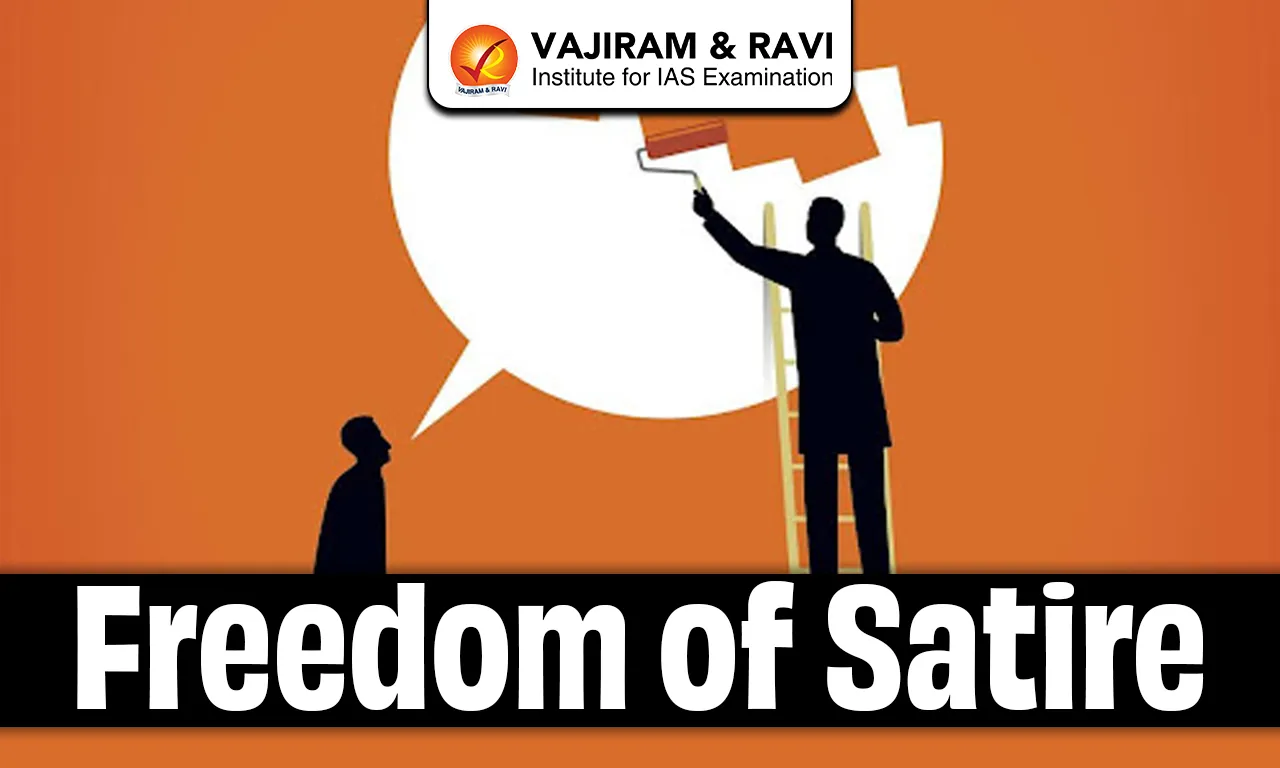
Freedom of Satire and the Limits of State Power in India

Freedom of Satire

Freedom of Satire Latest News

  • Access to a satirical cartoon video was recently blocked, citing national security concerns, sparking debate on freedom of satire in India.

Constitutional Basis of Free Speech in India

  • Freedom of speech and expression is guaranteed under Article 19(1)(a) of the Constitution of India. 
  • However, this right is not absolute. Under Article 19(2), the State may impose reasonable restrictions in the interests of sovereignty and integrity of India, security of the State, friendly relations with foreign States, public order, decency, morality, and prevention of incitement to an offence.
  • Satire, cartoons, and comedy fall within the broad domain of artistic and political expression protected under Article 19(1)(a). 
  • Courts have consistently held that democratic discourse must tolerate dissent, exaggeration, irony, and ridicule.

Satire as a Form of Democratic Expression

  • The Supreme Court has repeatedly recognised satire as a legitimate artistic tool. In Indibily Creative (P) Ltd. v. State of West Bengal (2019), the Court described satire as an exaggeration that exposes societal absurdities and hypocrisies. It emphasised satire’s “unique ability” to make complex points accessible and impactful.
  • Similarly, in D.C. Saxena v. Chief Justice of India (1997), the Court cautioned that suppressing debate on public issues can endanger democratic stability. 
  • Courts have also observed that satire should be evaluated from the perspective of a “reasonable person” and not a “hypersensitive individual.”
  • The Madras High Court in Kama v. M. Jothisorupan (2018) termed political cartoons as a “weapon of ridicule,” meant to sting and provoke thought rather than flatter authority.

Legal Framework for Blocking Online Content

  • The recent controversy arises in the context of the Information Technology Act, 2000 and related rules.
  • Section 69A of the IT Act
    • Section 69A empowers the Union government to block public access to online content on specific grounds aligned with Article 19(2).
    • Blocking orders must be reasoned, recorded in writing, and subject to review.
    • In Shreya Singhal v. Union of India (2015), the Supreme Court upheld Section 69A but clarified that both intermediaries and originators of content should be heard before blocking, and that restrictions must strictly fall within Article 19(2).
  • IT Rules and Amendments
    • Amendments to the Information Technology (Intermediary Guidelines and Digital Media Ethics Code) Rules, 2026, reduce the time for social media platforms to remove content deemed illegal from 24-36 hours to three hours.
    • The Karnataka High Court upheld the government’s ‘Sahyog’ content-blocking portal, which automates notice transmission to intermediaries. However, concerns have been raised about bypassing procedural safeguards.
    • Petitions before the Supreme Court challenge the IT (Procedure and Safeguards for Blocking for Access of Information by Public) Rules, 2009, particularly provisions allowing emergency blocking without prior notice and maintaining confidentiality of blocking orders.

Judicial View on Artistic Freedom

  • Indian courts have repeatedly affirmed the importance of artistic and satirical expression.
  • In a March 2025 verdict, the Supreme Court observed that 75 years into the Republic, India cannot be so fragile that poetry, stand-up comedy, or artistic expression would automatically incite hatred.
  • The Delhi High Court has similarly defended creative liberty, stating that satire exposes societal ills through exaggeration. Globally too, democracies afford cartoons and satire greater latitude, recognising them as essential to public life.
  • The Supreme Court has even invoked philosopher Albert Camus to underline that art unites society while tyranny separates it.

Tension Between National Security and Free Expression

  • The recent blocking of a satirical cartoon video reportedly featuring the Prime Minister was justified on grounds such as national security, defence, and foreign relations.
  • While Article 19(2) permits restrictions, courts insist that such limitations must be reasonable, proportionate, and procedurally fair. 
  • The key constitutional question is whether satire, by its very nature exaggerated and ironic, can genuinely threaten national security, or whether invoking such grounds in artistic contexts amounts to excessive restriction.

Source: TH

Freedom of Satire FAQs

Q1: Under which Article is freedom of speech protected in India?

Ans: It is protected under Article 19(1)(a) of the Constitution of India.

Q2: What does Section 69A of the IT Act allow?

Ans: It empowers the government to block online content on specific grounds listed under Article 19(2).

Q3: What did the Supreme Court hold in Shreya Singhal (2015)?

Ans: It upheld Section 69A but required procedural safeguards and adherence to Article 19(2) grounds.

Q4: How have courts defined satire?

Ans: Courts describe satire as an exaggerated expression that exposes societal absurdities and hypocrisies.

Q5: Why is satire considered important in a democracy?

Ans: Because it facilitates public debate, challenges authority, and strengthens democratic accountability.
IndiaAI Mission 2.0: MSME AI Stack, Sovereign Models and $200 Billion Investment Pus

IndiaAI Mission 2.0

IndiaAI Mission 2.0 Latest News

  • Union IT Minister Ashwini Vaishnaw has unveiled the broad roadmap for IndiaAI Mission 2.0, marking a strategic shift from infrastructure-building to deeper research, development, and widespread adoption of artificial intelligence across sectors.
  • The renewed mission aims to accelerate AI innovation, strengthen indigenous R&D capabilities, and ensure meaningful diffusion of AI technologies—particularly for India’s vast MSME ecosystem. 
  • By embedding AI into small and medium enterprises, the government seeks to enhance productivity, competitiveness, and global integration.
  • The announcement coincides with the India AI Impact Summit 2026 at Bharat Mandapam, underscoring India’s ambition to position itself as a major global AI player while aligning technology deployment with domestic economic priorities.

IndiaAI Mission 2.0: MSME-Focused AI Stack on the Lines of UPI

  • India is preparing the next phase of its AI Mission with a strong focus on creating a bouquet of ready-to-use AI solutions for MSMEs
  • Union IT Minister Ashwini Vaishnaw said these solutions will be hosted on a common digital platform—similar to UPI—allowing small and medium enterprises to easily access and deploy AI tools across key sectors.

Boosting Compute Capacity and Democratizing Access

  • India will expand its AI compute infrastructure by adding 20,000 GPUs to the existing 38,000.
  • Unlike many countries where AI infrastructure is concentrated in a few corporations, India is working to ensure broad-based access to AI compute capacity
  • Several sovereign AI models launched at the summit, he said, have outperformed many global systems on multiple evaluation parameters.

Global Recognition and Investment Momentum

  • Citing Stanford’s ranking, Union IT Minister noted that India is now among the top three AI nations globally. 
  • He projected that over the next two years, more than $200 billion in investments could flow into the ecosystem, with venture capital commitments spanning all five layers of the AI stack—from hardware and models to applications.
  • The minister also acknowledged the overwhelming response from youth at the summit, despite logistical challenges on the opening day.

AI and India’s IT Services Sector

  • Addressing concerns about AI’s impact on India’s IT services industry amid recent market volatility, the minister said the sector remains a key national strength. 
  • He stressed the need for collaboration between government, industry, and academia to upskill the existing workforce and prepare future talent for technological transitions.

Fair Remuneration for News Publishers

  • IT Minister also underscored the government’s view that news publishers must receive fair compensation when AI models use their publicly available content for training.
  • The government is in discussions with major AI platforms on remuneration mechanisms. 
  • A DPIIT committee’s white paper has recommended a mandatory blanket licensing regime, under which AI companies would pay royalties for copyrighted material. 
  • If adopted, India could become the first country to implement a statutory licensing framework with government-determined royalty rates for AI developers.

Sovereign AI Beyond Models

  • Mission 2.0 expands the idea of sovereign AI beyond just building domestic models. It includes:
    • Indigenous chip development
    • Infrastructure and control systems
    • Scalable applications
  • The goal is to ensure India can scale AI solutions independently, without reliance on external approvals or foreign technological gatekeepers.
  • Overall, IndiaAI Mission 2.0 marks a transition from infrastructure building to scalable innovation, sovereign capability, and inclusive AI adoption, positioning India as a global AI leader.

Source: IE | ToI

IndiaAI Mission 2.0 FAQs

Q1: What is IndiaAI Mission 2.0?

Ans: IndiaAI Mission 2.0 is the second phase of India’s national AI strategy, focusing on MSME adoption, sovereign AI capabilities, compute expansion, and global competitiveness.

Q2: How will IndiaAI Mission 2.0 support MSMEs?

Ans: IndiaAI Mission 2.0 proposes a UPI-style AI platform offering ready-to-use, vetted AI solutions to help MSMEs improve productivity and competitiveness.

Q3: What role does sovereign AI play in IndiaAI Mission 2.0?

Ans: IndiaAI Mission 2.0 extends sovereignty beyond models to chips, infrastructure, control systems, and scalable applications, reducing reliance on foreign technological ecosystems.

Q4: How much investment is expected under IndiaAI Mission 2.0?

Ans: The government projects over $200 billion in investments over two years, covering hardware, AI models, data centres, and application-layer innovation.

Q5: What is IndiaAI Mission 2.0’s stance on AI training data?

Ans: IndiaAI Mission 2.0 supports fair remuneration for content creators, with proposals for a statutory licensing regime requiring AI firms to pay royalties for copyrighted content.

DPDP Act Challenge: Supreme Court Examines Privacy, RTI and Press Freedom Concerns

DPDP Act

DPDP Act Latest News

  • Three Public Interest Litigations (PILs) have been filed in the Supreme Court questioning the constitutionality of the Digital Personal Data Protection Act, 2023 (DPDP Act). Although the law aims to protect individuals’ digital privacy, the petitioners argue that it weakens the Right to Information (RTI), restricts investigative journalism, and broadens state surveillance powers.
  • The petitioners have contended that certain provisions of the Act and its Rules dilute transparency safeguards and may curb access to public-interest information.
  • The Supreme Court has admitted the pleas, issued notice to the Centre, and referred the matter to a five-judge Constitution Bench for hearing in March. However, it declined to grant an interim stay on the Act.

Privacy vs Transparency: The RTI Amendment at the Heart of the DPDP Challenge

  • A core objection raised in the petitions concerns Section 44(3) of the DPDP Act, which amends Section 8(1)(j) of the RTI Act, 2005.
  • Earlier, public authorities could deny disclosure of personal information only if it had no relation to public activity or if it caused an “unwarranted invasion of privacy.” 
  • Crucially, the law allowed disclosure if a “larger public interest” justified it.
  • The amended provision now broadly exempts “information which relates to personal information,” removing the public interest override.

Concerns Over Shielding Corruption

  • The petitioners argue that this change eliminates the power of Public Information Officers (PIOs) to balance privacy against public interest. 
  • Investigative journalism and anti-corruption inquiries often depend on records such as asset disclosures, tender documents, and file notings — all of which may contain personal data.
  • According to analysts, the amendment converts a “carefully calibrated privacy exemption into an absolute bar,” potentially shielding corrupt officials. They describe it as a “death knell for participatory democracy.”

Proportionality Test Under Puttaswamy

  • All three petitions rely on the Supreme Court’s 2017 Puttaswamy judgment, which requires that any restriction on fundamental rights meet the proportionality testserving a legitimate aim, adopting the least restrictive means, and including safeguards against misuse.
  • The petitioners contend that replacing the RTI Act’s public interest safeguard with a blanket exemption fails this test and is “manifestly arbitrary,” as it creates a category of information that remains opaque regardless of public interest.

Impact on Journalism: Data Law and Press Freedom

  • The Reporters’ Collective argues that under the DPDP Act, journalists collecting personal data during investigations may be treated as “data fiduciaries.” 
  • This classification imposes obligations such as issuing notices and obtaining consent from individuals whose data is being used.
  • In investigative reporting — especially in cases involving fraud, corruption, or misuse of public funds — seeking consent from the subject of investigation is often impractical and defeats the purpose of the probe.

Consent and Data Erasure Concerns

  • Section 12 of the Act requires that if consent is not granted or is withdrawn, the data must be erased. 
  • The petition contends that this would make post-publication verification and fact-checking difficult, potentially undermining the credibility and continuity of investigative journalism.

Chilling Effect on Free Press

  • The petition also highlights the risk of severe financial penalties — up to ₹250 crore — for non-compliance. 
  • It argues that the fear of such heavy sanctions could discourage journalists from pursuing stories involving personal data, thereby creating a “chilling effect” on press freedom and limiting reporting in the public interest.

Concerns Over State Power and Surveillance

  • Section 36 of the DPDP Act, which authorises the Union government to demand information from any “data fiduciary.”
  • The petitions argue that this provision enables broad access to personal data without clear procedural safeguards, independent oversight, or prior authorisation.
  • As per the analysts, Section 36 is “vague, overbroad and arbitrary,” as it allows the government to obtain personal data without the individual’s consent.
  • The petition warns that, in the absence of specific protections for journalistic work, media organisations could be compelled to disclose data that may reveal confidential sources, discouraging whistleblowers and investigative reporting.
  • There is no statutory appeal or review mechanism against orders issued by the Central Government under Section 36.
  • This concentration of power creates the risk of arbitrary or excessive use, potentially enabling state control over private data and raising concerns about its implications for policymaking and electoral processes.

Concerns Over the Independence of the Data Protection Board

  • Experts argue that the Data Protection Board of India lacks institutional independence. 
  • Under the notified Rules, the search-cum-selection committee for appointing the Board’s chairperson and members comprises only government secretaries and government-nominated experts.
  • They contend that this “complete executive dominance” undermines the doctrine of separation of powers, especially since the Board performs quasi-judicial functions such as adjudicating disputes and imposing penalties.
  • As per them, the State itself is the largest collector of personal data. Therefore, a regulatory body appointed solely by the executive raises concerns about impartiality, potential conflicts of interest, and effective oversight of government actions.

Source: IE

DPDP Act FAQs

Q1: What is the DPDP Act challenge about?

Ans: The DPDP Act challenge questions whether amendments to the RTI Act, expanded surveillance powers, and press-related obligations violate constitutional guarantees of transparency and free speech.

Q2: Why is the RTI amendment controversial?

Ans: The DPDP Act challenge argues that removing the public interest override converts a limited privacy exemption into an absolute bar, potentially shielding corruption and weakening participatory democracy.

Q3: How does the DPDP Act challenge affect journalism?

Ans: Petitioners argue journalists may be classified as data fiduciaries, requiring consent from subjects under investigation, which could cripple investigative reporting and create a chilling effect.

Q4: What concerns exist regarding state surveillance?

Ans: The DPDP Act challenge highlights Section 36, which allows the government to demand information without independent safeguards or appeal mechanisms, raising fears of arbitrary digital searches.

Q5: Why is the Data Protection Board’s independence questioned?

Ans: Petitioners argue executive-dominated appointments undermine separation of powers, as the Board performs quasi-judicial functions while regulating data practices of the State itself.

Enquire Now

