Special Intensive Revision Latest News
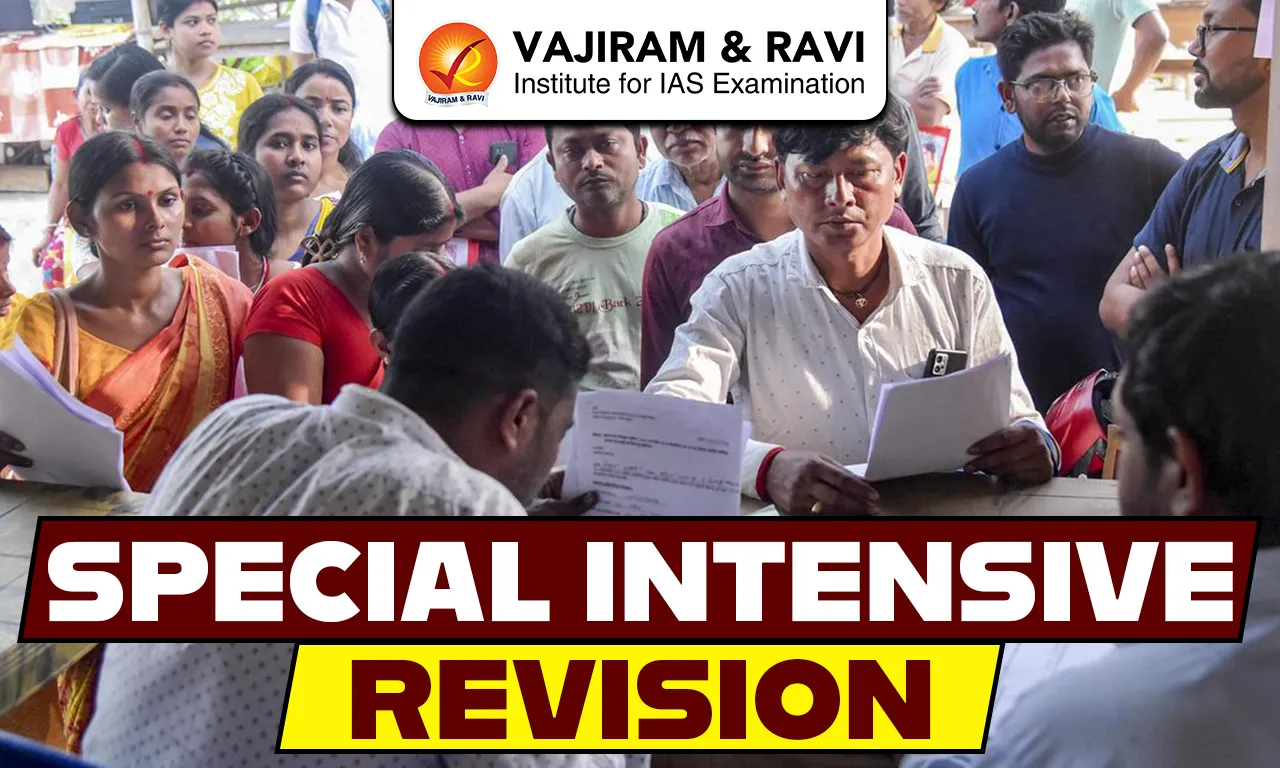
- The Supreme Court recently intervened in the Special Intensive Revision (SIR) of electoral rolls in West Bengal by deploying judicial officers to examine nearly 60 lakh disputed cases related to voter list verification.
Special Intensive Revision (SIR) of Electoral Rolls
- The Special Intensive Revision (SIR) is a comprehensive exercise conducted by the Election Commission of India (ECI) to update and verify electoral rolls.
- The purpose of the process is to ensure that voter lists remain accurate, inclusive, and free from errors such as duplicate or ineligible entries.
- Electoral rolls form the foundation of democratic elections in India because only those whose names appear on the voter list are eligible to vote.
- Therefore, maintaining accurate and updated rolls is essential to protect the integrity of the electoral process.
- The SIR process typically involves several steps:
- Verification of existing voter records
- Identification of discrepancies in voter information
- Inclusion of newly eligible voters
- Deletion of names of deceased or ineligible persons
- Correction of errors in personal details
- Electoral Registration Officers (EROs) and Assistant Electoral Registration Officers (AEROs) play a key role in scrutinising applications and documents submitted by citizens.
Categories of Cases in the SIR Process
- During the SIR exercise, certain cases are flagged for deeper scrutiny due to irregularities or inconsistencies in voter data.
- Two major categories identified in the West Bengal revision process include:
- Logical Discrepancies: These cases arise when inconsistencies appear in voter details such as age, address, or identity information that do not logically match official records.
- Unmapped Cases: These involve voter entries that cannot be clearly linked with previously verified electoral rolls or relevant documentation.
- Individuals falling under these categories are required to submit supporting documents to confirm their eligibility.
- In the ongoing revision process in West Bengal, nearly 60 lakh such cases require adjudication, making the exercise unusually large and complex.
Supreme Court’s Intervention in the SIR Process
- The Supreme Court stepped in when disputes arose between the Election Commission and the West Bengal government regarding the conduct of the SIR process.
- On February 20, 2026, the Court invoked its extraordinary powers under Article 142 of the Constitution to ensure the continuation and completion of the electoral roll revision.
- The Court directed the deployment of judicial officers to assist in scrutinising and adjudicating disputed voter cases.
- Initially, judicial officers from West Bengal were deployed. Later, the Court facilitated the inclusion of additional officers from neighbouring states such as Odisha and Jharkhand to accelerate the process.
- This measure was taken because the second phase of the SIR was nearing completion, and the large number of pending cases required urgent examination.
Dispute Between the Election Commission and the State Government
- The conflict primarily revolved around the availability of appropriate officials to carry out quasi-judicial functions related to voter verification.
- The Election Commission argued that the State government had not provided Group ‘A’ officers of the rank of Sub-Divisional Officer (SDO) or Sub-Divisional Magistrate (SDM) to serve as Electoral Registration Officers.
- Instead, the State had deployed officials from Group ‘B’ and ‘C’ cadres, which the Commission considered unsuitable for adjudicating complex documentation cases.
- The West Bengal government, however, disputed these claims and raised concerns regarding the procedures adopted by the Election Commission.
- Another issue involved the deployment of micro-observers by the Election Commission to assist in the verification process. The State government argued that this move was inconsistent with the guidelines governing the SIR exercise.
Supreme Court’s Observations on the Issue
- The Supreme Court emphasised that the SIR process should not be delayed, particularly because elections were approaching.
- The Court criticised repeated petitions filed regarding the SIR process and stressed that unnecessary litigation should not obstruct electoral preparations.
- At the same time, the Court attempted to strike a balance between two objectives:
- Ensuring that the SIR process is completed on time
- Maintaining the credibility and seriousness of the electoral roll verification exercise
- By appointing judicial officers to examine disputed cases, the Court sought to bring an independent and credible mechanism to the process.
Structural Issues in India’s Electoral System
- The controversy surrounding the SIR process has revived a long-standing institutional question about the Election Commission’s administrative structure.
- Under Article 324 of the Constitution, the Election Commission is responsible for the supervision, direction, and control of elections.
- However, the Commission does not have a permanent administrative staff of its own. Instead, it relies on personnel temporarily deputed from the Central and State governments.
- The recent dispute in West Bengal highlights the limitations of this arrangement. Since election officials ultimately belong to government services, questions sometimes arise regarding their independence in sensitive electoral processes.
Importance of Accurate Electoral Rolls
- An accurate and transparent electoral roll is crucial for the credibility of democratic elections. Errors in voter lists can result in:
- Exclusion of eligible voters
- Inclusion of ineligible individuals
- Electoral disputes and litigation
- Therefore, periodic revisions such as the SIR help ensure that electoral rolls remain updated and reliable.
Special Intensive Revision FAQs
Q1: What is the Special Intensive Revision (SIR) of electoral rolls?
Ans: SIR is a comprehensive exercise conducted by the Election Commission to update and verify voter lists.
Q2: Why did the Supreme Court intervene in the West Bengal SIR process?
Ans: The Court intervened to ensure timely adjudication of nearly 60 lakh disputed voter cases.
Q3: Which constitutional provision empowers the Election Commission to conduct elections?
Ans: Article 324 of the Constitution grants the Election Commission authority over elections.q
Q4: Why were judicial officers deployed in the SIR process?
Ans: Judicial officers were deployed to independently examine disputed voter cases and expedite verification.
Q5: Why are accurate electoral rolls important for democracy?
Ans: Accurate electoral rolls ensure that only eligible citizens vote and that elections remain fair and credible.