IBC Amendments 2026 – Strengthening Insolvency Framework

IBC Amendments

IBC Amendments Latest News

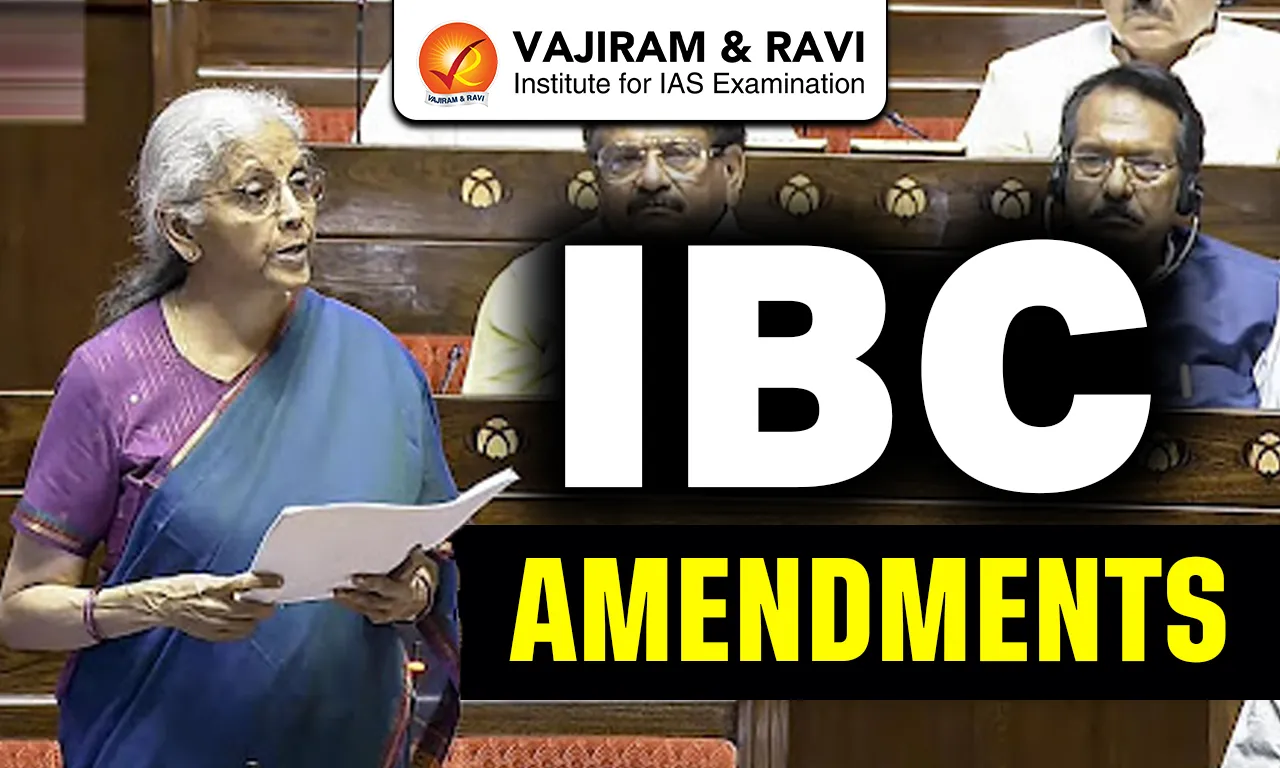
  • The Parliament has passed amendments to the Insolvency and Bankruptcy Code (IBC) to address delays and improve resolution efficiency. 

Insolvency and Bankruptcy Code

  • The Insolvency and Bankruptcy Code (IBC), enacted in 2016, provides a time-bound framework to resolve the insolvency of companies, partnerships, and individuals.
  • The objective is to either revive financially distressed firms through a resolution plan or liquidate them in an orderly manner if revival is not feasible.
  • The process is overseen by the National Company Law Tribunal (NCLT), with the Insolvency and Bankruptcy Board of India (IBBI) acting as the regulator.
  • The IBC marked a major shift from earlier fragmented laws by creating a creditor-driven process and enforcing strict timelines for resolution.

Issues in Implementation

  • Despite its transformative intent, the IBC has faced several operational challenges over time.
  • Delays in admission of cases have weakened the time-bound nature of the process.
  • Backlog of cases in tribunals has increased resolution timelines beyond prescribed limits.
    Recovery rates for banks have remained modest in many cases.
  • These challenges have reduced the effectiveness of the IBC and highlighted the need for further reforms. 


News Summary

  • The Insolvency and Bankruptcy Code (Amendment) Bill, 2026, has been passed to address structural gaps in the insolvency framework. 
  • The amendments aim to speed up the resolution process and introduce new mechanisms such as out-of-court resolution, group insolvency, and cross-border insolvency. 
  • One of the key changes relates to faster admission of insolvency applications. The NCLT is now required to admit applications once a default is established, without additional discretionary conditions. 
  • A major reform is the introduction of the Creditor-initiated Insolvency Resolution Process (CIIRP). 
  • This allows specified financial creditors to initiate insolvency proceedings outside the traditional court-driven process, provided at least 51% of creditors agree. 
  • The amendments also incorporate recommendations of the Select Committee, which suggested measures to reduce delays and improve oversight. These include stricter timelines for appellate decisions and enhanced powers for regulators. 
  • Another important reform is the introduction of group insolvency and cross-border insolvency frameworks. These aim to address complexities arising from interconnected companies and international operations. 
  • The amendments also seek to reduce conflicts of interest by preventing resolution professionals from acting as liquidators in the same case
  • Further, the law replaces certain criminal penalties with civil penalties for procedural violations, recognising that delays or non-compliance may not always involve malicious intent. 

Key Implications

  • The amendments are expected to significantly improve the efficiency of India’s insolvency framework.
  • Faster admission of cases will reduce initial delays, which have been a major bottleneck.
  • The introduction of out-of-court mechanisms will provide flexibility and reduce the burden on the tribunal.
  • Group and cross-border insolvency provisions will align India’s framework with global best practices.
  • The reforms are also likely to improve investor confidence by ensuring predictability and reducing litigation delays.

Performance of IBC So Far

  • The IBC has achieved notable outcomes since its implementation.
  • As of December 2025, 1,376 companies have been successfully resolved under the framework.
  • Creditors have recovered approximately Rs. 4.11 lakh crore. Financial creditors have achieved recovery of over 34% of their claims. 
  • These figures indicate that while the IBC has improved recovery and credit discipline, there is still scope for enhancement.

Way Forward

  • The recent amendments represent a step towards making the insolvency framework more efficient and responsive.
  • However, sustained improvement will depend on strengthening institutional capacity, especially tribunals.
  • Reducing litigation and ensuring strict adherence to timelines will be critical.
    Further clarity in cross-border insolvency rules will be necessary for effective implementation.
  • A balanced approach that prioritises resolution over liquidation will help preserve enterprise value and support economic growth.

Source: TH | IE

IBC Amendments FAQs

Q1: What is the main objective of the IBC?

Ans: To resolve insolvency in a time-bound manner by reviving or liquidating distressed firms.

Q2: What is CIIRP under the new amendments?

Ans: It is a creditor-initiated out-of-court insolvency resolution process requiring approval of at least 51% creditors.

Q3: Which authority oversees insolvency proceedings in India?

Ans: The National Company Law Tribunal (NCLT).

Q4: What is the significance of cross-border insolvency provisions?

Ans: They help manage insolvency cases involving assets or creditors across different countries.

Q5: What has been the recovery rate under IBC?

Ans: Financial creditors have recovered over 34% of their claims.

Right to Promotion Consideration: Understanding Right to Promotion Consideration as a Fundamental Right

Right to Promotion

Right to Promotion Latest News

  • A recent Punjab and Haryana High Court judgment has reaffirmed that while government employees do not have a guaranteed right to promotion, they do have a fundamental right to be fairly considered for promotion if they meet eligibility criteria.
  • The ruling highlights an important constitutional principle in public employment: authorities must ensure fair, timely, and non-arbitrary evaluation of eligible candidates. 
  • The case also shows how this right is often violated in practice, bringing attention to gaps between legal safeguards and actual implementation.

Background: Case of Denial of Promotion Consideration

  • Kulwant Singh, a junior engineer, approached the court after being excluded from a Departmental Promotion Committee (DPC), which evaluates candidates for promotion. 
  • The government claimed he was ineligible due to a distance-learning diploma.
  • However, the High Court found that the government had misinterpreted its own amended rules, which exempted existing employees like Singh from this requirement. As a result, his case was never considered by the DPC.
  • The court held that this amounted to a violation of his fundamental right to be considered for promotion. 
  • It directed the government to grant him a notional promotion with retrospective effect and mandated that DPC meetings be held every three months.

Constitutional Basis of the Right

  • The right to be considered for promotion is rooted in Articles 14 and 16(1) of the Constitution, which guarantee equality before law and equal opportunity in public employment. 
  • Courts have interpreted “employment” broadly to include not just entry into service, but also career progression, making fair consideration for promotion a constitutional requirement.

Distinction Between Consideration and Promotion

  • The Supreme Court clarified in 1991 (Lift Irrigation Corporation case) that there is no fundamental right to promotion itself. 
  • However, every eligible employee has a right to be considered for promotion in accordance with applicable rules whenever a vacancy arises.

Judicial Reinforcement of the Principle

  • This principle was reaffirmed by a five-judge Constitution Bench in the 1999 Ajit Singh vs State of Punjab case. 
  • The Court held that any employee who meets eligibility criteria and falls within the zone of consideration has a fundamental right to be considered for promotion.

Violation of the Right

  • The Court further clarified that if an eligible employee is not considered for promotion, it amounts to a clear violation of their fundamental right, as this right is a personal and enforceable constitutional guarantee.

Judicial Interpretation in Practice

  • The application of the right to be considered for promotion has been consistently shaped by court rulings. 
  • In July 2024 (Bihar State Electricity Board vs Dharamdeo Das), the Supreme Court reaffirmed that while this right is fundamental, there is no vested right to promotion from the exact date a vacancy arises. 
  • The Court rejected a claim for backdated promotion, noting that administrative delays can justify deviations.
  • High Courts have increasingly invoked this principle to address delays in holding Departmental Promotion Committee (DPC) meetings, which often stall career progression. 
  • Courts have recognised that prolonged inaction can effectively deny employees their fundamental right.

Key High Court Interventions

  • In December 2025, the Himachal Pradesh High Court directed the state to expedite DPC proceedings for senior lecturers nearing retirement, emphasising that this right cannot be defeated by unnecessary delays.
  • Similarly, in 2022, the Manipur High Court granted notional promotions to police inspectors who were eligible since 2007 but were promoted only in 2021, acknowledging the loss of career advancement due to state inaction.
  • The Delhi High Court (2024) stressed the importance of regularly convening DPCs to ensure eligible employees are considered on time. 
    • It highlighted that delays not only harm employees but can also affect administrative efficiency.

Conclusion

  • While promotion itself is not guaranteed, courts have made it clear that timely and fair consideration is a fundamental right, and administrative delays cannot be used to undermine it.

Source: IE

Right to Promotion FAQs

Q1: What is the right to promotion consideration?

Ans: The right to promotion consideration means eligible government employees must be fairly evaluated for promotion, even though promotion itself is not guaranteed under law.

Q2: Is promotion a fundamental right?

Ans: No, promotion is not a fundamental right. However, the right to promotion consideration is recognised as a fundamental right under Articles 14 and 16.

Q3: Which court cases established this principle?

Ans: Key cases include the 1991 Lift Irrigation Corporation case and the 1999 Ajit Singh case, which affirmed the right to be considered for promotion.

Q4: What happens if an employee is not considered?

Ans: If an eligible employee is not considered, it violates their fundamental right, and courts can grant relief such as notional promotion or direction for reconsideration.

Q5: How do courts address delays in promotions?

Ans: Courts direct timely Departmental Promotion Committee meetings and may grant retrospective benefits if delays deny employees fair consideration for promotion.

INS Aridhaman: Boosting India’s Nuclear Deterrence at Sea

INS Aridhaman

INS Aridhaman Latest News

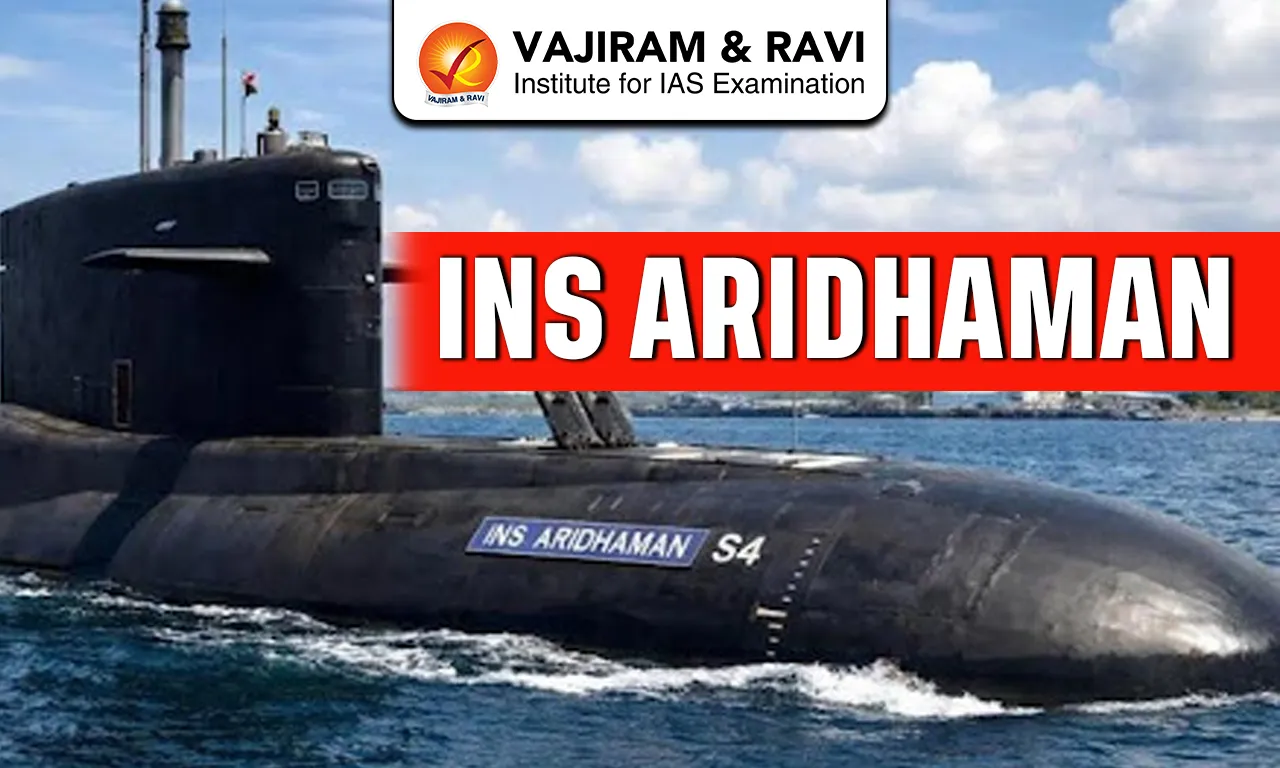
  • India has inducted its third nuclear-powered ballistic missile submarine (SSBN), INS Aridhaman, along with the stealth frigate INS Taragiri at Visakhapatnam. There has been no formal announcement of its commissioning.
  • The quiet induction of INS Aridhaman follows the same pattern as earlier Arihant-class submarines—INS Arihant (2016) and INS Arighaat (2024). 
  • Its addition is significant as it strengthens India’s sea-based nuclear deterrence, a crucial component of the country’s strategic defence capability.

Induction of INS Aridhaman

  • India has inducted its third nuclear-powered ballistic missile submarine (SSBN), INS Aridhaman, significantly enhancing its sea-based nuclear deterrence. 
  • With this induction, India now has three operational SSBNs, marking a major milestone in its strategic capabilities.

Enhanced Capabilities of the Submarine

  • INS Aridhaman is an indigenous SSBN designed to carry a greater number of long-range nuclear-tipped missiles compared to its predecessors—INS Arihant (commissioned in 2016) and INS Arighaat (2024). 
  • This advancement strengthens India’s ability to maintain a credible deterrent.

Strengthening India’s Nuclear Triad

  • The induction further consolidates India’s nuclear triad, which refers to the capability to launch nuclear weapons from land, air, and sea. 
    • Land-based systems: Agni series missiles 
    • Air-based systems: Fighter aircraft like Rafale, Su-30MKI, and Mirage 2000 
    • Sea-based systems: SSBNs like INS Aridhaman
  • India joins a select group of countries—the US, Russia, China, and France—that possess such capability.

Second-Strike Capability and Deterrence

  • India follows a “No First Use” nuclear doctrine, meaning nuclear weapons are intended only for deterrence and retaliation. 
  • In this context, SSBNs play a critical role by ensuring a second-strike capability.
  • Even if an adversary targets India’s land and air bases in a first strike, SSBNs operating stealthily at sea can launch a retaliatory nuclear attack, thereby maintaining credible deterrence.

Features of INS Aridhaman

  • INS Aridhaman is a 7,000-tonne nuclear-powered submarine equipped with eight vertical launch tubes, nearly double that of its predecessors. 
  • This allows it to carry a larger number of nuclear-capable missiles.
  • It is powered by upgraded nuclear reactors, enabling it to remain submerged for months without surfacing, significantly improving stealth and survivability.
  • The submarine can deploy:
    • K-15 SLBMs with a range of over 700 km 
    • K-4 SLBMs with a range of around 3,500 km 
  • This combination enhances India’s ability to strike targets at varying distances.
  • India is also building a fourth SSBN, expected to be larger and capable of carrying more K-4 missiles, further strengthening the country’s sea-based nuclear deterrent.

Origins of India’s Nuclear Submarine Programme

  • India’s nuclear-powered submarine project began over three decades ago, involving collaboration between the DRDO, private industry, and technical assistance from Russia. 
  • The aim was to build an indigenous sea-based nuclear deterrent.

INS Arihant: The First Milestone

  • INS Arihant, launched in 2009 and commissioned in 2016, became India’s first nuclear-powered submarine, giving the country a maritime nuclear strike capability for the first time.
  • In 2018, Arihant completed its first deterrence patrol, marking the operationalisation of India’s nuclear triad. 
  • Later, in October 2022, it successfully launched a submarine-launched ballistic missile (SLBM) in the Bay of Bengal with high accuracy.

INS Arighaat: Technological Advancement

  • The induction of the 6,000-tonne INS Arighaat in 2024 further strengthened India’s nuclear strike capability. 
  • It is considered more technologically advanced than Arihant, incorporating improved design, engineering, and manufacturing techniques.
  • Its construction involved advanced R&D, specialised materials, complex engineering processes, and skilled workmanship, reflecting India’s growing expertise in submarine technology.

Nuclear Propulsion and Stealth Capability

  • Both INS Arihant and INS Arighaat are powered by 83 MW pressurised light-water nuclear reactors, enabling them to remain submerged for long durations and operate with greater stealth compared to conventional diesel-electric submarines.
  • Together, these submarines form the backbone of India’s sea-based nuclear deterrent, enhancing survivability, stealth, and second-strike capability as part of the country’s broader nuclear strategy.

Future Submarine Plans of India

  • India is expanding its underwater capabilities through multiple initiatives. 
  • It is pursuing a nuclear-powered attack submarine (SSN) programme, under which two SSNs will be built indigenously, while one submarine will be leased from Russia, expected by 2027–28, to bridge immediate capability gaps.
  • Additionally, India is close to finalising the Project-75I submarine deal with Germany, where ThyssenKrupp Marine Systems will collaborate with Mazagon Dock Shipbuilders Ltd to build six advanced conventional submarines with Air Independent Propulsion (AIP) technology in India.
  • However, there is still uncertainty regarding the acquisition of three additional Scorpene-class submarines.

India’s Submarine Strength and Operational Capacity

  • India currently operates 16 conventional submarines, in addition to its SSBN fleet. 
  • These include six Kalvari-class submarines built with France’s Naval Group, four Shishumar-class, and seven Kilo (Sindhughosh)-class submarines.
  • While the Navy is authorised to maintain a fleet of 18 submarines, about 30% are typically under refit at any given time, reducing the number of operational submarines available.
  • In comparison, the United States operates 14 Ohio-class SSBNs and 53 attack submarines, while China has around 12 nuclear submarines, including six nuclear-powered attack submarines, highlighting the capability gap India aims to bridge.

Source: IE | ToI | IE

INS Aridhaman FAQs

Q1: What is INS Aridhaman?

Ans: INS Aridhaman is India’s third nuclear-powered ballistic missile submarine, designed to enhance sea-based nuclear deterrence and strengthen the country’s strategic defence and second-strike capabilities.

Q2: Why is INS Aridhaman important?

Ans: INS Aridhaman is crucial as it improves India’s nuclear deterrence, increases missile-carrying capacity, and ensures survivability of nuclear forces through stealthy underwater operations.

Q3: What is nuclear triad and how does INS Aridhaman help?

Ans: A nuclear triad means launching nuclear weapons from land, air, and sea. INS Aridhaman strengthens the sea-based leg, making deterrence more credible and resilient.

Q4: What missiles can INS Aridhaman carry?

Ans: INS Aridhaman can carry K-15 short-range and K-4 long-range submarine-launched ballistic missiles, enabling India to strike targets at varying distances effectively.

Q5: How does INS Aridhaman improve second-strike capability?

Ans: By remaining submerged for long durations, INS Aridhaman ensures retaliation capability even after a nuclear first strike, reinforcing India’s no-first-use doctrine.

Enquire Now