India’s Economic Ranking Decline – IMF WEO 2026

Economic Ranking

Economic Ranking Latest News

How Global Economic Rankings Are Measured

  • Global economic rankings are determined using nominal GDP expressed in US dollar terms. 
  • The IMF calculates this using two key variables: GDP in local currency and the exchange rate against the US dollar.
  • This methodology means that even if an economy grows in domestic terms, depreciation of its currency can reduce its ranking globally.

India’s Position in 2026

  • According to IMF estimates, India’s GDP in 2026 is projected at approximately $4.15 trillion
  • In comparison, the United Kingdom is expected to have a GDP of about $4.27 trillion, while Japan’s GDP is estimated at $4.38 trillion. 
  • As a result, India now ranks as the 6th largest economy. This marks a reversal from earlier optimism when India had overtaken the UK in 2022 to become the 5th largest economy. 

Key Reasons for the Decline

  • The decline in ranking is largely due to statistical revisions and exchange rate movements rather than a collapse in economic activity.
  • First, India revised its GDP estimates with a new base year. The revised data showed that earlier estimates had overstated the size of the economy. 
    • India’s GDP for 2025-26 was revised downward from Rs. 357 lakh crore to Rs. 345 lakh crore
  • Second, the Indian rupee depreciated significantly against the US dollar. This reduced the dollar value of India’s GDP. 
    • The effect was amplified because currencies like the British pound and Japanese yen performed relatively better during the same period. 
  • Third, the IMF’s reliance on dollar-based comparisons makes rankings highly sensitive to currency fluctuations. 
    • Even minor exchange rate movements can alter global rankings when economies are closely matched in size.

Global Economic Context

  • The global economy shows a sharp divide between the top two economies and the rest. 
  • The United States remains the largest economy with a GDP exceeding $32 trillion, followed by China at around $20 trillion. 
  • Beyond these two, major economies such as India, Japan, Germany, and the UK are clustered around the $4 trillion mark. 
  • This close grouping means that small changes in GDP estimates or exchange rates can significantly alter rankings. 

Future Outlook for India

  • Despite the current decline, India’s long-term growth trajectory remains strong. 
  • IMF projections indicate that India is likely to regain the position of the 4th largest economy by 2027
  • It is also expected to become the 3rd largest economy by 2031, overtaking Germany. 
  • This suggests that the current decline is temporary and largely driven by short-term statistical and currency-related factors.

Conclusion

  • India’s fall to the 6th position in global economic rankings reflects the limitations of nominal GDP comparisons rather than a structural weakness in the economy. 
  • The episode highlights the importance of exchange rate dynamics and data revisions in shaping global perceptions of economic size.
  • In the long run, India’s consistent growth, demographic advantage, and structural reforms are expected to strengthen its position in the global economic hierarchy.

Source: IE

Economic Ranking FAQs

Q1: Why did India slip to 6th largest economy in 2026?

Ans: Due to GDP revision and rupee depreciation affecting dollar-based GDP calculations.

Q2: How does the IMF rank economies globally?

Ans: It uses nominal GDP in US dollar terms based on local GDP and exchange rates.

Q3: What is India’s projected GDP for 2026?

Ans: Around $4.15 trillion.

Q4: Is India’s economic slowdown the main reason for the decline?

Ans: No, the decline is mainly due to statistical revisions and exchange rate changes.

Q5: When is India expected to regain higher ranking?

Ans: India is projected to become the 4th largest economy by 2027.
Women Representation in India: Trends in Women Representation in Parliament and Assemblies

Women Representation

Women Representation Latest News

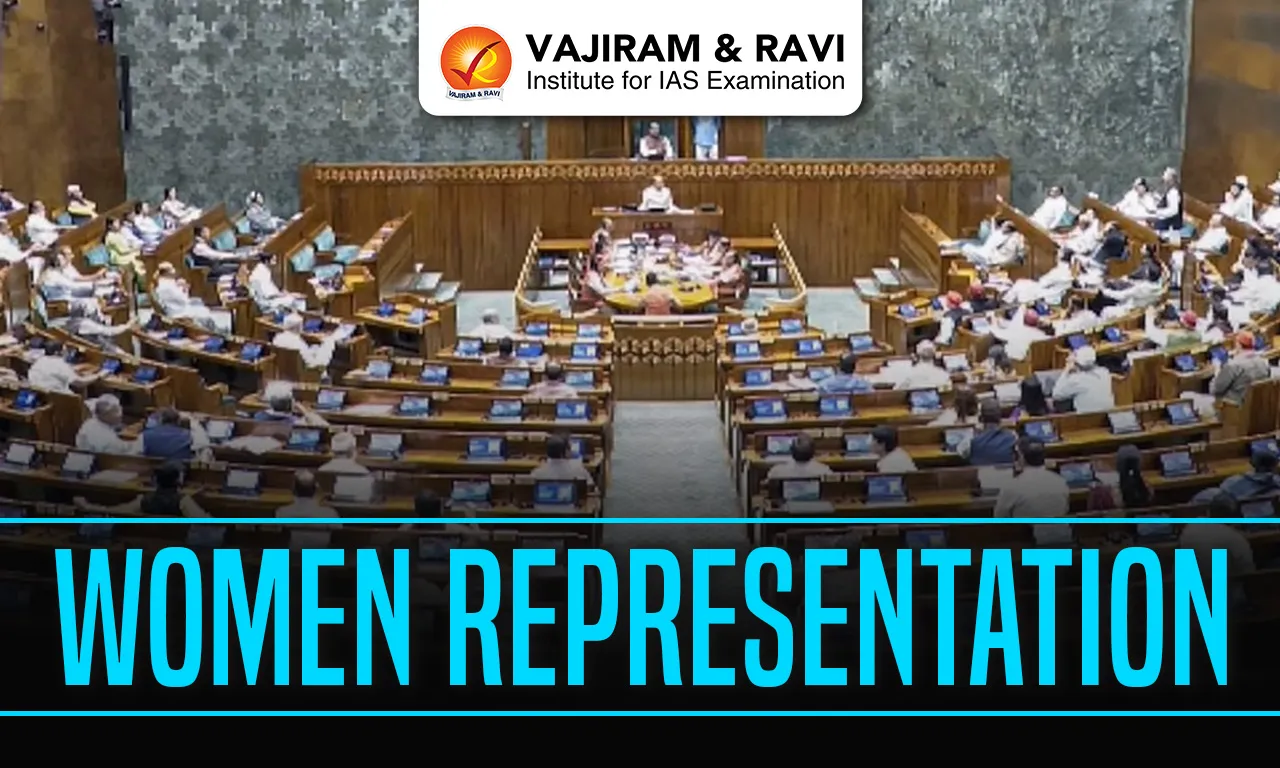
  • The Lok Sabha rejected a constitutional amendment Bill seeking to increase women’s representation to 33% in Parliament and state assemblies. 
  • Historically, women’s representation in Indian legislatures has rarely exceeded 15%, highlighting the persistent gender gap in political participation.

Women’s Representation in Parliament: Trends and Party Patterns

  • Women’s representation in the Lok Sabha has gradually increased over time, but remains limited. 
  • It rose from 4.9% in the first Lok Sabha (1951–52) to 13.6% in the 18th Lok Sabha (2024–29). 
  • The highest share recorded was 14.36% in 2019–24, while the lowest was 3.5% during the 6th Lok Sabha (1977–79). 
  • Notably, it took 15 general elections to cross the 10% mark, indicating slow progress.
  • In the Rajya Sabha, women currently make up around 16% (39 out of 245 members), slightly higher than in the Lok Sabha but still far from parity.
  • Experts highlight that women’s representation depends heavily on party leadership priorities. Where leadership is committed, representation improves; otherwise, progress remains slow.

Women’s Representation in State Assemblies: A Limited and Uneven Picture

  • Data from 31 State Assemblies and Union Territories shows that women’s representation remains low across India. 
  • Only Chhattisgarh (21.1%) has crossed the 15% mark, making it an outlier. Historically, no state had exceeded this threshold until Chhattisgarh’s 2023 election.

Leading and Lagging States

  • Among states with relatively higher representation:
    • Tripura: 15% 
    • Jharkhand: 14.8% 
    • Haryana: 14.4% 
    • West Bengal: 13.6% 
  • At the lower end:
    • Nagaland and Puducherry: 3.3% each
    • Notably, Nagaland elected women MLAs for the first time only in 2023, highlighting the depth of the gender gap.

Widespread Underrepresentation

  • As many as 19 Assemblies have less than 10% women MLAs, including major states such as:
    • Gujarat (7.7%) 
    • Maharashtra (7.6%) 
    • Tamil Nadu (7.3%) 
    • Assam (5.5%) 
    • Karnataka (4.5%)
  • Experts attribute this persistent gap to structural inequalities in a patriarchal society, where political power remains less accessible to women.
  • With ongoing Assembly elections in Assam, Kerala, Tamil Nadu, West Bengal, and Puducherry, these figures may shift, offering a potential opportunity to improve women’s representation.

Global Status of Women’s Representation in Parliaments: India’s Position

  • India ranks 147th globally in women’s representation in Lower Houses, according to April 2026 data from Inter-Parliamentary Union (IPU). 
  • This highlights India’s relatively low standing among nearly 190 countries.
  • India’s low global ranking reflects the absence of strong structural mechanisms like quotas, underscoring the need for institutional reforms to improve gender balance in political representation.

Countries Leading in Gender Parity

  • Several countries have achieved 50% or higher representation of women, including:
    • Rwanda, Cuba, Nicaragua 
    • Costa Rica, Bolivia, Mexico 
    • Andorra, United Arab Emirates 
  • Additionally, around 56 countries have over 33% women representation, indicating significant global progress.  

Global Trends Over Time

  • According to IPU data:
    • Women’s representation rose from 11.3% in 1995 to 27.2% in 2025 
    • Growth was steady between 2000 and 2015, but has slowed in recent years

Factors Driving Higher Representation

  • Countries that have made notable progress share common features:
    • Gender quotas in legislatures 
    • Gender-sensitive parliamentary practices 
    • Measures to address violence against women in politics 

Role of Electoral Systems and Quotas

  • Two key determinants of higher representation are:
    • Electoral systems, especially proportional or mixed systems 
    • Gender quotas, which significantly boost participation 
  • In 2024, countries with quotas had 31.2% women representation, compared to 16.8% in countries without quotas.

Source: IE

Women Representation FAQs

Q1: What is the current status of women representation in India?

Ans: Women representation in India remains low, with around 13–16% in Parliament and even lower levels in most state assemblies.

Q2: Why is women representation important in democracy?

Ans: Women representation ensures inclusive decision-making, reflects diverse societal interests, and strengthens democratic legitimacy by giving equal voice to half the population.

Q3: How does India rank globally in women representation?

Ans: India ranks 147th globally in women representation in lower houses, indicating significant gaps compared to countries with gender quotas and proportional systems.

Q4: What factors improve women representation in legislatures?

Ans: Women representation improves with gender quotas, supportive electoral systems, and political party commitment to nominating more women candidates.

Q5: What challenges limit women representation in India?

Ans: Women representation is limited by patriarchal norms, lack of political opportunities, party reluctance, and absence of structural mechanisms like reservation in legislatures.

Bank Nationalisation 1969: Why Bank Nationalisation Changed India’s Economic Policy

Bank Nationalisation

Bank Nationalisation Latest News

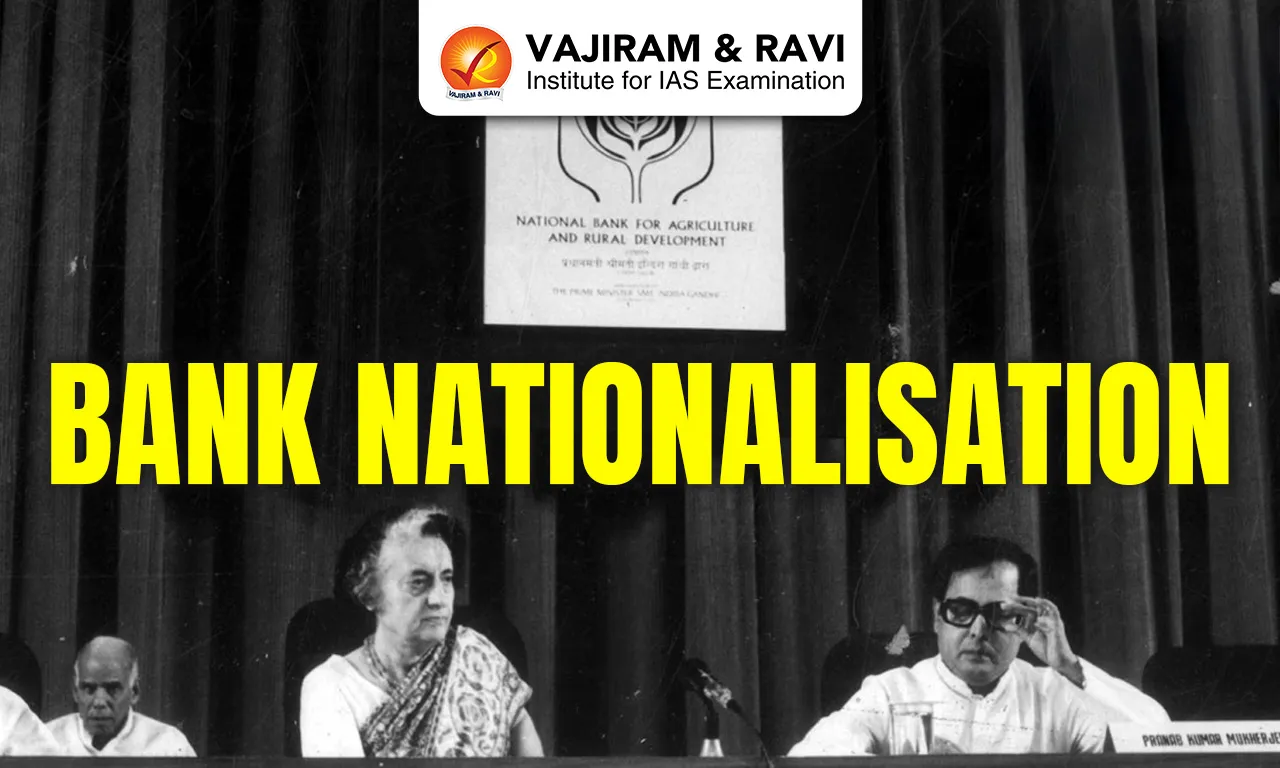
  • The nationalisation of banks in 1969 is widely seen as one of the most transformative economic decisions in independent India. 
  • Led by the then PM Indira Gandhi, the government nationalised 14 major private banks on July 19, 1969, marking a decisive shift toward a socialist, state-led development model.
  • The move aimed to align banking with broader social and economic goals, ensuring credit flowed to priority sectors and underserved regions. It built on earlier steps like the nationalisation of the State Bank of India in 1955.
  • Its impact was far-reaching—reshaping India’s financial system for decades and influencing political and economic structures. Between 1951 and 1966, the number of fragile commercial banks had already been reduced, laying the groundwork for this major reform.

Rationale Behind Bank Nationalisation in India

  • Limited Reach of Banking Services - Before the 1960s, banking expansion was largely confined to urban centres, leaving rural and semi-urban areas underserved. As a result, key sectors like agriculture, small-scale industries, and self-employed individuals lacked access to institutional credit.
  • Inadequate Support for Priority Sectors - The absence of banking services in large parts of the country meant that developmental needs of the economy were not being met, particularly in sectors crucial for inclusive growth.
  • Perception of Profit-Oriented Private Banks - There was a growing political belief that private banks prioritised profits over social responsibility. They were seen as reluctant to: Expand into less profitable rural areas; Lend to smaller borrowers; Diversify credit across sectors.

Need for Social Control Over Credit

  • The political leadership felt that banking needed to align with national development goals. Nationalisation was seen as a way to:
    • Ensure equitable distribution of credit 
    • Promote inclusive economic growth 
    • Make banks responsive to societal needs rather than just profits

Political Context Behind Bank Nationalisation

  • Bank nationalisation was not just an economic reform but a strategic political move, consolidating power while embedding a long-term shift toward state-led economic governance.
  • The concept of “social control” of banks emerged in 1967 as a compromise between opposing views—complete state control and continued private ownership. 
  • It reflected growing concern over aligning banking with public welfare.

Bank Nationalisation of 1969: Implementation and Immediate Reactions

  • The nationalisation of banks was executed swiftly through an Ordinance, reflecting strong political resolve, while triggering debate over its economic rationale, procedural propriety, and long-term impact.

Criteria and Selection of Banks

  • The process of nationalisation began with identifying banks based on deposit size
  • Initially, banks with deposits above ₹100 crore were considered, but the threshold was lowered to ₹50 crore to include more major institutions, in line with the RBI’s classification system.
  • On July 19, 1969, the government issued an Ordinance to nationalise 14 major private banks with deposits exceeding ₹50 crore.
  • In her national address, Indira Gandhi justified the move as essential for establishing a socialist economic framework, emphasising:
    • Control over the “commanding heights” of the economy 
    • Mobilisation of resources for development 
    • Reduction of regional and social inequalities

Political and Public Reactions

  • The decision sparked immediate debate:
    • Jayaprakash Narayan criticised it as unwarranted, arguing it would increase bureaucratic power without solving economic issues. 
    • Atal Bihari Vajpayee questioned the use of an Ordinance for such a major reform when Parliament was about to convene.
  • Within the Reserve Bank of India, discussions began shortly after the announcement, though records indicate only limited and cautious deliberation on the implications.

Source: IE | RBI

Bank Nationalisation FAQs

Q1: What is bank nationalisation?

Ans: Bank nationalisation refers to the transfer of private banks into government ownership to align financial systems with national development goals and ensure wider access to credit.

Q2: Why was bank nationalisation introduced in 1969?

Ans: Bank nationalisation was introduced to expand rural banking, support agriculture and small industries, and reduce the profit-driven bias of private banks.

Q3: How did bank nationalisation impact India’s economy?

Ans: Bank nationalisation expanded financial inclusion, increased credit to priority sectors, and strengthened state-led economic development, shaping India’s banking system for decades.

Q4: What was the political context behind bank nationalisation?

Ans: Bank nationalisation was also a political move by Indira Gandhi to consolidate power and promote a socialist economic framework.

Q5: What criticisms were raised against bank nationalisation?

Ans: Critics argued bank nationalisation increased bureaucracy, reduced efficiency, and expanded government control without necessarily solving core economic challenges.

Enquire Now