India New Zealand FTA – Key Features and Strategic Significance

India New Zealand FTA

India New Zealand FTA Latest News

  • India and New Zealand have signed a comprehensive Free Trade Agreement with investment commitments and expanded market access.

Free Trade Agreement: Concept

  • A Free Trade Agreement (FTA) is a pact between countries to reduce or eliminate tariffs, quotas, and trade barriers.
  • It aims to enhance trade flows, investment, and economic integration while improving market access for goods and services.

Key Aspects of India-New Zealand FTA

  • This is India’s seventh FTA in the past five years, after agreements with Mauritius, the UAE, Australia, European Free Trade Association countries, the UK and Oman.
  • Tariff Liberalisation and Market Access
    • The agreement provides duty-free or preferential access for a large number of Indian exports to New Zealand. 
    • Sectors such as textiles, pharmaceuticals, engineering goods, and agricultural products are expected to benefit significantly.
    • This improves India’s export competitiveness in a developed market.
  • Investment Commitments
    • New Zealand has committed to investing approximately $20 billion in India over a defined period. 
    • The investment is expected to flow into infrastructure, renewable energy, food processing, and technology sectors.
    • This enhances capital availability and supports India’s growth objectives.
  • Services Sector Opportunities
    • The FTA includes provisions to facilitate the movement of professionals and service providers.
    • Indian IT professionals, healthcare workers, and education service providers are likely to gain improved access.
    • This aligns with India’s comparative advantage in services exports.
  • Agricultural Trade Balance
    • New Zealand is a major exporter of dairy and agricultural products, which has been a sensitive area for India.
    • The agreement is expected to include safeguards or calibrated access to protect Indian farmers while enabling selective imports.
    • Balancing domestic interests with trade liberalisation remains a key feature.
  • Regulatory Cooperation and Standards
    • The agreement promotes mutual recognition of standards and regulatory cooperation.
    • This reduces non-tariff barriers and simplifies compliance for exporters.
    • It also improves the ease of doing business between the two countries.
  • Strategic and Geopolitical Significance
    • The FTA strengthens India’s engagement in the Indo-Pacific region.
    • It complements India’s broader strategy of diversifying trade partnerships beyond traditional markets.
    • The agreement also signals India’s renewed push towards bilateral trade agreements after exiting RCEP.
  • Expected Economic Impact
    • The FTA is likely to boost bilateral trade volumes, which have remained modest compared to potential.
    • It will support India’s goal of becoming a global manufacturing and export hub.
    • The investment inflows and technology partnerships can contribute to job creation and industrial growth.

Challenges and Concerns

  • There are concerns regarding competition from New Zealand’s agricultural exports, particularly dairy.
  • Domestic industries may require adjustment support and policy safeguards.
  • Ensuring effective utilisation of market access remains critical, as seen in previous FTAs.

Source: TH | IE

India New Zealand FTA FAQs

Q1: What is the India-New Zealand FTA?

Ans: It is a trade agreement aimed at reducing tariffs and boosting bilateral trade and investment.

Q2: What is the investment commitment under the FTA?

Ans: New Zealand has pledged around $20 billion in investments in India.

Q3: Which sectors benefit most from the FTA?

Ans: Textiles, pharmaceuticals, engineering goods, and services sectors benefit significantly.

Q4: Why is agriculture a sensitive issue in this FTA?

Ans: New Zealand’s dairy exports could impact Indian farmers, requiring safeguards.

Q5: What is the strategic importance of this FTA?

Ans: It strengthens India’s Indo-Pacific engagement and diversifies trade partnerships.
Strait of Hormuz History: How Strait of Hormuz History Shaped Global Power

Strait of Hormuz History

Strait of Hormuz History Latest News

  • The Strait of Hormuz has emerged as the central flashpoint in the ongoing West Asia conflict, with Iran restricting passage after US-Israeli strikes and the Donald Trump administration responding with a naval blockade.
  • However, the strait’s importance is not new. 
  • Owing to its strategic location controlling global energy flows, it has historically been a site of intense imperial competition, especially during the 18th and 19th centuries when colonial powers like United Kingdom used naval strength and diplomacy to dominate trade routes through the region.

16th Century: Portuguese Conquest and Control

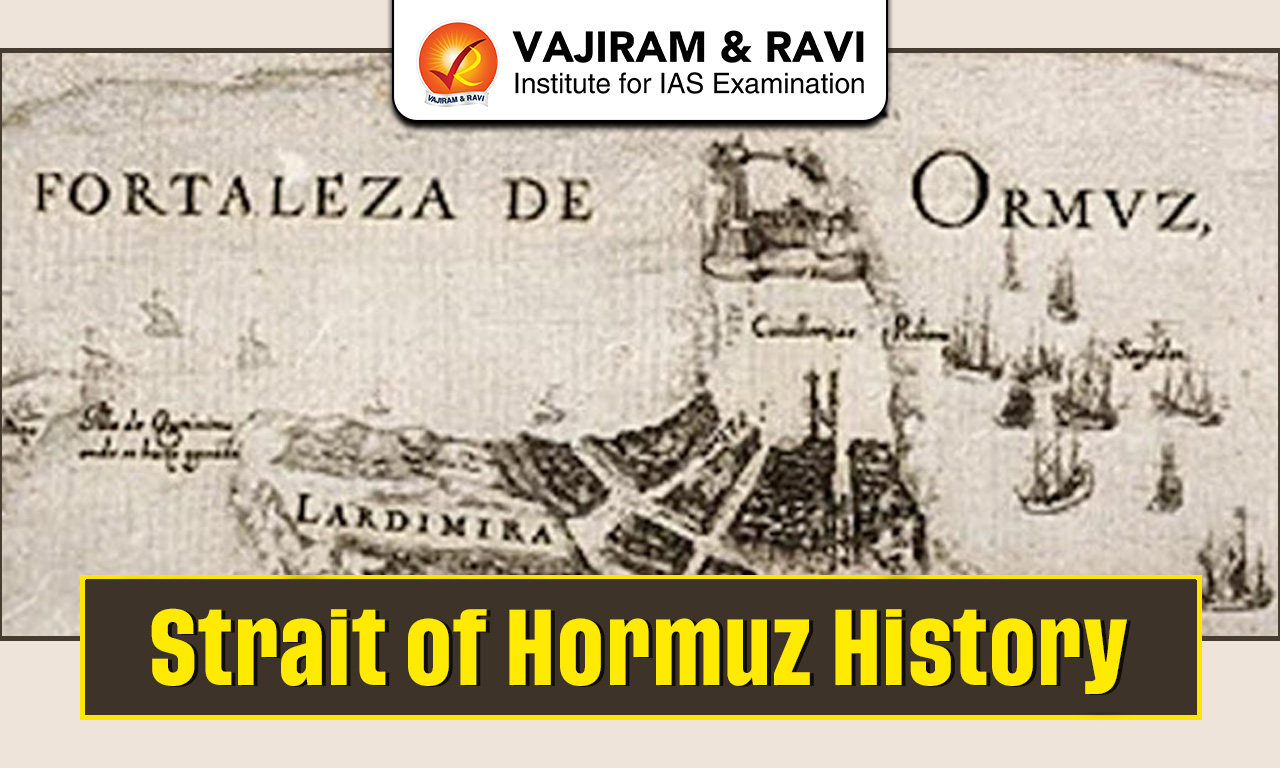
  • The Strait of Hormuz was originally controlled by the wealthy Kingdom of Hormuz, a major trade hub linking India, Persia, Arabia, and East Africa. 
  • In 1515, the Portuguese Empire seized Hormuz Island and transformed it into a fortified toll point, dominating and taxing lucrative spice and silk trade routes throughout the 16th century.
  • By the early 17th century, rising competition led the English East India Company to challenge Portuguese control. 
  • In 1622, a strategic alliance between the British, the Dutch East India Company, and the Safavid ruler Shah Abbas I successfully defeated the Portuguese, ending nearly a century of Iberian dominance over the strait.

7th–18th Century Rivalry in the Strait of Hormuz

  • After the fall of Portuguese control, the Strait of Hormuz entered a phase of intense rivalry between the English East India Company and the Dutch East India Company. 
  • The Dutch, operating as a quasi-sovereign power with military authority, dominated the region during much of the 17th century from their base in Bandar Abbas, leveraging a strong navy and aggressive trade practices to control the spice trade.
  • By the 18th century, the Dutch East India Company weakened due to overextension, internal corruption, and high administrative costs in its Asian territories. 
  • The situation worsened after the Fourth Anglo-Dutch War, which pushed the company into financial collapse. 
  • Its eventual withdrawal from the Persian Gulf created a power vacuum, enabling the British to expand their influence and establish dominance in the region.

British Hegemony in the Strait of Hormuz

  • After the exit of European rivals, the United Kingdom focused on controlling the Strait of Hormuz to safeguard maritime routes to British India. 
  • To ensure safe passage to Bombay, Britain launched naval campaigns in 1809 and 1819 against the Al Qawasim confederation, accusing them of piracy and destroying their fleets.
    • The Al Qawasim (also known as Al Qasimi) was a powerful 18th-century maritime confederation of Sunni tribes based in the southern Gulf.

Treaty System and Indirect Control

  • Rather than direct rule, Britain established control through treaties with local Arab rulers, restricting their foreign relations and trade while allowing internal autonomy. 
  • These arrangements effectively turned the region into British protectorates.
  • The treaty-bound Sheikhdoms came to be known as the Trucial States, which later evolved into the United Arab Emirates. 
  • This system ensured long-term British dominance over the strait without heavy administrative costs.

Models of Control in the Strait of Hormuz

  • The Portuguese Empire relied on direct military dominance over the Strait of Hormuz, constructing large fortifications like the Castelo de Nossa Senhora da Conceição and imposing taxes on passing trade. 
  • However, this heavily militarised system proved costly and unsustainable over time.
  • In contrast, the United Kingdom adopted a more cost-effective and strategic approach, combining naval power with diplomacy. 
  • By integrating local rulers into the Trucial system, Britain allowed internal autonomy while controlling foreign policy, defence, and trade.
  • This indirect model enabled Britain to secure the strait efficiently, ensuring control over a key global chokepoint. 
  • It facilitated the flow of resources from India while promoting the export of British goods, consolidating long-term economic and geopolitical dominance.

20th Century Shift: Oil and Strategic Control in the Strait of Hormuz

  • At the turn of the 20th century, British priorities in the Strait of Hormuz shifted from trade protection to energy security. 
  • In 1901, financier William Knox D’Arcy secured oil exploration rights in Persia, leading to a major breakthrough in 1908 when George Bernard Reynolds discovered oil at Masjed Soleyman—the first large commercial strike in the region.

Formation of Anglo-Persian Oil Company and State Control

  • Following this discovery, the Anglo-Persian Oil Company was established in 1909. 
  • Recognising oil’s strategic importance, especially after Winston Churchill shifted the navy from coal to oil, the British government acquired a 51% stake in the company by 1914, ensuring direct control over energy resources.

Transformation of the Strait’s Role

  • The strait evolved from a trade chokepoint into a critical energy corridor, facilitating the transport of West Asian oil to Britain. 
  • This marked a major shift in global geopolitics, aligning with the growing importance of petroleum during and after the First World War.
  • Through treaty-based control over Gulf states, Britain maintained its dominance in the region until 1971, when it formally withdrew its military presence, marking the end of the Trucial States era.

Source: IE

Strait of Hormuz History FAQs

Q1: Why is the Strait of Hormuz historically important?

Ans: Strait of Hormuz history highlights its strategic role as a chokepoint controlling global trade and energy flows, making it central to imperial and modern geopolitical conflicts.

Q2: How did the Portuguese control the Strait of Hormuz?

Ans: Strait of Hormuz history shows Portuguese domination in the 16th century through fortified bases and taxation of trade routes, turning the strait into a toll-based maritime hub.

Q3: What role did the British play in Strait of Hormuz history?

Ans: Strait of Hormuz history includes British dominance achieved through naval power and treaties, creating the Trucial States and securing trade routes to British India.

Q4: How did oil change Strait of Hormuz history?

Ans: Strait of Hormuz history shifted in the 20th century when oil discoveries made it a vital energy corridor, transforming its importance from trade to global energy supply routes.

Q5: What was the Anglo-Dutch rivalry in Strait of Hormuz history?

Ans: Strait of Hormuz history saw intense rivalry between British and Dutch trading companies, with the Dutch initially dominating before decline allowed British expansion in the region.

Index of Service Production: Why Index of Service Production Matters for India’s Economy

Index of Service Production

Index of Service Production Latest News

  • The Ministry of Statistics and Programme Implementation (MoSPI) has released an 'Approach Paper' outlining its plan to measure the output of India's formal services sector every month through a new Index of Service Production (ISP). 
  • The index will use 2024-25 as the base year and will rely heavily on GST Network data as a key input. Public comments on this proposal have been invited. 
  • A Technical Advisory Committee on ISP (TAC-ISP) was formed in May 2025. It consisted of 24 experts. It has prepared the current approach paper after extensive discussions.

What is the ISP and Why is it Needed

  • Currently, India publishes two key high-frequency (monthly) economic indicators:
    • Index of Industrial Production (IIP) — measures monthly output of the industrial sector (manufacturing, mining, electricity).
    • Consumer Price Index (CPI) — measures retail inflation and forms the basis of India's headline inflation number.
  • Both are closely watched by policymakers, the RBI, and economists to understand the economy's trajectory. 
  • However, there is no equivalent monthly index for the services sector — a glaring gap given that services contribute more than half of India's GDP and generate millions of jobs.

What Do Policymakers Use Currently

  • To understand services sector performance, policymakers and economists currently rely on the S&P Global's HSBC Purchasing Managers' Index (PMI). 
  • However, the PMI is a survey-based sentiment index — it captures how businesses feel about activity, not what is actually being produced. 
  • It does not measure actual output. The ISP is designed to fill this gap with hard, output-based data.

Index of Service Production (ISP)

  • ISP aims to track short-term movements in the services sector. It will be similar in concept to IIP but for services.
  • It will be developed by the National Statistical Office (NSO).

What Will the ISP Cover

  • The approach paper studies 40+ service sub-sectors, including:
    • Trade (wholesale & retail) 
    • Transport 
    • Banking and insurance 
    • Communication 
    • Hotels and restaurants 
    • Real estate 
    • Professional and technical services 
    • Entertainment and recreation 
  • Focus is on availability of output data and price deflators.

Methodology and Global Alignment

  • Based on international best practices.
  • Includes methods for: 
    • Data standardisation 
    • Use of price deflators (to adjust for inflation)

What Data Sources Will the ISP Use

  • MoSPI plans to draw from three key data sources:
    • GST Network (GSTN) Data — Provides information on production and outward supplies across different sectors and will serve as the primary data source for monitoring services sector output. However, sectors exempt from GST — such as health and education — cannot be captured through this route.
    • Administrative Data from Ministries and Organisations — Sector-specific data from relevant government bodies will supplement GSTN data for sectors not covered by GST.
    • Annual Survey of Incorporated Services Sector Enterprises (ASISSE) — MoSPI's own enterprise survey, currently being conducted, will provide additional granularity.
  • It should be note that all three data sources exclude the informal services sector. 
  • The excluded segments — due to data unavailability — account for nearly 33% of total GVA of the services sector. 
  • Specifically, health and education (which will be excluded until ASISSE results are available) alone account for nearly 10% of services sector GVA.

How Will Output be Adjusted for Prices

  • To convert nominal output into real output (adjusted for price changes), a Producer Price Index (PPI) would ideally be used — as it measures the prices received by producers. 
  • However, since India does not yet have a comprehensive PPI, MoSPI plans to use non-food CPI and sub-sector specific CPI as proxies in the interim.
    • DPIIT is currently working on revising the Wholesale Price Index (WPI) and developing a full Producer Price Index (PPI). 
    • A Working Group has recommended methodologies for compiling PPIs for services sub-sectors like Banking, Insurance, Securities, Pensions, Air Transport, Railways, and Telecom. 

Conclusion

  • The ISP, once operationalised, will be a transformative addition to India's statistical architecture. 
  • It will give policymakers — including the RBI's Monetary Policy Committee — a far more accurate and timely picture of the services sector, which is the backbone of India's economy. 
  • It will also reduce India's dependence on private sector survey-based indices like the PMI for understanding services output. 
  • The initiative reflects MoSPI's broader push toward evidence-based policymaking through better data.

Source: IE | PIB

Index of Service Production FAQs

Q1: What is the Index of Service Production?

Ans: Index of Service Production is a proposed monthly indicator to measure output in India’s services sector, similar to IIP for industry, using real data instead of surveys.

Q2: Why is the Index of Service Production needed?

Ans: Index of Service Production is needed because services contribute over half of India’s GDP, yet no reliable high-frequency data exists to track its actual output performance.

Q3: What data sources will the Index of Service Production use?

Ans: Index of Service Production will rely on GST data, administrative datasets, and enterprise surveys like ASISSE to measure output across more than 40 services sub-sectors.

Q4: What are the limitations of the Index of Service Production?

Ans: Index of Service Production excludes informal services and GST-exempt sectors like health and education, leaving out nearly one-third of total services sector output.

Q5: How will prices be adjusted in the Index of Service Production?

Ans: Index of Service Production will use CPI-based proxies for deflation until a full Producer Price Index is developed to convert nominal service output into real output.

Enquire Now