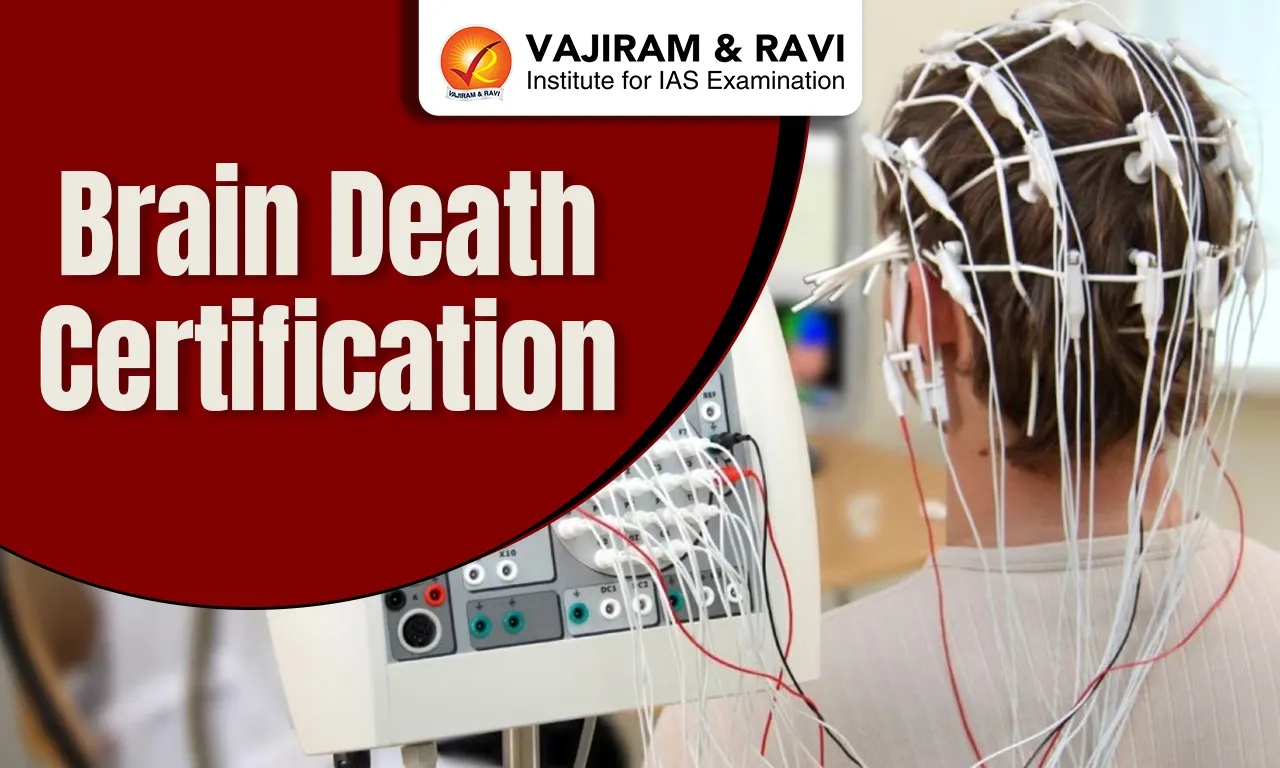
Brain Death Certification Latest News
- The Supreme Court of India is reviewing the process of brain death certification and has sought expert opinion from All India Institute of Medical Sciences doctors on whether additional tests like EEG and angiograms should be included.
- The case stems from allegations that some patients may be incorrectly declared brain dead to facilitate organ donation. Concerns have been raised about the reliability of the current apnea test, which can be subjective, and the lack of adherence to rules such as mandatory videography of the procedure.
Brain Death: Meaning and Medical Significance
- Brain Death, also called brain stem death, is an irreversible condition in which all brain activity—including vital functions like breathing controlled by the brain stem—completely stops.
- Although the patient may appear alive due to machines like ventilators keeping the heart beating and blood circulating, there is no possibility of recovery, and the person is medically considered dead.
Causes and Clinical Context
- Brain death typically occurs after severe brain injuries, such as those from road accidents or falls, where the brain is deprived of oxygen.
- These injuries permanently damage brain function, making revival impossible.
Importance in Organ Donation
- Patients who are brain dead are crucial for organ donation, as life support systems keep organs viable.
- They can donate vital organs such as the heart and lungs, which living donors cannot.
- While organ donation is also possible after circulatory death (when heartbeat and breathing stop), brain-dead donors remain the most common source.
Need for Brain Death Declaration in Organ Donation
- Declaring Brain Death is crucial for deceased organ donation, allowing vital organs like the kidney, liver, heart, and eyes to be transplanted to unrelated recipients.
- It provides an alternative to living donor transplants, which, although safer today, still involve health risks for donors.
- India performs a large number of transplants globally, but most rely on living relatives due to limited deceased donations.
Huge Gap Between Potential and Actual Donations
- Despite around 1.5 lakh deaths from traumatic brain injuries and 50,000 from strokes annually—many of whom could qualify as brain-dead donors—only about 1,100 people donate organs.
- India’s deceased donation rate is just 0.77 per million population, far below countries like Thailand (6.21), China (4.5), Sri Lanka (3.38), and Japan (1.18).
- There are 48 deceased donations per million population in Spain, which has one of the highest deceased donations.
Protocol for Declaring Brain Death in India
- The National Organ and Tissue Transplant Organisation mandates that brain death be certified by a four-member medical board, including the hospital in-charge, a neurologist or neurosurgeon, and the treating physician.
- The board must confirm irreversible loss of brain function twice, with a minimum 12-hour gap, and document the cause of the condition.
- Before declaring Brain Death, doctors must rule out reversible factors such as drug or alcohol influence, hypothermia, and metabolic disturbances, ensuring that the condition is truly irreversible.
No Mandatory Advanced Tests
- Current guidelines do not mandate advanced tests such as EEG or angiograms.
- According to experts at AIIMS, hospitals sometimes follow even stricter protocols, repeating tests more than twice to ensure accuracy.
EEG and Angiogram in Brain Death Certification
- An Electroencephalogram records the brain’s electrical activity using electrodes placed on the scalp. In cases of Brain Death, it shows no detectable electrical signals, indicating complete cessation of brain function.
- A Cerebral Angiogram uses contrast dye and X-rays to assess blood flow in the brain. In brain death, it reveals absence of blood circulation to the brain, confirming irreversible damage.
- While current bedside clinical tests can strongly indicate brain death, EEG and angiogram provide more definitive, objective confirmation by directly demonstrating the absence of brain activity and blood flow.
Practical Challenges in Use
- Despite their accuracy, these tests face significant practical limitations.
- They are mainly available in tertiary and super-speciality hospitals, making them inaccessible for many smaller centres.
- Mandating them universally could reduce brain death certification and organ donation rates, as smaller hospitals may be unable to comply.
Challenges in Brain Death Certification
- Lack of Awareness and Training - A major issue is limited knowledge among doctors, leading to many potential brain-dead patients not being formally declared or considered for organ donation. Studies show over half of physicians lack formal training in certification.
- Inadequate Postgraduate Training - Training for resident doctors is inconsistent. Even in teaching hospitals, only a small proportion of doctors regularly train residents in brain death certification.
- Absence of Standardised Curriculum - Many institutions do not have a fixed curriculum, resulting in uneven understanding and application of certification protocols across hospitals.
Source: IE
Brain Death Certification FAQs
Q1: What is brain death certification?
Ans: Brain death certification is the medical and legal process of declaring irreversible loss of brain function, enabling deceased organ donation and confirming death despite artificial life support.
Q2: Why is brain death certification under Supreme Court review?
Ans: Brain death certification is under review due to allegations of misuse, concerns over subjective apnea tests, and demands for adding objective tests like EEG and angiograms.
Q3: What tests are used in brain death certification?
Ans: Brain death certification currently relies on bedside clinical tests, but EEG and angiograms can provide objective confirmation by showing absence of brain activity and blood flow.
Q4: What are challenges in brain death certification?
Ans: Brain death certification faces challenges like lack of training among doctors, inconsistent protocols, absence of standard curriculum, and limited access to advanced diagnostic facilities.
Q5: Why is brain death certification important for organ donation?
Ans: Brain death certification is essential for increasing deceased organ donation, reducing reliance on living donors, and addressing the gap between potential donors and actual transplant availability.