India Electric Mobility Index 2025 – Delhi Tops NITI Aayog’s EV Rankings

India Electric Mobility Index

India Electric Mobility Index Latest News

  • NITI Aayog has released the India Electric Mobility Index (IEMI) 2025, with Delhi emerging as the top performer in electric vehicle adoption and e-mobility ecosystem development, followed by Maharashtra and Karnataka.

About the India Electric Mobility Index

  • The India Electric Mobility Index (IEMI) is a composite index that assesses both the policy framework and implementation outcomes for electric mobility at the state level.
  • It was developed by NITI Aayog in collaboration with WRI India. This is the second edition of the index, following the 2024 version.
  • Purpose: The index tracks, evaluates and scores all Indian States and Union Territories out of 100. Its objectives are to:
    • Inform decision-making at the state level
    • Foster healthy competition among states
    • Promote sharing of best practices

Structure of the Index

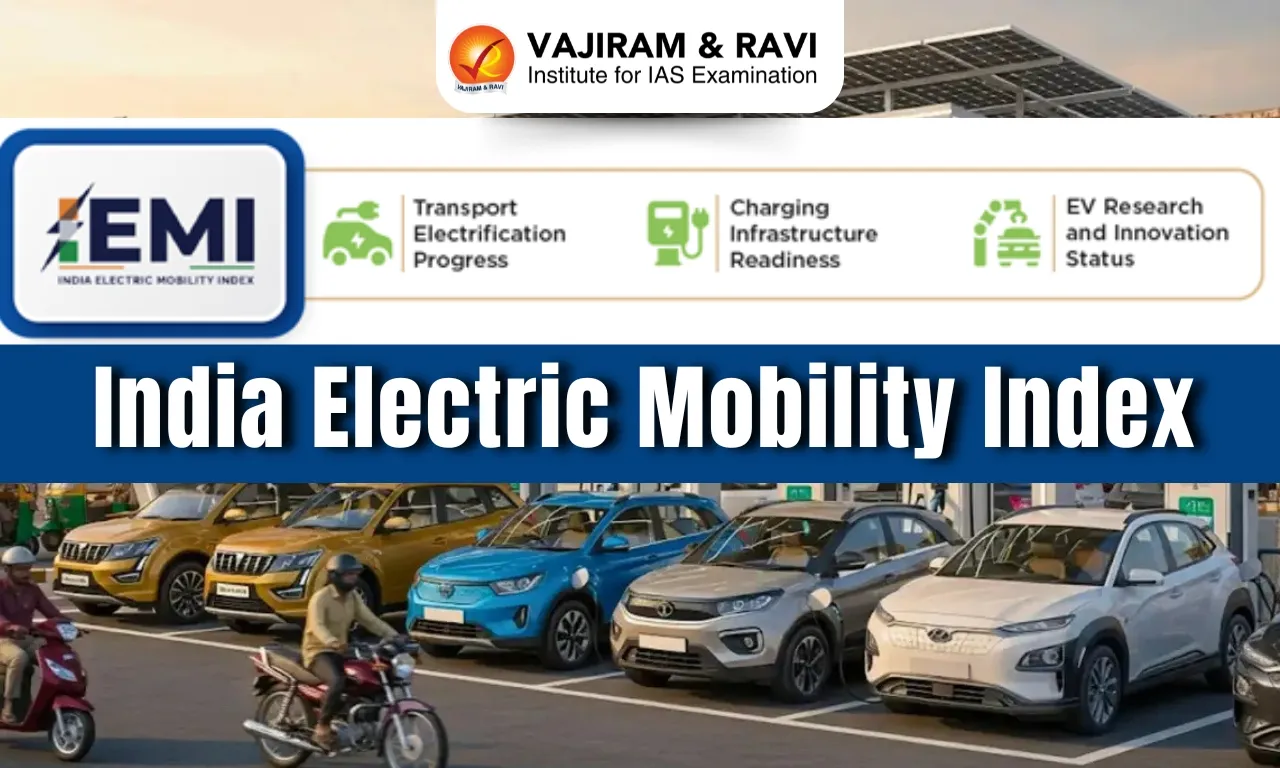
  • The IEMI assesses performance across 16 indicators grouped under three core themes, each carrying different weightage:
  • Transport Electrification Progress (50% weightage): Evaluates market absorption, consumer acceptance and demand-side momentum by measuring how effectively EVs are being adopted and supported.
  • Charging Infrastructure Readiness (30% weightage): Captures charger-to-vehicle ratio, subsidies for charging infrastructure, building bye-laws for charging, and power availability.
  • EV Research and Innovation Status (20% weightage): Covers EV startups, research and development initiatives, and patents.

News Summary: Key Findings

  • Composite scores across all 36 States and Union Territories range from 10 to 84, with a median score of 40. The top performers are: Delhi (84), Maharashtra (78), Karnataka (73), Chandigarh (71) and Goa (65).
  • Compared with the 2024 index, Delhi and Maharashtra retained the top two positions. Karnataka moved up to third, overtaking Chandigarh, while Goa climbed ten spots to fifth place.
  • The most notable improvement came from Madhya Pradesh, which rose from 23rd to seventh rank.
  • The top score itself improved from 77 in 2024 to 84 in 2025, indicating that leading states are continuing to advance rather than plateauing.

Performance Among Large States

  • Of the 17 large states, only Maharashtra and Karnataka featured among the top performers.
  • Eight large states qualified as frontrunners, scoring between 50 and 64 out of 100:
    • Tamil Nadu, Madhya Pradesh, Odisha, Andhra Pradesh, Telangana, Haryana, Rajasthan and Uttar Pradesh
  • Seven large states were classified as emerging performers, scoring between 35 and 49:
    • Chhattisgarh, West Bengal, Bihar, Kerala, Jharkhand, Punjab and Gujarat

Theme-Wise Performance

  • Transport Electrification Progress
    • This carries the highest weightage at 50%, and performance here was the weakest overall.
    • Only three States and UTs, Delhi, Chandigarh and Maharashtra, qualified as top performers in this category.
    • The report notes that for most States and UTs, transport electrification progress remains the largest opportunity for improving overall performance.
  • Charging Infrastructure Readiness
    • Karnataka recorded the highest score nationwide at 97, followed closely by Goa (92) and Maharashtra (91).
    • This indicates that some states have built charging networks faster than they have converted vehicle fleets, creating a mismatch between infrastructure and adoption.
  • EV Research and Innovation
    • Delhi achieved the top score of 94 in this category, reflecting strength in EV startups, R&D activity and patents.

Identified Barriers

  • The report identifies three main obstacles to progress:
    • Limited charging infrastructure in many states
    • Dispersed settlements, which make charging networks harder and costlier to build
    • A nascent innovation ecosystem outside a few leading states
  • A key observation is that charging rollout and EV adoption are moving at different speeds across the country, a sign that the transition remains uneven.
  • With foundational EV policy now in place for most States and UTs, the report argues that the focus must shift from policy formulation to effective implementation.

Why Electrification Matters

  • Road transport accounts for roughly 12% of India's energy-related carbon dioxide emissions, making the sector central to climate goals.
  • Beyond emissions, the transition also carries economic and strategic significance. 
  • Reducing dependence on imported crude oil improves energy security and eases pressure on the current account, a concern that has grown sharper with elevated global oil prices.
  • NITI Aayog has framed the transition to electric mobility as an economic, environmental and strategic imperative for the Viksit Bharat 2047 ambition.

India's EV Adoption Trajectory

  • The report documents substantial growth in EV uptake:
    • EV penetration, the share of EVs in total vehicles registered, reached 8.25% in 2025-26, up from just 0.5% in 2018.
    • Over 8.7 million EVs were running on Indian roads in 2025-26.
    • Close to 2.5 million EVs were registered during 2025-26 alone, a rise of about 25% over the previous year.

The Global Comparison

  • India's 8.25% penetration rate should be read against international benchmarks.
  • In 2025, electric cars accounted for:
    • Around one-tenth of new car sales in the United States
    • More than a quarter in the European Union
    • Over half in China
  • Projections suggest that by 2040, around 40% of all new car sales globally would be electric.
  • India's position reflects both the distance still to cover and the distinct shape of its transition, driven predominantly by two- and three-wheelers rather than passenger cars, which is a pattern suited to Indian mobility patterns and income levels.

Significance of the Index

  • The IEMI serves three practical functions.
  • It creates comparative pressure among states by making performance visible and ranked, which has proven effective in other policy areas.
  • It disaggregates the challenge by separating adoption from infrastructure from innovation, allowing states to identify where specifically they lag.
  • It shifts attention to implementation. With most states having formulated EV policies, the constraint is no longer policy design but execution, charger deployment, subsidy disbursement, building code enforcement and grid readiness.

Source: IE | PIB

India Electric Mobility Index FAQs

Q1: Who developed the India Electric Mobility Index?

Ans: NITI Aayog developed the index in collaboration with WRI India. This is its second edition.

Q2: Which state topped the IEMI 2025?

Ans: Delhi topped the index with a score of 84, followed by Maharashtra (78), Karnataka (73), Chandigarh (71) and Goa (65).

Q3: What are the three themes of the index and their weightage?

Ans: Transport Electrification Progress (50%), Charging Infrastructure Readiness (30%) and EV Research and Innovation Status (20%).

Q4: What is India's current EV penetration rate?

Ans: EV penetration reached 8.25% in 2025-26, up from 0.5% in 2018, with over 8.7 million EVs on Indian roads.

Q5: Which state scored highest in charging infrastructure readiness?

Ans: Karnataka scored highest nationwide at 97, followed by Goa (92) and Maharashtra (91).
1991 India-Pakistan Agreement: Naval Collision and Grey-Zone Tactics

1991 India-Pakistan Agreement

1991 India-Pakistan Agreement Latest News

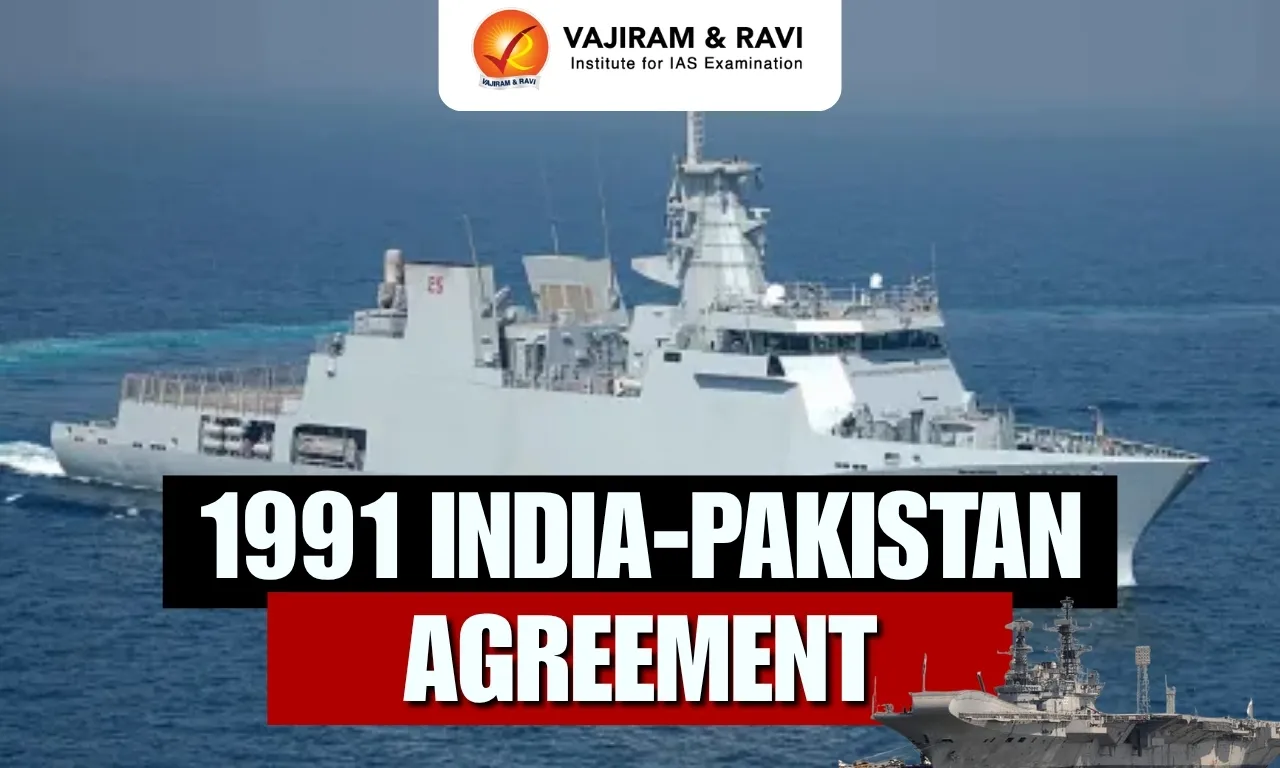
  • Recently, Pakistan Naval Ship (PNS) Hunain, a Yarmook-class corvette, approached an Indian Navy warship at high speed in international waters and manoeuvred unsafely, causing a minor collision.
  • The incident occurred about 120 nautical miles from the Gulf of Oman in the North Arabian Sea. 
  • The Indian warship was on a routine surveillance mission and suffered no damage, continuing its mission. PNS Hunain was damaged. 
  • India called the conduct "unacceptable and unprofessional" and a direct violation of Article 10 of the 1991 bilateral agreement on advance notice of military exercises.

The 2011 Precedent

  • This is the second such incident since 2011. In June 2011, the Pakistani warship PNS Babur brushed past the Indian Navy frigate INS Godavari in the Gulf of Aden, causing minor damage to the Indian vessel's helicopter safety net. 
  • That incident was also taken up diplomatically.

Maritime Zones under UNCLOS

  • The incident occurred in international waters. Under the UN Convention on the Law of the Sea:
    • A country's territorial sea extends 12 nautical miles from its coast.
      • One nautical mile equals 1.852 km.
    • The Exclusive Economic Zone (EEZ) extends up to 200 nautical miles, where the coastal state has rights to explore and manage seabed resources.

The 1991 Agreement Explained

  • The Agreement between India and Pakistan on Advance Notice on Military Exercises, Manoeuvres and Troop Movements was signed in April 1991. 
  • Its purpose was to prevent any crisis arising from misreading the other side's intentions. 
  • Key provisions:
    • Major military exercises close to each other's territory should be avoided. If held, they must follow set regulations and the other side must be informed.
    • Advance notice periods: 15 days for certain air and naval exercises, 60 days for corps-level exercises, 90 days for army-level exercises.
    • Either side can seek clarification on assembly of forces, direction, extent and duration of an exercise.
    • Naval definition: A major naval exercise involves six or more ships of destroyer or frigate size and above, exercising together and crossing into the other's EEZ.
    • Article 10: Naval ships and submarines of the two countries must not close within three nautical miles of each other in international waters, to avoid accidents. This is the provision India says was violated.
    • Aircraft rules: Combat aircraft must not fly within 10 km of each other's airspace, including Air Defence Identification Zones. 
      • Exceptions apply for aircraft operating from Jammu, Pathankot, Amritsar and Suratgarh (India) and Pasrur, Lahore, Vehari and Rahimyar Khan (Pakistan), where a 5 km distance applies.
  • On the same day, a companion treaty was signed: the Agreement on Prevention of Air Space Violations and for Permitting Over Flights and Landings by Military Aircraft.

Why the 1991 Agreement Was Signed

  • The 1980s saw a series of confidence-building measures between the two countries. 
  • Contributing factors included both nations' nuclear weapons programmes, which raised the cost of war, and the Soviet invasion of Afghanistan in December 1979, which made Pakistan and the US keen to avoid tension on Pakistan's eastern border. 
  • The immediate trigger was Exercise Brass Tacks IV in January 1987, a massive Indian military exercise in Punjab and Rajasthan. 
  • It involved two opposing corps-level forces, including two armoured divisions and a mechanised division, with simultaneous Air Force and Navy exercises. About 150,000 troops were mobilised. 
  • The scale rattled Pakistan and led to mechanisms for reducing uncertainty.

Ramming as a Naval Tactic

  • Ramming is almost as old as naval warfare. The Greeks and Romans used it as a core weapon. 
  • The first modern instance came in 1862 at the Battle of Hampton Roads during the American Civil War, when CSS Virginia sank the Union frigate Cumberland. 
  • The tactic resurfaced in both World Wars, including the sinking of PT-109 commanded by John F. Kennedy. 
  • It also featured in the Cod Wars between Iceland and the UK over fishing rights.

Grey-Zone Warfare in the Arabian Sea

  • The incident mirrors China's grey-zone tactics in the South China Sea, where Beijing uses its Coast Guard and maritime militia to ram vessels and fire water cannons. 
  • These tactics stay below the threshold of open conflict while advancing strategic goals, exploiting legal ambiguity, similar to salami slicing in Eastern Ladakh. 
  • Analysts argue that this ambiguity must end: ramming with reinforced hulls or close-range water cannons causing damage comparable to kinetic force should be treated as a grave use of force justifying proportionate self-defence.

Conclusion

  • The PNS Hunain collision violates Article 10 of the 1991 Agreement and signals the arrival of grey-zone tactics in the Arabian Sea. 
  • For two nuclear-armed neighbours, robust rules of engagement at sea are essential to prevent accidents from escalating into crises.

Source: IE |ToI

1991 India-Pakistan Agreement FAQs

Q1: What happened between the Pakistani and Indian naval vessels?

Ans: A Pakistani naval vessel approached an Indian warship at high speed in international waters, manoeuvred unsafely and caused a minor collision in the Arabian Sea.

Q2: What does the 1991 India-Pakistan Agreement regulate?

Ans: The 1991 India-Pakistan Agreement regulates advance notification of military exercises, manoeuvres and troop movements to reduce misunderstandings and prevent potential crises.

Q3: What is Article 10 of the 1991 Agreement?

Ans: Article 10 of the 1991 India-Pakistan Agreement requires naval ships and submarines to maintain at least three nautical miles between them in international waters.

Q4: Why was the 1991 India-Pakistan Agreement signed?

Ans: The 1991 India-Pakistan Agreement emerged from confidence-building efforts following tensions involving nuclear programmes, regional security concerns and the 1987 Exercise Brass Tacks.

Q5: What are grey-zone tactics in maritime conflicts?

Ans: Grey-zone tactics use actions below the threshold of open conflict, such as ramming or water cannons, to pursue strategic objectives while exploiting legal ambiguity.

Plurilateral Trade Agreements: Is India’s BRICS Declaration a Policy Shift?

Plurilateral Trade Agreements

Plurilateral Trade Agreements Latest News

  • India has consistently opposed plurilateral trade agreements at the World Trade Organisation (WTO), insisting that trade rules be negotiated by all members. 
  • But the 2026 BRICS New Delhi Declaration, issued under India's chairship, says members recognise the importance of identifying "pathways" for plurilateral initiatives to enter the WTO legal framework. 
  • This comes just months after India blocked such pacts at the WTO's 14th Ministerial Conference (MC14) in Cameroon in March 2026.

What Plurilateral Agreements Are

  • A plurilateral agreement is a trade deal among a group of WTO members rather than the full membership. 
  • Key features:
    • Countries that join must follow its rules; non-members are generally not bound.
    • Under the Marrakesh Agreement, a plurilateral pact can be added to the WTO rulebook (Annex 4) only by consensus of all members.
    • A multilateral agreement, by contrast, involves the entire WTO membership negotiating rules together.

Why India Opposes Plurilaterals

  • India's objections are systemic rather than issue-specific:
    • Plurilaterals could let a group of powerful or interested countries create new rules without everyone's participation, which is especially risky for developing countries.
    • WTO members should first agree on common safeguards, or "guardrails", for all plurilateral agreements before any single one is added to the rulebook.
    • Adding one agreement first and deciding broader rules later sets a dangerous precedent.

The Investment Facilitation for Development Agreement

  • The clearest test case is the China-backed Investment Facilitation for Development (IFD) agreement, launched by the WTO in 2017 to enhance FDI flows. 
  • At MC14, India blocked its inclusion as an Annex 4 agreement, arguing that:
    • Incorporating IFD risks eroding the WTO's foundational principles and functional limits.
    • Investment is not a core trade issue.
    • Members must first agree on legal safeguards for plurilaterals.
  • As many as 129 members support IFD, leaving India as the primary holdout. 

India's Objection to the E-Commerce Agreement

  • India has also questioned the Western-backed Agreement on Electronic Commerce (ECA). 
    • ECA is the world's first baseline set of global digital trade rules, designed to streamline and secure cross-border digital transactions among participating WTO members.
  • In a recent letter to the WTO, India challenged the legal basis for the Director-General acting as depositary of the ECA. 
  • India pointed out that consensus to add the agreement to Annex 4 was not reached on two occasions and asked on what institutional basis the "interim arrangements" were operating. 
  • According to the WTO Secretariat, 66 members covering about 70 per cent of global trade have adopted a pathway to bring the ECA into force through interim arrangements.

Pressure on India at the Trade Policy Review

  • Several countries targeted India's stance during its trade policy review last month:
    • Canada most prominently opposed India's position on plurilaterals.
    • The EU noted that India has benefited significantly from global trade integration and urged it to see plurilaterals as an opportunity to shape the WTO agenda rather than a threat to multilateralism.
    • Gambia and Costa Rica asked India to withdraw its opposition to IFD.
    • Others urged India to join plurilaterals on fossil fuel subsidy reform, plastics pollution and environmentally sustainable plastics trade.

What the BRICS Declaration Says

  • The New Delhi Declaration commits BRICS members to implementing MC14 outcomes, engaging constructively in WTO reform, and identifying appropriate pathways for plurilateral initiatives into the WTO legal framework, including on development-oriented issues, while exploring forward-looking rules.
    • Notably, the term "guardrails" is absent from the declaration despite India holding the chair. 
    • Experts warn that plurilaterals cannot work for development issues: if developed countries do not join a plurilateral on food security or farm subsidy reduction, the outcome will be meaningless. Such issues must remain multilateral.
  • The declaration also:
    • Strongly advocates immediate restoration of a fully functioning, two-tier binding WTO dispute settlement mechanism and appointment of Appellate Body members without delay.
    • Supports Ethiopia and Iran's bid for WTO accession.
    • Acknowledges China's expansion of zero-tariff treatment to 53 African countries.

Why It Matters for India

  • The direct implication could be India lifting its reservation on IFD, a significant policy shift. 
  • Two sectors are particularly relevant:
    • Services: India has a huge IT and business services industry. If new international services rules emerge, India needs a seat at the table.
    • Digital trade: With over 60 members moving ahead on e-commerce rules through interim arrangements, staying out risks India being bound later by rules it did not shape.

Conclusion

  • The BRICS declaration signals a subtle softening in India's opposition to plurilaterals, driven by mounting international pressure and the risk of isolation. 
  • Yet the missing "guardrails" language and the systemic concerns about IFD and e-commerce remain unresolved. 
  • India must balance openness to shaping new trade rules against protecting the consensus-based multilateralism that safeguards developing countries.

Source: IE | CNBC

Plurilateral Trade Agreements FAQs

Q1: What are plurilateral trade agreements?

Ans: Plurilateral trade agreements are trade deals involving a group of WTO members, where participating countries follow agreed rules while non-members generally remain unbound.

Q2: Why has India opposed plurilateral trade agreements?

Ans: India opposes plurilateral trade agreements because powerful groups could create WTO rules without universal participation, potentially disadvantaging developing countries and weakening consensus.

Q3: What does the BRICS declaration say about plurilateral trade agreements?

Ans: The BRICS declaration supports identifying pathways for plurilateral trade agreements to enter the WTO legal framework, including initiatives concerning development-oriented issues.

Q4: Why is the Investment Facilitation for Development Agreement significant?

Ans: The Investment Facilitation for Development Agreement is significant because India blocked its WTO inclusion, arguing that safeguards for plurilateral trade agreements must be established first.

Q5: What could the BRICS declaration mean for India?

Ans: The BRICS declaration could indicate greater flexibility on plurilateral trade agreements, particularly as India risks being excluded from shaping emerging services and digital trade rules.

Enquire Now