Chamaegastrodia reiekensis

Chamaegastrodia reiekensis

Chamaegastrodia reiekensis Latest News

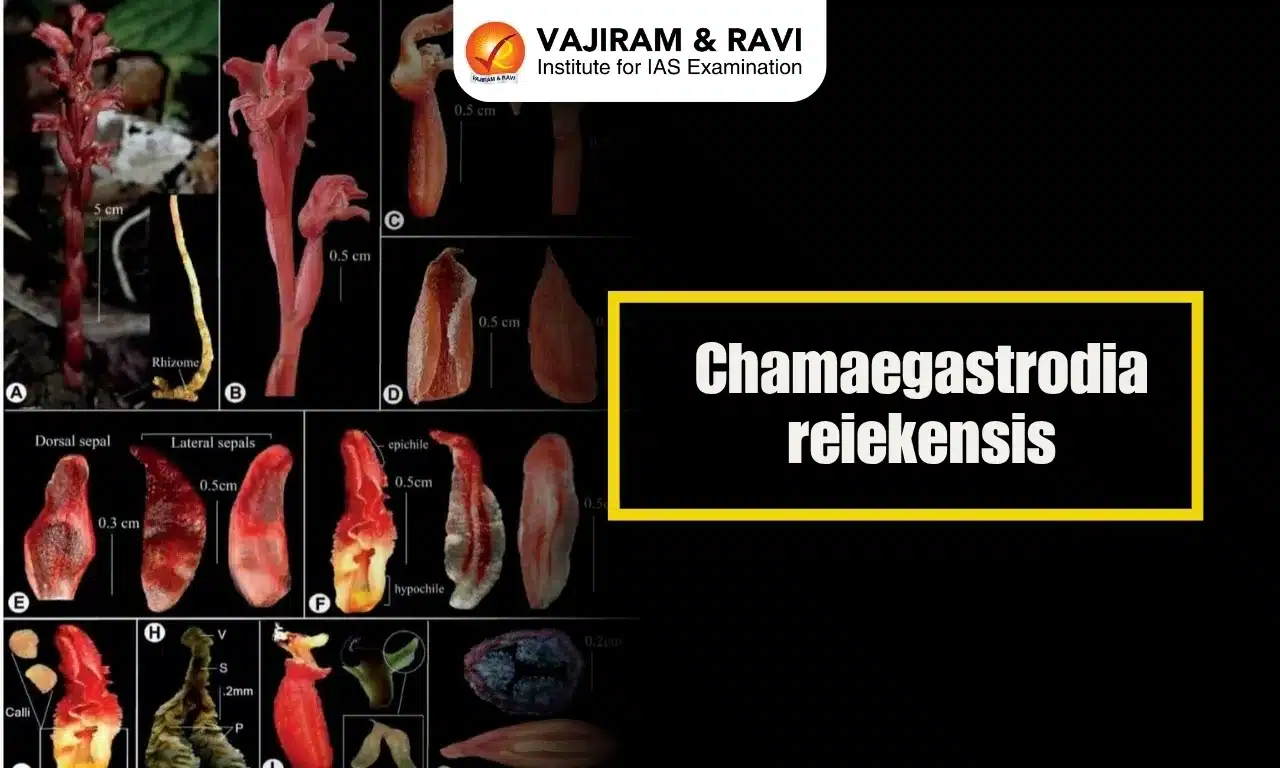
Scientists from Mizoram University and Manipur University recently discovered a new and extremely rare orchid species — Chamaegastrodia reiekensis — in the forests of Northeast India.

About Chamaegastrodia reiekensis

  • It is a new species of orchid.
  • It is named after its type locality, Reiek, a scenic mountain destination in Mizoram known for its rich biodiversity.
  • Belonging to the elusive genus Chamaegastrodia, this orchid is holomycotrophicentirely lacking chlorophyll and leaves—and derives its nutrients exclusively from underground fungi. 
  • Incapable of photosynthesis, it relies wholly on symbiotic fungal associations for survival.
  • With this addition, the global count of Chamaegastrodia species rises to eight. 
  • These mysterious orchids are sparsely distributed across parts of the Eastern Himalayas, South-Central China, Japan, Korea, Myanmar, Nepal, and Thailand. 
  • Notably, all Indian representatives of this genus have been recorded exclusively in Northeast India.
  • C. reiekensis was found in moist, humus-rich soil near bamboo clumps at an elevation of 1,500 metres. 
  • Reiek forest — where the orchid was located — features a multi-layered canopy with tall emergent trees and dense understorey vegetation, offering niches for numerous unique plant species. 
  • With temperatures ranging between 20–28°C and annual rainfall between 200–250 cm, the forest supports tropical vegetation year-round.
  • Flowering occurs from August to September, and fruiting from September to October.
  • It has been provisionally listed as Critically Endangered (CR) under IUCN criteria. 
  • Its small size and camouflaged coloration make it extremely difficult to detect on the forest floor.
  • The plant emerges only briefly during its flowering and fruiting periods — posing a major challenge for researchers.

Source: EM

Chamaegastrodia reiekensis FAQs

Q1: Chamaegastrodia reiekensis, recently discovered, belongs to which plant family?

Ans: Orchid family (Orchidaceae)

Q2: What is the type locality after which Chamaegastrodia reiekensis is named?

Ans: It is named after its type locality, Reiek, a scenic mountain destination in Mizoram known for its rich biodiversity.

Q3: Where in India have all species of the genus Chamaegastrodia been recorded?

Ans: Northeast India

Environmental Flow (e-flow)

Environmental Flow

Environmental Flow (e-flow) Latest News

Recently, the Union Jal Shakti Minister led a comprehensive meeting focused on the environmental flow (e-flow) of the Ganga River and its tributaries. 

About Environmental Flow

  • Environmental flow refers to the quantity, timing, and quality of water flow required to sustain freshwater ecosystems and the livelihoods that depend on them.

Problems in Indian Rivers e-Flow

  • In recent decades, extensive interventions in river flow—such as the construction of dams and barrages, pollution, and encroachments—have severely impacted the ecological balance of rivers.
  • To address these issues, the concept of "Environmental Flow" has been introduced, emphasizing the need to maintain a minimum water flow to ensure the health of river ecosystems.

Significance of Environmental flow

  • It is critical for maintaining the ecological integrity of rivers and their estuaries.
  • E-flow also ensures significant benefits for human welfare, especially in areas where water use is highly competitive and regulated.
  • E-Flow studies  consider the habitat and flow requirements of key fish species to ensure the survival of aquatic life and balanced river flow.
  • This contributes to long-term ecological and economic benefits for society.

Source: PIB

Environmental Flow (e-flow) FAQs

Q1: What is the environmental flow concept?

Ans: Environmental flows are the quantity and timing of water flows required to maintain the components, functions, processes and resilience of aquatic ecosystems and the goods and services they provide to people.

Q2: Which ministry launched e-flows?

Ans: The Union Jal Shakti Ministry

Indian Regional Navigation Satellite System

Indian Regional Navigation Satellite System

Indian Regional Navigation Satellite System Latest News

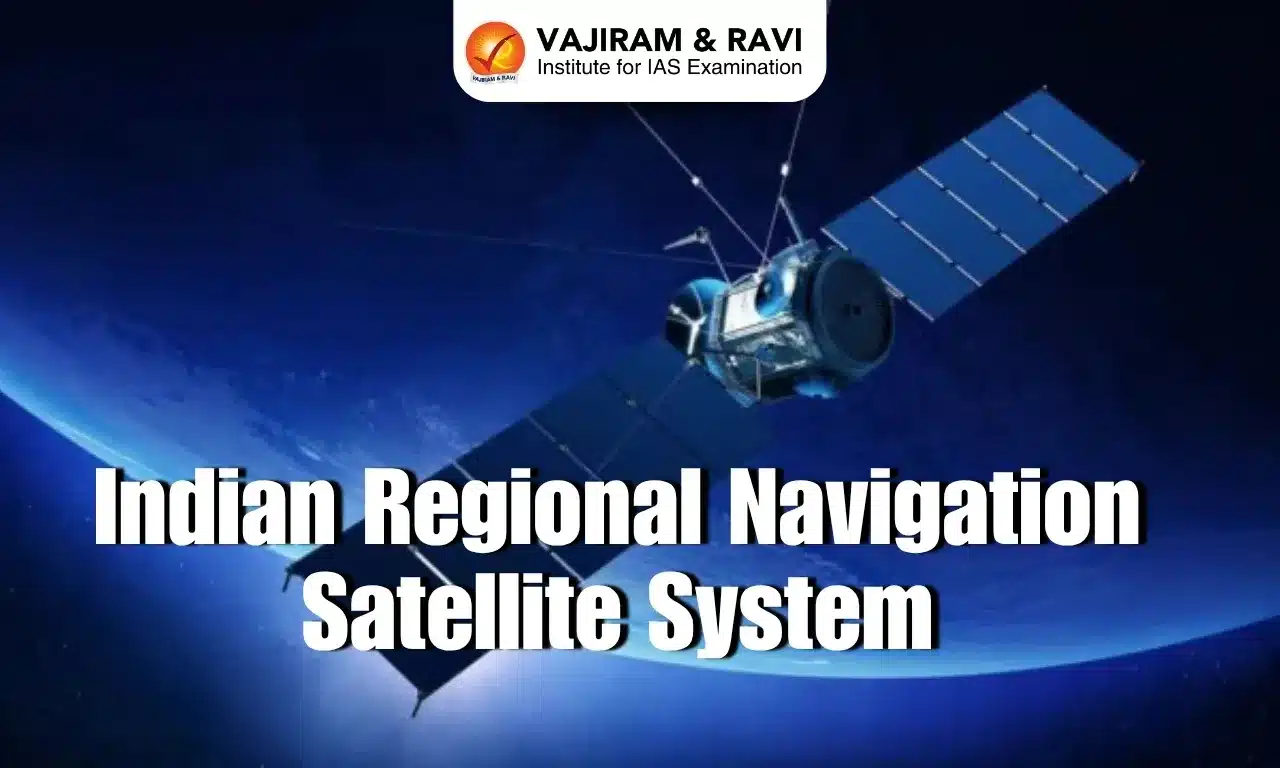
ISRO will launch three navigation satellites for its Indian Regional Navigation Satellite System (IRNSS) by 2026.

About Indian Regional Navigation Satellite System

  • It is India’s independent regional navigation satellite system also known as NavIC (Navigation with Indian Constellation).
  • It is developed in India by the Indian Space Research Organisation (ISRO).
  • IRNSS envisages the establishment of a regional navigational satellite system using a combination of geosynchronous orbit(GEO) and geostationary orbit (GSO) spacecraft and state-of-the-art ground systems.
  • Area covered: IRNSS-NavIC is designed to provide accurate position information service to users in India and the region extending up to 1500 km from its boundary.
  • IRNSS-NavIC network: NavIC is designed with a constellation of seven satellites and a network of ground stations operating around the clock.
    • Three satellites are placed in GSO.
    • Four satellites are placed in inclined GEO.
  • IRNSS provides two types of services, namely:
    • Standard Positioning Service (SPS) – that is provided to all users.
    • Restricted Service (RS) – an encrypted service provided only to authorised users.
  • The signals of the other global navigation satellite systems (GNSS), including GPS, GLONASS, Galileo, and BeiDou provide interoperability with those of the NavIC SPS signals.

Source: IE

Indian Regional Navigation Satellite System FAQs

Q1: Which satellite is used for navigation in India?

Ans: NavIC

Q2: Is NavIC available for public use?

Ans: NavIC will provide two levels of service, the "standard positioning service", which will be open for civilian use.

Comet

Comet

Comet Latest News

NASA’s Hubble Space Telescope has captured the first detailed images of interstellar comet 3I/ATLAS as it passes through our solar system, offering scientists a rare glimpse at a visitor from another star system.

About Comet

  • Comets are large objects made of dust and ice that orbit the Sun. 
  • Best known for their long, streaming tails, these ancient objects are leftovers from the formation of the solar system 4.6 billion years ago.
  • Comets are mostly found way out in the solar system. 
  • Some exist in a wide disk beyond the orbit of Neptune called the Kuiper Belt. 
    • We call these short-period comets. They take less than 200 years to orbit the Sun.
  • Other comets live in the Oort Cloud, the sphere-shaped, outer edge of the solar system that is about 50 times farther away from the Sun than the Kuiper Belt. 
    • These are called long-period comets because they take much longer to orbit the Sun. 
  • The comet with the longest known orbit takes more than 250,000 years to make just one trip around the Sun.
  • A comet is made up of four visible parts: the nucleus, the coma, the ion tail, and the dust tail. 
    • The nucleus is a solid body typically a few kilometres in diameter and made up of a mixture of volatile ices (predominantly water ice) and silicate and organic dust particles. 
    • The coma is the freely escaping atmosphere around the nucleus that forms when the comet comes close to the Sun and the volatile ices sublimate, carrying with them dust particles that are intimately mixed with the frozen ices in the nucleus. 
    • The dust tail forms from those dust particles and is blown back by solar radiation pressure to form a long curving tail that is typically white or yellow in colour. 
    • The ion tail forms from the volatile gases in the coma when they are ionized by ultraviolet photons from the Sun and blown away by the solar wind.
    • Ion tails point almost exactly away from the Sun and glow bluish in colour because of the presence of CO+ ions.

Source: IT

Comet FAQs

Q1: What are comets primarily made of?

Ans: Dust and ice

Q2: Where are most comets found in the solar system?

Ans: In the Kuiper Belt and Oort Cloud

Q3: What is the bluish color of a comet's ion tail caused by?

Ans: Presence of CO⁺ ions

Q4: How old are comets estimated to be?

Ans: 4.6 billion years

Unmanned Aerial Vehicle Launched Precision Guided Missile-V3

Unmanned Aerial Vehicle Launched Precision Guided Missile-V3

Unmanned Aerial Vehicle Launched Precision Guided Missile-V3 Latest News

Defence Research & Development Organisation (DRDO) has successfully carried out flight-trials of Unmanned Aerial Vehicle Launched Precision Guided Missile (ULPGM)-V3 at the National Open Area Range (NOAR) test range in Kurnool, Andhra Pradesh.

About Unmanned Aerial Vehicle Launched Precision Guided Missile-V3

  • It is a precision-guided air-to-surface missile launched from drones and designed to strike targets with high accuracy while reducing risk to personnel. 
  • Developed by:The missile is jointly developed by DRDO in collaboration with Bharat Dynamics Limited (BDL), Adani, and multiple MSMEs and start-ups under the Make in India initiative

Features of Unmanned Aerial Vehicle Launched Precision Guided Missile-V3

  • The ULPGM-V3 is equipped with a high definition dual-channel seeker that can strike a wide variety of targets.
  • It can be fired in plain and high-altitude areas. It has day-and-night capability and two-way data link to support post-launch target/aim-point update.
  • The missile is equipped with three modular warhead options: Anti-armour to destroy modern age armoured vehicles equipped with Rolled Homogeneous Armour (RHA) with Explosive Reactive Armour (ERA); Penetration-cum-Blast warhead with Anti Bunker application and Pre-fragmentation warhead with a high lethality zone.
  • There are three known ULPGM variants: ULPGM V1 (baseline), ULPGM V2 (production variant, also known as ULPGM), and ULPGM V3 (extended-range variant, also referred to as ULM-ER).
  • The ULPGM-V3 can be carried and operated by individual soldiers in remote and mountainous regions.
  • The drone-launched missile also comes with a tandem warhead to defeat tanks equipped with explosive reactive armor (ERA).
  • Range: It can achieve a maximum range of 4 km during the day and 2.5 km at night.
  • Weight: 12.5 kg which enables integration with lightweight drones.

Source: PIB

Unmanned Aerial Vehicle Launched Precision Guided Missile-V3 FAQs

Q1: What is unmanned aerial vehicle?

Ans: An unmanned aerial vehicle (UAV) is defined as a "powered, aerial vehicle that does not carry a human operator, uses aerodynamic forces to provide vehicle lift, can fly autonomously or be piloted remotely, can be expendable or recoverable, and can carry a lethal or nonlethal payload".

Q2: When was DRDO formed?

Ans: DRDO was formed in 1958 by the merger of the then-existing Technical Development Establishment (TDEs) of the Indian Army and the Directorate of Technical Development and Production (DTDP) with the Defence Science Organisation (DSO).

Bambusatulda

Bambusa tulda

Bambusa Tulda Latest News

A team of researchers from the Indian Institute of Technology Guwahati (IIT-G) have fused bambooBambusatulda with biodegradable polymers to develop a composite material as a suitable replacement for conventional plastics.

About Bambusa Tulda

  • It is commonly known as Bengal Bamboo or Indian Timber Bamboo.
  • Local names: JatiBahn (Assam), mritinga (Tripura), spineless Indian bamboo.

Features of Bambusa Tulda

  • It is a fast growing medium-sized tropical clumping bamboo.
  • It has short pachymorph rhizomes which mean that it grows in densely tufted clumps.
  • It is considered to be one of the most valuable multipurpose bamboo species, which usually grows up to a height of 20 m with culm diameters between 5-10 cm.
  • It requires loamy and alluvial soils, fertile and well drained for its growth.
  • Propagation: It can be propagated by seed, rhizome cuttings, culm cuttings and by tissue culture.
  • It is native to the Indian subcontinent, Indochina, Tibet, and Yunnan. It is grown across India’s northeast, has potential applications in furniture, electronics, and packaging industries too, the researchers said.

Uses of Bambusa Tulda

  • In India it is used extensively by the paper pulp industry, but due to its nearly solid culms it is also an excellent and strong timber that can be used in construction and scaffolding.
  • The shoots of Bambusatulda are edible, but taste slightly bitter and are therefore often pickled. Fermented shoots are rich in phytosterols and can be used for the production of sterol drugs to lower cholesterol levels.
  • In agroforestry, Bambusatulda is often planted as a wind-break around farms and fields. 

Source: TH

Bambusa Tulda FAQs

Q1: Which bamboo is best in India?

Ans: Bambusa tulda

Q2: What is Bambusa bamboo used for?

Ans: Culms are used for house construction, scaffolding, rafters, thatching and roofing, handicrafts and art objects

Scheme for Promotion of Culture of Science

Scheme for Promotion of Culture of Science

Scheme for Promotion of Culture of Science Latest News

The Union Minister for Culture and Tourism informed Rajya Sabha about the Scheme for Promotion of Culture of Science.

About Scheme for Promotion of Culture of Science

  • It is a flagship initiative of the Ministry of Culture, Government of India.
  • It is aimed at fostering scientific temper and awareness across the country for the public in general and students in particular.
  • The scheme supports the establishment of Science Cities, Science Centres, Innovation Hubs, and Digital Planetariums in various regions.
  • Nodal Agency: The National Council of Science Museums (NCSM), an autonomous body under the Ministry of Culture, serves as the nodal agency for implementation of the scheme.
  • Under this Scheme Science Centres/Digital Planetariums (Category-III) are set up in areas with a population of less than 5 lakhs.
  • As of July 2025, a total of 27 Science Centres have been established across the country under the Scheme for Promotion of Culture of Science (SPoCS) of the Ministry of Culture.
  • Significance: These institutions have significantly contributed to enhancing scientific awareness and informal science education through hands-on exhibits, innovation hubs, digital planetariums, and outreach programmes.

Source: PIB

Scheme for Promotion of Culture of Science FAQs

Q1: Is NCSM Government or private?

Ans: National Council of Science Museums (NCSM) is an autonomous society under the Ministry of Culture, Government of India.

Q2: What is the main purpose of a planetarium?

Ans: To popularise education and entertainment in astronomy and related fields, especially space science

National Financial Reporting Authority (NFRA)

National Financial Reporting Authority

National Financial Reporting Authority Latest News

Nitin Gupta, the former Chairman of CBDT, has been recently appointed as the Chairperson of the National Financial Reporting Authority (NFRA).

About National Financial Reporting Authority

  • It is an independent regulatory body established by the Government of India under Section 132(1) of the Companies Act, 2013. 
  • Its primary role is to oversee and enforce compliance with accounting and auditing standards to improve the credibility, quality, and transparency of financial reporting in India.
  • It aims to protect the interests of investors, stakeholders, and the public by ensuring high standards in the financial reporting ecosystem.
  • Head Office: New Delhi

National Financial Reporting Authority Functions

  • Recommend accounting and auditing policies and standards to be adopted by companies for approval by the Central Government;
  • Monitor and enforce compliance with accounting standards and auditing standards;
  • Oversee the quality of service of the professions associated with ensuring compliance with such standards and suggest measures for improvement in the quality of service;
  • Perform such other functions and duties as may be necessary or incidental to the aforesaid functions and duties.

National Financial Reporting Authority Composition

  • The Companies Act requires the NFRA to have a chairperson who will be appointed by the Central Government and a maximum of 15 members.
  • The appointment of such chairperson and members is subject to the following qualifications:
  • They should have an expertise in accountancy, auditing, finance, or law.
  • They are required to make a declaration to the Central Government that there is no conflict of interest or lack of independence in their appointment.
  • All the members, including the chairperson, who are in full-time employment, should not be associated with any audit firm (including related consultancy firms) during their term of office and 2 years after their term.

National Financial Reporting Authority Powers

  • NFRA has the power to investigate, either suo moto or on a reference made to it by the Central Government, into the matters of professional or other misconduct committed by any member or firm of chartered accountants registered under the Chartered Accountants Act, 1949.
  • It has the same powers as are vested in a civil court under the Code of Civil Procedure, 1908, while trying a suit.
  • Where professional or other misconduct is proved, it shall have the power to impose punishment.
  • Any person who is not satisfied with the order of the NFRA can then make an appeal to the Appellate Authority.

National Financial Reporting Authority Jurisdiction

  • The jurisdiction of the NFRA for the investigation of Chartered Accountants and their firms would extend to listed companies and large unlisted public companies, the thresholds for which shall be prescribed in the Rules.
  • The Central Government can also refer such other entities for investigation where public interest would be involved.

Source: ET

National Financial Reporting Authority FAQs

Q1: What is the primary role of National Financial Reporting Authority (NFRA)?

Ans: Overseeing compliance with accounting and auditing standards.

Q2: What powers does National Financial Reporting Authority (NFRA) have while investigating misconduct?

Ans: Same as a civil court under the Code of Civil Procedure, 1908.

Q3: Where is the head office of NFRA located?

Ans: New Delhi

Piratula acuminata

Piratula acuminata

Piratula acuminata Latest News

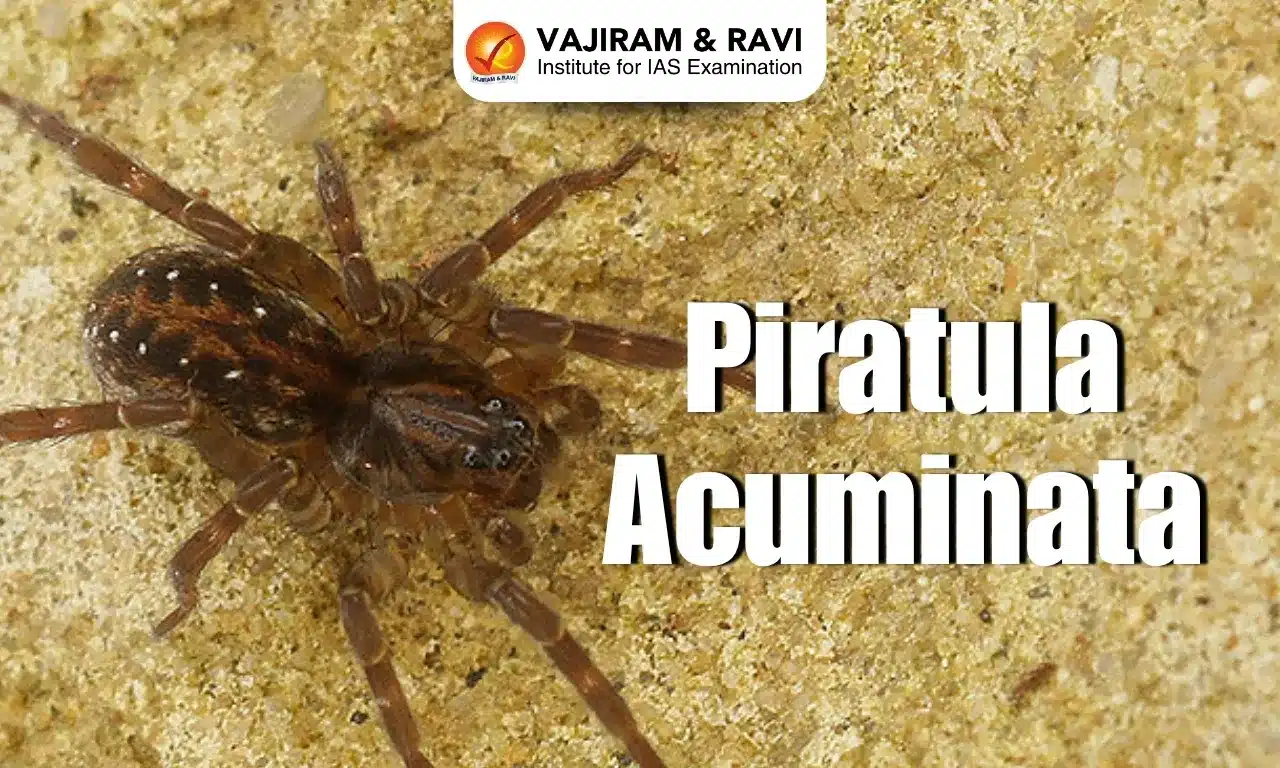
Zoological Survey of India (ZSI) researchers recently announced the discovery of a new spider species on Sagar Island in the Sundarbans, named Piratula acuminata.

About Piratula acuminata

  • It is a new species of spider.
  • It was discovered on Sagar Island in the Sundarbans.
  • The newly identified species, Piratula acuminata, belongs to the family Lycosidae, commonly known as wolf spiders.
    • Unlike web-building spiders, these agile predators are ground-dwelling and rely on ambush tactics to capture prey.
  • It marks the first recorded instance of the genus Piratula in India, a group of wolf spiders predominantly found across Asia, with limited distribution in Europe and North America.
  • Piratula acuminata is a medium-sized spider, approximately 8–10 millimetres long, with a pale creamy-white body featuring brown and chalk-white spots on its abdomen and a pair of light brown stripes towards the rear.

Source: PTI

Piratula acuminata FAQs

Q1: Where was the new spider species Piratula acuminata discovered?

Ans: Sagar Island in the Sundarbans

Q2: Piratula acuminata belongs to which family of spiders?

Ans: It belongs to the family Lycosidae, commonly known as wolf spiders.

Q3: What is unique about Piratula acuminata’s hunting behavior?

Ans: It is a ground-dwelling predator relying on ambush tactics..

Macquarie Island

Macquarie Island

Macquarie Island Latest News

An earthquake of magnitude 6.0 on the Richter Scale jolted the West of Macquarie Island recently.

About Macquarie Island

  • It is located around 1,500 km southeast of Tasmania, Australia, in the Pacific Ocean.
  • It is located about halfway between Australia and Antarctica.
  • The island is about 34 kilometers (21 miles) long and 5 kilometers (3 miles) wide.
  • No people live there permanently today.
  • The island is the exposed crest of the undersea Macquarie Ridge, raised to its present position where the Indo-Australian tectonic plate meets the Pacific plate. 
  • It is a site of major geoconservation significance, being the only place on earth where rocks from the earth’s mantle (6 km below the ocean floor) are being actively exposed above sea level. 
  • Macquarie Ridge is one of only 3 such ridges that impede the Antarctic Circumpolar Circulation.
  • This results in distinct differences between the west and east sides of the ridge, which are used in different ways by different species.
  • Although the island is treeless, there are a variety of native vegetation types, including grasses and many species of moss
  • There are a few small glacial lakes.
  • Fauna: It is home to 4 species of penguins and 4 species of albatross, the island recorded 57 seabird species. 
  • Regionally part of Oceania and politically a part of Tasmania, Australia, since 1900, it became a Tasmanian State Reserve in 1978 and was inscribed as a UNESCO World Heritage Site in 1997.

Source: ZEEB

Macquarie Island FAQs

Q1: Macquarie Island is located in which ocean?

Ans: Pacific Ocean

Q2: Which two tectonic plates meet near Macquarie Island?

Ans: Indo-Australian Plate and Pacific Plate

Q3: Why is Macquarie Island geologically significant?

Ans: It is the only place where mantle rocks are actively exposed above sea level.

Enquire Now