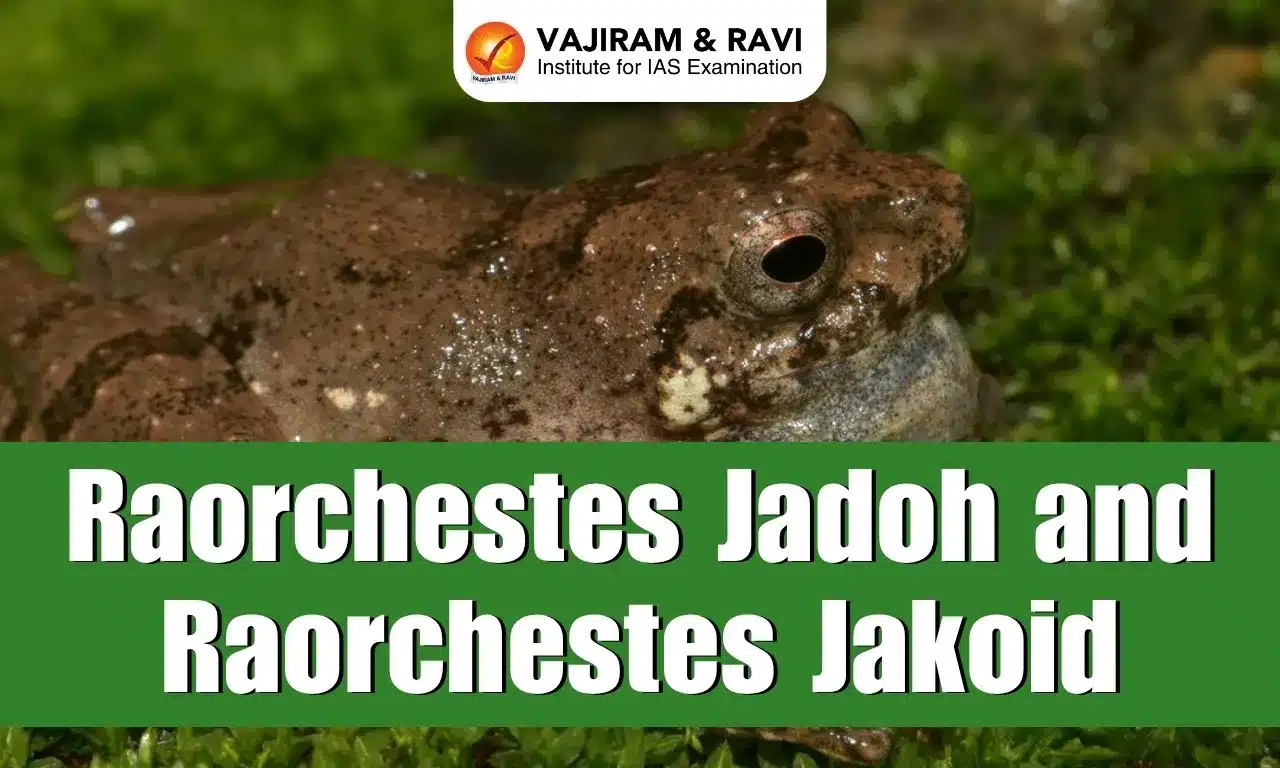
Raorchestes Jadoh and Raorchestes Jakoid

Raorchestes Jadoh and Raorchestes Jakoid

Raorchestes Jadoh and Raorchestes Jakoid Latest News

Recently, two new bush frogs were discovered in Meghalaya and researchers named them as Raorchestes jadoh and Raorchestes jakoid.

About Raorchestes Jadoh and Raorchestes Jakoid

  • These are bush frog species belongs to genus Raorchestes 
  • Raorchestes jadoh recorded from Langtor in the Eastern West Khasi Hills district at an altitude of 1,655 metres above the mean sea level and Raorchestes jakoid was found in the East Khasi Hills district’s Lawbah at an elevation of 815 metres.
  • Habitat: These frogs were located in bushes and trees near human settlements.
  • Both these species are direct-developing frog i.e these frogs are those that bypass the free-swimming tadpole stage and hatch from eggs as froglets or miniature versions of the adults.
  • The genus Raorchestes is one of the most diverse in the family Rhacophoridae, currently comprising 80 recognised species.
  • The two frogs’ unique calls, morphology, and DNA sequences have placed them within the Raorchestes parvulus species complex.
  • This genus has a wide geographical range from southern and northeastern India to Nepal, extending through Myanmar, Thailand, Laos, and southern China, reaching Vietnam, Cambodia, and western Malaysia.

Source: TH

Raorchestes Jadoh and Raorchestes Jakoid FAQs

Q1: What is the Khasi bush frog?

Ans: Raorchestes shillongensis (common names: Shillong bubble-nest frog, Shillong bush frog, Xmas frog) is a species of frog in the family Rhacophoridae.

Q2: What is the common name of Rhacophorus?

Ans: Rhacophorus lateralis is a rhacophorid tree frog endemic to the Western Ghats in South India. It has several common names: small tree frog, Boulenger's tree frog, small gliding frog, and winged gliding frog.
United Nations Office on Drugs and Crime (UNODC)

United Nations Office on Drugs and Crime

United Nations Office on Drugs and Crime (UNODC) Latest News

A recent report of the World Health Organization (WHO) and the United Nations Office on Drugs and Crime (UNODC) said that over the past 90 years, contaminated medicines killed 1,300 people in 90 years.

About United Nations Office on Drugs and Crime

  • It was established in 1997 through a merger between the United Nations Drug Control Programme and the Centre for International Crime Prevention.
  • It is a global leader in the fight against illicit drugs and international crime, in addition to being responsible for implementing the United Nations lead programme on terrorism.

Functions of United Nations Office on Drugs and Crime

  • It works to educate people throughout the world about the dangers of drug abuse.
  • Strengthen international action against illicit drug production and trafficking and drug-related crime. 
  • It also works to improve crime prevention and assist with criminal justice reform in order to strengthen the rule of law, promote stable and viable criminal justice systems and combat the growing threats of transnational organized crime and corruption. 
  • In 2002, the UN General Assembly approved an expanded programme of activities for the Terrorism Prevention Branch of UNODC.
  • The activities focus on providing assistance to States, on request, in ratifying and implementing the eighteen universal legal instruments against terrorism.
  • Funding: It relies on voluntary contributions, mainly from governments, to carry out the majority of our work.
  • Headquarters: Vienna, Austria

Source: TH

United Nations Office on Drugs and Crime FAQs

Q1: What does the United Nations Office on Drugs and Crime do?

Ans: The agency's focus is the trafficking and abuse of illicit drugs, crime prevention and criminal justice, international terrorism, and political corruption.

Q2: Where is the headquarters of the United Nations Office on Drugs and Crime?

Ans: Vienna

Bhitarkanika National Park

Bhitarkanika National Park

Bhitarkanika National Park, Latest News

A 6.3-feet-long female saltwater crocodile was recently netted by forest personnel from a pond in a village close to Bhitarkanika National Park in Odisha's Kendrapara district.

About Bhitarkanika National Park

  • It is located in the Kendrapara district of Odisha.
  • Spread across an area of 672 sq.km. of the mangrove swamp situated on the delta formed by the three rivers, namely Brahmani, Baitarani, and Dhamra, the park houses an array of creeks, backwaters, estuaries, deltas, and mudhuts.
  • It is India’s second largest mangrove ecosystem after the Sunderbans.
  • Proximity to the Bay of Bengal makes the soil of the area enriched with salt; the vegetation and species of the sanctuary are those that are mainly found in the tropical and subtropical intertidal regions.
  • It is also designated as a Ramsar site.
  • Flora: Mangrove species, casuarinas, and grasses like the indigo bush.
  • Fauna:
    • It is home to the largest congregation of the endangered Salt Water Crocodile in the country.
    • The Gahirmatha Beach, which forms the boundary of the park in the east, is the largest colony of the Olive Ridley Sea Turtles.
    • It is also home to numerous animals like hyenas, wild boar, Chitals, Sambar, Spotted Deer, Wild Boar, Jungle cat, Wild Pigs, etc., and migratory birds, which make it their home during the winter season, lending a vibrant hue to the ecosystem.
    • It is also home to eight varieties of Kingfisher birds, which is also a rarity.

Source: FPJ

Bhitarkanika National Park FAQs

Q1: Bhitarkanika National Park is located in which Indian state?

Ans: Odisha.

Q2: Which rivers form the delta on which Bhitarkanika National Park is situated?

Ans: Brahmani, Baitarani, Dhamra.

Q3: Which endangered reptile species has the largest congregation in Bhitarkanika National Park?

Ans: Saltwater Crocodile.

Q4: Is Bhitarkanika National Park a Ramsar Site?

Ans: Yes, Bhitarkanika National Park is a Ramsar Site.

Horsehair Worms

Horsehair Worms

Horsehair Worms Latest News

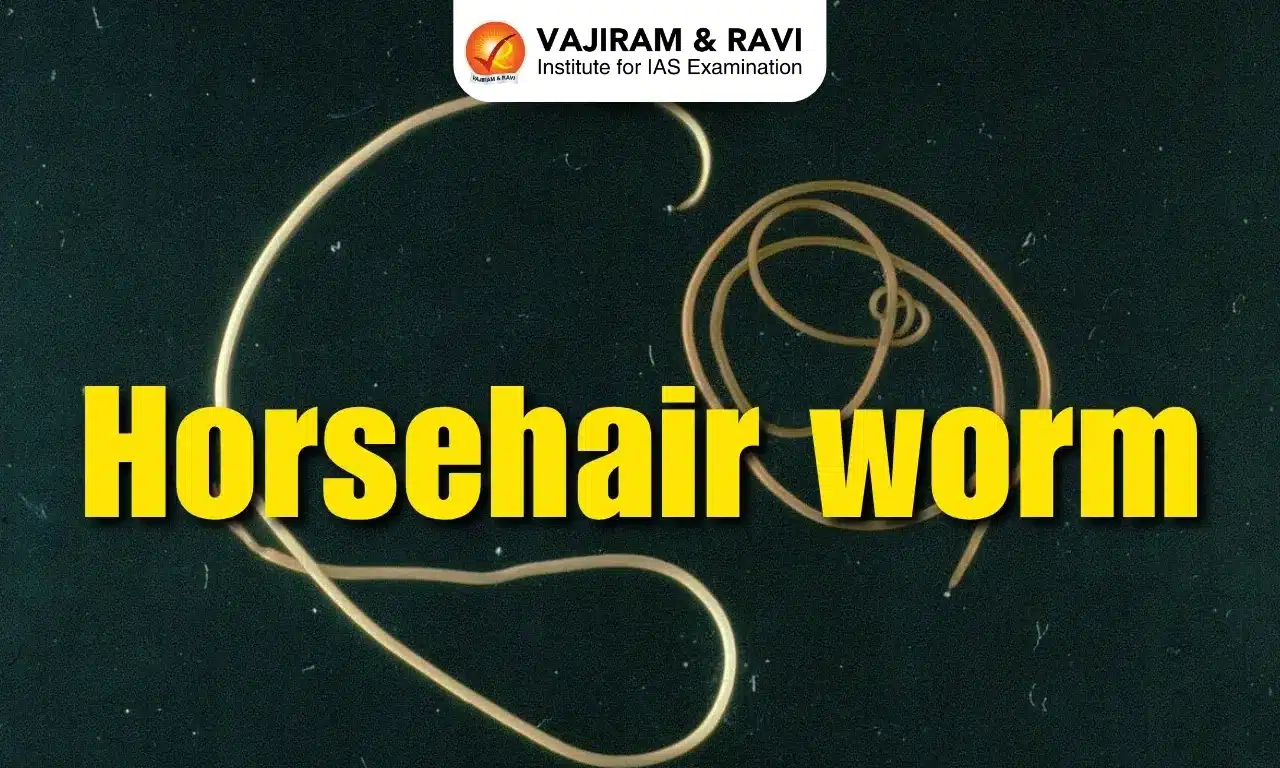
Recently the officials of the Forest Department have stumbled upon Horsehair worm or Nematomorpha in the Motidol beat area of the Mohandra region in the Southern Forest Division under Panna Tiger Reserve.

About Horsehair Worms

  • Horsehair worms, also known as Gordian worms, belong to the phylum Nematomorpha.
  • They are long, measuring from several inches to over 14 inches.
  • They are quite thin, ranging from 1/25 inch to 1/16 inch wide (1 mm to 1.5 mm) and are uniform in diameter from front to back.
  • They vary in color from whitish to yellow/tan to brown/black.
  • They occur in knotted masses or as single worms in water sources such as ponds, rain puddles, swimming pools, animal drinking troughs, and even domestic water supplies.
  • Adult worms are free-living and non-parasitic. 
  • Immature stages are internal parasites of grasshoppers, crickets, cockroaches, beetles, and other insects and millipedes and centipedes. 
  • They are not parasites of humans, livestock, or pets and pose no public health threat.
  • They should be considered beneficial because they can be effective in controlling certain insects.

Source: ETVB

Horsehair Worms FAQs

Q1: Horsehair worms belong to which phylum?

Ans: Nematomorpha.

Q2: What is the primary ecological benefit of horsehair worms?

Ans: Controlling insect populations.

Q3: Why are horsehair worms also called "Gordian worms"?

Ans: Because they form knotted masses resembling the "Gordian Knot".

Sohrai Paintings

Sohrai Paintings

Sohrai Paintings Latest News

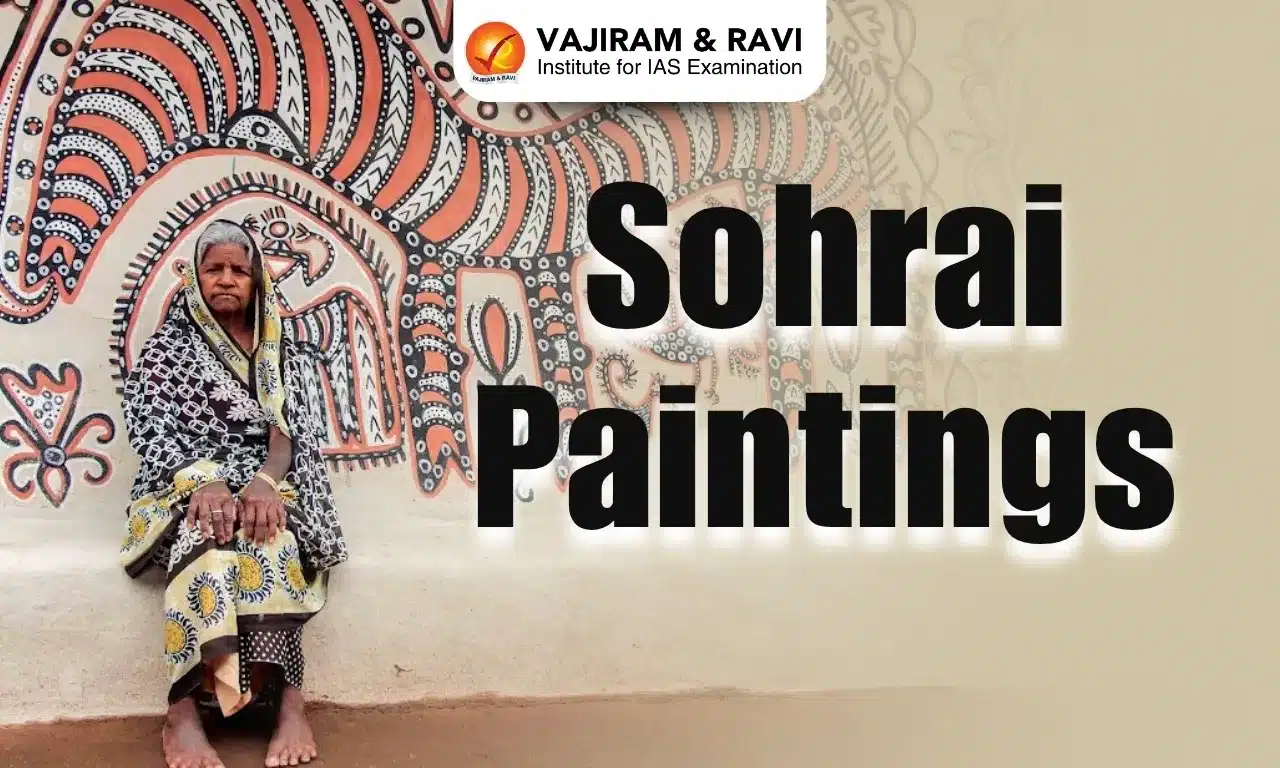
The indigenous mural tradition of Sohrai Art from Jharkhand took centre stage at the second edition of Kala Utsav 2025 – Artists in Residence Programme, held at Rashtrapati Bhavan. 

About Sohrai Paintings

  • It is an indigenous mural art form.
  • The word ‘Sohrai’ comes from soro – translating to ‘to drive with a stick’.
  • This art form dates back to the Meso-chalcolithic period (9000-5000 BC).
  • The Isko rock shelter excavated in Barkagaon, Hazaribagh area also has rock paintings that are exactly similar to the traditional Sohrai paintings.

Features of Sohrai Paintings

  • Sohrai paintings are distinctive for their vibrant colours, intricate patterns, and symbolic motifs;
  • There is a Sohrai festival held every year, marking the harvesting season and the arrival of winter.
  • Themes: It is usually based on natural elements of the universe, this includes forests, rivers, animals amongst others.
  • These ancient paintings are made by tribal women with the use of natural substances like charcoal, clay, or soil.
  • It is practiced by indigenous communities, particularly in the States of Jharkhand, Bihar, Odisha, and West Bengal.
  • It is the art of the women of the Kurmi, Santal, Munda, Oraon, Agaria, Ghatwal tribes.
  • This art form from Hazaribagh in Jharkhand has received the GI tag for this art form. 

Source: PIB

Sohrai Paintings FAQs

Q1: What is the meaning of Sohrai art?

Ans: Sohrai art also known as harvest art is traditionally associated with the domestication of cattle and their use in agriculture. The traditional term 'Soh' or 'Soro' means to drive away and 'Rai' means a stick.

Q2: Which tribe made the painting of Sohrai?

Ans: Kurmi Mahto, Santhals, Oraons and Mundas

Democratic Republic of the Congo (DRC)

Democratic Republic of the Congo (DRC)

Democratic Republic of the Congo Latest News

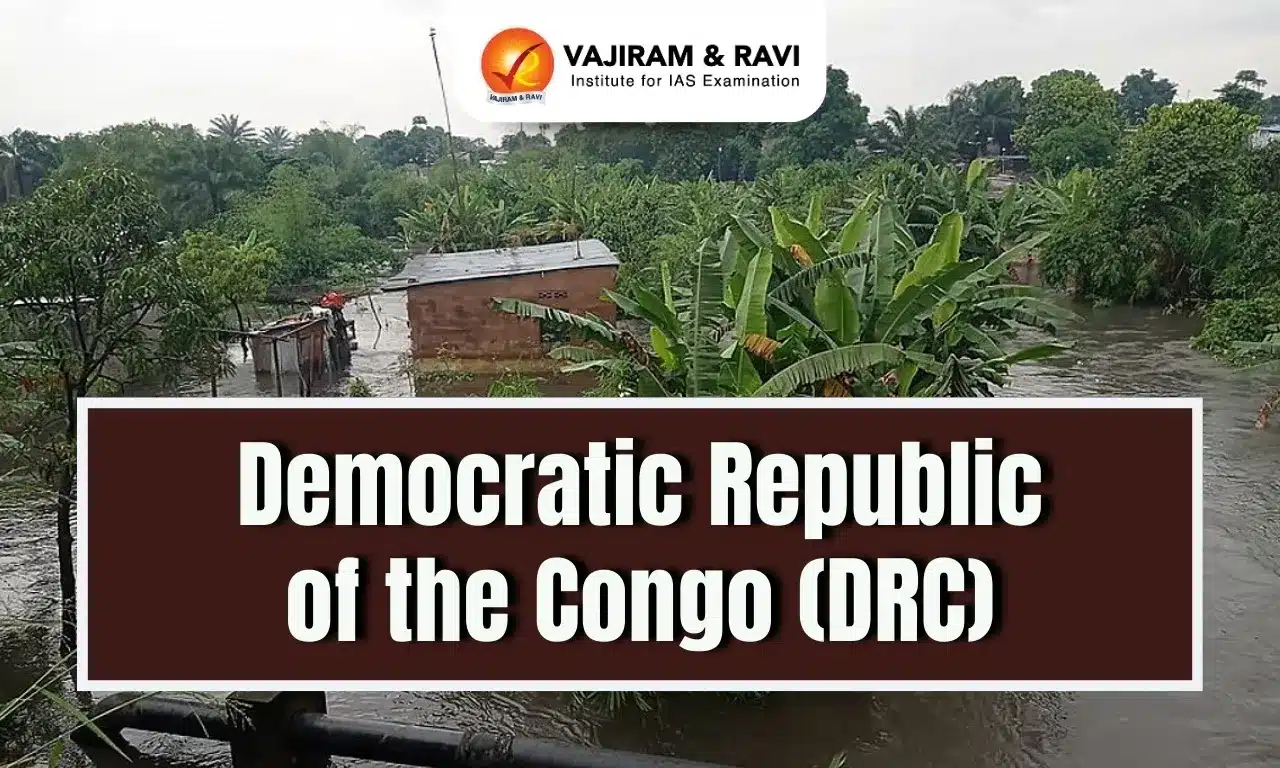
Recently, the Democratic Republic of the Congo government and the rebel group M23 signed a declaration of principles which was mediated by Qatar.

About Democratic Republic of the Congo

  • It is located in Central Africa with the equator passing through the country.
  • Bordering countries: Angola, Republic of the Congo, Central African Republic, South Sudan, Uganda, Rwanda, Burundi, Tanzania, Zambia.
  • The country also has a coastline on the Atlantic Ocean to the southwest.
  • High Point: The highest point in the Republic of the Congo is Mount Nabemba.
  • Major River: Congo River 
  • Important plateau region: Katanga. The plateaus are mostly covered in savanna grasslands, with patches of forests in the valleys and lower areas.
  • Lakes: It has famous lakes like Lake Tanganyika, Lake Albert, Lake Edward, Lake Kivu
  • Volcanoes: Mount Nyiragongo which is an active volcano located in Virunga Mountains.
  • Natural Resources: The DRC is rich in natural resources such as industrial diamonds, cobalt, and copper, and it has large forest reserves and significant hydroelectric potential.
  • Capital city: Kinshasa

Source: TOI

Democratic Republic of the Congo (DRC) FAQs

Q1: Where is the Democratic Republic of the Congo (DRC) located?

Ans: The DRC is located in Central Africa and is the second-largest country on the African continent by area.

Q2: What language is spoken in Congo?

Ans: French

Kargil Vijay Diwas

Kargil Vijay Diwas

Kargil Vijay Diwas Latest News

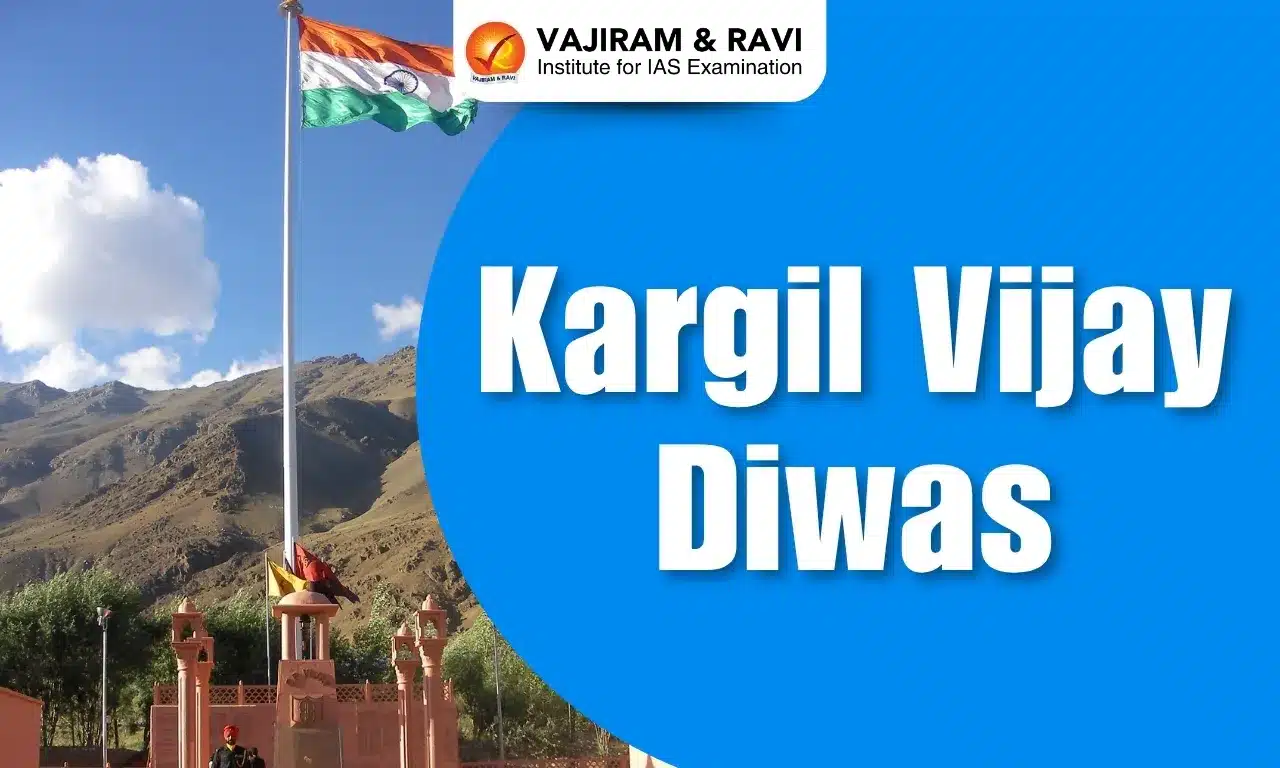
On the 26th anniversary of the Kargil Vijay Diwas, the President and Prime Minister led the nation in paying tributes to the Kargil heroes.

About Kargil Vijay Diwas

  • Kargil Vijay Diwas, also known as Kargil Diwas, is celebrated annually on July 26 to commemorate India’s victory over Pakistan in the Kargil War.
  • The day celebrates the courage and sacrifice of Indian soldiers who valiantly defended the nation’s sovereignty.
  • The year 2025 marks the 26th anniversary of Kargil Vijay Diwas.

Key Facts about Kargil War

  • It was fought between India and Pakistan between May and July 1999 in the Kargil district of Kashmir and along the Line of Control (LOC).
  • Cause: 
    • In an effort to ease these tensions, India and Pakistan signed the Lahore Declaration in February 1999, which aimed for a peaceful resolution to the Kashmir issue.
    • However, during the winter of 1998-1999, Pakistani forces secretly infiltrated the Drass and Batalik sectors of Kargil in the Ladakh region.
    • Their objective was to capture positions that would allow them to monitor and potentially control movements along the vital NH 1A highway.
    • Initially, the Indian military mistook these infiltrators for insurgents. 
    • As the scale of the infiltration became apparent, India mobilized nearly 200,000 troops to counter the threat, leading to the onset of the Kargil War.
  • Operation Vijay: The Indian Army fought bravely and recaptured the famous ‘Tiger Hill’ and other important posts under ‘Operation Vijay’ by evicting the Pakistani troops in the 1999 Kargil War.
  • High Altitude Warfare: It was fought at extreme altitudes, with some of the battlegrounds reaching heights of over 18,000 feet.
  • Duration: It lasted for approximately three months.
  • Armaments:
    • The Indian Army employed heavy artillery, airpower, as well as major infantry operations during the Kargil War.
    • In a first, the Indian side used the Bofors FH-77B howitzers to shoot down enemy positions nested at the top of the mountains. 
    • Israel provided their Unmanned Aerial Vehicles (UAVs) to India during the conflict.
  • Live on TV: It was the first ever war to be broadcasted live on TV channels in India. 
  • The End of Conflict: The war came to an end on July 26, 1999,when India successfully pushed back the Pakistani forces from the occupied positions.
  • Casualties: As per official figures, around 500 Indian soldiers laid down their lives while at least 1,000 Pakistani troops were also killed.
  • It was the last war that happened between India and Pakistan.

Source: TH

Kargil Vijay Diwas FAQs

Q1: Kargil Vijay Diwas is celebrated on which date?

Ans: Kargil Vijay Diwas is celebrated annually on July 26.

Q2: The Kargil War was fought between India and Pakistan in which year?

Ans: 1999

Q3: What was the name of the Indian military operation launched to evict Pakistani forces during the Kargil War?

Ans: Operation Vijay

Trimbakeshwar Shiva Temple

Trimbakeshwar Shiva Temple

Trimbakeshwar Shiva Temple Latest News

Nashik rural police recently uncovered a major black-marketing racket involving darshan passes at the renowned Trimbakeshwar Shiva Temple.

About Trimbakeshwar Shiva Temple

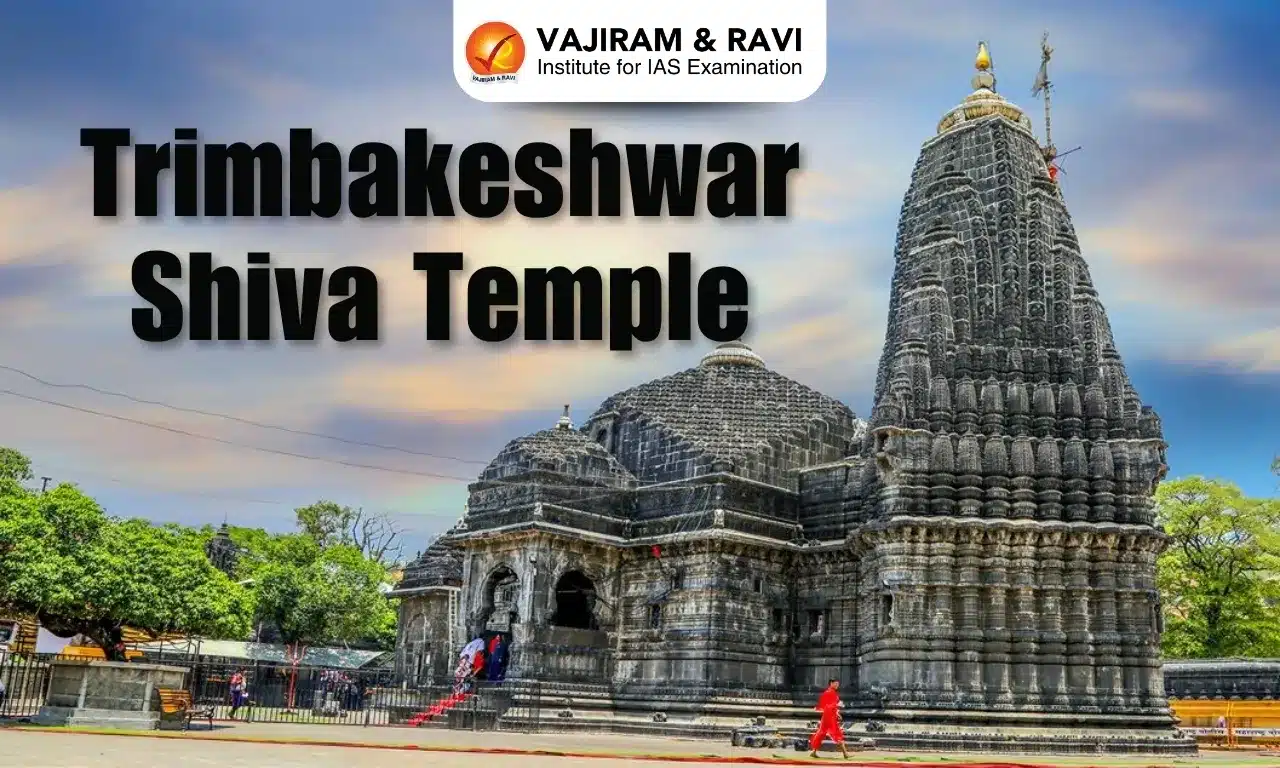
  • It is a renowned Hindu temple dedicated to Lord Shiva, situated in the town of Trimbak in the Nashik district of Maharashtra.
  • It is 28 km far from the city of Nashik. 
  • It is located near the mountain named Brahamagiri, from which the river Godavari flows.
  • It was constructed by the third Peshwa, Balaji Bajirao (1740-1760), on the site of an old temple.
  • It is identified as one of the divine 12 Jyotirlinga.

Trimbakeshwar Shiva Temple Architecture

  • The architecture of the Trimbakeshwar Temple reflects a blend of traditional Hindu temple design with distinctively local elements. 
  • It features intricate carvings and sculptures depicting various mythological stories and deities. 
  • The temple complex also includes other shrines dedicated to various gods and goddesses. 
  • One unique feature of Trimbakeshwar Temple is its presence of three lingams, symbolic representations of Lord Shiva, enshrined within the sanctum sanctorum. 
  • These represent the Hindu trinity of Brahma, Vishnu, and Shiva, embodying creation, preservation, and destruction, respectively. 

What are Jyotirlingas?

  • A Jyotirlinga is a shrine where Lord Shiva is worshipped in the form of a Jyotirlingam.
  • There are currently 12 main Jyotirlingas in India.
  • The 12 Jyotirlinga temples in India take the name of the presiding deity. Each considered a different manifestation of Lord Shiva.
  • 12 Jyotirlingas in India are:
    • Somnath Jyotirlinga in Gir, Gujarat
    • Mallikarjuna Jyotirlinga in Srisailam, Andhra Pradesh
    • Mahakaleshwar Jyotirlinga in Ujjain, Madhya Pradesh
    • Omkareshwar Jyotirlinga in Khandwa, Madhya Pradesh
    • Baidyanath Jyotirlinga in Deoghar, Jharkhand
    • Bhimashankar Jyotirlinga in Maharashtra
    • Ramanathaswamy Jyotirlinga in Rameshwaram, Tamil Nadu
    • Nageshwar Jyotirlinga in Dwarka, Gujarat
    • Kashi Vishwanath Jyotirlinga in Varanasi, Uttar Pradesh
    • Trimbakeshwar Jyotirlinga in Nasik, Maharashtra
    • Kedarnath Jyotirlinga in Rudraprayag, Uttarakhand
    • Ghrishneshwar Jyotirlinga in Aurangabad, Maharashtra.

Source: HT

Trimbakeshwar Shiva Temple FAQs

Q1: Trimbakeshwar Shiva Temple is located in which state?

Ans: Maharashtra

Q2: Which river originates near the Trimbakeshwar Temple?

Ans: Godavari

Q3: Who constructed the Trimbakeshwar Shiva Temple?

Ans: It was constructed by the third Peshwa, Balaji Bajirao (1740-1760), on the site of an old temple.

Global Specs 2030 Initiative

Global Specs 2030 Initiative

Global Specs 2030 Initiative Latest News

The World Health Organisation (WHO) has launched a global initiative called  ‘Global Specs 2030’.

About Global Specs 2030 Initiative

  • It aims to ensure that everyone has access to affordable eyecare services by 2030.
  • The SPECS 2030 initiative spearheads the actions needed for success, focusing on five key areas: 
    • Services: Improving access to refractive services 
    • Personnel: Building capacity of eye care personnel 
    • Education: Promoting public awareness about eye health 
    • Cost: Reducing the cost of eyeglasses and services 
    • Surveillance: Strengthening data collection and research 
  • The initiative will focus on 4 key strategies of engagement to support countries and stakeholders.
    • Normative work builds on WHO’s existing technical guidance for eye care and developing additional resources.
    • Global SPECS Network: It provides a platform for relevant organizations to promote collective and coordinated advocacy and action, share experiences, and expand their professional network.
    • Private sector dialogues: It will be convened with relevant private sector actors, including for example the optical, pharmaceutical and technology industries, private sector service providers and insurance companies.
    • Engagement of regions and countries, including a range of activities, will accelerate progress and bridge the gap between global eye care commitments and country implementation.

Source: IE

Global Specs 2030 Initiative FAQs

Q1: What is the Global SPECS Network?

Ans: The Global SPECS Network is a WHO-hosted network of stakeholders whose mission is to support the WHO SPECS 2030 initiative through coordinated advocacy and united action across all sectors.

Q2: What is the Specs 2030 initiative?

Ans: WHO SPECS 2030 envisions a world in which everyone who needs a refractive error intervention has access to quality, affordable and people-centred refractive error services.

Enquire Now