Geosynchronous Satellite Launch Vehicle (GSLV)

GSLV

Geosynchronous Satellite Launch Vehicle Latest News

Ahead of the launch of the NASA-ISRO NISAR satellite, the ISRO recently announced that the satellite had been mounted on a geosynchronous satellite launch vehicle (GSLV), and all systems of the rocket had been checked.

About Geosynchronous Satellite Launch Vehicle

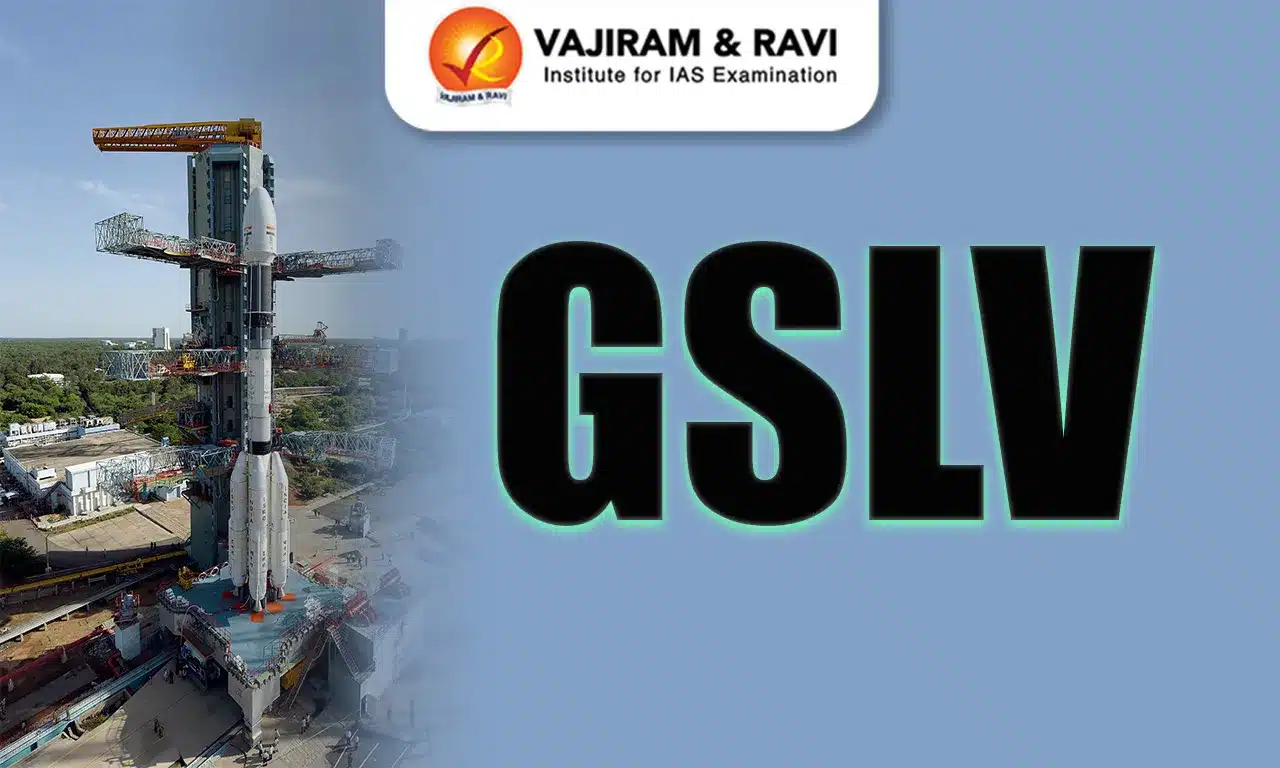
  • It is a space launch vehicle designed, developed, and operated by the Indian Space Research Organization (ISRO) to launch satellites and other space objects into Geosynchronous Transfer Orbits (GTOs). 
  • GSLV has the capability to put a heavier payload in orbit than the Polar Satellite Launch Vehicle (PSLV).
  • GSLV is 49.13 m tall and the tallest among all other vehicles of ISRO. 
  • It is a three-stage vehicle with a lift-off mass of 420 tonnes.
    • The first stage comprises S139 solid booster with 138-tonne propellant and four liquid strap-on motors, with 40-tonne propellant. 
    • The second stage is a liquid engine carrying 40-tonne of liquid propellant. 
    • The third stage is the indigenously built Cryogenic Upper Stage (CUS) carrying 15-tonne of cryogenic propellants.
  • The GSLV improves on the performance of the PSLV (Polar Satellite Launch Vehicle) by the addition of liquid strap-on boosters and a cryogenic upper stage. 
  • The solid first and liquid second stages are carried over from the PSLV, while the cryogenic upper stage is being supplied by Russia until India has developed an indigenous version. 

Variants of Geosynchronous Satellite Launch Vehicle

  • GSLV Mk I:
    • The first-generation GSLV with a payload capacity of carrying 2-2.5 ton satellites to GTO.
    • It used the Russian-supplied cryogenic upper stage, as it had early difficulty with mastering indigenous cryogenic technology.
    • It conducted around 5 flights from 2001-2010, including suborbital tests, with the last launch in 2010.
  • GSLV Mk II:
    • It is an enhanced variant with an indigenously developed cryogenic upper-stage engine and stage. 
    • It is capable of carrying payloads to GTO around the 2.5-ton class.
    • The first successful launch occurred in 2014. 
  • GSLV Mk III: The GSLV Mk III, also known as LVM-3, is the most advanced and powerful variant in the GSLV series, currently in service with a payload capacity of up to 4 tons to GTO.

Performance of Geosynchronous Satellite Launch Vehicle

  • The GSLV has launched various satellites, including communication satellites like INSAT and GSAT, as well as spacecraft from the NavIC and IDRSS series, into GTO.
  • Notable missions include the launch of the South Asia Satellite in 2017, a satellite for military applications in 2018, and the Chandrayaan-2 moon mission in 2019.

Source: TH

Geosynchronous Satellite Launch Vehicle FAQs

Q1: What is the primary purpose of the Geosynchronous Satellite Launch Vehicle (GSLV)?

Ans: To launch satellites into Geosynchronous Transfer Orbit (GTO).

Q2: Which organization has developed and operates the GSLV?

Ans: ISRO

Q3: What is unique about the third stage of GSLV?

Ans: It is a cryogenic upper stage.

Q4: The GSLV Mk III, also known as LVM-3, can carry how much payload to Geosynchronous Transfer Orbit (GTO)?

Ans: 4.0 tons
Baitarani River

Baitarani River

Baitarani River Latest News

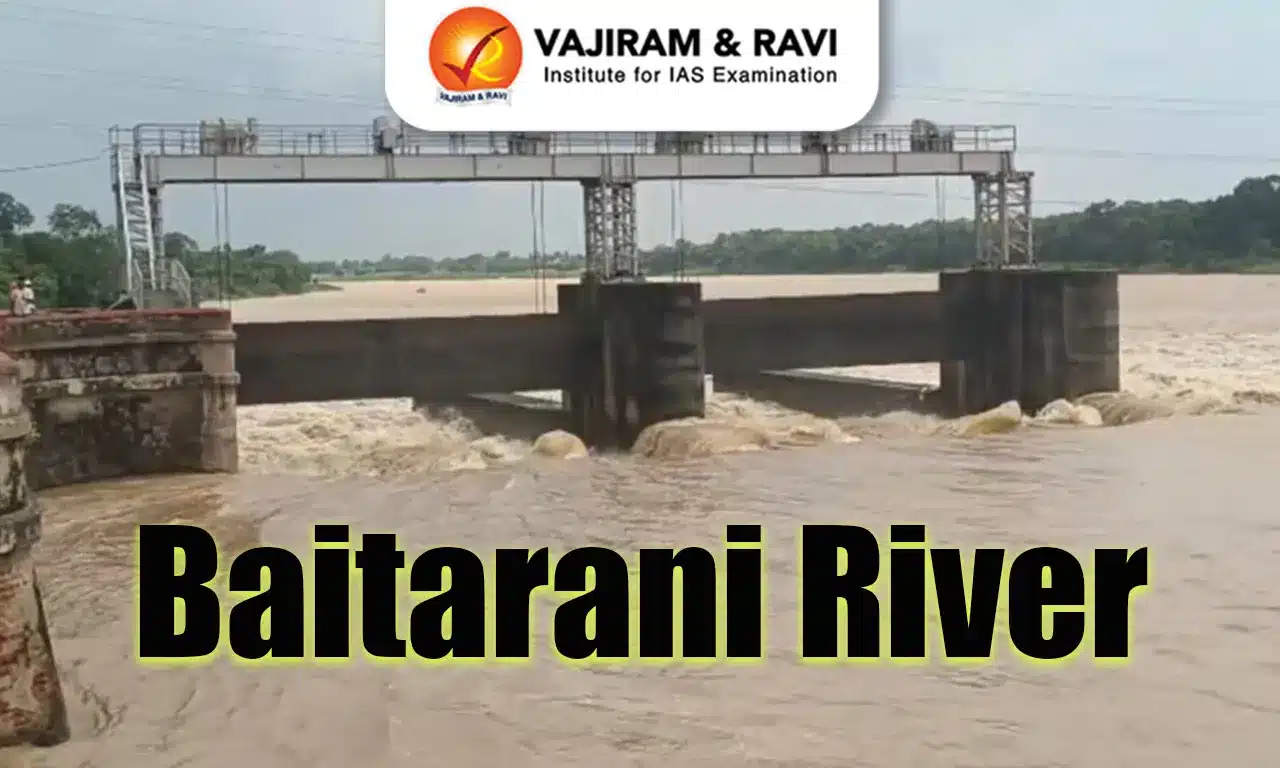
The Baitarani river briefly surged past the danger mark, triggering floods that have inundated several low-lying villages across Bhadrak district, Odisha, recently.

About Baitarani River

  • It is an important east-flowing river in eastern India, primarily flowing through Odisha and partially through Jharkhand.
  • Baitarani,  along with rivers like Mahanadi and Brahmani, forms a fertile delta.
  • Course: 
    • Baitarani originates from the Gonasika Hills in Keonjhar district, Odisha, at an elevation of 900 meters above sea level.
    • At its source, it first flows underground through a small stream called Guptaganga before emerging again, making the site sacred.
    • The uppermost part of the river flows in a northerly direction. 
    • Then it changes its path and flows eastward. 
    • The beginning portion of Baitarani acts as the boundary between Odisha and Jharkhand.
    • It travels approximately 360 km before draining into the Bay of Bengal.
  • Total Basin Area: Approximately 12,790 sq. km.
  • The River basin is geographically bounded by several important river basins and water bodies:
    • South and West: Brahmani River basin
    • North: Subarnarekha River basin
    • East: Burhabalang River and the Bay of Bengal
  • Major Tributaries:
    • The river has 65 tributaries. Out of all the tributaries, 35 join from the left side and 30 join from the right side. 
    • Major tributaries include Salandi, Gahira, Kusei, Deo, Kanjhari, Musal, Arredi, Siri, Kukurkata, Budhi, Ambajhara, and Remal.
  • The Baitarani basin possesses rich mineral and agricultural resources and thus offers an ideal ground for establishment of various industries.

Source: NIE

Baitarani River FAQs

Q1: The Baitarani River primarily flows through which Indian state?

Ans: Odisha

Q2: Where does the Baitarani River originate?

Ans: Baitarani originates from the Gonasika Hills in Keonjhar district, Odisha.

Q3: What is the total length of the Baitarani River?

Ans: 360 km

Q4: Into which water body does the Baitarani River ultimately drain?

Ans: Bay of Bengal

Gavri Festival

Gavri Festival

Gavri Festival Latest News

Every year, the Bhil community of Mewar embarks on a 40‑day ritual called Gavri.

About Gavri Festival

  • It is a 40-day festival of dance-drama which is performed by the Bhil community of Rajasthan.
  • It is a fusion of act and dance, dedicated to the fight between goddess and demon.
  • This most popular southern Rajasthani ritual reflects the divine perception of the Bheel tribe.
  • It has been known to be in existence since the 3rd or 4th century, it was prevalent in the times of SiddhRaj Jai Singh, a ruler in Gujarat.
  • A vigorous fight between Goddess Amba and Demon Bhiamwal shows the conquest of good over the bad.
  • The original story of ‘Gavri’ is the story of Lord Shiva and the demon Bhasmasur. 
  • The artists perform plays in those villages where their married sisters and daughters reside. The purpose behind this custom is to ensure the wellness of their loved ones after marriage and instil in them a sense of pride and security.
  • This dance drama skillfully combines mime and dialogue, known by the names Gavri or Rai Nach.
  • Moreover, energetic background music and colorful costumes makes the place full of verve.
  • Throughout the performance, various scenes are enacted, referred to as Khel.
  • Kutkadiya, a character skillfully narrates the story before each scene, allowing the audience to immerse themselves fully in the play’s narrative.
  • All the characters are played by men and not women.

Source: IE

Gavri Festival FAQs

Q1: In which state is the Gavri festival celebrated?

Ans: Rajasthan

Q2: What is the famous folk theatre of Rajasthan?

Ans: Hela Khayal Dangal is a distinct form of folk theatre of Rajasthan.

Paithani Sarees

Paithani Sarees

Paithani Sarees Latest News

Recently, the Prime Minister of India in the monthly radio programme praised the traditional craftsmanship of Paithani sarees.

About Paithani Sarees

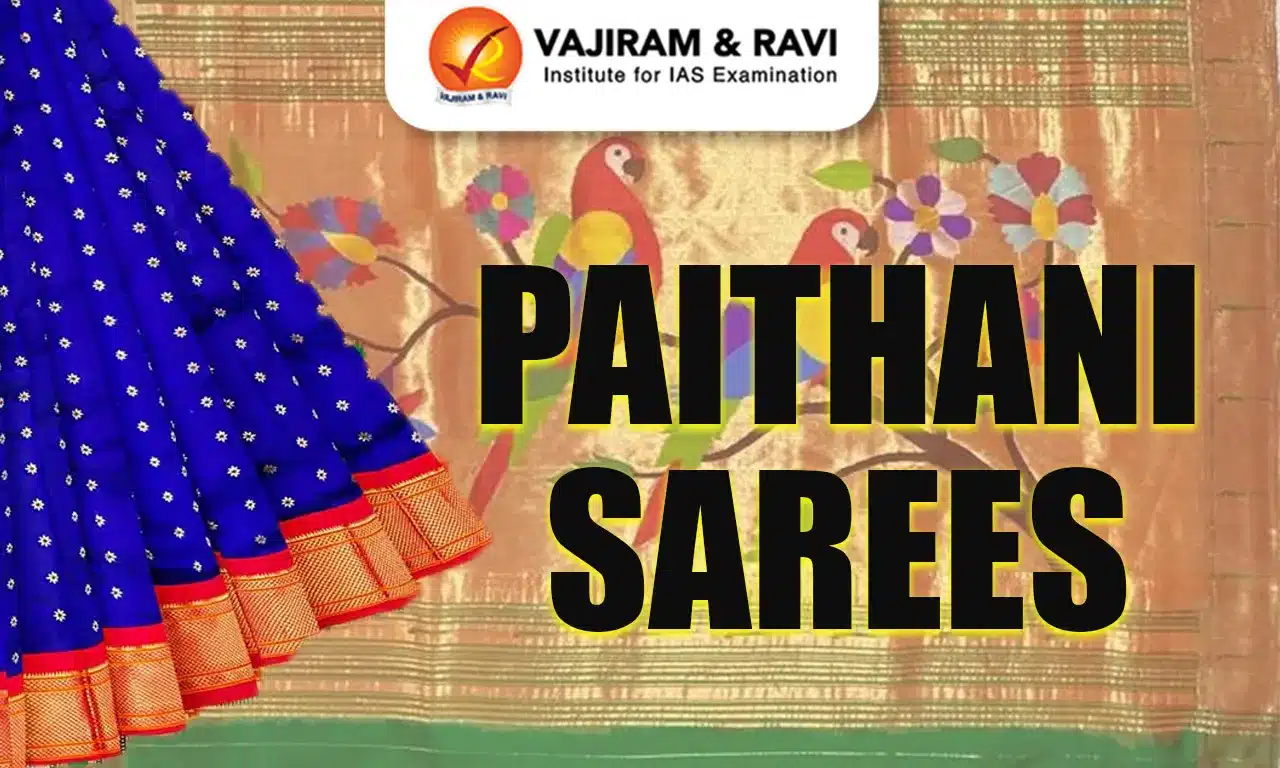
  • It is known as the ‘mahavastra of the state of Maharashtra’.
  • It is known for its rich, vibrant colors woven in pure silk and gold zari.
  • The birthplace of Paithani, is the medieval town of Paithan, located on the banks of the River Godavari.

Features Paithani Sarees

  • The traditional Paithani saree is manufactured by hand in pure silk and dyed in traditional colours.
  • Its kath (border) and padar (pallu or end-piece), have distinctive motifs that make the textile stand out.
  • The traditional motifs used in Paithanis include parrots, lotuses and peacocks. The six- or nine-yard sari has been favored by Maharashtrian brides for centuries.
  • It was awarded with the Geographical Indication (GI) tag in 2010.
  • Paithanis are easily recognizable and considered among the most exquisite and expensive sarees in India.
  • These sarees are made using the finest silk available in the country and are regarded as a symbol of Maharashtrian heritage and skilled craftsmanship.

Source: News On Air

Paithani Sarees FAQs

Q1: What is special in a Paithani saree?

Ans: Paithani saris are handwoven masterpieces known for their luxurious silk, intricate zari work, and heritage value.

Q2: Which state is famous for Paithani sarees?

Ans: Maharashtra state

Legionnaire’s Disease

Legionnaire’s Disease

Legionnaires' Disease Latest News

Residents of Central Harlem in New York City have been advised to exercise caution after cases of Legionnaires' disease have been identified recently, prompting health authorities to launch an urgent investigation.

About Legionnaires' Disease

  • It is a severe form of a lung infection called pneumonia. 
  • It is caused by a bacterium known as legionella.

Legionnaires' Disease Transmission

  • Legionella is found naturally in freshwater, such as lakes and rivers. It can also be found in soil. 
  • Most people who catch Legionnaires' disease breathe in the bacteria from water or soil. 
  • You usually can't get infected by drinking water that contains the bacteria unless you aspirate it (accidentally breathe the water into your lungs).
  • It is not contagious, meaning it is not spread from person to person.
  • Older adults, people with weakened immune systems, and people who smoke have a higher risk of getting Legionnaires' disease.

Legionnaires' Disease Symptoms

  • The main symptoms are fever, chills, headache, malaise, and muscle pain (myalgia).
  • Untreated Legionnaires' disease can kill.

Legionnaires' Disease Treatment

  • Treating right away with antibiotics most often cures Legionnaires' disease.
  • But some people still have problems after treatment.

Source: NDTV

Legionnaires' Disease FAQs

Q1: What type of illness is Legionnaires’ disease?

Ans: It is a severe form of a lung infection called pneumonia.

Q2: What is the causative agent of Legionnaires’ disease?

Ans: It is caused by a bacterium known as legionella.

Majuli Island

Majuli Island

Majuli Island Latest News

In a village of Majuli Island local residents have discovered a remarkable way to combat riverbank erosion by planting Kanchan trees along the Brahmaputra River.

About Majuli Island

  • It is the world’s largest river island located in Assam.
  • The island is formed by the Brahmaputra River in the south and the Kherkutia Xuti, a  branch of the Brahmaputra, joined by the Subansiri River in the north.
  • The island’s landscape is characterised by lush greenery, water bodies, and paddy fields.
  • Rice cultivation is the primary livelihood for the residents of Majuli, with several unique varieties of rice, such as Komal Saul and Bao Dhan, grown in the region.
  • Most of the islanders belong to three tribes-Mishing, Deori, and Sonowal Kachari, with the non-tribal Assamese comprising the rest.
  • The island has also been the hub of Assamese neo-Vaishnavite culture, initiated around the 16th century by the great Assamese saint-reformer Srimanta Sankerdeva and his disciple Madhavdeva. 
  • They initiated the tradition of Satras (monastic institutions), and these Satras have preserved Sattriya dance, literature, bhaona (theatre), dance forms, mask making, and boat-making. 
  • Apart from Satras or Vaishnavite monasteries, Majuli is famous for mask-making and has a tradition of pottery making.

Source: ET

Majuli Island FAQs

Q1: Which river is Majuli island on?

Ans: River Bramhaputra

Q2: Is Majuli a Unesco site?

Ans: River island of Majuli is part of the Tentative list of India in order to qualify for inclusion in the World Heritage List.

e-Shram Portal

e-Shram Portal

e-SHRAM Portal Latest News

The Ministry of Labour & Employment stated in a latest update that as of 22nd July 2025, over 30.95 crore unorganised workers have already registered on the eShram portal.

About e-SHRAM Portal

  • It was launched by the Ministry of Labour and Employment on 26th August 2021 to support and empower the unorganized workforce.
  • It is designed to create a comprehensive National Database of Unorganised Workers (NDUW).
  • It is the first-ever national database of unorganised workers including migrant workers, construction workers, gig and platform workers, etc.
  • The Ministry of Electronics and Information Technology’s (MEITY’s) Bhashini project has been leveraged to upgrade the eShram portal with 22 languages. The previous version was available only in English, Hindi, Kannada, and Marathi.

e-SHRAM Portal Objectives

  • Establish a centralized database of unorganized workers for effective policy implementation.
  • Enhance access to social security schemes and benefits for workers in sectors such as agriculture, construction, domestic work, and street vending.
  • Facilitate job matching and skill development opportunities.
  • Strengthen labor market resilience by integrating unorganized workers into the formal economy.
  • Promote financial inclusion through direct benefit transfers and digital payments.

Eligibility for Registering on e-SHRAM Portal

  • Be aged between 16 and 59 years.
  • Be employed in the unorganized sector, including self-employed individuals, daily wage laborers, and gig workers.
  • Possess an Aadhaar card, a valid mobile number linked to Aadhaar, and a bank account.
  • Not be a member of the Employees' Provident Fund Organization (EPFO) or Employees' State Insurance Corporation (ESIC).

e-SHRAM Portal Features

  • Universal Account Number (UAN): Registered workers receive a UAN linked to their Aadhaar, enabling seamless access to benefits.
  • Single Registration Process: The portal streamlines the registration process, requiring minimal documentation such as Aadhaar and bank account details. The ease of self-registration is also available to the beneficiaries.
  • Multilingual Support: Workers from diverse regions can access the portal in multiple Indian languages, ensuring inclusivity.
  • Grievance Redressal Mechanism: A dedicated helpline and support system address workers’ queries and grievances promptly.
  • Integration with Employment and Skill Opportunities: Registered workers can connect with employment opportunities, skilling, apprenticeship, pension schemes, digital skilling, and state-specific schemes through the portal.
  • Family Details for Migrant Workers: Family details for migrant workers are captured, aiding in the provision of child education and women-centric schemes for those who have migrated with their families.
  • Data Sharing with BOCW Welfare Boards: The data of construction workers registering on e-Shram is shared with the concerned Building and Other Construction Workers’ (BOCW) Welfare Boards, ensuring their registration with the respective boards and access to schemes meant for them.
  • Data Sharing Portal (DSP): A Data Sharing Portal has been launched to allow the secure sharing of e-Shram beneficiary data with State and Union Territory governments. facilitating the targeted implementation of social security and welfare schemes for registered unorganised workers.

Source: BS

e-SHRAM Portal FAQs

Q1: What is the purpose of e-SHRAM portal?

Ans: To create a national database of unorganised workers.

Q2: Which Ministry launched the e-SHRAM Portal?

Ans: Ministry of Labour and Employment.

Q3: When was the e-SHRAM Portal launched?

Ans: 26th August 2021

Q4: What key identification do registered workers on the e-SHRAM Portal receive?

Ans: Universal Account Number (UAN)

Enquire Now