Human Outer Planet Exploration

Human Outer Planet Exploration

Human Outer Planet Exploration Latest News

Bengaluru-based space tech company Protoplanet, along with the Indian Space Research Organisation (ISRO), has developed the analogue station, called the Human Outer Planet Exploration (HOPE) station in Ladakh’s Tso Kar region. 

About Human Outer Planet Exploration

  • HOPE is an analogue site, closely mimicking the geological and environmental conditions found on the Moon and Mars.
  • It is developed by Bengaluru-based space tech company Protoplanet, along with the Indian Space Research Organisation (ISRO), has developed the analogue station.
  • It is developed with the aim of conducting “critical research for future crewed interplanetary journeys”.
  • The site at Tso Kar, located at an altitude of over 14,500 feet, was chosen because of its terrain and environment, which closely mimics conditions on the Moon and Mars
  • An analogue research station is a site with conditions closest to a planet or planetary body with regard to the topography, environment, etc.
  • These stations usually act as testing grounds for relevant technologies, help advance technology readiness levels (TRL) and engineering integration, and facilitate human studies, crew training and research around geological, geomorphological, habitability, and life detection.
  • Currently, there are 33 analogue research stations in the world. Some of the prominent ones are the BIOS-3 in Russia, HERA at the US’ Johnson Space Centre, SHEE in Europe, and the Mars Desert Research Station (MDRS) in the US’ Utah.
  • Significance to India: The station marks a significant step towards India’s human space exploration ambitions, helping scientists and researchers understand the physiological and psychological aspects of long-duration space travel.

Source: TH

Human Outer Planet Exploration FAQs

Q1: What is an analog site?

Ans: Analogue sites are places on Earth with assumed, past or present, geological, environmental or biological conditions of a celestial body.

Q2: Who is the father of the Indian Space Research Organization?

Ans: Vikram Ambalal Sarabhai
Darwin Tree of Life (DToL) Project

Darwin Tree of Life (DToL) Project

Darwin Tree of Life (DToL) Project Latest News

The first phase of the Darwin Tree of Life (DToL) project is almost complete. 

About Darwin Tree of Life (DToL) Project

  • It aims to sequence the genomes of 70,000 species of eukaryotic organisms in Britain and Ireland. 
  • It is one of several initiatives across the globe working towards the ultimate goal of sequencing all complex life on Earth, in a venture known as the Earth BioGenome Project.
  • It will carefully collect representatives of each species, and use advanced DNA sequencing technologies to generate high quality genome sequences.
  • It also uses cutting edge computational tools to understand how the DNA sequence translates into the diversity of life.
  • It is a collaborative project between ten biodiversity, genomics and analysis partners.

What are Eukaryotes?

  • Eukaryotic cells are found in multi-cellular organisms such as protists, plants, animals, and fungi. They are more complex as compared to prokaryotic cells.
  • These are any cell or organism that possesses a clearly defined nucleus.
  • The eukaryotic cell has a nuclear membrane that surrounds the nucleus, in which the well-defined chromosomes are located.
  • Eukaryotic cells also contain organelles, including mitochondria (cellular energy exchangers), a Golgi apparatus.
  • Reproduction: Eukaryotes can reproduce asexually through mitosis and sexually through meiosis and gamete fusion.

Darwin Tree of Life (DToL) Project FAQs

Q1: What is the Darwin Tree of Life project?

Ans: The Darwin Tree of Life Project is a collaboration by scientific partners to produce high-quality reference genomes for all known species of animals, plants, fungi and protists in Britain and Ireland.

Q2: What is genome?

Ans: A genome is the complete set of genetic information in an organism. It provides all of the information the organism requires to function. In living organisms, the genome is stored in long molecules of DNA called chromosomes.

Indo-Burma Ramsar Regional Initiative (IBRRI)

Indo-Burma Ramsar Regional Initiative

Indo-Burma Ramsar Regional Initiative (IBRRI) Latest News

Recently, the Ramsar COP15 concluded with a side event of Indo-Burma Ramsar Regional Initiative (IBRRI) for wetland conservation and restoration.

About Indo-Burma Ramsar Regional Initiative (IBRRI)

  • It was jointly developed by the Ramsar National Focal Points (NFPs) Cambodia, Lao People’s Democratic Republic (PDR), Myanmar, Thailand and Viet Nam, and IUCN’s Asia Regional Office.
  • It is supported by IUCN’s BRIDGE (Building River Dialogue and Governance) project.
  • It aims to support the coordinated implementation of the objectives of the Strategic Plan of the Ramsar Convention.
  • To ensure oversight and transparency in the management of the IBRRI, the initiative has established a governance structure with representatives from both government and non‐governmental organisations:
    • Steering Committee: It includes representatives from Ramsar Administrative Authorities from the five countries.  
    • Secretariat: It is hosted by the IUCN Asia Regional Office in Bangkok.
    • Stakeholder Committee provides technical and strategic guidance as a platform for inclusive, transparent and multi-stakeholder engagement in IBBRI activities. 
  • The IBRRI officially launched its Strategic Plan 2025–2030 during a side event at the 15th Meeting of the Conference of the Contracting Parties to the Ramsar Convention.
  • The Plan sets out a collaborative, transboundary framework to halt and reverse the loss of wetlands across its Member States.

Source: IUCN

Indo-Burma Ramsar Regional Initiative (IBRRI) FAQs

Q1: What is the Ramsar Regional Initiative for Central Asia?

Ans: RRI-CA aims to promote stronger cooperation and synergies between the members to the RRI-CA to effectively implement the Ramsar Convention and its Strategic Plan 2016-2024 at the national and regional levels.

Q2: What is the Indo-Burma Ramsar Regional Initiative?

Ans: Its aim is to support the effective implementation of the Ramsar Convention in the Indo-Burma Region, focusing on five objectives for sustainable regional wetlands, with climate change as a crosscutting issue.

Liver Cirrhosis

Liver Cirrhosis

Liver Cirrhosis Latest News

A team of scientists from Institute of Liver and Biliary Sciences (ILBS) New Delhi, and National Institute of Pharmaceutical Education and Research (NIPER) Guwahati found a new approach to treat liver cirrhosis.

About Liver Cirrhosis

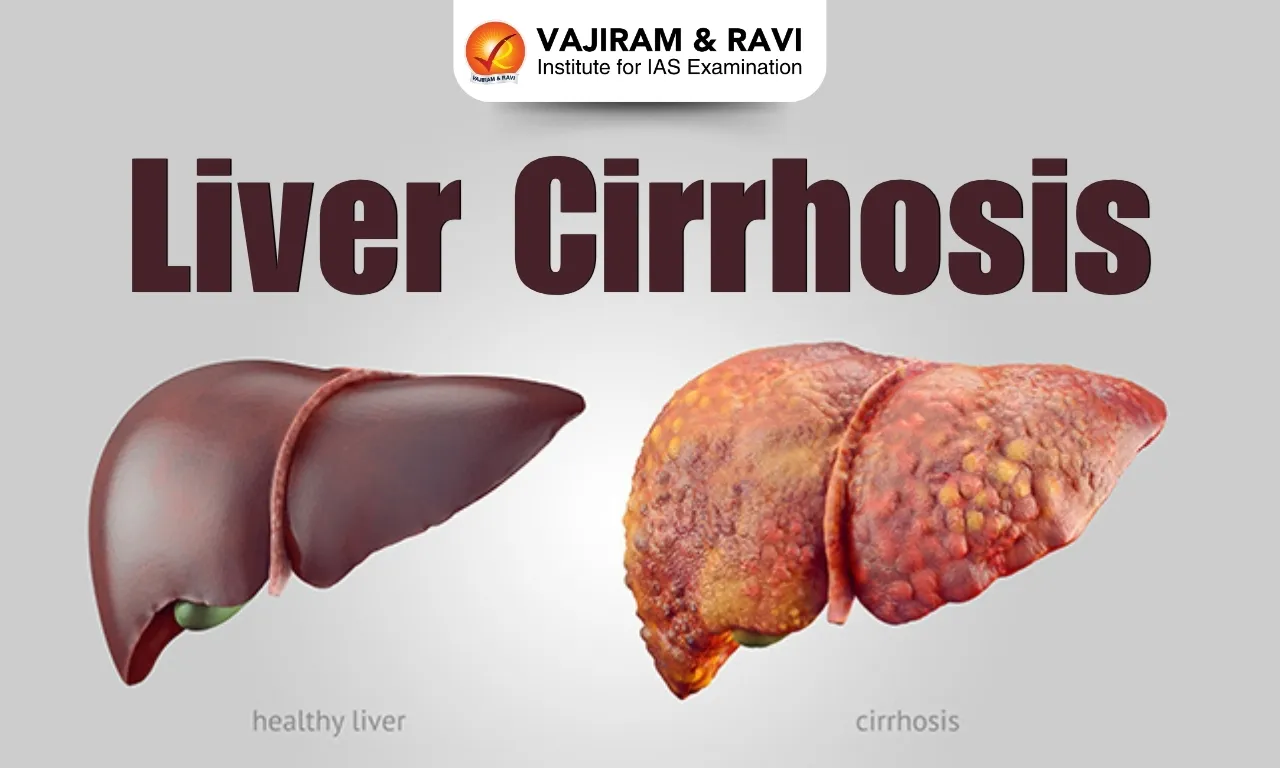
  • Cirrhosis is advanced scarring of the liver caused by many diseases and conditions.
  • At this stage, a significant amount of healthy liver tissue has turned to scar tissue. Scarring comes from long-term inflammation in liver
  • It is accompanied by distortion of both blood and lymphatic vessels in the liver and intestine.
  • Causes: Some of the common causative factors include alcohol, NASH (Non-alcoholic Steato-Hepatitis) and hepatitis B and C viral infections.
  • Cirrhosis often has no symptoms until liver damage is serious. When symptoms do happen, they may include: extreme tiredness, easily bleeding or bruising, loss of appetite, swelling in the legs, feet or ankles, called edema etc.
  • Treatment of liver cirrhosis: Cirrhosis can be treated if diagnosed early. Both hepatitis B and C can be Abstinence from alcohol can also improve liver disease to some extent controlled or cured with medication.

Source: PIB

Liver Cirrhosis FAQs

Q1: Can a liver recover from cirrhosis?

Ans: The damage done by cirrhosis typically cannot be undone. But if caught early enough and depending on the cause, there is a chance of slowing it with treatment.

Q2: What is the main function of the liver?

Ans: All the blood leaving the stomach and intestines passes through the liver. The liver processes this blood and breaks down, balances, and creates the nutrients and also metabolizes drugs into forms that are easier to use for the rest of the body or that are nontoxic.

Oreshnik Missile

Oreshnik Missile

Oreshnik Missile Latest News

Russian President Vladimir Putin recently announced that Russia has begun production of its latest hypersonic missile, the Oreshnik, and reaffirmed plans to deploy it in Belarus before the end of 2025.

About Oreshnik Missile

  • It is a Russian intermediate-range hypersonic ballistic missile.
  • This high-velocity missile, named after the Russian word for “hazel tree,” was first launched operationally on November 21, 2024, in a precision strike targeting the Pivdenmash defence-industrial facility in Dnipro, Ukraine.
  • Its hypersonic speed, mid-flight manoeuvrability, and multiple warheads make it particularly hard to intercept, even with advanced missile defence systems.

Oreshnik Missile Features

  • It is a mobile, solid-fueled missile.
  • It is capable of reaching speeds of Mach 10—ten times the speed of sound.
  • The system is reportedly capable of carrying multiple independently targetable re-entry vehicles (MIRVs), allowing a single missile to strike several distinct targets simultaneously with either conventional or nuclear warheads.
  • It has a reported range of approximately 5,000 kilometers (3,100 miles).

Source: IT

Oreshnik Missile FAQs

Q1: What type of missile is the Oreshnik?

Ans: Intermediate-range hypersonic ballistic missile.

Q2: What is the reported speed capability of the Oreshnik missile?

Ans: It is capable of reaching speeds of Mach 10—ten times the speed of sound.

Q3: Which country developed the Oreshnik missile?

Ans: Russia

Bluebird Satellite

Bluebird Satellite

Bluebird Satellite Latest News

The ISRO is hoping to launch the Block 2 BlueBird communications satellite, developed by the U.S.-based AST SpaceMobile, in three to four months from now.

About Bluebird Satellite

  • It is an advanced American communications satellite.
  • It was developed by the U.S.-based AST SpaceMobile.
  • The Bluebird satellite boasts revolutionary technology that will enable individuals to make calls using smartphones from space. 
  • With an innovative antenna spanning 64 square meters and a weight of approximately 6,000 kilograms, the satellite will operate in low Earth orbit, facilitating direct satellite-to-smartphone connections. 
  • This capability will allow users to make calls and access broadband internet from space without relying on traditional ground-based towers.
  • The BlueBird satellites' beams are designed to support a capacity of up to 40 MHz, enabling peak data transmission speeds of up to 120 Mbps.
  • After launch, the BlueBird satellites are planned to offer non-continuous cellular broadband service across the United States and in select markets globally.

Source: TH

Bluebird Satellite FAQs

Q1: Who developed the Bluebird satellite?

Ans: It was developed by the U.S.-based AST SpaceMobile.

Q2: What is the primary purpose of the Bluebird satellite?

Ans: Direct smartphone communication from space.

Q3: What is the approximate weight of the Bluebird satellite?

Ans: 6,000 kg

Q4: In which type of Earth orbit will the Bluebird satellite operate?

Ans: Low Earth Orbit (LEO)

INS Satpura

INS Satpura

INS Satpura Latest News

Indian naval ship Satpura recently arrived in Singapore to participate in a bilateral maritime exercise.

About INS Satpura

  • It is an indigenous Shivalik-class stealth multi-role frigate.
  • Built by Mumbai’s Mazagaon Docks Ltd, INS Satpura was delivered to the Indian Navy on 9th July 2011 and was officially commissioned on 20th August 2011
  • It is the second ship under the Project 17 program.
  • It is a frontline warship of the Eastern Fleet of the Indian Navy based at Visakhapatnam.

INS Satpura Features

  • It has a length of 142.5 m, a beam of 16.9 m and a draught of 4.5 m. 
  • Powered by two French Pielstick diesel engines and two General Electric LM-2500 gas turbines, the multi-role frigate is capable of cruising at a maximum speed of 32 knots. 
  • Moreover, INS Satpura displaces about 4,900 tonnes at normal load and 6,200 tonnes at full load.
  • The vessel has the capacity to accommodate around 257 people, including 35 officers.

Source: HT

INS Satpura FAQs

Q1: INS Satpura is classified as which type of Indian Navy vessel?

Ans: Stealth multi-role frigate

Q2: Under which naval project was INS Satpura built?

Ans: Project 17

Q3: What is the maximum speed of INS Satpura?

Ans: 32 knots

Mithun

Mithun

Mithun Latest News

Scientists and tribal farmers from the Northeast have jointly raised a request to the Central government to include Mithun (Bos frontalis) under key central sector schemes such as the National Livestock Mission (NLM).

About Mithun

  • The Mithun, or gayal (Bos frontalis), is a heavily built, semi-domesticated bovine species.
  • Mithun is believed to have originated more than 8000 years ago and is considered to be a descendent of wild Indian gaur, or bison.
  • It is known as the ‘cattle of the mountain’.
  • Distribution:
  • The highest concentration of mithuns in the world is spread over the North Eastern (NE) region of India, with Arunachal Pradesh having the highest population.
  • It is also found in parts of Southeast Asia, viz., Bangladesh, Myanmar, and Bhutan.
  • The geographic zone is covered with tropical evergreen rain forests. 
  • It is the state animal of Arunachal Pradesh and Nagaland.
  • The ‘Soulung’ festival is observed annually by the Adi tribes of Arunachal Pradesh to commemorate the birth and arrival of Mithun on this earth.

Mithun Features

  • Mithun appears somewhat similar to that of the Guar (Indian bison) but is smaller in size.
  • Like Guars, they are strongly built, large-sized fleshy animals with an average weight of 400-650 kg.
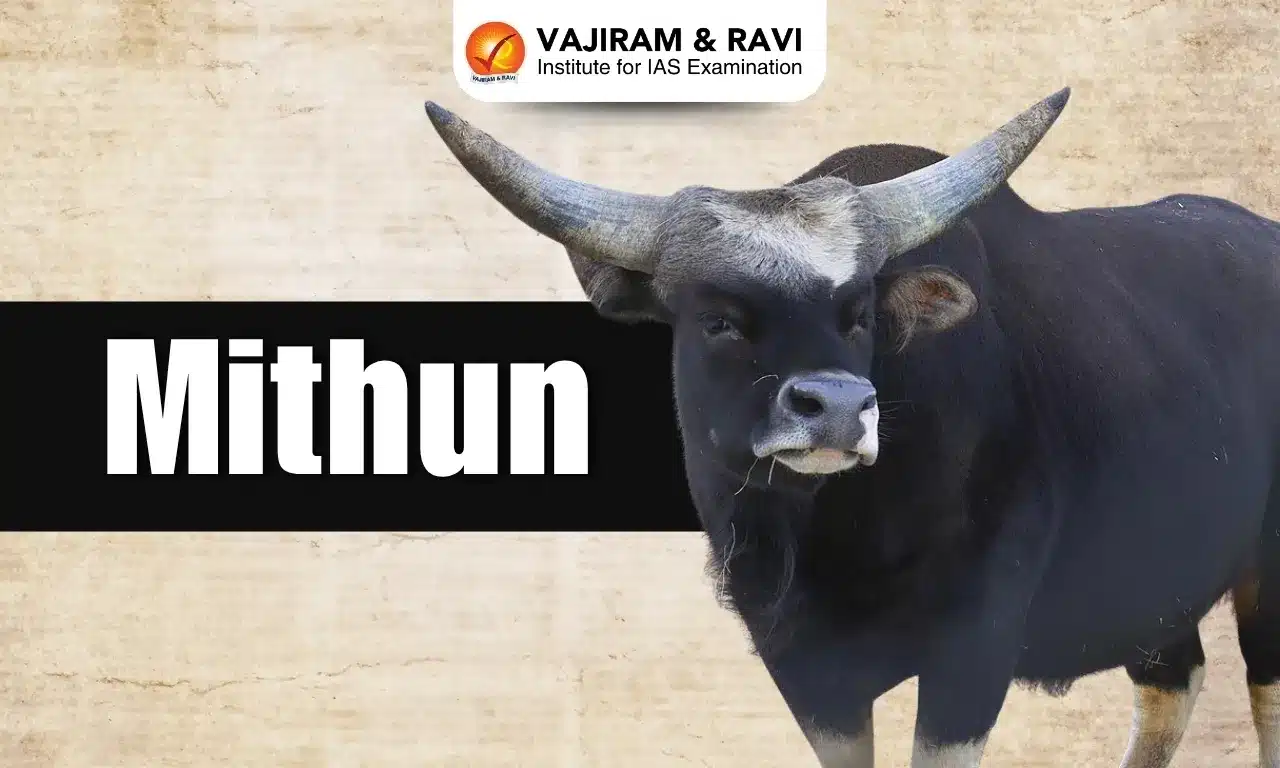
  • The characteristic feature of Mithun lies in the head, which has a well-developed, broad frontal bone with a flat-shaped face, and from the front view, it appears like an inverted triangle from where two horns emerge from the lateral sides.
  • Horn colour varies from whitish yellow to salty black in most animals.
  • The skin color of the head and body is blackish-brown in both sexes, and the forehead is creamy white or yellowish in color.
  • They move in small groups with one or two males and several females and calves.

Mithun Conservation Status

  • IUCN Red List: Vulnerable
  • CITES: Appendix I

Source: ITNE

Mithun FAQ's

Q1: What is the scientific name of the Mithun?

Ans: Bos frontalis

Q2: In which Indian state is the population of Mithuns the highest?

Ans: Arunachal Pradesh

Q3: What is the conservation status of Mithun on the IUCN Red List?

Ans: Vulnerable

Nahargarh Wildlife Sanctuary

Nahargarh Wildlife Sanctuary

Nahargarh Wildlife Sanctuary Latest News

The Rajasthan Forest Department recently altered the boundaries of Nahargarh Wildlife Sanctuary (NWS), reportedly benefiting luxury hotels and commercial establishments within the sanctuary and its Eco Sensitive Zone (ESZ).

About Nahargarh Wildlife Sanctuary

  • It is located just 20 kilometres from Jaipur, Rajasthan.
  • It encompasses a large area of 720 hectares and is situated under the Aravalli range.
  • The sanctuary is named after Nahargarh Fort, a historic fort built in the 18th century by Maharaja Sawai Jai Singh II, the founder of Jaipur. 
  • Nahargarh Biological Park, a part of the Nahargarh sanctuary, is famous for the lion safaris.
  • Flora: The vegetation comprises dry deciduous forests, scrublands, and grasslands.
  • Fauna
    • Common species include leopards, wild boars, deer, lions, tigers, sloth bears, and several small mammals.
    • It’s a haven for bird watchers, with a variety of species, including peacocks, owls, and eagles.
    • In addition to mammals and birds, the sanctuary is home to reptiles like Indian rock pythons, monitor lizards, and amphibians like frogs and toads.

Source: TOI

Nahargarh Wildlife Sanctuary FAQs

Q1: Nahargarh Wildlife Sanctuary is located in which Indian state?

Ans: Rajasthan

Q2: The Nahargarh Wildlife Sanctuary is situated under which mountain range?

Ans: Aravalli Range

Q3: What is the approximate area covered by the Nahargarh Wildlife Sanctuary?

Ans: 720 hectares

Q4: What type of forest vegetation is mainly found in Nahargarh Wildlife Sanctuary?

Ans: Dry deciduous forests

Red Panda

Red Panda

Red Panda Latest News

Recently, under a conservation programme at the Himalayan Zoological Park near Sikkim’s capital, Gangtok red panda cubs were born after a 7 years gap.

About Red Panda

  • It is also known as the lesser panda which is primarily a herbivorous, shy, solitary and arboreal animal.
  • It uses its long, bushy tails for balance and to cover them in winter, presumably for warmth. 
  • It is considered an indicator species for ecological change. 
  • Appearance: It is the size of a house cat, the red panda is famous for its cute face and adorable defense stance.
  • Distribution: It is mainly found in the mountainous forests of Bhutan, China, India, Myanmar, and Nepal.
  • Conservation status
    • IUCN Red list: Endangered
    • CITES: Appendix I
    • Wildlife Protection Act 1972: Schedule I
  • Threats: The loss of nesting trees and bamboo in the Eastern Himalayas which is causing a decline in red panda populations across much of their range.

What are Indicator Species?

  • Indicator species are a species, or group of species, that reflect the biotic or abiotic state of an environment.
  • They reveal the possible evidence and impact of environmental change, and indicate the diversity of other species, taxa, or entire communities within an area. 
  • Indicator species can provide an early warning of environmental changes.
  • They can be used to assess the health of an environment or ecosystem – they are often termed ‘bioindicators’.
  • They can be a useful management tool.

Source: TH

Red Panda FAQs

Q1: Can red pandas live in India?

Ans: The red panda is a small arboreal mammal found in the forests of India, Nepal, Bhutan, and the northern mountains of Myanmar and southern China.

Q2: What is the IUCN status of red panda?

Ans: It is listed as Endangered in the IUCN red list of Threatened Species.

Enquire Now