National Highways & Infrastructure Development Corporation Limited (NHIDCL)

National Highways & Infrastructure Development Corporation Limited (NHIDCL)

National Highways & Infrastructure Development Corporation Limited Latest News

The traffic from Sikkim and Kalimpong to Siliguri and vice versa on NH10 remained suspended because of repairs by the National Highways & Infrastructure Development Corporation Limited on a 30 km-long stretch following a landslide and cave-ins.

About National Highways & Infrastructure Development Corporation Limited 

  • It is a Central Public Sector Undertaking (CPSU) under the Ministry of Road Transport & Highways, Government of India.
  • The company was incorporated on the 18th of July, 2014, under the Companies Act, 2013. 
  • It is a wholly owned Government entity.
  • It is dedicated exclusively to the task of constructing/upgrading/widening National Highways in parts of the country which shares international boundaries with neighbouring countries in order to promote regional connectivity on a substantial basis.
  • NHIDCL’s domain extends across the Union Territories of Jammu & Kashmir, Ladakh,  and Andaman & Nicobar Islands; the state of Uttarakhand; and the entire Northeastern Region (NER). 
  • Its ambit includes tunnels, logistics hubs, interstate and international road linkages, and advanced mobility facilities - all serving as the arteries of India’s economic and geopolitical aspirations.
  • As the executing arm of the Government of India’s vision to realize the “Act East Policy,” NHIDCL plays a pivotal role as the nodal agency in the Northeastern region.

Source: TELEG

National Highways & Infrastructure Development Corporation Limited FAQs

Q1: Under which Ministry does the National Highways & Infrastructure Development Corporation Limited (NHIDCL) operate?

Ans: Ministry of Road Transport & Highways.

Q2: When was National Highways & Infrastructure Development Corporation Limited (NHIDCL) incorporated?

Ans: It was incorporated on the 18th of July, 2014, under the Companies Act, 2013.

Q3: What is the main purpose of National Highways & Infrastructure Development Corporation Limited (NHIDCL)?

Ans: Constructing and upgrading National Highways near international borders.
Sahel Region

Sahel Region

Sahel Region Latest News

Russia has tightened its grip over the Sahel region in West Africa, signing a key nuclear agreement with Niger recently.

About Sahel Region

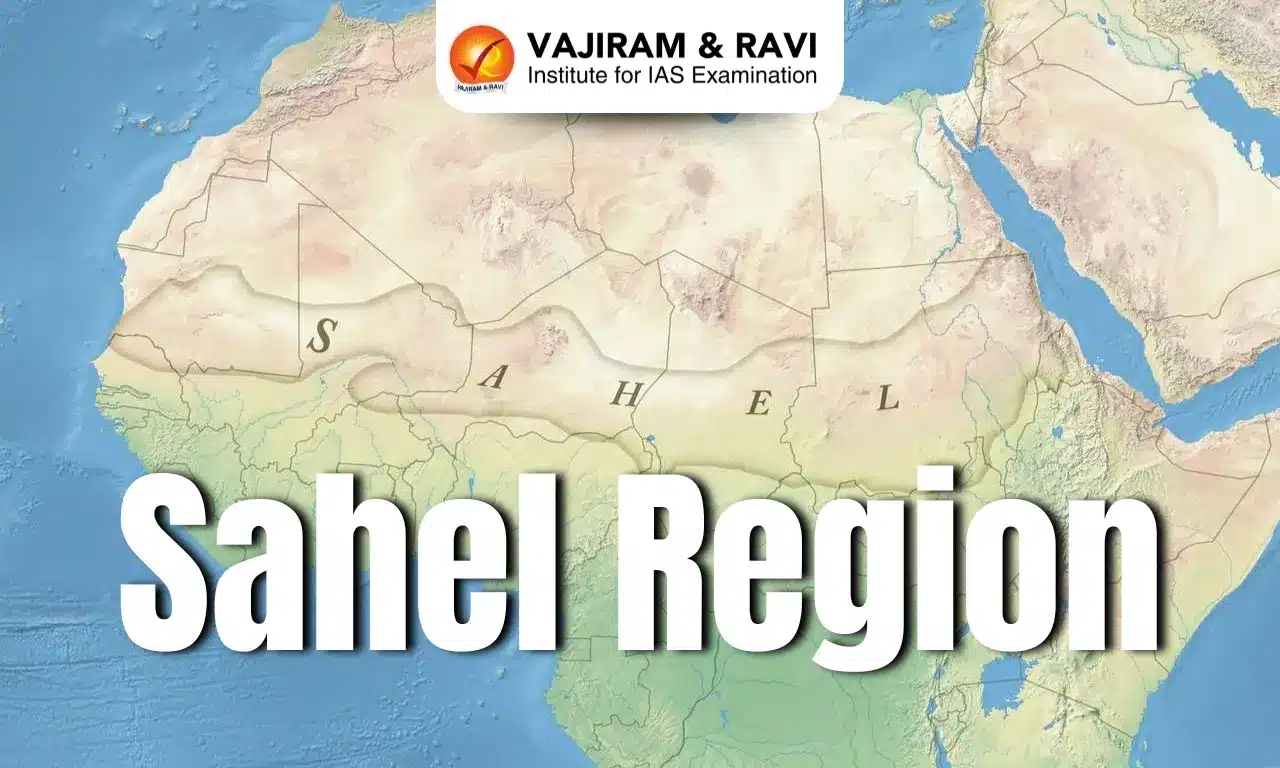
  • It is a semiarid region of western and north-central Africa.
  • A 5,000 kilometre belt of land, the Sahel stretches from Africa’s Atlantic Coast to the Red Sea.
  • It forms a transitional zone between the arid Sahara (desert) to the north and the belt of humid savannas to the south. 
  • It runs through portions of the countries of Senegal, Mauritania, Mali, Burkina Faso, Niger, Nigeria, Chad, Sudan, and Eritrea.
  • Vegetation
    • The Sahel is a semiarid steppe, a type of dry grassland. 
    • The vegetation is chiefly of the savanna type, with little continuous cover.
    • It has low-growing grass, thorny shrubs, and scattered acacia and baobab trees. 
  •  Since gaining independence in the 1960s, many countries in the Sahel have experienced violent extremism due to the confluence of weak and illegitimate governance, economic decline, and the worsening effects of climate change. 
  • The Sahel remains a principal transit point for migrants traveling from sub-Saharan Africa to northern coastal states and on to Europe.

Source: TOI

Sahel Region FAQs

Q1: What is the Sahel region best described as?

Ans: It is a semiarid region of western and north-central Africa.

Q2: What type of vegetation is commonly found in the Sahel?

Ans: The vegetation is chiefly of the savanna type, with little continuous cover.

Q3: What lies directly to the north of the Sahel region?

Ans: Sahara Desert

Q4: Approximately how long is the Sahel region?

Ans: 5,000 km

RS-28 Sarmat

RS 28 Sarmat

RS-28 Sarmat Latest News

As tensions escalate between the United States and Russia, the spotlight is back on one of the deadliest weapons in Russia’s nuclear arsenal, the RS-28 Sarmat intercontinental ballistic missile (ICBM), dubbed ‘Satan 2’ by NATO.

About RS-28 Sarmat

  • The RS-28 Sarmat is Russia’s new generation intercontinental ballistic missile.
  • It is named after the Sarmatian people of the fourth and fifth century BC. 
  • It has also been referred to in the West as the “Satan II”.

RS-28 Sarmat Features

  • It is a three-stage, liquid-fueled missile with a range of 18,000 km and a launch weight of more than 208 tonnes. 
  • It is the world's heaviest ICBM.
  • The missile is 35.3 meters long and 3 meters in diameter.
  • Maximum speed of 25,500 kph (about Mach 20). 
  • It can carry a 10-ton payload and can load a wide variety of warhead options.
  • It can carry up to 16 independently targetable nuclear warheads as well as Avangard hypersonic glide vehicles.
  • Each warhead gets its guidance system, using inertial navigation, GLONASS (Russia’s GNSS), and Astro-inertial tech to stay on target.
  • While the RS-28 Sarmat can be launched much like a regular ICBM, it is thought to be also capable of what is called fractional orbital bombardment.
  • A fractional orbital bombardment means firing an ICBM into a low orbit of the Earth – much lower than a conventional firingpotentially in the opposite direction to the target.
  • The Sarmat reportedly could deliver warheads 2,000 times as powerful as the atom bombs dropped on Hiroshima and Nagasaki in 1945.

Source: N18

RS-28 Sarmat FAQs

Q1: What is the RS-28 Sarmat missile also referred to as in the West?

Ans: Satan II

Q2: What is the maximum range of the RS-28 Sarmat missile?

Ans: 18,000 km

Q3: What is the launch weight of the RS-28 Sarmat?

Ans: It has a launch weight of more than 208 tonnes.

Q4: What type of fuel does the RS-28 Sarmat missile use?

Ans: It is a three-stage, liquid-fueled missile.

Mahabodhi Temple

Mahabodhi Temple

Mahabodhi Temple Latest News

The Supreme Court recently agreed to review a petition seeking the repeal of the Bodh Gaya Temple Act of 1949, advocating for its replacement with a central law to better manage the Mahabodhi Temple in Bihar.

About Mahabodhi Temple

  • It is one of the four most sacred sites of Buddhism, marking the location where Buddha attained Enlightenment (Bodhi), along with:
    • Lumbini (Buddha’s birthplace)
    • Sarnath (Buddha’s first sermon)
    • Kushinagar (Buddha’s parinirvana)
  • Location: Bodh Gaya, Bihar, on the banks of the Niranjana River.
  • The first temple at the site was constructed by the Mauryan emperor Ashoka in the 3rd century BC
  • The present temple was built in the 5th–6th century AD, in the Gupta period.
  • It is one of the earliest Buddhist temples built entirely in brick, still standing in India, from the late Gupta period.
  • The temple was heavily restored in the 19th century, by Myanmar (Burmese) Buddhists and then by the British archaeologist Sir Alexander Cunningham.
  • It was declared a World Heritage site by UNESCO in 2002.

Mahabodhi Temple Architecture

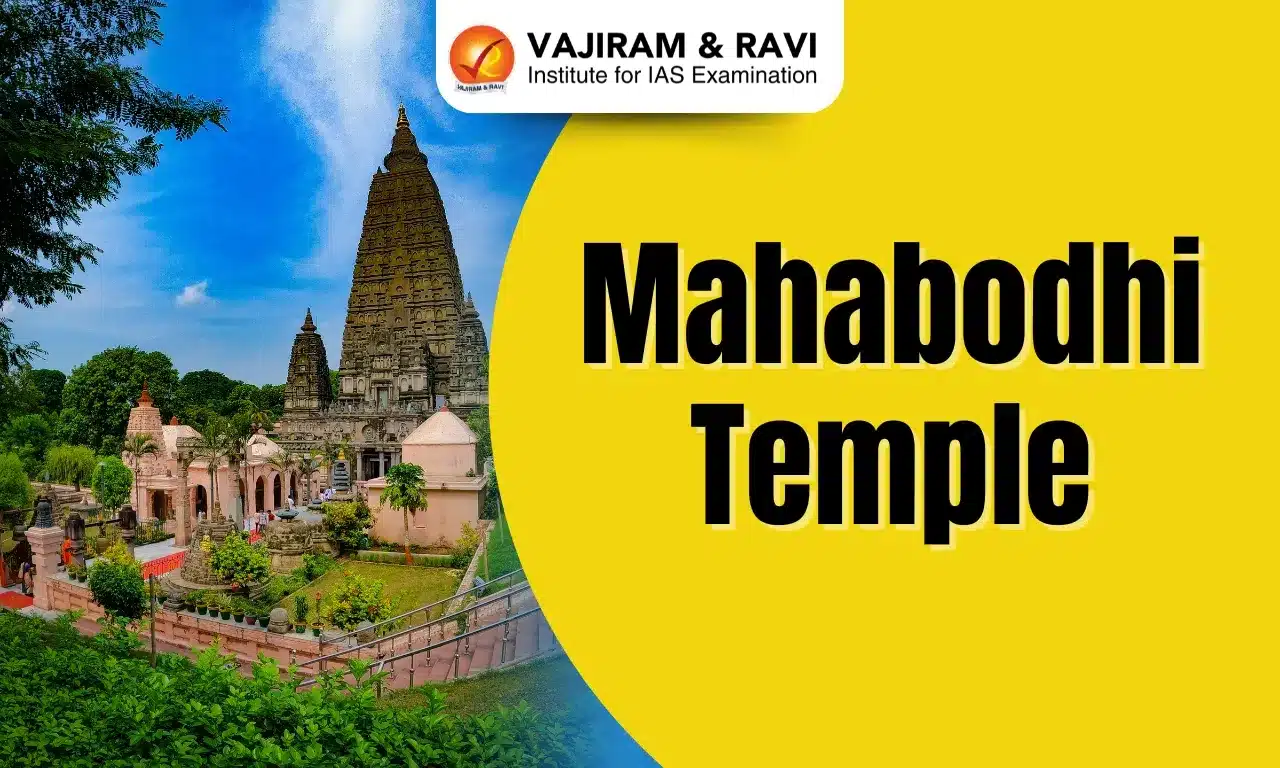
  • The temple structure is 180 feet (55 meters) in height. It is dominated by a pyramid-shaped central tower, called a shikhara
  • This tower comprises several layers of niches, arch motifs, and fine engravings. 
  • Four additional towers, each identical to the main tower but smaller in size, adorn the corners of the two-story structure. 
  • A shrine inside the temple holds a yellow sandstone statue of the Buddha encased in glass.
  • Sacred Bodhi Tree: Believed to be a direct descendant of the original tree under which Buddha attained Enlightenment.
  • Vajrasana (Diamond Throne): A stone slab marking the exact spot where Buddha meditated and attained enlightenment.
  • Stone railings surround the temple as well as the Bo tree. 
  • One of the most famous of Ashoka’s many pillars (on which he had engraved his proclamations and his understanding of religious doctrine) stands at the southeast corner of the temple.
  • The 4.8-hectare complex includes ancient shrines and modern Buddhist structures built by devotees.

Source: ET

Mahabodhi Temple FAQs

Q1: Where is the Mahabodhi Temple located?

Ans: Bodh Gaya, Bihar, on the banks of the Niranjana River.

Q2: Who built the first Mahabodhi Temple?

Ans: Mauryan emperor Ashoka in the 3rd century BC.

Q3: What is the significance of the Mahabodhi Temple in Buddhism?

Ans: It marks the site of Buddha's Enlightenment.

Q4: In which period was the present Mahabodhi Temple built?

Ans: The present temple was built in the 5th–6th century AD, in the Gupta period.

Q5: What is the Vajrasana in the Mahabodhi Temple complex?

Ans: The stone marking where Buddha attained enlightenment.

Asian Giant Tortoise

Asian Giant Tortoise

Asian Giant Tortoise Latest News

Recently, the Asian giant tortoise, the largest tortoise in mainland Asia, has been reintroduced into the Zeliang Community Reserve in Nagaland’s Peren district.

About Asian Giant Tortoise

  • The Asian Giant Tortoise (Manouria emys phayrei) is the largest tortoise in Asia.
  • It is considered to be one of the oldest tortoise lineages in the world. And these ancient tortoises share an interesting behavior with many crocodilians—to protect their eggs and maintain appropriate temperatures for incubation.
  • Appearance: As hatchlings, these tortoises appear a grayish brown, and become more charcoal colored as they mature into adulthood.
  • Habitat: The Asian Giant Tortoise can be found in the tropical and subtropical hill forests.
  • Distribution: They are found in Bangladesh, India, Indonesia, and Malaysia and other places.
  • Diet: Bamboo shoots, tubers and other juicy vegetation and some invertebrates and frogs.
  • Threats: Hunting for consumption, habitat loss, anthropogenic activities like construction and slash and burn.
  • Conservation Status
    • IUCN: Critically Endangered
    • CITES: Appendix II

Source: TH

Asian Giant Tortoise FAQ's

Q1: What is the largest tortoise in India?

Ans: Asian giant tortoises

Q2: What is the rarest tortoise in India?

Ans: Indian Star Tortoise

Q3: Which is the first turtle sanctuary in India?

Ans: The Turtle Wildlife Sanctuary (TWS) was established in Varanasi district in 1989 under the Ganga Action Plan.

Ayurveda Aahara

Ayurveda Aahara

Ayurveda Aahara Latest News

Recently, the Food Safety and Standards Authority of India (FSSAI), in consultation with the Ministry of Ayush, has released a definitive list of Ayurvedic food preparations under the category of “Ayurveda Aahara.”

About Ayurveda Aahara

  • Ayurveda Aahara refers to food products developed in line with the holistic dietary principles of Ayurveda, one of the world's oldest systems of health and wellness.
  • These preparations emphasise balance, seasonal suitability, and using natural ingredients and herbs known for their therapeutic benefits.
  • This significant step brings India’s time-honoured food wisdom into the mainstream, following the introduction of the Food Safety and Standards (Ayurveda Aahara) Regulations in 2022
  • These regulations recognise foods based on recipes, ingredients, and processes from authoritative Ayurvedic texts, and the new list brings unprecedented clarity and confidence to consumers and businesses alike.
  • The list, issued under Note (1) of Schedule B of the regulations, draws directly from classical Ayurvedic texts listed in Schedule A, ensuring the authenticity and traditional basis of these food formulations.
  • This initiative aims to assist Food Business Operators (FBOs) by providing a clear and credible reference for the manufacture of Ayurveda Aahara products.
  • This initiative marks a pivotal moment in enhancing regulatory clarity for industry stakeholders while promoting the widespread adoption of Ayurveda-based nutrition for better public health outcomes.

Source: PIB

Ayurveda Aahara FAQs

Q1: What is Ayurveda Ahara?

Ans: It is a food prepared in accordance with the recipes or ingredients or processes as per method described in the authoritative books of Ayurveda listed under 'Schedule A' of these regulations.

Q2: What is Food Safety and Standards Authority of India (FSSAI)?

Ans: It is an autonomous body established under the Ministry of Health and Family Welfare, Government of India.

India Electric Mobility Index

India Electric Mobility Index

India Electric Mobility Index Latest News

Recently, NITI Aayog launched the India Electric Mobility Index (IEMI).

About India Electric Mobility Index

  • It is a first-of-its-kind tool developed to comprehensively track and benchmark the progress of States and Union Territories (UTs) in achieving their Electric Mobility goals.       
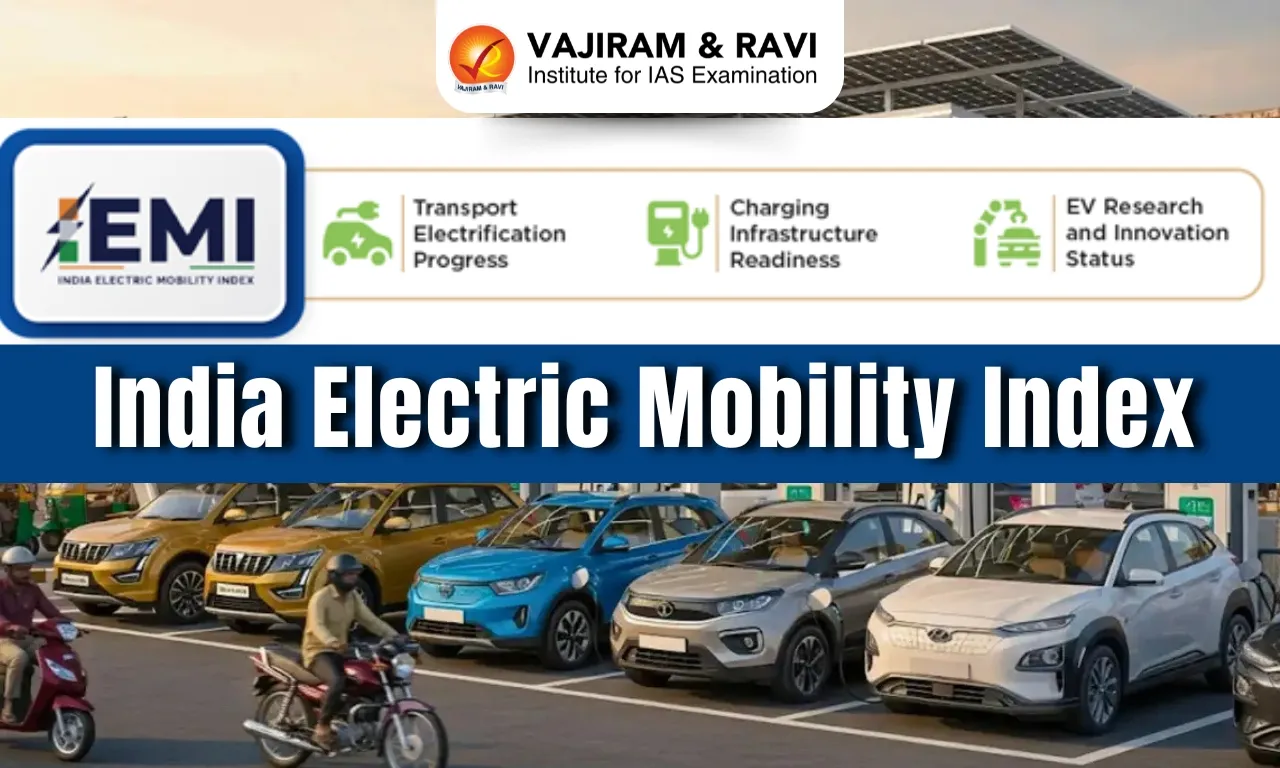
  • The India Electric Mobility Index (IEMI) tracks, evaluates and scores all Indian States and UTs out of 100 across 16 indicators under three-core themes
    • Transport Electrification Progress to capture demand-side adoption, 
    • Charging Infrastructure Readiness to track allied charging infrastructure development and 
    • EV Research and Innovation Status: Covers supply-side ecosystem R&D efforts.
  • It enables evaluation across states and union territories, identifying key drivers of success as well as areas requiring targeted interventions. The Index aims to inform decision-making, foster healthy competition among states, and promote sharing of best practices.
  • The Index underscores the importance of state-level coordination, integrated planning, and cross-sectoral collaboration in achieving India’s electric mobility vision.
  • By identifying strengths and gaps, the Index aims to support states in aligning with national goals while addressing local needs.
  • It provides a transparent, comparative framework to assess progress across key themes such as electrification, infrastructure, and innovation.
  • It enables states to benchmark their efforts, identify gaps, and learn from each other’s successes.

Source: PIB

India Electric Mobility Index FAQs

Q1: What is the electric Mobility Index of India?

Ans: The India Electric Mobility Index (IEMI) provides a comprehensive assessment of India's states and Union Territories in their progress toward an electric mobility ecosystem.

Q2: What is the National electric Mobility Mission in India?

Ans: Government of India launched the National Electric Mobility Mission Plan (NEMMP) 2020 in 2013. It aims to achieve national fuel security by promoting hybrid and electric vehicles in the country

Q3: What is the full form of e mobility?

Ans: E-mobility, or electromobility, refers to the use of electrified vehicles for transportation purposes.

UN World Food Programme

UN World Food Programme

UN World Food Programme Latest News

Recently, India launched a new collaborative initiative with the support of the UN World Food Programme to strengthen Rice Fortification and Supply Chain Management in Nepal.

About UN World Food Programme

  • It is a branch of the United Nations that deals with hunger eradication and promotes food security in the world.
  • It is the world’s largest humanitarian agency and was established in 1961.
  • The organization’s work is guided by Sustainable Development Goal 2, which aims to end hunger, achieve food security and improved nutrition, and promote sustainable agriculture by 2030.
  • It operates in more than 120 countries, provides food assistance during emergencies and works with communities to enhance nutrition and generate resilience.
  • Funding: WFP is funded by voluntary donations from governments, corporates and private donors.
  • It is a member of the United Nations Development Programme (UNDP)
  • WEF was awarded the Nobel Peace Prize in 2020. 
  • Reports by WEF: Report released by the WFP is the Global Report on Food Crisis which describes the scale of acute hunger in the world.
  • Headquarters: Rome, Italy

Source: News on air

UN World Food Programme FAQs

Q1: Is India a member of WFP?

Ans: The World Food Programme (WFP) has been working in India since 1963.

Q2: Where is the headquarter of WFP located?

Ans: Rome, Italy

Seabuckthorn

Seabuckthorn

Seabuckthorn Latest News

Seeds of seabuckthorn and buckwheat grown in the cold desert of Ladakh are part of the experiments on board the International Space Station flown by NASA's Crew-11 mission.  

About Seabuckthorn

  • It is popularly known as the ‘Wonder Plant’, ‘Ladakh Gold’, ‘Golden Bush’, or ‘Gold Mine’ of cold deserts.
  • Distribution: Sea buckthorn (Hippophae rhamnoides) is a plant found throughout Europe and Asia. 
  • In India, it is found above the tree line in the Himalayan region, generally in dry areas such as the cold deserts of Ladakh and Spiti.
  • It produces small orange or yellow-coloured berries that are sour in taste but rich in vitamins, especially vitamin C.
  • The shrub can withstand extreme temperatures ranging from minus 43 degrees Celsius to 40 degrees Celsius and is considered drought-resistant.
  • These two characteristics make the shrub an ideal plant species to establish in cold deserts.
  • Sea Buckthorn berries have a unique characteristic of remaining intact on the shrub throughout the winter months despite the subzero temperature.

Uses of Seabuckthorn

  • It has been used traditionally for a variety of purposes.
  • Every part of the plant–fruit, leaf, twig, root, and thorns has been traditionally used as medicine, nutritional supplement, fuel, and fence.
  • Many bird species feed on the berries when other sources of food are limited in the region.
  • The leaves serve as protein-rich fodder for cold desert animals like sheep, goats, donkeys, cattle, and double-humped camels.

Source: TH

Seabuckthorn FAQs

Q1: Why is seabuckthorn important?

Ans: Seabuckthorn is a soil-binding plant which prevents soil-erosion, checks siltation in rivers and helps preserve floral biodiversity.

Q2: What is sea buckthorn called in India?

Ans: In India, sea buckthorn berry is commonly called “Chharma” or “Leh berry”.

Assets Under Management (AUM)

Assets Under Management

Assets Under Management Latest News

The asset under management (AUM) of India’s mutual fund (MF) industry was estimated at ₹74.40 lakh crore, marking a more than sevenfold growth in 10 years, according to a recent report.

About Assets Under Management

  • AUM is a crucial metric in the financial industry, particularly in mutual funds. 
  • AUM refers to the total market value of the assets that a financial institution or investment company manages on behalf of its clients. 
  • These assets can include stocks, bonds, and other financial investments.
  • AUM is affected by:
    • Market fluctuations
    • Net investor inflows (new investments)
    • Redemptions or withdrawals
    • Dividend reinvestments
  • AUM is an essential measure of the size and success of a mutual fund, as it provides investors with insight into the fund's popularity and credibility
  • It also indicates the financial institution's expertise and ability to attract and retain clients. 
  • Additionally, investors often use AUM to assess the fund's liquidity and stability. 
  • The larger the AUM, the more resources and diversification potential the fund may have, which can attract investors seeking long-term growth and stability.
  • A mutual fund’s AUM can have a large impact on the fees that an investor usually pays to invest in the mutual fund. For example, some larger funds might have a very high minimum investment.

Source: TH

Assets Under Management FAQs

Q1: What is Assets Under Management (AUM)?

Ans: AUM is the total market value of the assets that a financial institution or investment company manages on behalf of its clients.

Q2: Why do investors often consider Assets Under Management (AUM) when selecting a mutual fund?

Ans: It reflects the fund’s popularity, expertise, and stability.

Q3: How does Assets Under Management (AUM) impact investor fees in a mutual fund?

Ans: Larger AUM funds may have high minimum investment requirements.

Enquire Now