Salina Aurantiamaculata and Salina Pseudomontana

Salina Aurantiamaculata and Salina Pseudomontana

Salina Aurantiamaculata and Salina Pseudomontana Latest News

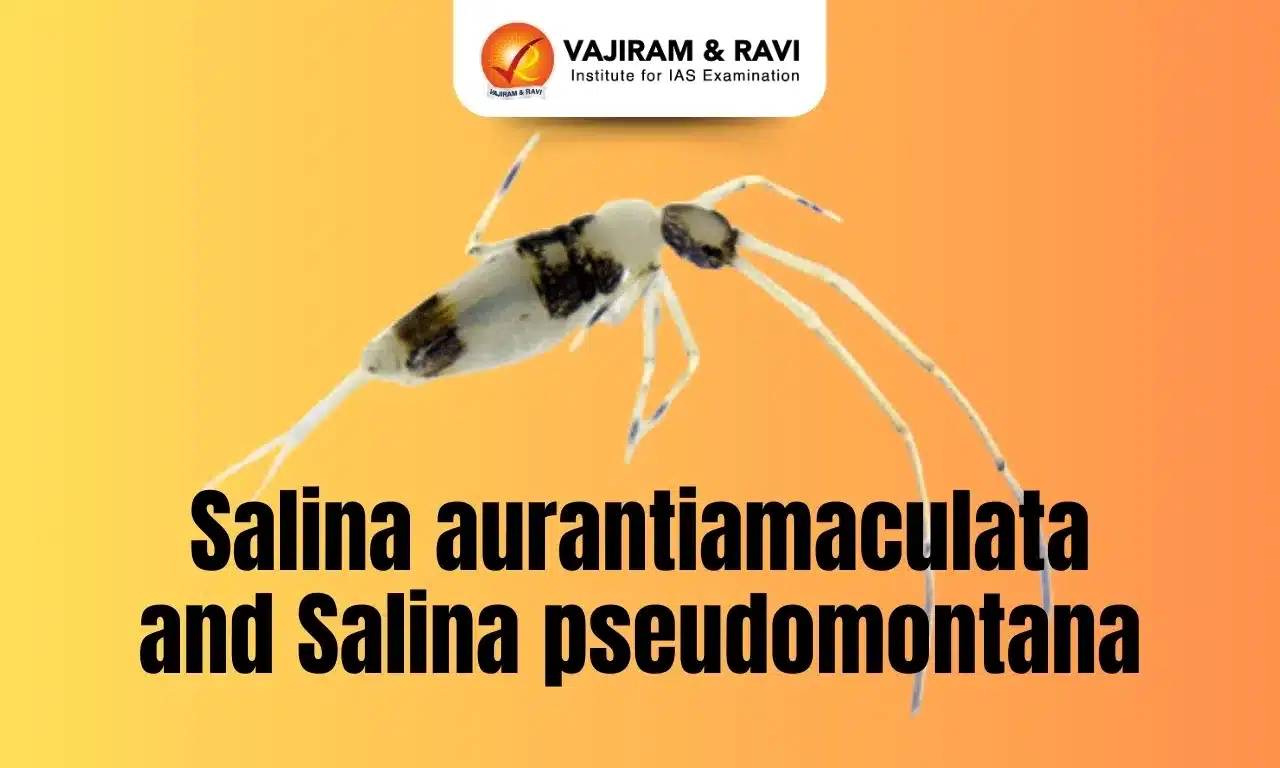
Recently, scientists at the Zoological Survey of India (ZSI) announced the discovery of two new Collembola, or springtails species -- Salina aurantiamaculata and Salina pseudomontana.

About Salina Aurantiamaculata and Salina Pseudomontana

  • Salina aurantiamaculata is named for its striking bright orange markings – an unusual pigment pattern among its peers.
  • Its counterpart, Salina pseudomontana, looks very similar to the already known Salina montana.
  • Both species belong to the cosmopolitan “celebensis” group of Collembola. 
  • Collembola improves soil structure, aid nutrient cycling, and serves as indicators of ecosystem health. Their role, though often overlooked, is fundamental for the ecosystem.”
  • The last time a Salina species was recorded in India was in 1979. After more than four decades, these two new additions bring the country’s tally to 17 species.

What are Collembola Springtails?

  • These are among the oldest land-dwelling hexapods on Earth, dating back hundreds of millions of years.
  • Habitat: They are found in leaf litter, decaying wood, and soil, they thrive quietly in habitats most of us overlook.
  • Significance: Their abundance and sensitivity make them invaluable in monitoring pollution, climate change, and agricultural sustainability.

Source: IE

Salina Aurantiamaculata and Salina Pseudomontana FAQs

Q1: What is an indicator species?

Ans: These are species which can provide information on ecological changes and give early warning signals regarding ecosystem processes in site-specific conditions due to their sensitive reactions to them.

Q2: What is the function of Zoological Survey of India?

Ans: It provides information and vital data for the in-situ conservation of various species in different ecosystems, both within and outside the protected areas.


Unified District Information System for Education Plus

Unified District Information System for Education Plus

Unified District Information System for Education Plus Latest News

The Ministry of Education released a report on Unified District Information System for Education Plus (UDISE+) 2024-25 on school education of India which says that, since the beginning of UDISE +, the total number of teachers has crossed the 1 crore mark in 2024–25.

About Unified District Information System for Education Plus

  • It is an educational management information system under the Department of School Education & Literacy, Ministry of Education under the Government of India.
  • UDISE+ functions as a central platform that enables respective schools to efficiently record and submit data related to its profile (infrastructure & facilities), individual students and teachers’ details.
  • This is done in real-time mode by all recognised schools that provide formal, and special education in any of the school categories (that is, from pre-primary to higher secondary levels) throughout the country each academic year.
  • The recorded data is validated by the MIS and other designated officials at the block, district and state levels; and monitored at four levels, including the national.

Features of the UDISE+

  • Each onboarded school is provided a unique 11-digit UDISE code & login credentials to complete data entry and its modification in real-time.
  • School User Directory module enables onboarding of schools, and management of designated users who can submit data on the UDISE+. This module enables block, district, state and national level user overall management of the UDISE+.
  • The data on school profile, students and teachers is reported in three distinct but integrated modules:
  • School profile & facilities: Infrastructure details and services and facilities available in schools are recorded in this module.
  • Student module: General and academic profile of each student, including extracurricular activities, are recorded and maintained in this module using the Permanent Education Number
  • Teacher Profile: General, academic and appointment details of all teaching and non-teaching staff are recorded and maintained individually in this module.

Source: PIB

Unified District Information System for Education Plus FAQs

Q1: Who released the UDISE Plus report?

Ans: Ministry of Education (MoE)

Q2: What is the purpose of UDISE plus?

Ans: This system is used for data storage, updation, manipulation, analysis and sharing.

Prairies

Prairies

Prairies Latest News

Recent efforts—including a newly launched database—aim to ensure that the prairies are restored much more comprehensively.

About Prairies

  • Prairies are flat, temperate grasslands found in North America.
  • Most North American prairies are in locations with a low amount of annual
  • rainfall.
  • Prairie vegetation is maintained by grazing, fire, drought, and low temperatures. 
  • Although grasses dominate, lichens, mosses, forbs, and low- to mid-size shrubs also comprise prairie vegetation. 
  • Taller shrubs and trees, mostly willows and poplars, including aspen and cottonwoods, are found in depressions and valleys where there is sufficient moisture and nutrients.
  • Prairie, like other temperate grasslands, is among the most productive and diverse of earth’s terrestrial ecosystems.
  • Grasses, the predominant cover in prairie vegetation, have the following adaptations:
  • Deep or extensive roots.
  • Growing points at or near the soil surface that are tucked in the crown of the plant.
  • Narrow leaves.
  • Small flowers in dense heads that are pollinated by wind.
  • Tough stems and leaves hardened with silica phytoliths (plant stones).
  • Strategies to optimize photosynthesis without losing moisture.
  • Wildlife species living in prairies have adapted to a semi-arid, windy, open environment. 
  • Species found here include elk, deer, coyote, bobcat, Badgers, jackrabbits, ground squirrels, pocket gophers, etc
  • Similar temperate grasslands in South America are called Pampas, while in Africa they are described as velds  and in Asia are known as steppes.

Source: PHY

Prairies FAQs

Q1: Prairies are mainly found in which region?

Ans: North America

Q2: Which of the following is the dominant vegetation in prairies?

Ans: Grasses

Q3: What are temperate grasslands in South America called?

Ans: Steppes

Gangotri Glacier

Gangotri Glacier

Gangotri Glacier Latest News

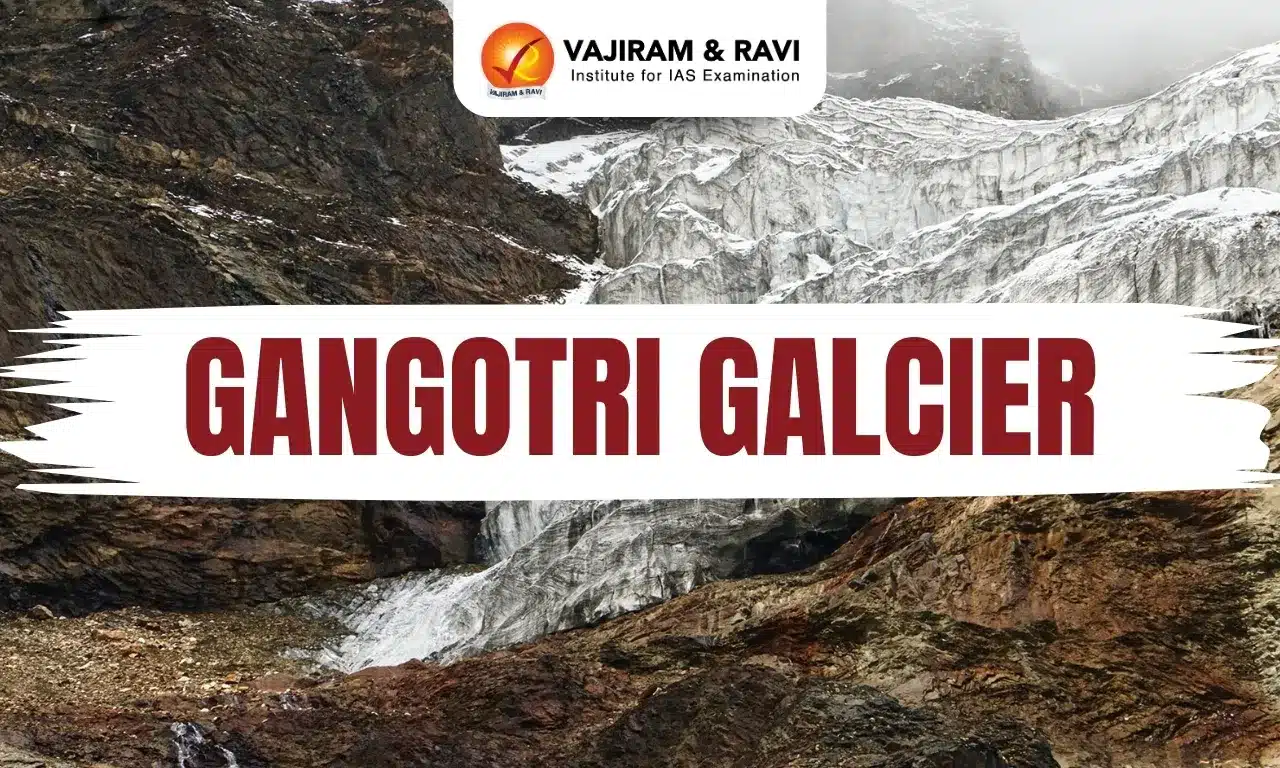
A study by IIT Indore and international collaborators reveals that the Gangotri Glacier has lost 10% of its snowmelt flow over four decades due to climate change.

About Gangotri Glacier

  • It is one of the largest glaciers in the Himalayas and is the primary source of the Ganges, the largest river in India. 
  • It is situated in the Uttarkashi district of Uttarakhand in the Garhwal Himalayas. 
  • It originates at the northern slope of the Chaukhamba range of peaks.
  • It is fed by snow and ice from several peaks, including Shivling, Thalay Sagar, Meru, and Bhagirathi III. 
  • It lies at an altitude of around 4,000 meters bordering Tibet.
  • The glacier is around 30 km in length and 4 km in width.
  • Popularly known as Gaumukh, the terminus of the glacier resembles a cow’s mouth
  • From its snout at Gaumukh, the Bhagirathi River emerges, which later joins the Alaknanda River to form the Ganges at Devprayag.
  • The Gangotri Glacier holds immense religious significance in Hinduism and is visited by thousands of pilgrims every year, who trek up to Gaumukh, the source of the Ganges.

Source: DTE

Gangotri Glacier FAQs

Q1: The Gangotri Glacier is the primary source of which river?

Ans: Ganges

Q2: The Gangotri Glacier originates from which mountain range?

Ans: Chaukhamba Range

Q3: What is the approximate length of the Gangotri Glacier?

Ans: 30 km

Nimbrix Missile

Nimbrix Missile

Nimbrix Missile Latest News

Swedish defense company Saab recently announced the development of a new missile named Nimbrix.

About Nimbrix Missile

  • It is a counter-unmanned aircraft system (C-UAS) missile.
  • The missile is being developed to counter the growing battlefield threat posed by small unmanned aerial vehicles (UAVs).
  • It was developed by the Swedish defense company Saab. It is its first dedicated C-UAS missile.
  • Saab designed the missile to minimize costs, including through the use of additive manufacturing and low-cost commercial and military off-the-shelf parts.

Nimbrix Missile Features

  • It is a “fire-and-forget” guided missile.
  • The missile will offer a range of up to 5 km and use an active seeker to track targets.
  • It uses an air-burst warhead designed to detonate in the vicinity of small drones or other UAS, bringing down multiple at a time.
  • Nimbrix is intended for ground-based use, operating either independently or as part of wider air defence systems.
  • With adaptable mounting options, it can be fitted to vehicles or fixed positions to meet different customer requirements.

Source: INVEST

Nimbrix Missile FAQs

Q1: The Nimbrix Missile has been developed by which country’s defense company?

Ans: Sweden

Q2: The Nimbrix Missile is primarily designed for which purpose?

Ans: Counter-unmanned aircraft systems (C-UAS)

Q3: What is the maximum range of the Nimbrix Missile?

Ans: 5 km

Q4: The Nimbrix Missile uses which type of warhead?

Ans: Air-burst warhead

National Annual Report and Index on Women’s Safety (NARI) 2025

National Annual Report and Index on Women’s Safety (NARI) 2025

National Annual Report and Index on Women’s Safety (NARI) 2025 Latest News

The National Annual Report & Index on Women’s Safety (NARI) 2025, released recently, has shed new light through its latest report on how safe Indian cities really are for women.

About National Annual Report and Index on Women’s Safety (NARI) 2025

  • Released by the National Commission for Women, NARI 2025 offers the telling reality of the urban safety landscape. 
  • The report, a collaborative effort by the Group of Intellectuals and Academicians (GIA), Pvalue Analytics, The NorthCap University, and Jindal Global Law School, is based on a survey of 12,770 women across 31 cities in all states.

Highlights of the National Annual Report and Index on Women’s Safety (NARI) 2025

  • It placed the national safety score at 65%, categorising cities as “much above”, “above”, “below” or “much below” this benchmark.
  • Kohima, Visakhapatnam, Bhubaneswar, Aizawl, Gangtok, Itanagar, and Mumbai have emerged as the safest cities in the country for women, while Patna, Jaipur, Faridabad, Delhi, Kolkata, Srinagar, and Ranchi were ranked the lowest.
  • Kohima and other top-ranked cities were associated with stronger gender equity, civic participation, policing, and women-friendly infrastructure.
  • At the other end of the spectrum, cities like Patna and Jaipur fared poorly due to weak institutional responsiveness, patriarchal norms, and gaps in urban infrastructure.
  • Overall, six in ten women surveyed felt “safe” in their city, but 40% still considered themselves “not so safe” or “unsafe”. 
  • Prevalence of harassment remains high, with 7% women reporting at least one incident of harassment in public spaces in 2024. 
  • The highest risk group is women under 24 years of age (14% reported harassment). 
  • Verbal harassment was most common (58%), with physical, psychological, economic, and sexual harassment reported less frequently. 
  • Neighborhoods (38%) and transport (29%) were the main hotspots for harassment. 
  • In terms of response, 28% of women confronted harassers, 25% left the scene, 21% sought safety in crowds, and 20% reported to authorities.
  • The study revealed sharp drops in perceptions of safety at night, particularly in public transport and recreational spaces. 
  • While 86% of women felt safe in educational institutions during daylight hours, safety perceptions fall sharply at night or off-campus.
  • The report shows low levels of faith in the redressal mechanism. 
    • Only one in three victims of harassment filed a formal complaint.
    • Only one in four women expressed confidence that authorities would take effective action on their safety complaints.
    • A concerning 53% were unaware whether their workplaces had a Prevention of Sexual Harassment (POSH) policy in place.
    • Even when incidents are reported, only 22% are formally registered, and action is taken in a mere 16% of those cases.

Source: NIE

National Annual Report and Index on Women’s Safety (NARI) 2025 FAQs

Q1: Which cities topped the National Annual Report and Index on Women’s Safety (NARI) 2025 as the safest for women?

Ans: Kohima, Visakhapatnam, Bhubaneswar, Aizawl, Gangtok, Itanagar, and Mumbai

Q2: Which cities ranked lowest in women’s safety according to National Annual Report and Index on Women’s Safety (NARI) 2025?

Ans: Patna, Jaipur, Faridabad, Delhi, Kolkata, Srinagar, and Ranchi

Q3: Which type of harassment was most commonly reported by women in National Annual Report and Index on Women’s Safety (NARI) 2025?

Ans: Verbal harassment

International Atomic Energy Agency (IAEA)

International Atomic Energy Agency

International Atomic Energy Agency Latest News

The head of the UN's nuclear watchdog International Atomic Energy Agency has said a team of its inspectors are "back in Iran,"

About International Atomic Energy Agency

  • It is the world’s leading intergovernmental organisation for scientific and technical cooperation in the nuclear field.
  • The IAEA Statute was approved on 23 October 1956 and came into force on 29 July 1957.
  • The IAEA is an autonomous organization within the United Nations system.
  • It reports to both the United Nations General Assembly and the UN Security Council.
  • Its primary goal is to ensure that nuclear energy is not diverted for weapons purposes.
  • Member Countries: The agency currently has 180 member states, reflecting its wide international mandate and credibility.
  • Headquarters: Vienna, Austria.

Institutional Structure of the IAEA

  • General Conference: The General Conference, composed of all member states, meets annually to approve budgets and set general policy directions.
  • Board of Governors: The Board of Governors, comprising 35 members, meets about five times a year to: Approve safeguards agreements, Carry out statutory functions, and Appoint the Director General.
  • Secretariat: The Secretariat, led by the Director General, handles the IAEA’s daily operations.

Functions of the IAEA

  • The IAEA works to ensure that nuclear technology is used solely for peaceful purposes.
  • It applies comprehensive nuclear safeguards, including: Monitoring,On-site inspections,Information analysis, and Other techniques to verify peaceful use.

Source: NIE

International Atomic Energy Agency FAQs

Q1: Where is the International Atomic Energy Agency situated?

Ans: Vienna, Austria

Q2: How many countries are members of the IAEA?

Ans: 180 member states

Burmese Pythons

Burmese Pythons

Burmese Python Latest News

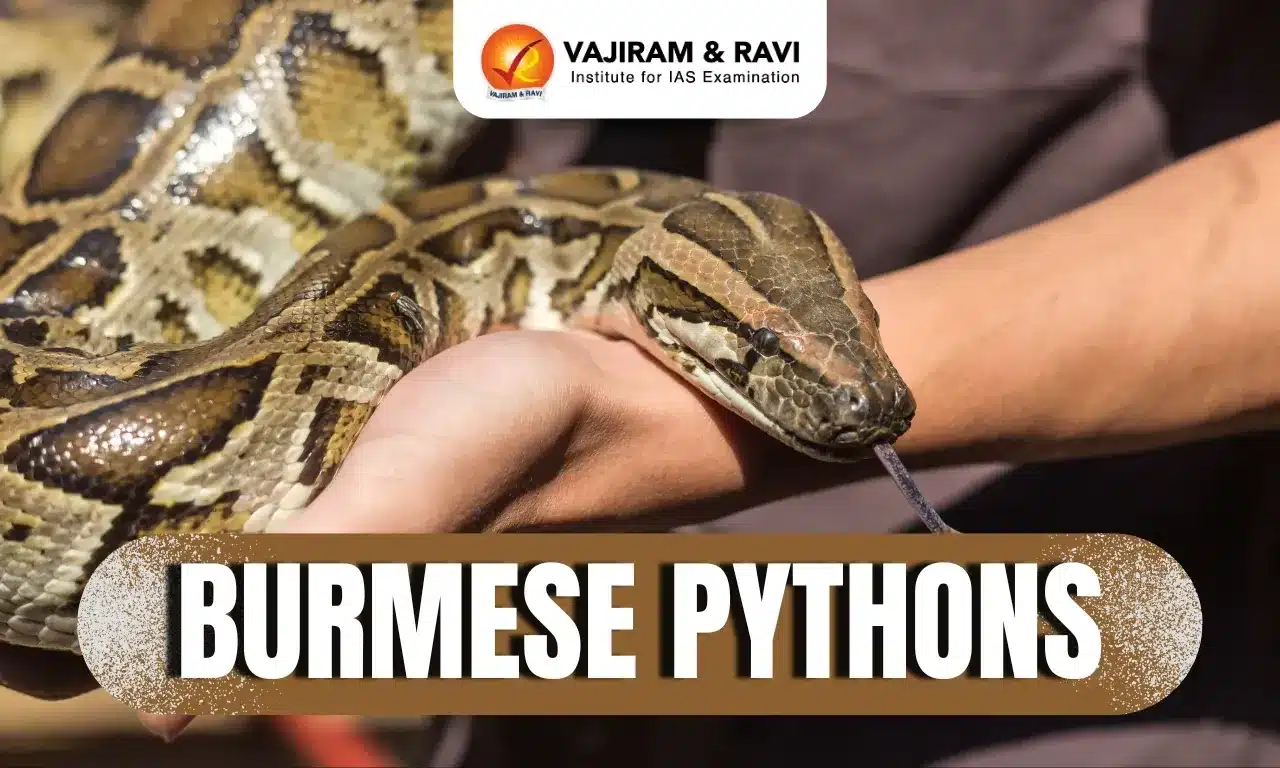
Authorities in Florida have turned to robot rabbits for help to control the population of Burmese pythons.          

About Burmese Python

  • It is one of the largest snake species in the world. It can grow up to 20 feet and weigh more than 250 pounds, with females being larger than males. 
  • It is a non-venomous, solitary and mainly nocturnal forest dweller snake.
  • It is also an excellent swimmer and is able to stay submerged for up to half an hour. Burmese pythons spend the majority of their time hidden in the underbrush and will usually move only when hunting or when threatened.
  • Until 2009, it was considered a subspecies of Python molurus, but is now recognized as a distinct species.
  • Habitat of Burmese Pythons: They live in grasslands, marshes, swamps, wet rocky areas, caves, woodlands, rainforests, mangrove forests, river valleys, and jungles with open clearings.
  • Conservation Status of Burmese Pythons: IUCN: Vulnerable

Distribution of Burmese Pythons

  • It is native to the tropical rainforests and subtropical jungles of eastern and northeastern India, Myanmar, southern China, Southeast Asia, and to some extent of the Indonesian archipelago. Its distribution also encompasses eastern Nepal, Bhutan, and Bangladesh.
  • It is an invasive species in Florida as a result of the pet trade.

Source: IE

Burmese Python FAQs

Q1: How poisonous is a BuBurmese pythons are a non-venomous constrictor, meaning they wrap their body around prey to suffocate it before swallowing the meal whole.rmese python?

Ans: Burmese pythons are a non-venomous constrictor, meaning they wrap their body around prey to suffocate it before swallowing the meal whole.

Q2: What is the Burmese python also known as?

Ans: Common Name Burmese python, Asiatic rock python, tiger python

Mount Fuji

Mount Fuji

Mount Fuji Latest News

The Japanese government recently released a video created by artificial intelligence (AI) to illustrate what would happen if Mount Fuji were to erupt.

About Mount Fuji

  • Mount Fuji, also called Fuji-san, is Japan’s tallest mountain, with a height of 3,776 meters.
  • It is situated close to the Pacific coast in the Yamanashi and Shizuoka prefectures in the heart of the large island of Honshu.
  • Tokyo, Japan’s capital, lies 60 miles (100 kilometers) to the east.
  • It is an active stratovolcano, which last erupted from 1707 to 1708.
  • It is part of the Fuji Volcanic Zone.
  • The mountain is considered the world’s 7th highest mountain peak of an island and Asia’s 2nd highest volcano that is situated on an island.
  • Mount Fuji is one of Japan’s “Three Holy Mountains” along with Mount Tate and Mount Haku. 
  • The mountain is the major feature of Fuji-Hakone-Izu National Park (1936), and it is at the centre of a UNESCO World Heritage site designated in 2013.
  • The age of Fuji is disputed, but it seems to have formed during the past 2.6 million years on a base dating from up to 65 million years ago; the first eruptions and the first peaks probably occurred sometime after 700,000 years ago.
  • The earliest precursors to Mount Fuji were Komitake (which forms the mountain’s north slope) and Ashitaka-yama (which sits southeast of the mountain).

Source: NDTV

Mount Fuji FAQs

Q1: Mount Fuji is located in which country?

Ans: Japan

Q2: Mount Fuji is classified as which type of volcano?

Ans: Stratovolcano

Q3: Mount Fuji is the major feature of which national park?

Ans: Fuji-Hakone-Izu National Park

Q4: What is the height of Mount Fuji, the tallest mountain in Japan?

Ans: 3,776 meters

Enquire Now