Dongsha Islands

Dongsha Islands

Dongsha Islands Latest News

Taiwan's Coast Guard Administration (CGA) confirmed recently that it had dispatched vessels to repel both a Chinese coast guard ship and a Chinese fishing boat operating near Dongsha Island.

About Dongsha Islands

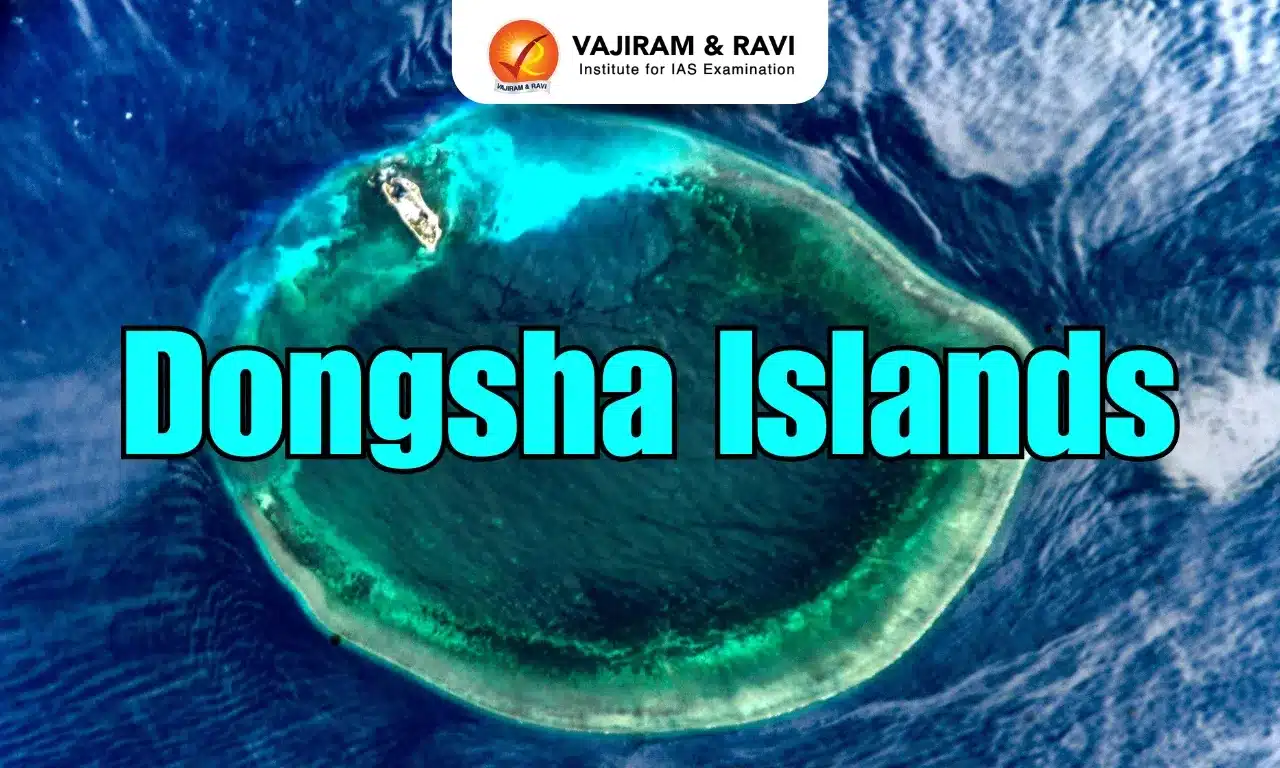
  • The Dongsha Islands, also known as the Pratas Islands, are a small group of three islands located in the northern part of the South China Sea. 
  • It lies approximately 445 km southwest of Kaohsiung, Taiwan, and 320 km southeast of Hong Kong.
  • The Dongsha Islands are governed by Taiwan. There are no permanent residents. But Taiwanese marines are stationed there.
  • These islands are characterized by a circular coral atoll structure.
  • They are composed primarily of clastic coral and reef flats approximately 15 miles (24 kilometers) in diameter, enclosing a lagoon about 10 miles (16 kilometers) in diameter. 
  • The island group includes Dongsha Island, being the only island above sea level, about 1 mile (1.6 kilometers) long and a little over 0.5 miles (0.8 kilometers) wide, and Northern Vereker and Southern Vereker atolls, both of which are below sea level.

Source: ET

Dongsha Islands FAQs

Q1: The Dongsha Islands are located in which sea?

Ans: The Dongsha Islands located in the northern part of the South China Sea.

Q2: Who governs the Dongsha Islands?

Ans: Taiwan

Q3: What is the structural type of the Dongsha Islands?

Ans: Coral atoll

Q4: What is the approximate diameter of the Dongsha atoll?

Ans: 24 km
Garra nambashiensis

Garra nambashiensis

Garra nambashiensis Latest News

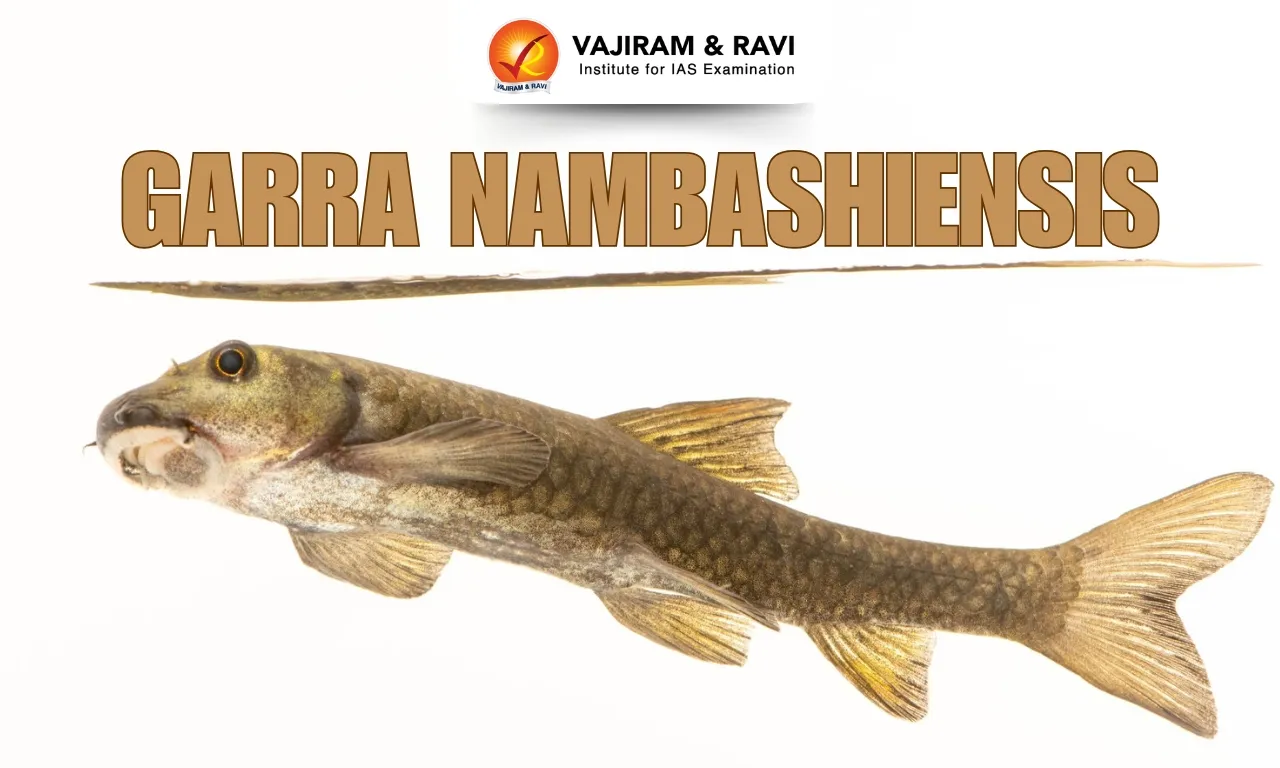
Researchers recently discovered a new species of freshwater fish, Garra nambashiensis, in Manipur.

About Garra nambashiensis

  • It is a new species of freshwater fish which belongs to the Labeonine family.
  • It was discovered in Taretlok, a tributary of the Chindwin River, near Nambashi Valley in Manipur’s Kamjong district.
  • It was collected from “swift-flowing riffles (shallow sections of a river or stream) with algae-covered gravel beds and mixed substrate comprising cobbles, boulders, pebbles, sand, fine silt, and coarse sediments.
  • The species features a quadrate-shaped proboscis, 7-8 acanthoid tubercles on the anterolateral margin, black spots on the opercle, 8-11 dorsal-fin scales, and six black stripes extending to the hypural plate.
  • It typically measures 90-140 mm (9-14 cm), and locals call it Nutungnu.
  • Currently, 60 species of Garra have been recorded from various river systems in the Northeast, encompassing the Eastern Himalayan and Indo-Burma regions. 
    • Of these, 32 are grouped in the ‘proboscis species group’ and occur in the Chindwin, Brahmaputra, Barak, and Kaladan river systems. 
    • Eight species have been recorded from the Chindwin river system alone, including the recently described G. chingaiensis.

Source: NEN

Garra nambashiensis FAQ's

Q1: Garra nambashiensis, recently discovered in Manipur, belongs to which family of fishes?

Ans: It belongs to the Labeonine family.

Q2: The new species Garra nambashiensis was discovered in which river system?

Ans: It was discovered in Taretlok, a tributary of the Chindwin River.

Q3: What is the local name of Garra nambashiensis in Manipur?

Ans: Nutungnu

Pink Tax

Pink Tax

Pink Tax Latest News

While there are no specific laws in India to address the issue of Pink Tax, the National Consumer Disputes Redressal Commission ruled that companies must follow fair pricing policies and avoid gender-based price discrimination.

About Pink Tax

  • The Pink tax is neither a real tax nor is it a government-imposed fee.
  • It is a term used to describe the extra cost that some companies charge for products marketed to women compared to similar products marketed to men.
  • This means women might end up spending more money for the same product that men get for less.
  • When companies charge more for pink (female) products compared to blue (male) versions, the extra revenue does not go to the government but benefits the companies themselves.
  • Pink toys, haircuts, dry cleaning, razors, shampoos, body lotions, deodorants, facial care, skincare items, beauty care, clothing, T-shirts, jeans, salon services ,etc. suffer the tax.
  • The term “Pink Tax” is believed to have originated in the U.S. in California in 1994
    • It emerged following the realisation that brands in various cities consistently charged women higher prices for goods and services than men. 
    • As per a study done in the U.S., personal care products targeting women were 13% costlier than men’s. Further, women’s accessories and adult clothing were 7% and 8% more expensive.

Pink Tax in India

  • The "pink tax" is not prohibited by law in India, and there are no set government regulations on this pricing practice. 
  • Female-targeted goods and services prices are determined based on market dynamics and demand. 
  • While there is limited research on the pink tax in India, surveys indicate price variations between products for women and men.
  • While there are no specific laws in India to address the issue of Pink Tax, the National Consumer Disputes Redressal Commission ruled that companies must follow fair pricing policies and avoid gender-based price discrimination.

Source: TH

Pink Tax FAQs

Q1: What is the Pink Tax?

Ans: It is a term used to describe the extra cost that some companies charge for products marketed to women compared to similar products marketed to men.

Q2: Is the Pink Tax prohibited by law in India?

Ans: The "pink tax" is not prohibited by law in India, and there are no set government regulations on this pricing practice.

Q3: Which Indian authority has ruled that companies must follow fair pricing and avoid gender-based price discrimination?

Ans: National Consumer Disputes Redressal Commission (NCDRC)

Koala

Koala

Koala Latest News

Recently, Australia approved the world's first vaccine to save koalas from Chlamydia.

About Koala

  • Koala bear (Phascolarctos cinereus) is an arboreal herbivorous marsupial native to Australia.
  • It is the only extant representative of the family Phascolarctidae and its closest living relatives are the wombats.
  • Koalas are asocial animals, congregating only during the breeding season.
  • They spend most of their time eating and sleeping in eucalyptus trees, and their paws have two opposing thumbs to help them grasp and climb up tree trunks.
  • Distribution: Koalas are distributed across eastern and southeastern Australia, including northeastern, central, and southeastern Queensland, eastern New South Wales, Victoria as well as southeastern parts of South Australia.
  • Habitat: They can be found in habitats ranging from relatively open forests to woodlands, and in climates ranging from tropical to cool temperate.
  • Food: Koalas are herbivorous (folivorous) animals, feeding primarily upon the leaves of the eucalyptus tree.
  • Conservation status: IUCN: Vulnerable
  • Threats: These species are facing compounded threats from disease, habitat loss, climate change and road collisions.   

Chlamydia in Koalas

  • Koalas suffer from both bacterium species Chlamydia pneumonia and Chlamydia pecorum.
  • The disease occurs in koalas multiple ways, including through mating, infected discharges and at birth. 
  • It can cause eye infections, blindness, urinary tract problems, and even infertility.
  • Infected koalas often become weak, dehydrated, and more vulnerable to predators and bushfires.
  • In some areas of Australia, up to 70% of wild koalas carry the disease.
  • Chlamydia spreads quickly in koalas because they live in overlapping territories and groom each other. 

Source: TH

Koala FAQ's

Q1: What is the IUCN status of the koala bear?

Ans: Vulnerable

Q2: What are three animals that are marsupials?

Ans: Kangaroos, wallabies, wombats

Ho Tribe

Ho Tribe

Ho Tribe Latest News

Recently, adivasis from the Ho tribe staged a protest in Jharkhand’s West Singhbhum district against district administration for interfering in their traditional self-governance system called Manki- Munda system.

About Ho Tribe

  • The Ho or Kolha people are an Austroasiatic Munda ethnic group of India.
  • They call themselves the Ho, Hodoko and Horo, which mean 'human' in their own language.
  • Distribution: They are mostly concentrated in the Kolhan region of Jharkhand, Odisha, West Bengal and Bihar.
  • Language: Ho people speak the Ho language, an Austroasiatic language closely related to Mundari.
  • Occupation: The majority of the Ho tribe is involved in agriculture, either as land owners or labourers, while others are engaged in mining.
  • Women have higher status among the Ho than they do in most tribes.
  • Most villages have a dedicated dancing ground, called akhra, usually consisting of a cleared space of hard ground under a spreading tree.
  • Traditional Ho music incorporates native instruments including a dama (drum), dholak, dumeng (mandar), and the rutu (flute).

Belief system of Ho Tribe

  • Over 90% of the Ho practices the indigenous religion Sarnaism.
  • They have a village priest called a deuri.
  • They have a spirit doctor called a deowa who makes sacrifices to these spirits and gods. Much of this happens in a sacred grove outside the village.

What is the Manki- Munda system?

  • The Munda, or the head of the village, was responsible for resolving socio-political disputes at the village level.
  • Each village had one Munda, appointed hereditarily.
  • The Manki headed the pidh, which generally consists of 8 to 15 villages. If cases were not resolved by the Munda, they moved upwards to the Manki.
  • The Manki and Munda had no responsibilities for revenue or land-related issues.
  • The system was purely an internal, self-governing mechanism, with no sovereign authority outside or the concept of paying taxes.

Source: IE

Ho Tribe FAQs

Q1: Where is the Ho tribe located?

Ans: They are concentrated in the area of Kolhān on the lower Chota Nāgpur Plateau.

Q2: What is the festival of the Ho tribe?

Ans: Mage Parab

Zircon Missile

Zircon Missile

Zircon Missile Latest News

Russia recently said that it had fired a Zircon (Tsirkon) hypersonic cruise missile at a target in the Barents Sea.

About Zircon Missile

  • The 3M22 Zircon (Tsirkon), NATO code-named SS-N-33, is a scramjet-powered hypersonic cruise missile developed by Russia.
  • Initially designed to target naval assets, the missile has evolved to include land-attack capabilities, making it an important tool for precision strike missions.
  • It entered service in 2022, with initial deployments on Project 22350 Admiral Gorshkov-class frigates. 

Zircon Missile Features

  • It has an estimated length of 9 meters (30 feet) and a diameter of 60 cm (24 inches), with an estimated weight of between 3,000 and 4,000 kg (3–4 tons).
  • The missile is powered by a two-stage propulsion system. 
    • The first stage consists of a booster engine powered by solid fuel, which accelerates the missile to supersonic speeds. 
    • After reaching a certain speed, the scramjet engine in the second stage ignites, utilizing liquid fuel to accelerate the missile to hypersonic speeds.
  • Its speed—reaching up to Mach 9—makes it extremely difficult to intercept.
  • The operational range of the Zircon is reported to be around 400–450 km (250–280 miles) at low altitudes, while it can extend up to 1,000 km (620 miles) in a semi-ballistic trajectory. 
  • It is capable of carrying both conventional and nuclear warheads, providing it with a versatile role in modern warfare.
  • The missile uses a combination of inertial navigation, radar homing, and plasma stealth to navigate towards its target. 
  • One of the key features of the Zircon is its ability to generate a plasma cloud during hypersonic flight, which absorbs radio waves and makes the missile more difficult to detect by radar. This phenomenon is known as plasma stealth.

Source: TH

Zircon Missile FAQs

Q1: The Zircon Missile was developed by which country?

Ans: Zircon Missile was developed by Russia.

Q2: The Zircon missile is powered by which type of propulsion system?

Ans: Two-stage system: solid-fuel booster + scramjet

Q3: What is the NATO reporting name for the Zircon missile?

Ans: SS-N-33

Q4: What is the maximum speed of the Zircon missile?

Ans: Mach 9

INS Trikand

INS Trikand

INS Trikand Latest News

The maiden bilateral maritime exercise between India and Greece will be steered by the Indian Naval Ship Trikand, which was called at Salamis Bay, Greece, during her ongoing deployment to the Mediterranean Sea recently.

About INS Trikand

  • It is a Talwar-class guided-missile frigate of the Indian Navy.
  • It is the third and final ship of the second batch of Talwar-class frigates ordered by the Indian Navy.
  • It was built by the Yantar shipyard in Kaliningrad, Russia.
  • It was commissioned into the Indian Navy on 29 June 2013 at Kaliningrad, Russia.
  • It is part of the Indian Navy's Western Fleet and operates under the Western Naval Command headquartered at Mumbai.

INS Trikand Features

  • INS Trikand carries a state-of-the-art combat suite, which includes the supersonic BRAHMOS missile system, advanced surface-to-air missiles Shtil, an upgraded A190 medium-range gun, electro-optical 30 mm close-in weapon system, anti-submarine weapons such as torpedoes and rockets, and an advanced electronic warfare system.
  • The weapons and sensors are integrated through a Combat Management System ‘Trebovanie-M’, which enables the ship to simultaneously neutralise multiple surface, sub-surface, and air threats. 
  • Powered by four gas turbines, INS Trikand is capable of speeds more than 30 knots and is configured to carry a Kamov 31 helicopter.
  • It has a complement of about 300 personnel, including officers.

Source: HANSI

INS Trikand FAQ's

Q1: INS Trikand was built at which shipyard?

Ans: Yantar Shipyard, Kaliningrad

Q2: When was INS Trikand commissioned into the Indian Navy?

Ans: It was commissioned into the Indian Navy on 29 June 2013.

Q3: INS Trikand operates under which Naval Command?

Ans: It is part of the Indian Navy's Western Fleet and operates under the Western Naval Command headquartered at Mumbai.

Q4: What is the maximum speed of INS Trikand?

Ans: 30+ knotsa

International Electrotechnical Commission

International Electrotechnical Commission

International Electrotechnical Commission Latest News

India will host the 89th General Meeting (GM) of the International Electrotechnical Commission (IEC) from 15 to 19 September 2025 at Bharat Mandapam, New Delhi.    

About International Electrotechnical Commission

  • It is a nonprofit organization which was established in 1906.
  • It is the organization that prepares and publishes international Standards for all electrical, electronic and related technologies.
  • IEC’s mission is to promote, through its members, international cooperation on all questions of electrotechnical standardization and related matters. 
  • Its standards are developed in a consensus process by experts from the participating countries.
  • IEC Standards are often used as a basis to globally harmonize technical requirements in IEC member and non-member countries.
  • IEC standards reach over 150 countries.
  • Governance: Standardization Management Board (SMB) is an apex governance body of IEC responsible for technical policy matters.
  • The IEC works closely with the International Organization for Standardization (ISO) and the International Telecommunication Union (ITU).
  • It is the world’s leading body for developing international standards for electrical, electronic and related technologies, with a network of 30,000 experts worldwide.
  • It is the fourth time India is hosting the prestigious IEC General Meeting, after 1960, 1997 and 2013.
  • It is headquartered in Geneva, Switzerland.

Source: LM

International Electrotechnical Commission FAQs

Q1: What is the International telecommunications Union?

Ans: The International Telecommunication Union is the United Nations specialized agency for information and communication technologies.

Q2: What is the International Organization for Standardization?

Ans: It is an independent, non-governmental international organization. It provides organizations with guidelines to consistently achieve universally recognized standards.

PLI Scheme for White Goods

PLI Scheme for White Goods

PLI Scheme for White Goods Latest News

Recently, the government has re-opened the application window for the production-linked incentive (PLI) scheme for white goods.

About PLI Scheme for White Goods

  • It is designed to create a complete component ecosystem for Air Conditioners and LED Lights Industry in India and make India an integral part of the global supply chains.
  • It is implemented as a pan India scheme and is not specific to any location, area or segment of population.
  • Objectives: It proposes a financial incentive to boost domestic manufacturing and attract large investments in the White Goods manufacturing value chain.
  • Its prime objectives include removing sectoral disabilities, creating economies of scale, enhancing exports, creating a robust component ecosystem and employment generation.
  • Incentives: The scheme will extend an incentive of 4-6% on incremental turnover over base year (2019-20) of goods sold in India and exported to global markets, to eligible companies for a period of 5 years.
  • Eligibility
    • Applicants can be any company that should be incorporated in India under the provisions of the Company Act, 2013.
    • Eligibility shall be subject to the achievement of thresholds of net incremental sales of Eligible Products for the respective financial year over the base year and cumulative incremental investment in the preceding financial year.
    • Any entity availing benefits under any other PLI Scheme of Govt. of India will not be eligible under this scheme for the same products.
  • Duration : It is to be implemented over FY 2021-22 to FY 2028-29
  • Nodal Ministry: The scheme was notified by the Department for Promotion of Industry and Internal Trade (DPIIT), Ministry of Commerce and Industry.

Source: TH

PLI Scheme for White Goods FAQs

Q1: What are white goods in economics?

Ans: White goods traditionally refer to large home appliances such as stoves, refrigerators, freezers and washing machines

Q2: What is the pli scheme for white goods?

Ans: It is designed to create a complete component ecosystem for Air Conditioners and LED Lights Industry in India and make India an integral part of the global supply chains.

INS Androth

INS Andorth

INS Androth Latest News

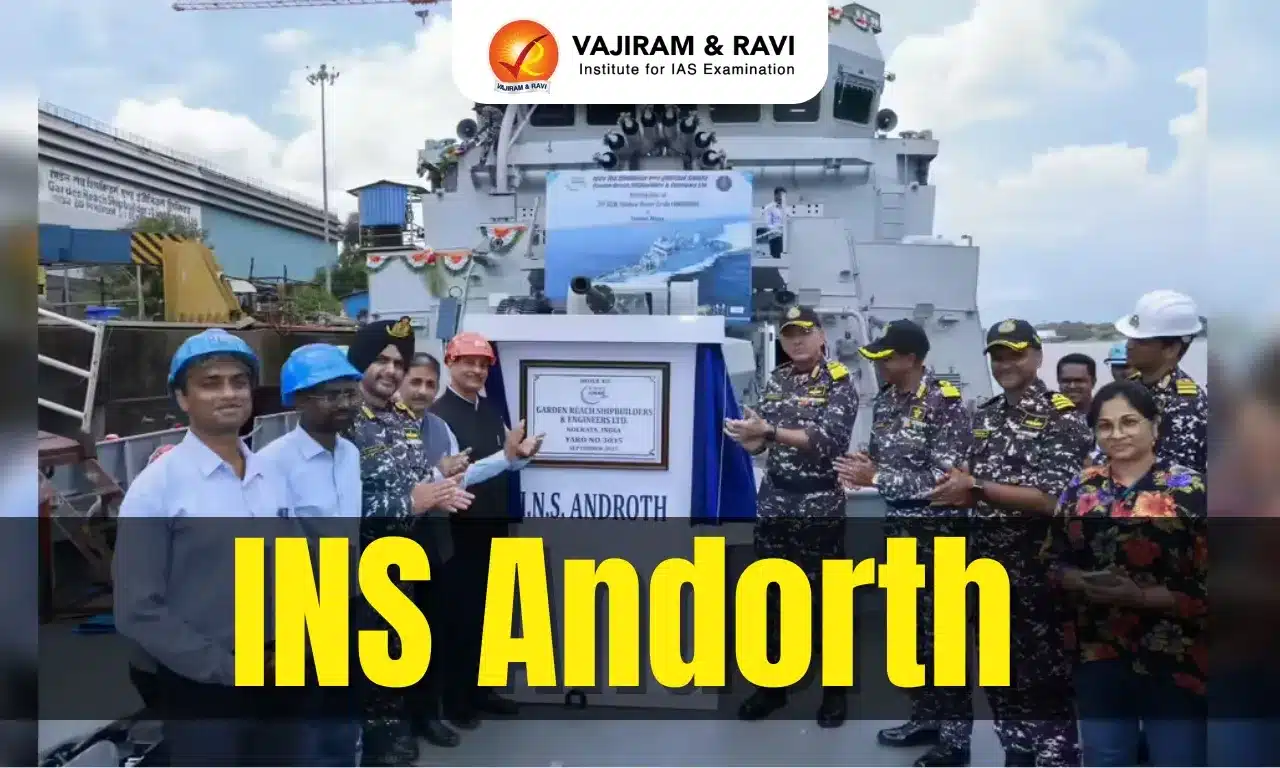
Recently, the Indian Navy has received the second indigenously built anti-submarine warfare-shallow watercraft INS Andorth.

About INS Androth

  • It draws its name from Androth Island in the Lakshadweep archipelago
  • It is the second of eight anti-submarine warfare-shallow watercraft (ASW-SWC) built by Garden Reach Shipbuilders and Engineers (GRSE), Kolkata.
  • The ASW SWC ships have been indigenously designed and constructed as per the Classification Rules of Indian Register of Shipping (IRS) at GRSE, Kolkata 

Features of INS Androth

  • It is approximately 77 meters in length and it is the largest Indian Naval warship.
  • Propulsion: The ship is propelled by a diesel engine-waterjet combination, which allows for high speed and efficient maneuverability in shallow waters.
  • Armament: It is equipped with state-of-the-art lightweight torpedoes, indigenous ASW rockets, and advanced shallow water SONAR,
  • It enables effective submarine detection and engagement in littoral zones.
  • Significance: It strengthens the Indian Navy's Anti-submarine, coastal surveillance and mine laying capabilities.
  • It is built by using over 80 percent indigenous content, reflecting growing domestic capabilities and reducing dependency on imports.

Source: TH

INS Androth FAQs

Q1: What language is spoken in Androth Island?

Ans: Mahl, Malayalam, and English

Q2: What is meant by Anti-Submarine Warfare?

Ans: Anti-submarine warfare includes a wide range of activities from placing and monitoring passive sensors on the sea floor to actively hunting.

Enquire Now