INS Rajali

INS Rajali

INS Rajali Latest News

The Indian Navy’s Eastern Naval Command recently hosted a two-day seminar on long-range maritime reconnaissance (LRMR) at INS Rajali, Arakkonam, underscoring India’s growing maritime responsibilities and surveillance capabilities.

About INS Rajali

  • It is an Indian Naval Air Station located near Arakkonam in Tamil Nadu.
  • It was commissioned on March 11, 1992
  • It was named as 'Rajali', named after an aggressive bird of the Hawk family, predominant in the Tamil Nadu coastal belt. 
  • The air station is spread over 2,200 acres and is located 80 km west of Chennai.
  • INS Rajali is the most modern and largest Naval Air Station, with a garrison strength of 4,700 personnel.
  • It contributes towards two very distinct tasks -Operations and Training.
  • It operates under the Eastern Naval Command of the Indian Navy and has the longest military runway in Asia.
  • It is home to the navy's INAS 312 squadron which has been at the forefront of maritime reconnaissance and anti-submarine warfare with the P8I. 
  • Apart from hosting the P8I fleet, it also operates MQ-9B Sea Guardian drones, providing a technological edge for high-endurance operations in the vast expanses of the Indian Ocean.
  • INS Rajali is also home to the navy's Helicopter Training School.

Source: DEF

INS Rajali FAQs

Q1: What is INS Rajali?

Ans: It is an Indian Naval Air Station.

Q2: INS Rajali is located in which Indian state?

Ans: Tamil Nadu

Q3: When was INS Rajali commissioned?

Ans: It was commissioned on March 11, 1992.

Q4: INS Rajali operates under which Naval Command?

Ans: It operates under the Eastern Naval Command of the Indian Navy.

Registered Unrecognised Political Party

Registered Unrecognised Political Party

Registered Unrecognised Political Parties Latest News

The Election Commission of India (ECI) recently de-listed a total of 474 more Registered Unrecognised Political Parties (RUPP) for flouting norms, including not contesting elections in the last six years.

About Registered Unrecognised Political Parties

  • These are the parties which are either newly registered parties or those which have not secured enough percentage of votes in the assembly or general elections to become a state party, or those which have never contested elections since being registered.
  • Despite not having official recognition, RUPPs enjoy certain benefits:
    • Tax exemption under Section 13A of the Income Tax Act, 1961.
    • Eligibility for common poll symbols during elections. Common symbols are provided to RUPPs based upon an undertaking that they would put up “at least 5% of total candidates with regard to said Legislative Assembly election of a State”.
    • Permission to nominate up to 20 ‘star campaigners’ for canvassing.
  • They are, however, required to:
    • Contest elections periodically.
    • File annual audit accounts and contribution reports.
    • Disclose donations exceeding Rs. 20,000, and ensure that no donations above Rs. 2,000 are accepted in cash.

What are Registered Parties?

  • Political parties in the country are registered with the ECI under the provisions of Section 29A of the Representation of the People Act (RPA) 1951. 
  • There are many benefits of registering a party. 
    • Firstly, the RPA allows political parties to accept contributions voluntarily offered to it by any person or company other than a government company.
    • Apart from this, candidates of registered parties get preference in allotment of election symbols. Other candidates are identified as independents and do not get preference in symbol allocation.
    • Tax exemption for donations received under Section 13A of the Income Tax Act, 1961.
  • Guidelines for registration of Political Parties mention that if the party does not contest elections continuously for 6 years, the party shall be taken off the list of registered parties.
  • Registered political parties, in course of time, can get recognition as a state party or national party subject to the fulfilment of the conditions prescribed by the EC in the Election Symbols (Reservation and Allotment) Order, 1968, as amended from time to time.
  • Recognised political parties get to reserve a symbol and use it exclusively, whereas unrecognised parties have to choose from a list of free symbols. 
  • Recognition also comes with other benefits, such as free broadcast facilities over Doordarshan and All India Radio, more allowances for campaign expenditure, and free copies of electoral rolls before elections.

Conditions for Recognition as a State Party

  • A political party shall be treated as a recognised political party in a state if it fulfils any of the following conditions
    • The party has to win 3 percent of seats in the Legislative Assembly of the state in the General Election.
    • The party has to win one Lok sabha seat for every 25 Lok Sabha seats allotted for the state in the General Election.
    • The party has to secure a minimum of 6 percent of votes in a state, and in addition it has won one Lok Sabha or two Legislative Assembly seats in elections.
    • The party has to secure 8 percent of votes in a state in the General Election to Lok Sabha or Legislative Assembly.

Conditions for Recognition as a National Party

  • A political party shall be treated as a national party if it fulfils any of the following conditions
    • Secure at least 6 percent of votes polled in four or more states in the Lok Sabha or Assembly elections, and, in addition, it has at least four members in the Lok Sabha.
    • It also has to have at least 2 percent of the total Lok Sabha seats and its candidates come from not less than three states.
    • It is recognised as a state party in at least four states.
  • Both national and state parties have to fulfil these conditions for all subsequent Lok Sabha or state elections. Else, they lose their status.

Source: TH

Registered Unrecognised Political Parties FAQs

Q1: Under which Act are political parties in India registered?

Ans: Section 29A of the Representation of the People Act (RPA) 1951

Q2: How many ‘star campaigners’ can a Registered Unrecognised Political Parties (RUPP) nominate during elections?

Ans: 20 ‘star campaigners

Q3: What is the maximum amount that can be accepted by political parties as cash donations from a single donor?

Ans: Rs. 2,000

Q4: If a registered political party does not contest elections continuously for how many years, it can be deregistered?

Ans: 6 years

Aflatoxin

Aflatoxins

Aflatoxin Latest News

Exporters are disputing Indonesia’s delayed notification of aflatoxins in groundnut shipments from India.

About Aflatoxin

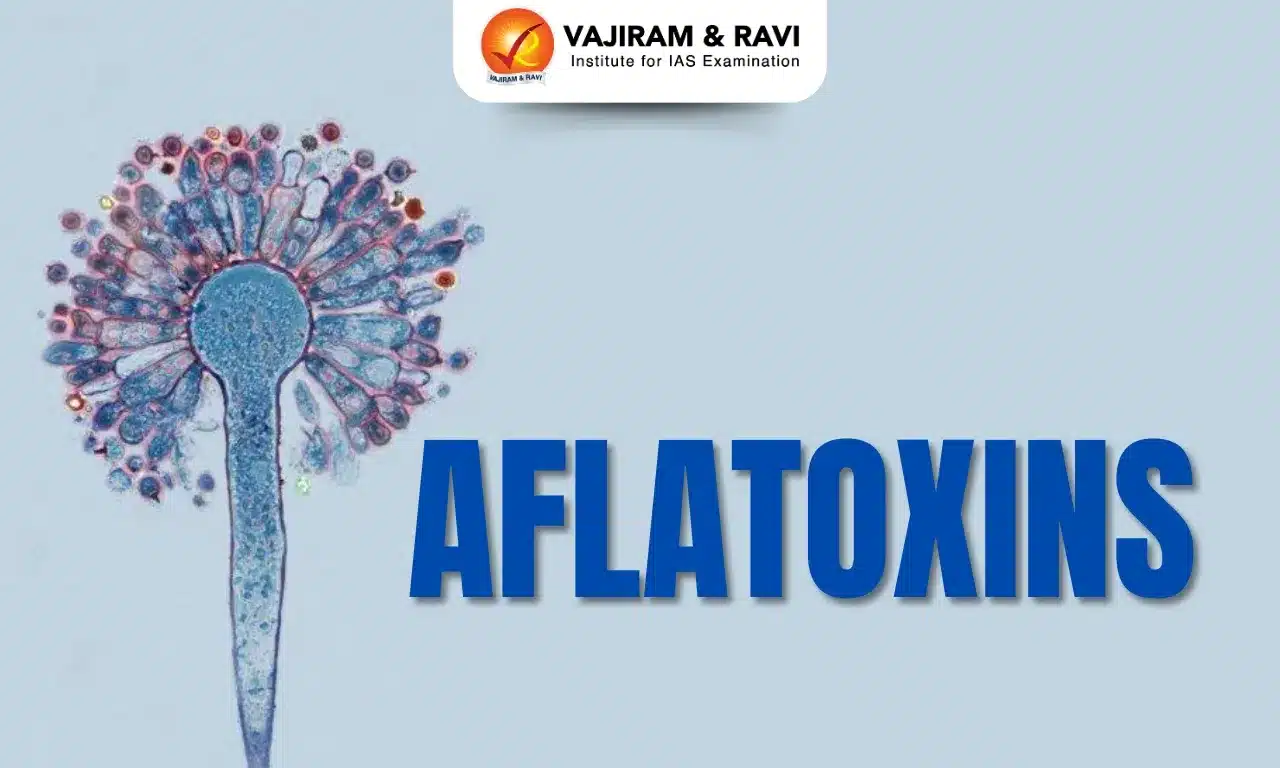
  • Aflatoxins are a toxic chemical (a mycotoxin) produced by fungi.
  • The mould-like fungi that produce aflatoxins belong to a large group called Aspergillus (It is produced mainly by Aspergillus flavus and Aspergillus parasiticus fungi).
  • Aspergillus flavus and Aspergillus parasiticus thrive mainly in agricultural crops but also in soils, rotting food and compost.
  • The fungi emerge as spores and form networks of microscopic filaments that can grow on products such as grains and nuts.
  • These fungi contaminate groundnuts in warm, humid conditions.
  • It can occur in foods such as groundnuts, tree nuts, maize, rice, figs and other dried foods, spices, crude vegetable oils and cocoa beans, as a result of fungal contamination before and after harvest.
  • Health Impacts: This toxin is reported to be genotoxic, carcinogenic, and pose risks to human and animal health.

How are people Exposed to Aflatoxins?

  • People can be exposed to aflatoxins by eating contaminated plant products (such as peanuts) or by consuming meat or dairy products from animals that ate contaminated feed. 
  • Farmers and other agricultural workers may be exposed by inhaling dust generated during the handling and processing of contaminated crops and feeds.

Source: TH

Aflatoxin FAQs

Q1: Which foods contain aflatoxins?

Ans: Aflatoxins can occur in foods such as groundnuts, tree nuts, maize, rice, figs and other dried foods, spices, crude vegetable oils and cocoa bean.

Q2: What is the primary health risk associated with aflatoxin exposure?

Ans: Liver cancer

Q3: Which of the following fungi is known to produce aflatoxin?

Ans: Aspergillus

Yellow-Crested Cockatoos

Yellow-Crested Cockatoos

Yellow-Crested Cockatoos Latest News

Yellow-crested cockatoos in Hong Kong are losing natural nesting due to typhoons and tree trimming and conservationists installing artificial nest boxes that mimic natural nests of these birds.

About Yellow-Crested Cockatoos

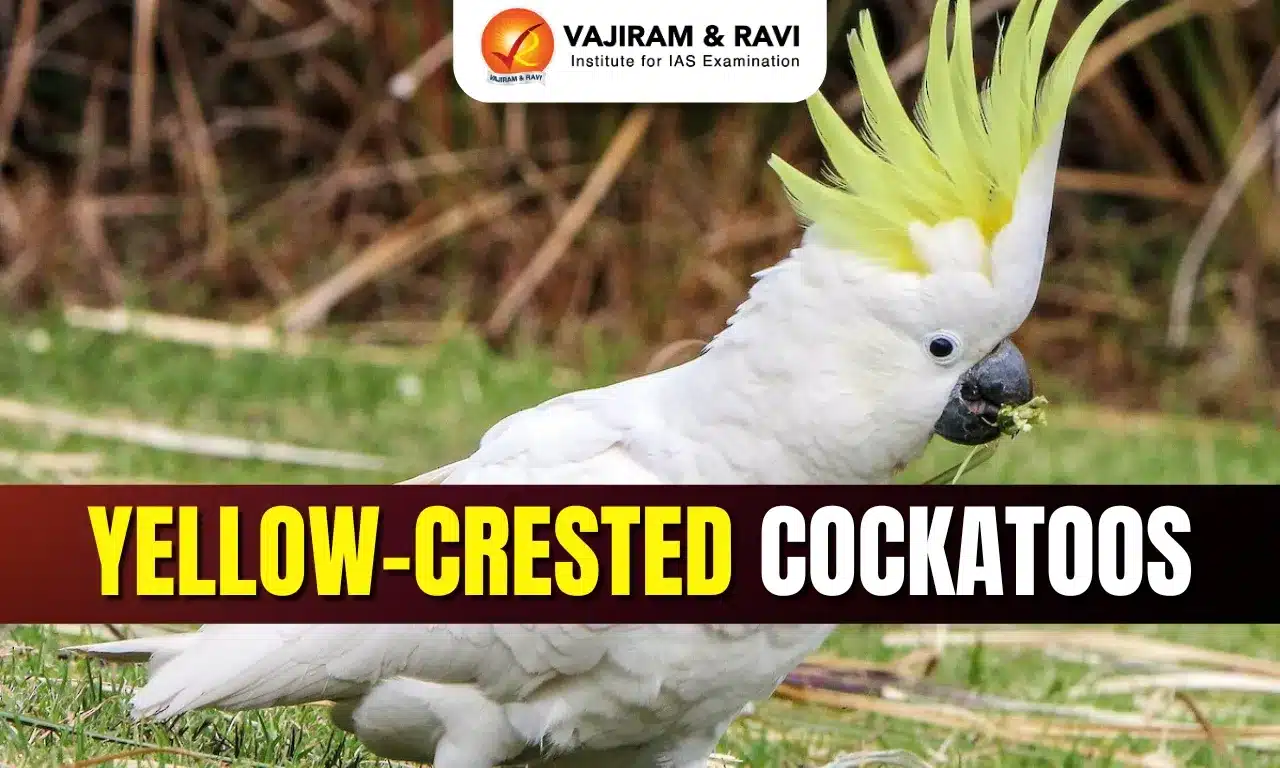
  • The Yellow-crested cockatoo (Cacatua sulphurea) is a medium-sized cockatoo with a retractile yellow or orange crest.
  • Appearance: It usually has white plumage, and on its head is a yellow crest that curves forwards.
  • Habitat: This cockatoo inhabits forest, forest edge, scrub and cultivated areas from sea-level up to about 1500 meters.
  • Distribution: It is native to East Timor and Indonesia's islands of Sulawesi and the Lesser Sundas. 
  • It is also introduced in Hong Kong developed from caged birds that have been released.
  • Food: It is an omnivorous feeder, with a diet that consists primarily of seeds, fruits, nuts, and berries. It is also known to feed on the occasional insect, small reptiles, and roots,
  • Social behavior: They are monogamous birds, and pairs stay together for life. 
  • They are very gregarious animals and learn quickly to mimic.
  • Breeding Season: Breeding typically occurs in September to May 
  • Threats: The main threats to the Yellow-crested cockatoo are illegal pet trade, habitat loss and climate change (rising temperatures dry out forests, leaving them more vulnerable to fires)
  • Conservation Status:  IUCN: Critically Endangered

Source: TH

Yellow-Crested Cockatoos FAQs

Q1: Where are yellow crested cockatoos found?

Ans: Indonesia and Hong Kong

Q2: What is the scientific name of the Yellow-crested Cockatoo?

Ans: Cacatua sulphurea

Q3: What kind of diet do Yellow-crested Cockatoos have?

Ans: It is primarily herbivores, eating seeds, fruits, and vegetation.

Gulf of Finland

Gulf of Finland

Gulf of Finland Latest News

Three Russian MiG-31 fighter jets violated the airspace of NATO member Estonia over the Gulf of Finland recently and remained there for 12 minutes.

About Gulf of Finland

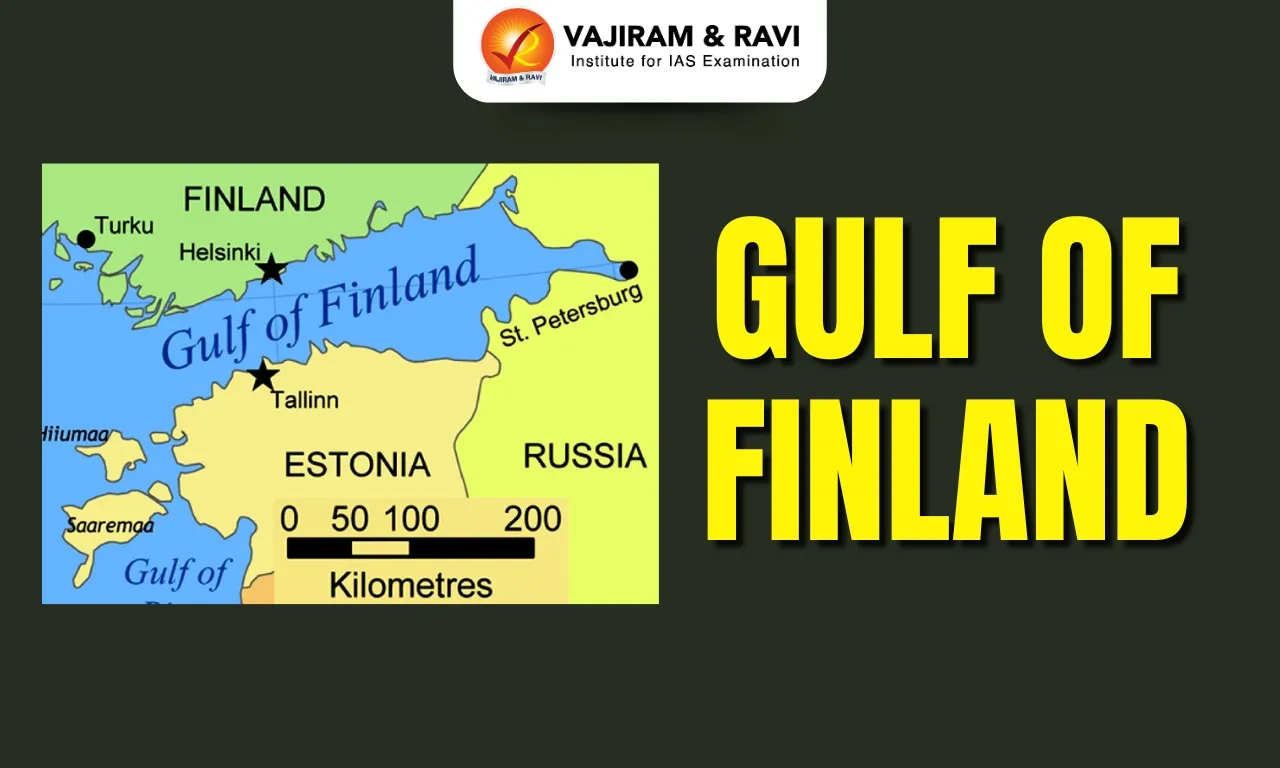
  • It is the easternmost extension of the Baltic Sea, located in Northern Europe.
  • It covers an area of 30,000 sq.km. It is one of the largest bodies of brackish water in the world.
  • The gulf extends for 400 km from east to west but only 19 to 130 km from north to south.
  • It is bordered by Finland in the north, Russia in the east, and Estonia in the south.
  • Both the Finnish capital city, Helsinki, and the Estonian capital, Tallinn, are located right on the shores of the Gulf of Finland. 
  • At the very eastern end of the gulf is the Russian city of St. Petersburg.
  • The gulf is relatively shallow with an estimated average depth of 38 m.
  • Of low salinity (six parts per thousand), the gulf freezes over for three to five months in winter. 
  • It receives the Neva and Narva rivers and the Saimaa Canal.
  • The gulf faces a humid continental climate with hot summers and relatively harsh winters. 
  • The gulf contains numerous banks, skerries and islands.
  • The largest include Kotlin Island with the city of Kronstadt (population 42,800), Beryozovye Islands, Lisiy Island, Maly Vysotsky Island, and many others.

Source: TH

Gulf of Finland FAQs

Q1: The Gulf of Finland is the easternmost extension of which sea?

Ans: It is the easternmost extension of the Baltic Sea.

Q2: Which countries border the Gulf of Finland?

Ans: Finland, Russia, Estonia

Q3: Which two capital cities are located on the shores of the Gulf of Finland?

Ans: Helsinki and Tallinn

Q4: The Russian city located at the eastern end of the Gulf of Finland is?

Ans: St. Petersburg

Kurmi Community

Kurmi Community

Kurmi Community Latest News

Defying prohibitory orders, Kurmis began their rail blockade at various stations in Jharkhand recently to press demand for a ST status for the community and inclusion of the Kurmali language in the Eighth Schedule of the Constitution.

About Kurmi Community

  • Kurmis, also known as Kunbi, are a Hindu farming caste in India and Nepal. 
  • The term "Kurmi" is believed to be derived from the Sanskrit word "Krishi," which means agriculture.
  • They are mostly found in the lower regions of the Indo-Gangetic plains, especially southern regions of Awadh, eastern Uttar Pradesh and parts of Bihar.
  • It is believed that the Kurmis were descendants of ancient Kshatriya warriors who practiced agriculture. 
  • There are several sub-groups within the Kurmi caste called gotras. Some common Kurmi gotras include Chandel, Chauhan, Solanki, Tomar, Baghel and Sengar. 
  • The Kurmis came to be known for their exceptional work ethic, superior tillage and manuring, and gender-neutral culture, bringing praise from Mughal and British administrators alike.
  • The Kurmali language, primarily spoken by the Kurmi community in Bihar, Jharkhand, and Odisha, is part of the Indo-Aryan language family.
  • Nowadays, Kurmis are placed in the Other Backward Class (OBC) category in most parts of India. 
  • However, Kurmis tend to believe that they have tribal roots and have long been demanding Scheduled Tribe (ST) status for their community and inclusion of the Kurmali language in the Eighth Schedule of the Constitution.

Source: ETVB

Kurmi Community FAQs

Q1: Kurmis are primarily associated with which traditional occupation?

Ans: Agriculture

Q2: In which regions are Kurmis predominantly found?

Ans: Southern Awadh, Eastern Uttar Pradesh, and parts of Bihar.

Q3: The Kurmis are believed to be descendants of which group?

Ans: It is believed that the Kurmis were descendants of ancient Kshatriya warriors who practiced agriculture.

Q4: The Kurmali language, spoken by the Kurmi community, belongs to which language family?

Ans: Indo-Aryan language family.

Swasth Nari, Sashakt Parivar Abhiyaan

Swasth Nari

Swasth Nari, Sashakt Parivar Abhiyaan Latest News

Recently, the Prime Minister of India launched the ‘Swasth Nari, Sashakt Parivar’ (SNSP) Abhiyaan in Dhar, Madhya Pradesh.

About Swasth Nari, Sashakt Parivar Abhiyaan

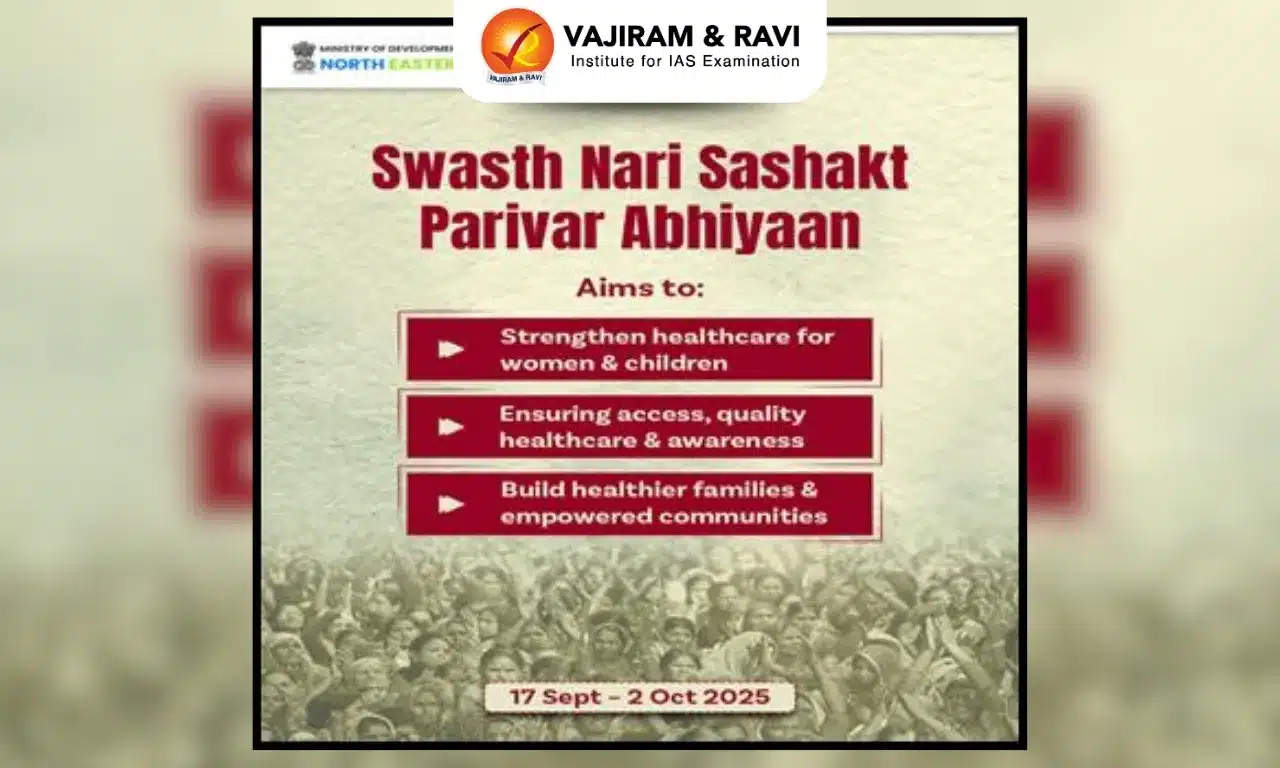
  • It is aimed at strengthening healthcare services for women and children across India, with a focus on improving access, quality care, and awareness.
  • It is an initiative by the Ministry of Health and Family Welfare (MoHFW) and the Ministry of Women and Child Development (MoWCD).
  • It encourages active participation from private hospitals and healthcare professionals to foster inclusive healthcare delivery.

Objectives of Swasth Nari, Sashakt Parivar Abhiyaan

  • Enhance Women’s Health Through Comprehensive Screening and Services
  • Promote Family Well-Being via Maternal and Child Care
  • Foster Behaviour Changes Through Education
  • Encourage Community Participation and Public Awareness

Implementation Strategy Swasth Nari, Sashakt Parivar Abhiyaan

  • Nationwide Health Camps with Real-Time Monitoring : It will organise more than one lakh health camps across Ayushman Arogya Mandirs and Community Health Centres, coordinated and tracked through the SASHAKT portal.
  • Multi-Platform Outreach for Awareness: This abhiyan aims to leverage Doordarshan, All India Radio (AIR), and social media campaigns to maximise public awareness and participation
  • Volunteer and Nikshay Mitra Engagement: The campaign expands participation through Nikshay Mitras and volunteers, who support tuberculosis eradication efforts and community health initiatives.

Source: PIB

Swasth Nari, Sashakt Parivar Abhiyaan FAQs

Q1: What is the SASHAKT Portal?

Ans: SASHAKT (Systematic Assessment of Health care providers Knowledge and Training ) is developed to support states in implementation and monitoring of trainings, provide real-time update on the progression of trainings.

Q2: What is swasth nari sashakt parivar abhiyaan?

Ans: Swasth Nari Sashakt Parivar is a 'Maha Abhiyaan' towards bringing about women-led development”.

Javari Temple

Javari Temple

Javari Temple Latest News

A seven-foot-tall headless Vishnu idol at the Javari temple in Madhya Pradesh's Khajuraho has grabbed headlines following the Chief Justice of India’s remark during a recent hearing on a petition seeking its restoration.

About Javari Temple

  • It is a Hindu temple, which forms part of the Khajuraho Group of Monuments, a UNESCO World Heritage Site located in Madhya Pradesh. 
    • The temples at Khajuraho were built during the Chandella dynasty, which reached its apogee between 950 and 1050 AD. 
    • The temples are famous for their nagara-style architectural symbolism and their erotic sculptures.
  • Built between 1075 and 1100 AD, the Javari Temple is dedicated to Lord Vishnu.

Javari Temple Architecture

  • The temple is built in the Nagara style of architecture. 
  • Situated on a plinth, it contains a sanctum, vestibule, mandapa, and portico but without pradakshinapatha. 
  • It has an exquisitely carved Makara Torana (Capricorn Arch) and shikhara.
  • The sanctum of Javari Temple contains a four-armed idol of Lord Vishnu, though it is now broken and headless. 
  • There are sculptures of Hindu Gods and navagrahas.
  • The elaborate gateway of the temple is beautiful, and there are images of men and women carved on the walls.

Source: IT

Javari Temple FAQs

Q1: The Javari Temple forms part of which UNESCO World Heritage Site?

Ans: Khajuraho Group of Monuments

Q2: The Javari Temple is dedicated to which deity?

Ans: The Javari Temple is dedicated to Lord Vishnu.

Q3: The Javari Temple was built in which period?

Ans: Between 1075 and 1100 A

Q4: The Javari Temple is an example of which style of architecture?

Ans: Nagara style

Adamya Fast Patrol Vessel

Adamya Fast Patrol Vessel

Adamya Fast Patrol Vessel Latest News

Recently, the Indian Coast Guard ship fast patrol vessel Adamya was commissioned at Paradip Port.

About Adamya Fast Patrol Vessel

  • It is the first ship of the eight in series Adamya-class Fast Patrol Vessels (FPVs).
    • Adamya’ meaning ‘indomitable’ is a projection of ICG’s will and commitment in ensuring safe, secure, and clean seas towards the maritime interest of the Nation.
  • Developed by:  It has been designed and built indigenously by Goa Shipyard Limited.

Features of Adamya Fast Patrol Vessel

  • Carrying Capacity: It displaces approx. 320 tons.
  • It is propelled by two 3000 KW diesel engines to attain a maximum speed of 28 Knots along with an endurance of 1500 nm at economical speed. 
  • It is the first ship fitted with indigenously developed two Controllable Pitch Propellers and gearboxes offering superior manoeuvrability, operational flexibility and enhanced performance at sea.
  • Its weaponry includes a 30 mm CRN 91 gun and two 12.7 mm stabilized remote controlled machine guns, all supported by fire control systems.
  • The vessel also features an Integrated Bridge System, Integrated Platform Management System, Automated Power Management System and augmenting operational efficiency & automation.

Source: PIB

Adamya Fast Patrol Vessel FAQs

Q1: What is a fast patrol vessel?

Ans: Fast Patrol Vessels for Indian Coast Guard are designed to offer high speed and enhanced maritime security.

Q2: What is the Indian Coast Guard?

Ans: It operates under the Ministry of Defence. It has jurisdiction over the territorial waters of India including contiguous zone and exclusive economic zone.

Chirality

Chirality

Chirality Latest News

Recent work by researchers has provided critical insights into how chiral perovskite materials crystallize, unlocking the possibility of building high-performance devices with phase-pure chiral perovskite films. 

About Chirality

  • It is the property of an object being non-superimposable on its mirror image.
  • It is found everywhere in nature, from spiral galaxies to the DNA in our cells.

Chirality’s Role in Material Science

  • In materials science, chirality can enable unique light–matter interactions, such as controlling the spin of electrons or detecting circularly polarized light.
  • These capabilities help futuristic technologies in quantum optoelectronics, advanced sensors, and spin-based computing.
    • Example: Chiral materials can distinguish between left- and right-handed circularly polarized light and influence electron spin.
  • Applications: Chirality is relevant for building devices such as circularly polarized light (CPL) detectors, spintronic components, and neuromorphic photonic synapses.

Why are Perovskites Game-Changers?

  • Traditionally, most chiral materials studied have been organic in nature.
  • These organic materials can interact with light effectively, but their poor electrical conductivity has limited their role in optoelectronic devices.
  • On the other hand Halide perovskites bring together strong optical properties with efficient charge transport.
  • When combined with chiral molecules, these low-dimensional halide perovskites can yield chiral perovskites that are both functionally versatile and structurally robust.
  • Challenges:  Making high-quality chiral perovskite films for devices requires precise control over how they crystallize – something that has remained poorly understood.

Source: PIB

Chirality FAQs

Q1: What do you mean by chirality?

Ans: Chirality is when a molecule does not coincide with its mirror image.

Q2: Can chirality exist in inorganic compounds?

Ans: Yes, chirality can also exist in inorganic and organometallic compounds, particularly in coordination chemistry.

Enquire Now