Direct Broadcast Network Latest News
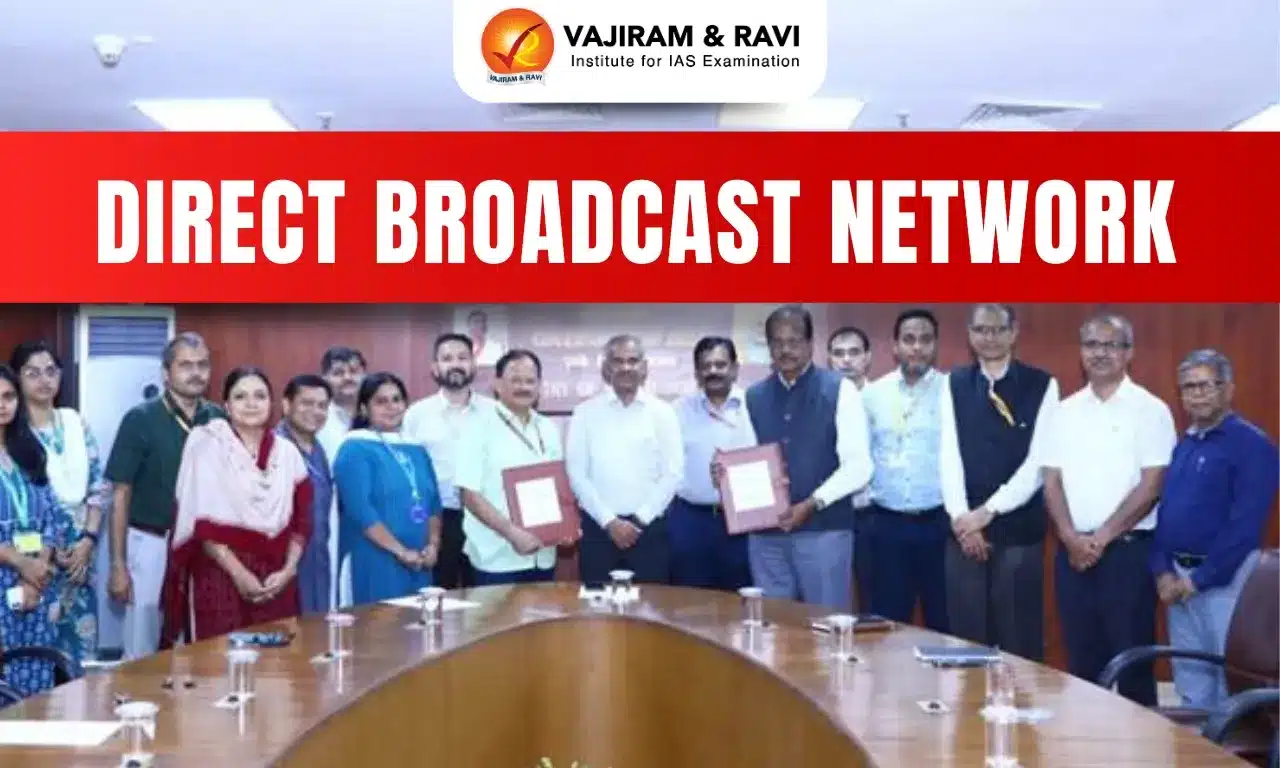
Recently, the National Centre for Medium Range Weather Forecasting (NCMRWF) signed a Memorandum of Understanding (MoU) with New Space India Limited (NSIL) to establish two Direct Broadcast Network (DBNet) stations in Delhi/NCR and Chennai.
About Direct Broadcast Network
- The DBNet is a global operational framework designed for the real-time acquisition of satellite data from Low Earth Orbit (LEO) satellites.
- It plays a critical role in Numerical Weather Prediction (NWP) and supports a wide range of applications, including weather forecasting, cyclone monitoring, and climate research.
- DBNet stations ensure rapid data availability, hence significantly improving the accuracy and timeliness of weather forecasts and related services.
- The proposed DBNet stations will be capable of receiving direct broadcast data from various existing Indian and international Earth Observing System (EOS) satellites, including Oceansat, NOAA, and MetOp.
- Key Benefits:
-
- Timeliness for NWP: It provides the near real-time availability of LEO satellite data, which is essential for generating high-resolution, short- to medium-range weather forecasts.
- Reduced Data Latency: DBNet captures data directly as satellites pass overhead, overcoming latency issues and enabling faster data delivery.
- Rapid Processing: NCMRWF will complete the full data processing chain within 5 minutes of a satellite overpass, ensuring timely ingestion of these datasets into MoES’s NWP models for across-scale forecasting.
Source: PIB
Direct Broadcast Network FAQs
Q1: What is a broadcast network?
Ans: A Broadcast Network is a type of network where a machine can send data to all other machines within the network simultaneously.
Q2: Which organization is responsible for coordinating the DBNet?
Ans: World Meteorological Organization (WMO)